
Top Medical Colleges to Apply to After NEET PG 2026

Choosing a medical college after NEET PG 2026 isn't really a research problem; it's a matching problem. The exam gives you a rank; counselling turns that rank, plus your quota eligibility and specialty preference, into a seat. A "top colleges" list is only useful once you filter it through that lens.

If you're preparing for NEET PG 2026 or waiting for results, the question that matters most isn't "which are the top medical colleges in India" it's "which of them can I realistically get, and how do I plan for it?" This guide is built around that exact question. It walks through what NEET PG 2026 involves, how counselling actually allocates seats, where India's top medical institutes currently stand (NIRF 2025, the latest official ranking available), and most importantly how to turn your expected rank into a workable college shortlist rather than a wish list.
This is written for MBBS interns and final-year students appearing for NEET PG 2026, and for parents and class 12 students trying to understand how the MBBS-to-PG pathway works before it becomes relevant to them.
What Is NEET PG 2026 and Why Your College Shortlist Depends on It
NEET PG 2026 exam date and pattern
NEET PG 2026 is scheduled for August 30, 2026, conducted by the National Board of Examinations in Medical Sciences (NBEMS) as a single-shift, computer-based test of 200 MCQs over 3.5 hours, with negative marking. It is the mandatory entrance exam for MD, MS, and PG Diploma admissions across India.
Registration for NEET PG 2026 opened on July 1, 2026 through the official NBE portal (nbe.edu.in), following the release of the official information bulletin. Because the exam date and process are set by NBEMS under National Medical Commission (NMC) oversight, any changes to dates or pattern will be announced only through the official bulletin treat third-party "expected date" articles published before July 2026 as historical estimates, not confirmed information.
Your NEET PG score and All India Rank (AIR) are the single input that determines which of these top colleges are realistically within reach. Everything downstream counselling, seat allotment, and your final college flows from this one number, which is why understanding the exam and the counselling mechanics together matters more than memorising a static list of "top colleges".
Who is eligible to apply
To be eligible for NEET PG 2026, a candidate must hold an MBBS degree (or provisional pass certificate) from an NMC-recognised institution, have completed a compulsory rotatory internship, and hold permanent or provisional registration with the NMC or a State Medical Council. Indian citizens, NRIs, OCIs, PIOs, and eligible foreign nationals can apply; those who studied MBBS abroad must have cleared the FMGE/NExT screening requirement first.
Interns whose internship completes close to the eligibility cut-off date specified in the official bulletin should verify their exact eligibility window directly against the NBE notification, since this date has shifted in past cycles.
How NEET PG Counselling Actually Decides Which College You Get
This is the part most "top colleges" lists skip and it's the part that actually determines your outcome. A college being ranked #5 nationally is irrelevant if you don't understand which quota you're competing in for a seat there.
All India Quota (AIQ) vs. State Quota what's the difference
All India Quota (AIQ) covers 50% of seats in government medical colleges and is open to candidates from any state, purely on merit, with no domicile requirement. The remaining 50% of government seats go to State Quota, where each state's own counselling authority runs a separate process, and many states apply domicile or residency conditions.
The Medical Counselling Committee (MCC), under the Directorate General of Health Services, conducts AIQ counselling. This means: if you want a seat at a government medical college in a state where you're not domiciled, your realistic route is almost always through the AIQ 50%, competing against candidates from across the country which pushes the effective cutoff higher than the state-quota cutoff for the same college.

Deemed universities, ESIC, and AFMS seats
MCC manages 100% of seats in deemed and central universities (such as many top-ranked private/deemed institutes), 50% of ESIC college seats, and handles registration for Armed Forces Medical Services (AFMS) institutions. These categories are open nationally, without state domicile restrictions, but deemed-university seats typically carry significantly higher fees than government college seats a trade-off worth planning for before you fill choices.
The four counselling rounds explained
MCC conducts NEET PG counselling in four stages Round 1, Round 2, a Mop-Up round, and a Stray Vacancy round each involving registration, choice-filling, seat allotment, and a reporting/joining window, typically spread across two to three months from August/September through November.
In the most recent completed cycle (NEET PG 2025), counselling allocated approximately 26,168 MD, 13,649 MS, 922 PG Diploma, and 1,338 DNB-CET seats across roughly 6,102 colleges and 649 hospitals nationwide cited here as historical context for the scale of the process, not as a prediction for 2026, since seat numbers can shift year to year based on NMC approvals. Out of roughly 2 lakh NEET PG 2025 aspirants, about 1,28,116 qualified for counselling a useful reminder that qualifying and getting your preferred college are two very different thresholds. Only students in the upper portion of that qualified pool secured seats in Round 1; most serious college decisions actually get finalised across Rounds 2 and the Mop-Up round, not Round 1.
Practical implication: Don't treat Round 1 as your only shot. A large share of movement including seats opening up at strong colleges as higher-rank candidates upgrade elsewhere, happens in Round 2 and Mop-Up. Plan your choice list (and your patience) accordingly.
Top Medical Colleges in India for PG (NIRF 2025 Ranking, Explained)
Top 10 medical institutes table with rank, state, and score
The National Institutional Ranking Framework (NIRF) 2025 medical ranking, released by the Ministry of Education on September 4, 2025, is the most recent official ranking available. It evaluates institutions on teaching/learning resources, research and professional practice, graduation outcomes, outreach/inclusivity, and perception.
NIRF 2025 Rank | Institute | State | NIRF Score (out of 100) |
1 | All India Institute of Medical Sciences (AIIMS), Delhi | Delhi | 91.80 |
2 | Post Graduate Institute of Medical Education and Research (PGIMER) | Chandigarh | 82.58 |
3 | Christian Medical College (CMC) | Tamil Nadu | 76.48 |
4 | Jawaharlal Institute of Postgraduate Medical Education & Research (JIPMER) | Puducherry | 73.30 |
5 | Sanjay Gandhi Postgraduate Institute of Medical Sciences (SGPGIMS) | Uttar Pradesh | 70.09 |
6 | Banaras Hindu University (BHU) | Uttar Pradesh | 70.05 |
7 | National Institute of Mental Health & Neurosciences (NIMHANS) | Karnataka | 69.77 |
8 | King George's Medical University (KGMU) | Uttar Pradesh | 68.77 |
9 | Amrita Vishwa Vidyapeetham | Tamil Nadu | 68.52 |
10 | Kasturba Medical College, Manipal | Karnataka | 68.05 |
AIIMS Delhi has held the #1 spot in NIRF's medical category for eight consecutive years (2018–2025) and additionally topped the dental category for the first time in the 2025 edition. PGIMER Chandigarh and CMC Vellore have consistently held second and third place since the medical category was introduced.
Beyond the top 10, colleges ranked 11–50 (including AIIMS Rishikesh, AIIMS Bhubaneswar, AIIMS Jodhpur, AIIMS Bhopal, AIIMS Patna, AIIMS Raipur, Madras Medical College, Maulana Azad Medical College, Lady Hardinge Medical College, and several others) remain strong, well-recognised options particularly relevant for candidates in the mid-rank band, discussed below.
What the NIRF score actually measures (and what it doesn't)
NIRF ranks institutions on a composite score covering research output, faculty resources, teaching quality, graduation outcomes, and perception it is not a specialty-specific ranking. A college can rank lower in the overall NIRF list while still being an outstanding choice for a specific PG specialty, because clinical case volume and department-specific training strength aren't separately weighted in the aggregate score.
This is a genuinely important nuance most "top colleges" lists skip entirely. NIRF rewards research publications and citations heavily which favours institutes like AIIMS Delhi and PGIMER that combine clinical excellence with strong research output. But a large government medical college with heavy patient inflow (and therefore excellent hands-on clinical exposure for a resident) may sit outside the aggregate top 20 simply because it publishes less research, even though its MD Medicine or MS Surgery department gives residents comparable or better case exposure than some higher-ranked institutes.
Practical takeaway: When shortlisting, look at NIRF rank as one input, not the whole answer. For a research-oriented career (academic medicine, competitive super-specialty DM/MCh later), aggregate NIRF rank correlates well with what you want. For a purely clinical/practice-oriented career, ask about patient load, bed strength, and department reputation for your specific specialty information NIRF's composite score doesn't fully capture.
Government vs. Deemed vs. Private Medical Colleges What Changes for a PG Student
Fee ranges by college type
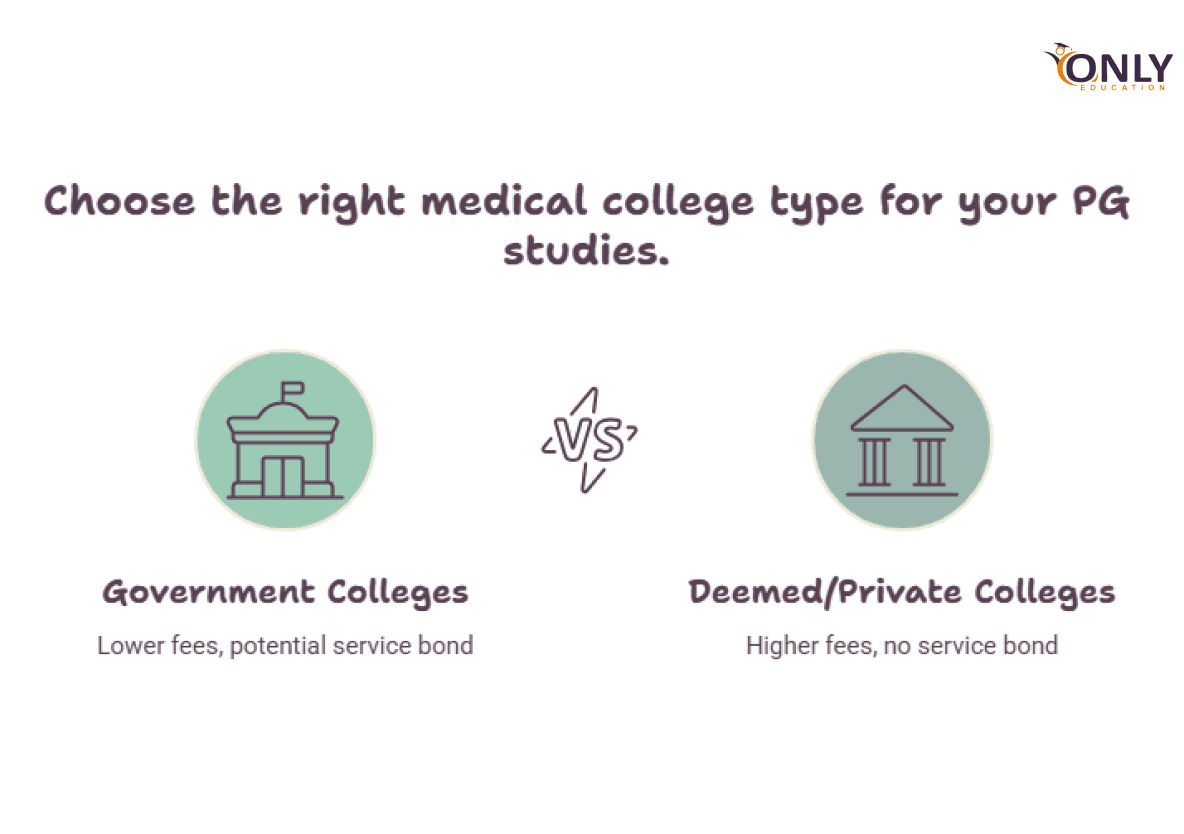
Government medical college MD/MS fees are typically the lowest, often in the range of a few thousand to around one to two lakh rupees per year; deemed and private university PG fees are substantially higher, commonly running into several lakhs to well over ten lakhs per year depending on the institute and specialty, particularly for clinical branches.
Because exact fee figures change year to year and vary significantly by college, quota, and specialty, this article deliberately avoids quoting precise per-college numbers that cannot be verified against a live, current source. Before finalising any deemed or private college choice, check the fee structure directly on the institute's official prospectus or the MCC/state counselling portal for that admission cycle figures published on third-party aggregator sites are frequently outdated by the time you read them.
Bond and service obligations to check
Several government medical colleges and some state quota seats carry a rural service bond or a financial penalty for not completing a specified service period after the PG course. These obligations vary by state and college and are usually disclosed in the counselling brochure or the college's admission letter read this document before locking a choice, not after.
How to Build Your Own Shortlist by Rank Band
This is the core decision-making tool this guide offers that a static top-10 list cannot: matching your likely NEET PG 2026 rank to a realistic shortlisting strategy.
If you're in the top 1–500 AIR
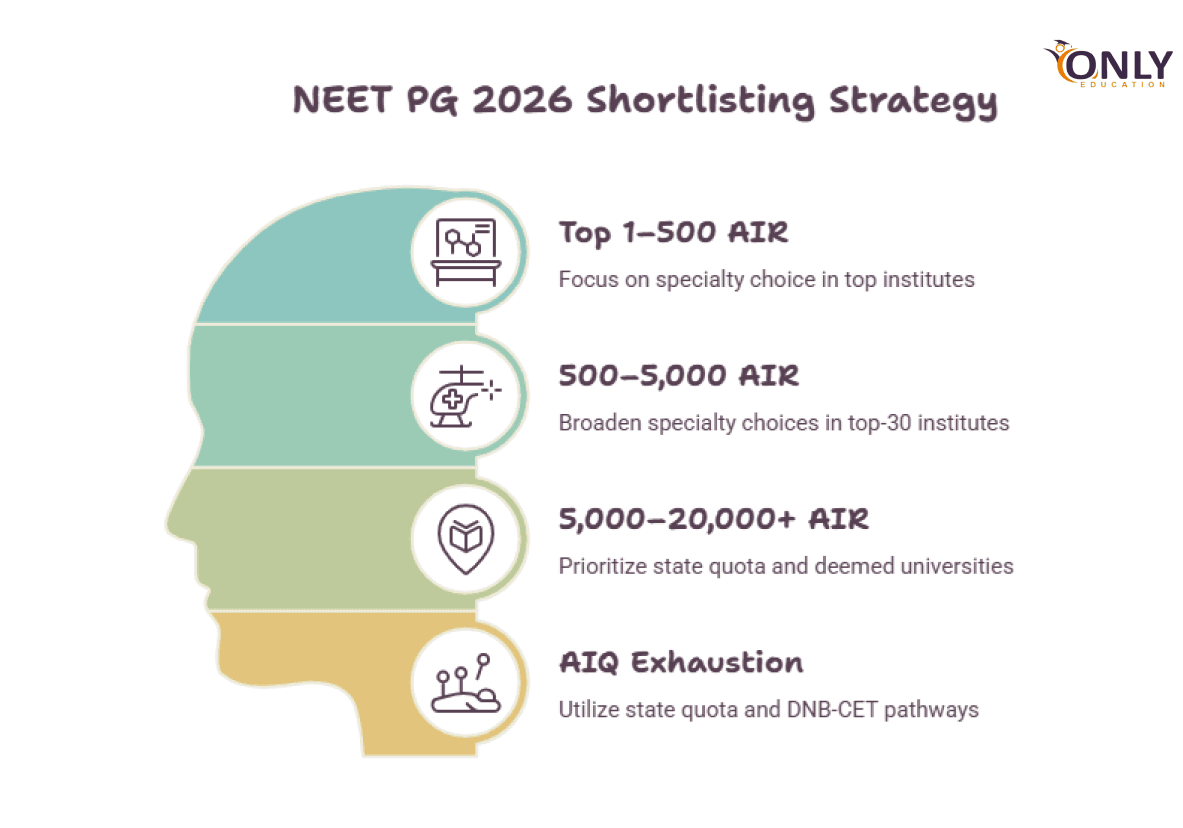
You are in genuine contention for AIIMS Delhi, PGIMER Chandigarh, CMC Vellore, JIPMER Puducherry, and similar top-5–10 NIRF institutes for competitive clinical branches (Radiology, Dermatology, General Medicine, General Surgery, and similar high-demand specialties). At this level, the strategic question shifts from "which college" to "which specialty" since top colleges will very likely be available, your specialty preference becomes the binding constraint.
If you're in the 500–5,000 AIR range
Top-10 institutes remain possible for less oversubscribed specialties, and colleges ranked roughly 11–30 on NIRF (AIIMS Rishikesh, AIIMS Bhubaneswar, BHU, KGMU, Madras Medical College, and peers) become realistic for a broader specialty choice. This band benefits most from filling a long, carefully ordered choice list rather than a short one narrow lists in this range are the single most common cause of avoidable seat loss.
If you're in the 5,000–20,000+ AIR range
Focus shifts toward state quota (where your home-state domicile often gives a significant cutoff advantage over AIQ competition), strong state government medical colleges outside the NIRF top 50, and reputable deemed universities where fees are manageable. This is also the band where evaluating a college on specialty-specific clinical strength (see the NIRF nuance above) matters more than chasing aggregate rank.
If AIQ options run out state quota and DNB-CET
If a candidate's AIQ options are exhausted without a satisfactory seat, state quota counselling (with its domicile advantage) and DNB-CET now integrated with NEET PG performance rather than a separate exam remain genuine, NMC/NBE-recognised pathways to a postgraduate medical qualification, not fallback options to be dismissed.
DNB courses, counselled by the NBE, run at many well-regarded hospitals (including several outside the traditional "medical college" list) and are increasingly viewed as equivalent in market value to an MD/MS in most specialties. Don't let name-recognition bias rule this pathway out without checking the specific hospital's reputation and infrastructure for your specialty.
Common Mistakes Students Make While Choosing Colleges After NEET PG
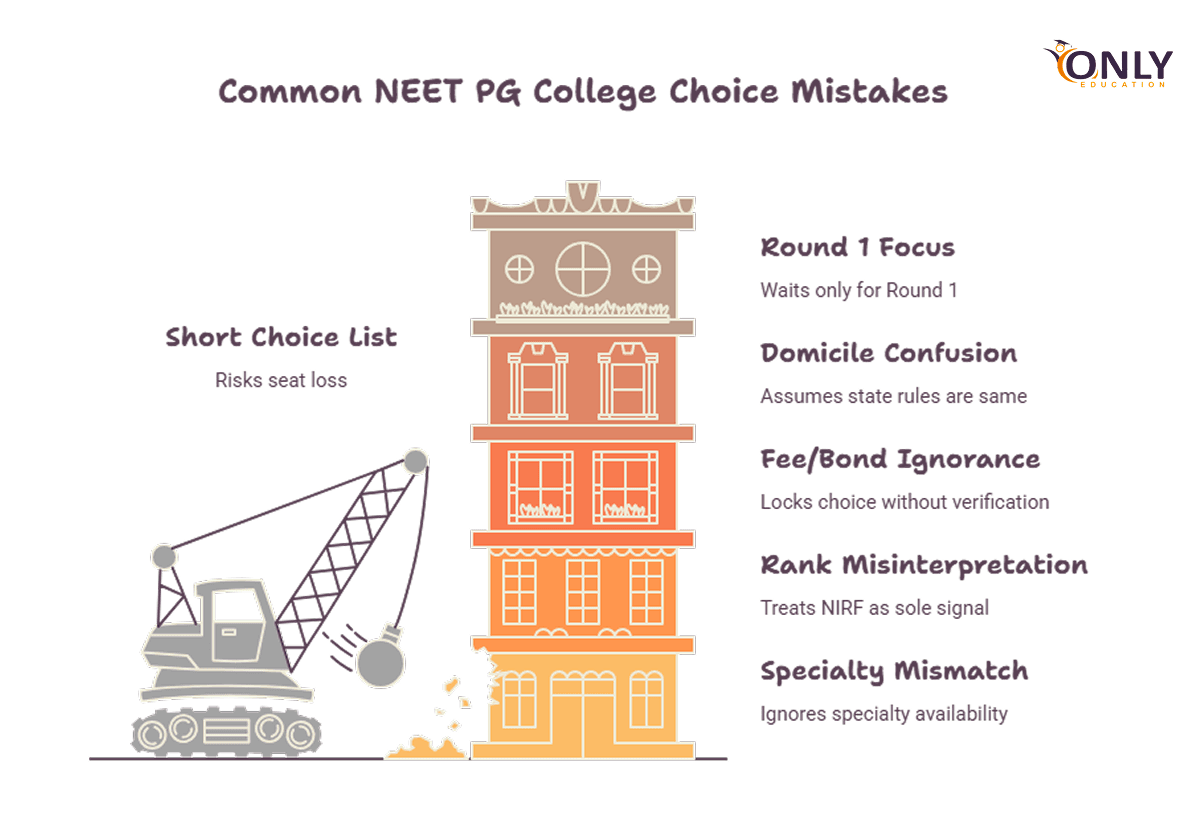
- Filling too short a choice list. A short list based only on "dream colleges" risks a Round 1/Round 2 seat loss with no fallback, forcing a wait until Mop-Up or Stray Vacancy losing valuable time.
- Ignoring specialty-college fit. Chasing the highest-ranked college regardless of specialty availability, rather than matching specialty priority to realistic college-rank combinations.
- Treating NIRF rank as the only quality signal. As covered above, clinical training strength for a specific specialty doesn't always track aggregate NIRF score.
- Not verifying fee and bond terms before locking a choice. Once a choice is locked and allotted in MCC counselling, withdrawal typically carries a financial penalty read the fee and bond structure before choice-locking, not after allotment.
- Assuming state quota domicile rules are the same everywhere. They vary significantly by state; confirm your specific state's domicile and residency requirement before counting on a state-quota advantage.
- Waiting only for Round 1 results to plan next steps. As shown by 2025-cycle data, a meaningful share of seat movement happens in Round 2 and Mop-Up don't disengage from counselling after a disappointing Round 1.
A Pre-Counselling Checklist Before You Lock Your Choices
- Confirm your MBBS degree, internship completion certificate, and NMC/State Medical Council registration are in order and match NEET PG 2026 eligibility criteria exactly.
- Note your NEET PG 2026 percentile/AIR as soon as results are declared, and compare it against your target colleges' previous-year closing ranks (available on MCC's official past-cycle data) not against unverified third-year predictions.
- Build a long, ordered choice list spanning your realistic rank band plus a few "stretch" and "safety" options, rather than a short list of only top-ranked colleges.
- Separately verify the fee structure and any service bond for every deemed/private/state college on your list directly from the official prospectus.
- Check whether each shortlisted college is strong specifically in your intended specialty, not just on the aggregate NIRF score.
- Confirm your domicile/residency status for state quota eligibility in every state you plan to apply through.
- Keep DNB-CET and reputable non-medical-college hospital options on your radar as a genuine parallel path, not a last resort.
- Read the MCC/state counselling bulletin's choice-locking and withdrawal-penalty rules before the locking deadline this determines how much flexibility you retain after Round 1.
Key Takeaways
- NEET PG 2026 is scheduled for August 30, 2026; your rank not a static "top colleges" list determines your realistic options.
- Counselling runs on two parallel tracks: 50% AIQ (merit-only, all-India, via MCC) and 50% state quota (often domicile-based, via state authorities), plus 100% deemed/central university seats via MCC.
- AIIMS Delhi, PGIMER Chandigarh, CMC Vellore, and JIPMER Puducherry lead the NIRF 2025 medical ranking, but NIRF rank is a composite score, not a specialty-specific measure of clinical training strength.
- Building a long, well-ordered choice list and staying engaged through Round 2 and Mop-Up, not just Round 1 meaningfully affects outcomes.
- State quota and DNB-CET are legitimate, NMC/NBE-recognised alternative routes worth planning for, not just fallback options.
Conclusion
Choosing a medical college after NEET PG 2026 isn't really a research problem it's a matching problem. The exam gives you a rank; counselling turns that rank, plus your quota eligibility and specialty preference, into a seat. A "top colleges" list is only useful once you filter it through that lens. AIIMS Delhi, PGIMER Chandigarh, CMC Vellore, and JIPMER Puducherry will remain the aspirational names at the top of every list, and they're worth targeting if your rank supports it. But for most candidates, the more decisive factors are the ones covered here: understanding how AIQ and state quota actually compete against each other, recognising that a college's aggregate NIRF score doesn't always reflect its strength in your specific specialty, building a choice list long enough to survive Round 1 without panic, and treating DNB-CET and state quota as real options rather than consolation prizes.
Use this guide as a working framework, not a one-time read revisit the rank-band section once your NEET PG 2026 result is out, Cross-check colleges on your shortlist against the official NIRF, MCC, and NBE sources linked above, and build your choice list around your actual, verified rank rather than an aspirational one.