12th PCM: Which Entrance Exams Should You Actually Write?


The phone call in June

The form, the fee, and the test date went past the house in March.
It is the third week of June. The seat allotment list is out. Your rank is fine. Not bad. Just not enough.
And somebody in the room finally says the thing that has been sitting there quietly since January.
“So what now?”
So the search starts. Someone remembers a cousin’s son who got into a good private college down south. Someone opens a laptop. And somewhere in the next twenty minutes, the family discovers that the entrance exam for that college closed in March. The form, the fee, the test date: all of it went past the house while everyone inside it was concentrating very hard on one exam.
Nobody in that family did anything wrong. They did exactly what they were told to do.
Write JEE first. Then we’ll see.
Here is the problem with “then we’ll see.” It is not possible. And that is not our opinion; it is written in NTA’s own information bulletin for JEE Main 2027:
“The Common Rank List shall be compiled and declared after conduct of Session 2 of JEE (Main) – 2027 Examination.” — NTA Information Bulletin, JEE Main 2027
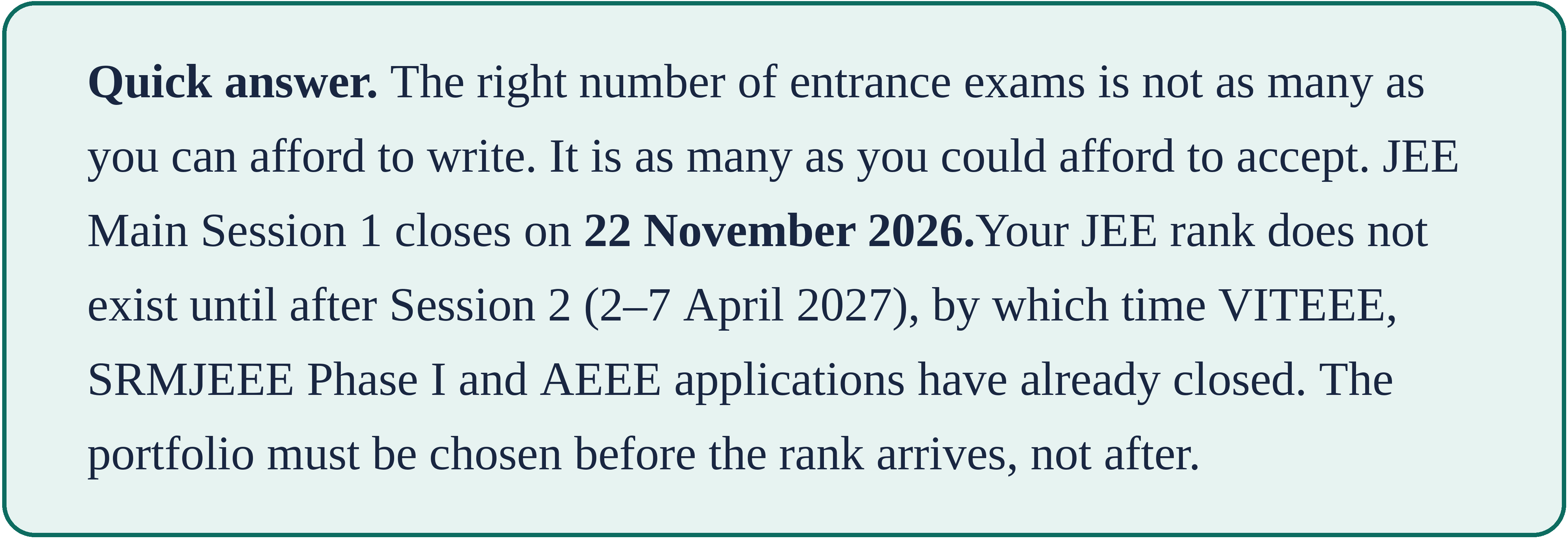
Session 2 runs from 2 to 7 April 2027. Read that again slowly. Your JEE rank does not exist until April. January gives you a percentile score, not a rank, and a percentile on its own tells you nothing about which college will take you.
Now look at where the other doors are. SRMJEEE Phase I: 17 and 18 April. AEEE: 15 April to 7 May. VITEEE: 27 to 30 April. Every backup is tested in the same three weeks in which you finally learn your rank, or before it.
So the sequence everybody believes in, write JEE first and then decide, is not a plan. It is a coin toss with the coin already in the air.
The part that is for the parents
Here is why that family in June got caught, and it has nothing to do with intelligence or effort.
| Your child does not know your budget. He knows which exams his friends are writing. He does not know whether this house can find Rs 24,00,000 over four years. Nobody wants to say it out loud, and he would rather not ask. | You do not know the exam calendar. You know exactly what this family can afford. You do not know that one form shuts on 22 November, that one college does not need Chemistry, or that a 70% board result can lock your child out of an IIT seat. |
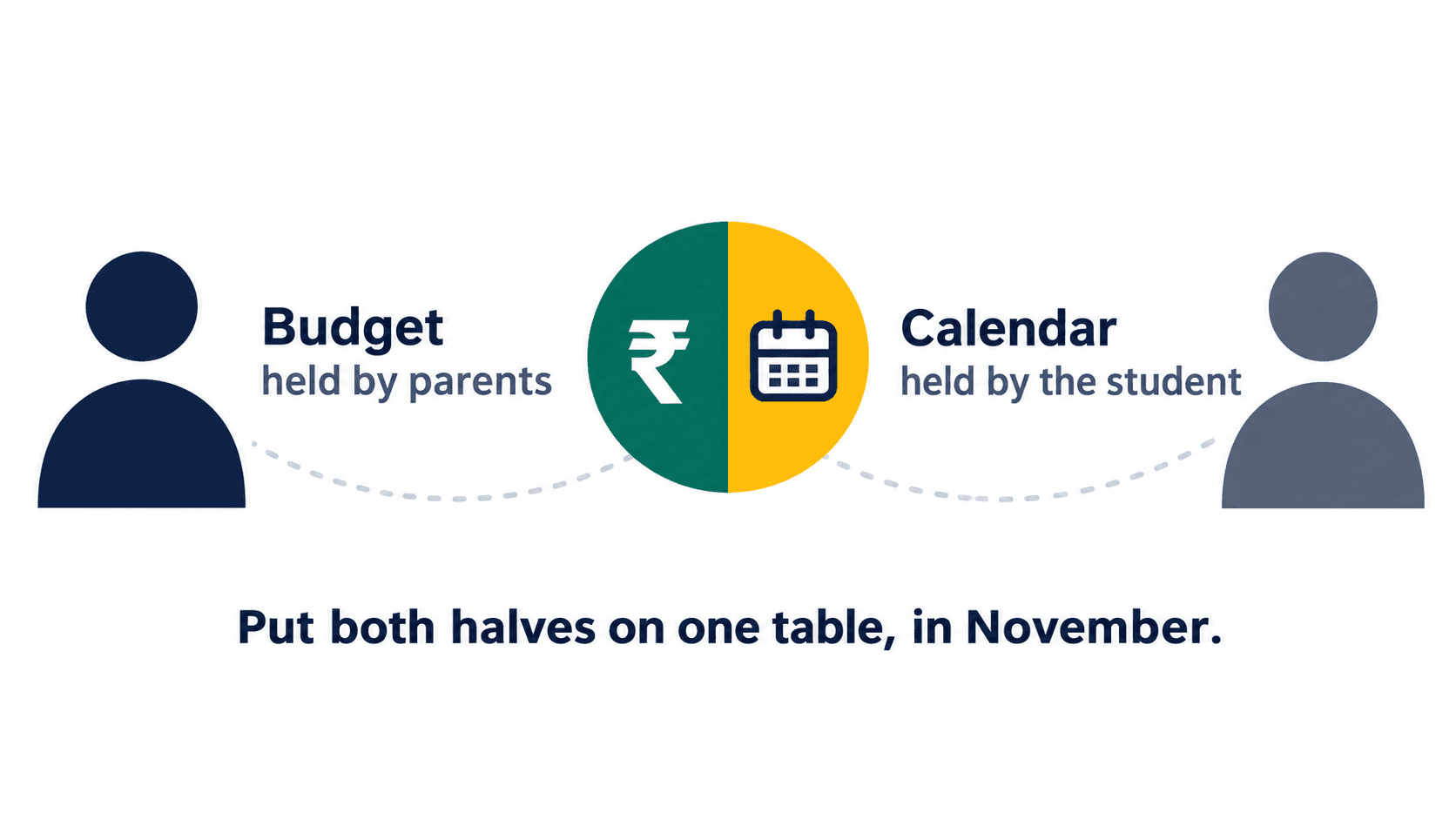 Each side holds half the decision.
Each of you is holding one half of the decision. In most houses, the two halves are not put on the same table until June, about four months after it would have mattered.
That conversation costs you nothing. Having it in November instead of June is worth more than any coaching class you will pay for this year.
The short answer
If you read nothing else, read this.
- Write JEE Main, both sessions. Rs 2,000 for a General male candidate, Rs 1,600 for a General female, Rs 1,000 for SC/ST. It is the cheapest and widest door in Indian engineering, and nothing else substitutes for it.
- Write your own state CET. For Maharashtra readers, MHT CET is your strongest card, for a reason most families do not expect: government colleges carry no all-India quota.
- Add at most one or two private exams, chosen by what your family can actually pay if the offer comes. Not by what your friends are writing.
- Skip the exam whose college you could never afford. VITEEE costs Rs 1,450. A VIT seat at the lowest fee slab costs roughly Rs 7,80,000 over four years, and at the highest slab roughly Rs 19,60,000. If those numbers are impossible for your house, the application fee is wasted and the preparation hours are worth more elsewhere.
- Stop planning to decide in June. That option does not exist. The next section shows why.
Why you cannot wait and see
The JEE Main calendar has a gap in it that almost nobody points out. Follow the year in order:
🟡 22 Nov 2026: JEE Main Session 1 application closes
⚪ 20–28 Jan 2027: Session 1 exam. You get a percentile, not a rank
🟡 31 Mar 2027: VITEEE application closes
🟡 2 Apr 2027: SRMJEEE Phase I application closes
⚪ 2–7 Apr 2027: JEE Main Session 2 exam
⚪ 15 Apr – 7 May: AEEE window · SRMJEEE Phase I on 17–18 Apr · VITEEE on 27–30 Apr (tentative)
🟢 April at the earliest: Your JEE rank (Common Rank List) finally exists
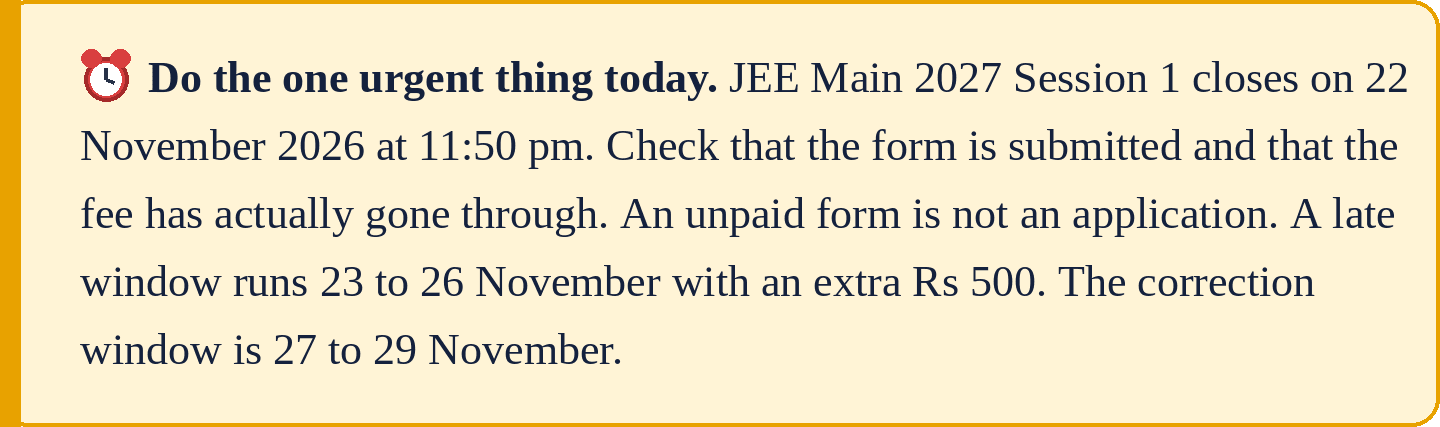
⏰ Deadline: JEE Main 2027 Session 1 closes on 22 November 2026, 11:50 pm
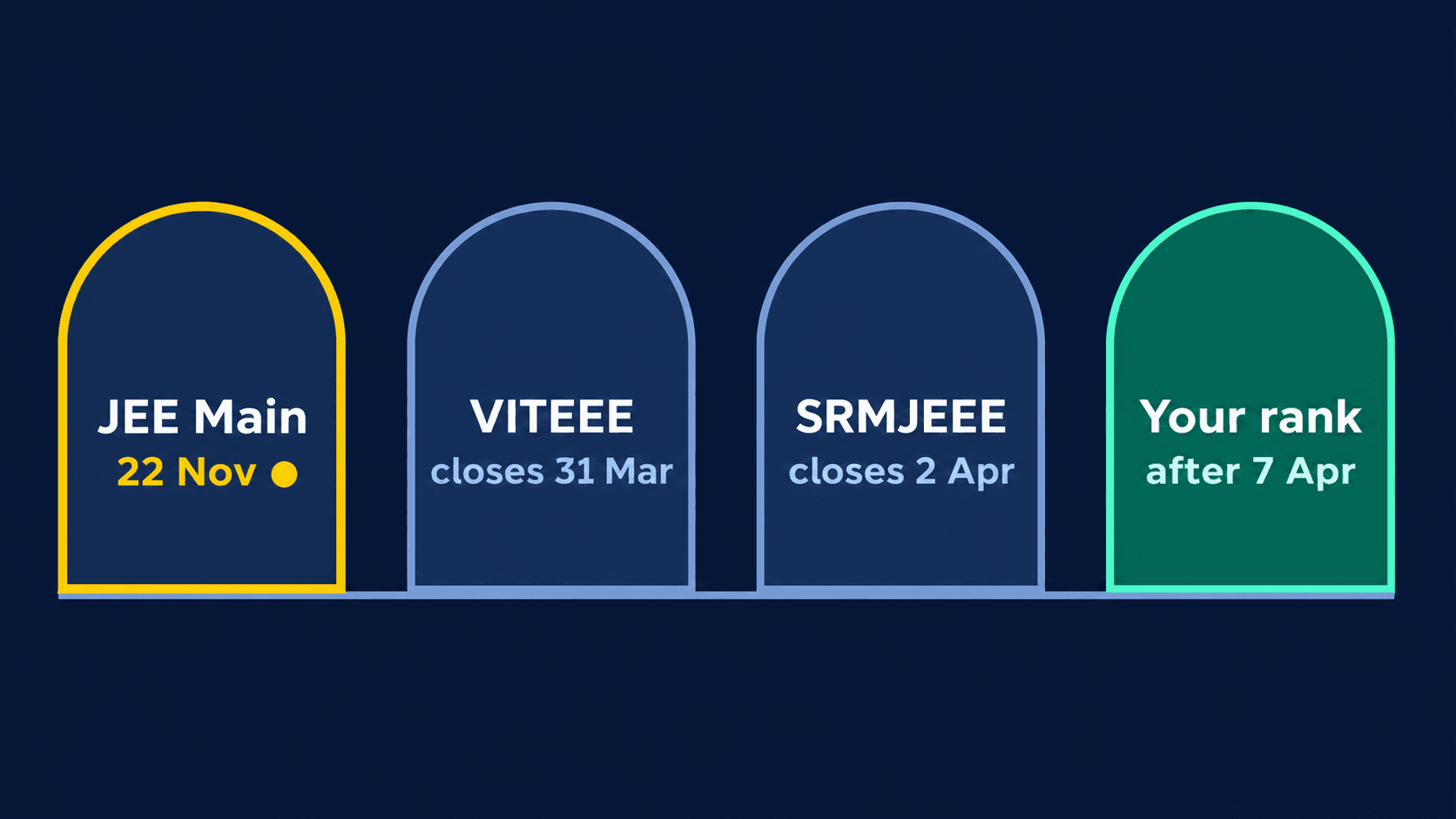
The rank door opens last. Three of the others have shut by then.
After January, you hold a percentile score: a measure of how many candidates scored at or below you in your own session. It does not tell you which college will admit you, because that depends on how everyone else did and on how many seats each college has.
The AEEE window completely contains both SRMJEEE Phase I and the VITEEE window. A student writing all three has to fit three exams into three weeks, and cannot choose when; AEEE and VITEEE both assign your slot inside their window. And both application deadlines fall before your rank exists.
So the decision is forced on you in March, using information you will not have until April. The only honest response is a portfolio chosen on purpose rather than a plan to decide later.
“NTA… does not collect the information regarding the total number of seats available in the institutions.” — Same bulletin. Seat matters sit with JoSAA and CSAB, which is why nobody can give you a straight seat count.
What is actually open right now
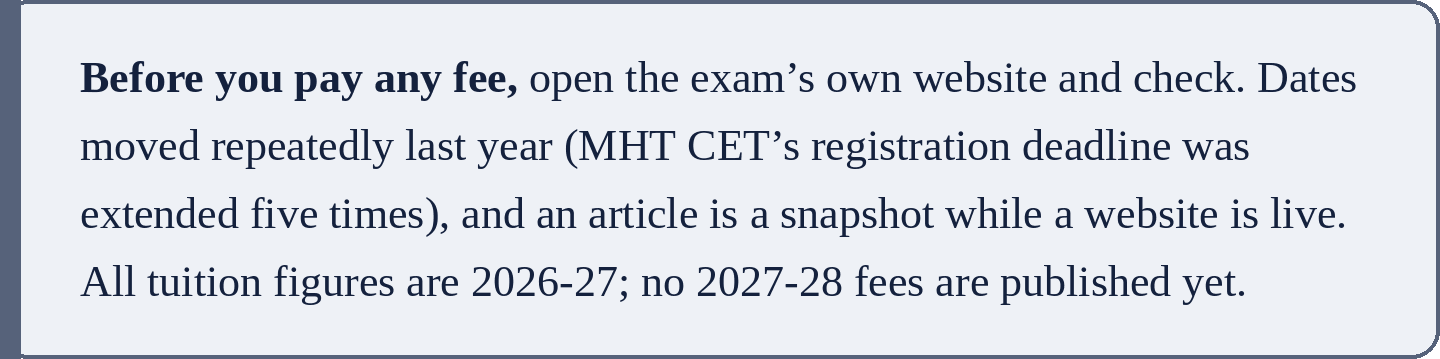
We checked all eleven exams against their own official websites and reliable reporting on 3 November 2026. Most of the 2027 cycle does not exist yet, which means there is nothing to miss. One deadline on 22 November. Two forms are already open with months to spare. Everything else arrives between December and March.
| Exam | 2027 cycle | Where it stands today |
|---|---|---|
| JEE Main | Published | Session 1 closes 22 Nov 2026. The only urgent deadline |
| VITEEE | Published | Open since 20 Oct 2026, closes 31 Mar 2027 |
| SRMJEEE | Published | Portal live; Phase I closes 2 Apr 2027 |
| AEEE (Amrita) | Partly | Exam window announced (15 Apr – 7 May). Applications “will start in November”, no date. Fee and eligibility not yet published |
| JEE Advanced | Not yet | Site still serves 2026. Last year’s brochure came out 30 Dec 2025 |
| BITSAT | Not yet | BITS says the cycle “will open in December 2026 (tentatively).” |
| COMEDK UGET | Not yet | 2026 applications opened 3 Feb 2026 |
| MHT CET | Not yet | No 2027 brochure, schedule, or fee. 2026 registration opened 10 Jan 2026 |
| IISER IAT | Not yet | 2026 registration opened 5 Mar 2026 |
| NEST | Not yet | Site says “To be updated soon for NEST 2027” |
| NATA | Not yet | 2026 form filling began 9 Mar 2026 |
Dates in the “Not yet” rows are last year’s. They show when each window tends to open; they are not forecasts for 2027.
What the whole menu actually costs
Every figure is the full cost of that exam, including all its sessions, phases, or attempts. Where 2027 fees are not published, the 2026 fee is used.
| Exam | General male | Female | SC/ST | Fee year |
|---|---|---|---|---|
| JEE Main, both sessions | Rs 2,000 | Rs 1,600 | Rs 1,000 | 2027 |
| JEE Advanced | Rs 3,200 | Rs 1,600 | Rs 1,600 | 2026 |
| BITSAT, both sessions | Rs 5,600 | Rs 4,600 | Rs 5,600 | 2026 |
| MHT CET PCM, both attempts | Rs 2,600 | Rs 2,600 | Rs 2,000 | 2026 |
| SRMJEEE, both phases | Rs 2,800 | Rs 2,800 | Rs 2,800 | 2027 |
| COMEDK UGET | Rs 1,950 | Rs 1,950 | Rs 1,950 | 2026 |
| AEEE, including Phase 2 | Rs 1,900 | Rs 1,900 | Rs 1,900 | 2026 |
| MET (Manipal), both attempts | Rs 3,200 | Rs 3,200 | Rs 3,200 | 2026 |
| VITEEE | Rs 1,450 | Rs 1,450 | Rs 1,450 | 2027 |
| All nine | Rs 24,700 | Rs 21,700 | Rs 21,500 |
Most of these exams give no category concession at all. BITSAT varies its fee by gender and test centre only, so an SC/ST male candidate pays the full Rs 5,600. VITEEE, SRMJEEE, COMEDK, AEEE and MET publish a single flat fee. A General-category female writing all nine pays Rs 21,700; an SC/ST male pays Rs 21,500, just Rs 200 less. Only JEE Main, JEE Advanced, and MHT CET carry a meaningful concession.
Now set the exam fees against what the colleges they open actually cost:
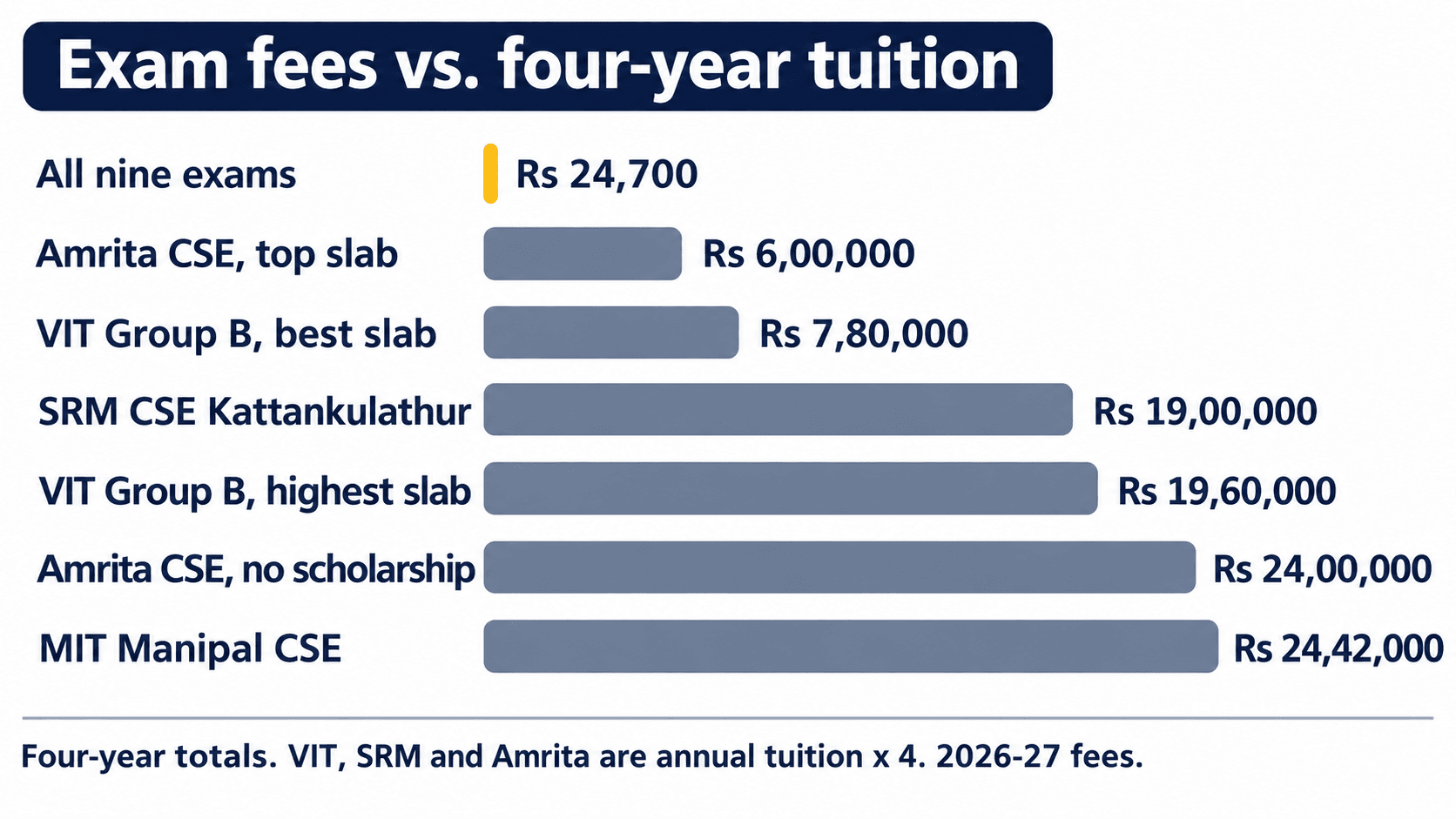
Exam fees vs. four-year tuition. The nine-exam total is the tiny first bar.
Four-year totals. Manipal’s is its own published total; VIT, SRM, and Amrita are annual tuition × 4, our multiplication.
The entire nine-exam portfolio costs about one-hundredth of a single one of those degrees. So the argument families actually have in November, who will pay the fees for so many exams, is the wrong argument. The exam fees are a rounding error. The tuition is the decision, and it is roughly a hundred times larger.
The right number of entrance exams is not as many as you can afford to write. It is as many as you could afford to accept.