
JEE Main 2027: Registration, Exam Dates, Fees, Eligibility, Syllabus and Cutoffs


JEE Main 2027 registration opened on 24 October 2026. The regular application and fee-payment deadline is 22 November 2026, 11:50 pm. Three updates matter: a ₹500 late fee, fixed city-slip/admit-card dates, and admission eligibility details now directed to JoSAA/CSAB instead of appearing in NTA's bulletin. Claims that the MeriPehchaan login is compulsory are unsupported by the cited NTA documents.
JEE Main 2027 Important Dates
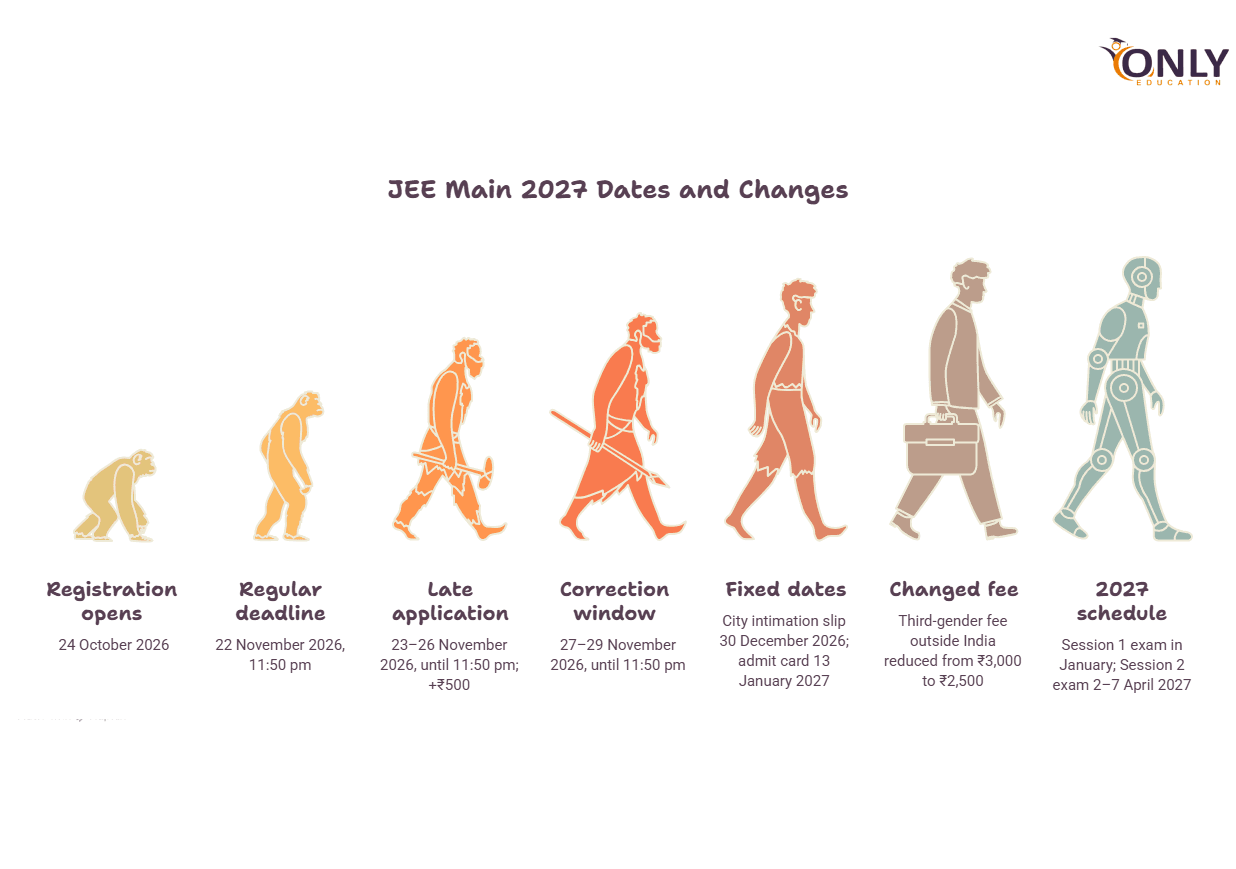
Event | Date |
| Registration opens. | 24 October 2026 |
| Application and payment deadline | 22 November 2026, 11:50 pm |
| Late application (+₹500) | 23–26 November 2026, until 11:50 pm |
| Correction window | 27–29 November 2026, until 11:50 pm |
| City intimation slip | 30 December 2026 |
| Admit card | 13 January 2027 |
| Session 1 exam | 20, 21, 22, 23, 24 and 28 January 2027 |
| Session 2 registration | 5 January–3 February 2027 |
| Session 2 exam | 2–7 April 2027 |
Three-hour shifts are 9 am–noon and 3–6 pm. Combined B.Arch/B.Planning papers last 3½ hours: 9 am–12:30 pm or 3–6:30 pm. The exam is offered in 13 languages. Unlike 2026's tentative city-slip timing and admit-card release 3–4 days before the test, the 2027 bulletin specifies 30 December and 13 January, helping travel planning. Note: the source article's later checklist says 31 December for the city slip, conflicting with its 30 December schedule; confirm on NTA's website.
What Has Not Changed?
- Syllabus: The 2026 and 2027 documents are identical, word for word.
- Two sessions: January and April; the higher NTA score, never the average, counts.
- Fees: Unchanged except for the third-gender fee for one paper outside India, reduced from ₹3,000 to ₹2,500. The new ₹500 late charge applies to every category; 2026 had no late fee.
Is MeriPehchaan Mandatory for JEE Main 2027?
No compulsory login requirement appears in the cited official record. On pages 7–8, NTA describes MeriPehchaan single sign-on as enabled “for the convenience of the applicants.” On 25 October, the registration portal showed standard Register and Application Number/password login options, without mentioning MeriPehchaan, DigiLocker, JanParichay or e-Pramaan. No separate compulsory login public notice was identified. Candidates can use the normal NTA registration route. Reports of mandatory DigiLocker linking for GATE 2027 concern a different examination.
Service | Purpose |
| MeriPehchaan | Reusable government single-sign-on account, avoiding separate logins |
| DigiLocker | Digital government-document storage (including marksheets, Aadhaar and PAN) and identity option |
| JanParichay | Government login service, often for existing government-service users |
| e-Pramaan | Government identity-verification service |
- Optional MeriPehchaan process:
Visit meripehchaan.gov.in. - Register Now
- Choose DigiLocker (often the easiest for students already using it) or another provider
- Enter your name, birth date and phone number exactly as on your Class 10 certificate
- Verify via an available Aadhaar, PAN, driving licence or APAAR option
- Open jeemain.nta.nic.in to apply.
Options depend on the provider. Save the generated application number and password for corrections, admit card and results.
Name mismatch example: Class 10 says Priya Sharma, Aadhaar says Priya Kumari Sharma, and PAN says PRIYA SHARMA. Aadhaar verification may fail. Try an accepted alternative, such as PAN; Aadhaar correction through a centre can take several days. Resolve mismatches early. Aadhaar itself is not compulsory: NTA says candidates “may” use Aadhaar, PAN, driving licence or APAAR for eKYC, while advising updated Aadhaar records. Check names and birth dates against your Class 10 certificate even when using ordinary registration.
JEE Main 2027 Application Fees
One paper (Paper 1, 2A or 2B):
Category | Gender | India | Outside India |
| General | Male | ₹1,000 | ₹5,000 |
| General | Female | ₹800 | ₹4,000 |
| Gen-EWS/OBC-NCL | Male | ₹900 | ₹4,500 |
| Gen-EWS/OBC-NCL | Female | ₹800 | ₹4,000 |
| SC/ST/PwD/PwBD | Any | ₹500 | ₹2,500 |
| Third Gender | — | ₹500 | ₹2,500 |
Two or more papers (any combination):
Category | Gender | India | Outside India |
| General/Gen-EWS/OBC-NCL | Male | ₹2,000 | ₹10,000 |
| General/Gen-EWS/OBC-NCL | Female | ₹1,600 | ₹8,000 |
| SC/ST/PwD/PwBD | Any | ₹1,000 | ₹5,000 |
| Third Gender | — | ₹1,000 | ₹5,000 |
Payment methods: credit/debit card, net banking or UPI. Processing charges and GST are extra. Multiple papers cost more; 23–26 November applications incur another ₹500, irrespective of category. Payment alone does not complete submission; finish both by 22 November, preferably a week early: a failed last-minute payment could leave the form incomplete.
JEE Main 2027 Eligibility and the 75% Rule
Requirement | Position in cited NTA bulletin |
| Class 12 passing year | Passed in 2025 or 2026, or appearing in 2027; 2024 or earlier ineligible |
| Age limit | None |
| Attempt count | No published numerical cap; eligibility follows passing year |
| Subject requirements | Referred to JoSAA/CSAB admission rules |
An improvement exam does not reset your original Class 12 passing year. This generally permits three consecutive years, with two sessions per year; it is not an explicitly stated “three attempts” rule.
JEE Main qualification does not automatically guarantee admission. Unlike the 2026 bulletin, NTA's 93-page 2027 bulletin does not list 75%, 65% or top-20-percentile criteria. Section 11.6 refers admissions to competent institutes and JoSAA/CSAB.
Under JoSAA 2026 Business Rules, candidates needed five Class 12 subjects and either 75% aggregate (65% for SC, ST and PwD) or their category-wise top 20 percentile in their board. Board-wise cutoffs, sometimes below 75%, are published by JoSAA. JoSAA 2027 rules were not available as of 25 October 2026, so these are previous-year requirements, not confirmed 2027 rules. Plan around them and verify the new rules when released; assuming the condition disappeared could cost a seat even at 72% board marks.
Subject combinations: For NITs, IIITs and GFTIs (Government Funded Technical Institutes), the cited requirements are Physics, Mathematics, a language, one of chemistry/biology/biotechnology/technical vocational subject, and one additional subject. For IITs and IISc, Physics, Chemistry and Mathematics are compulsory. Consequently, Biology instead of Chemistry may satisfy the first group but not the second.
JEE Main 2027 Syllabus: 54 Units, No Changes
Paper 1 contains 14 Mathematics, 20 Physics and 20 Chemistry units; none were added or removed from 2026. Existing 2026 preparation material remains relevant.
Mathematics (14): Sets, Relations and Functions; Complex Numbers and Quadratic Equations; Matrices and Determinants; Permutations and Combinations; Binomial Theorem; Sequence and Series; Limit, Continuity and Differentiability; Integral Calculus; Differential Equations; Coordinate Geometry; Three-Dimensional Geometry; Vector Algebra; Statistics and Probability; Trigonometry.
Physics (20): Units and Measurements; Kinematics; Laws of Motion; Work, Energy and Power; Rotational Motion; Gravitation; Properties of Solids and Liquids; Thermodynamics; Kinetic Theory of Gases; Oscillations and Waves; Electrostatics; Current Electricity; Magnetic Effects of Current and Magnetism; Electromagnetic Induction and Alternating Currents; Electromagnetic Waves; Optics; Dual Nature of Matter and Radiation; Atoms and Nuclei; Electronic Devices; Experimental Skills.
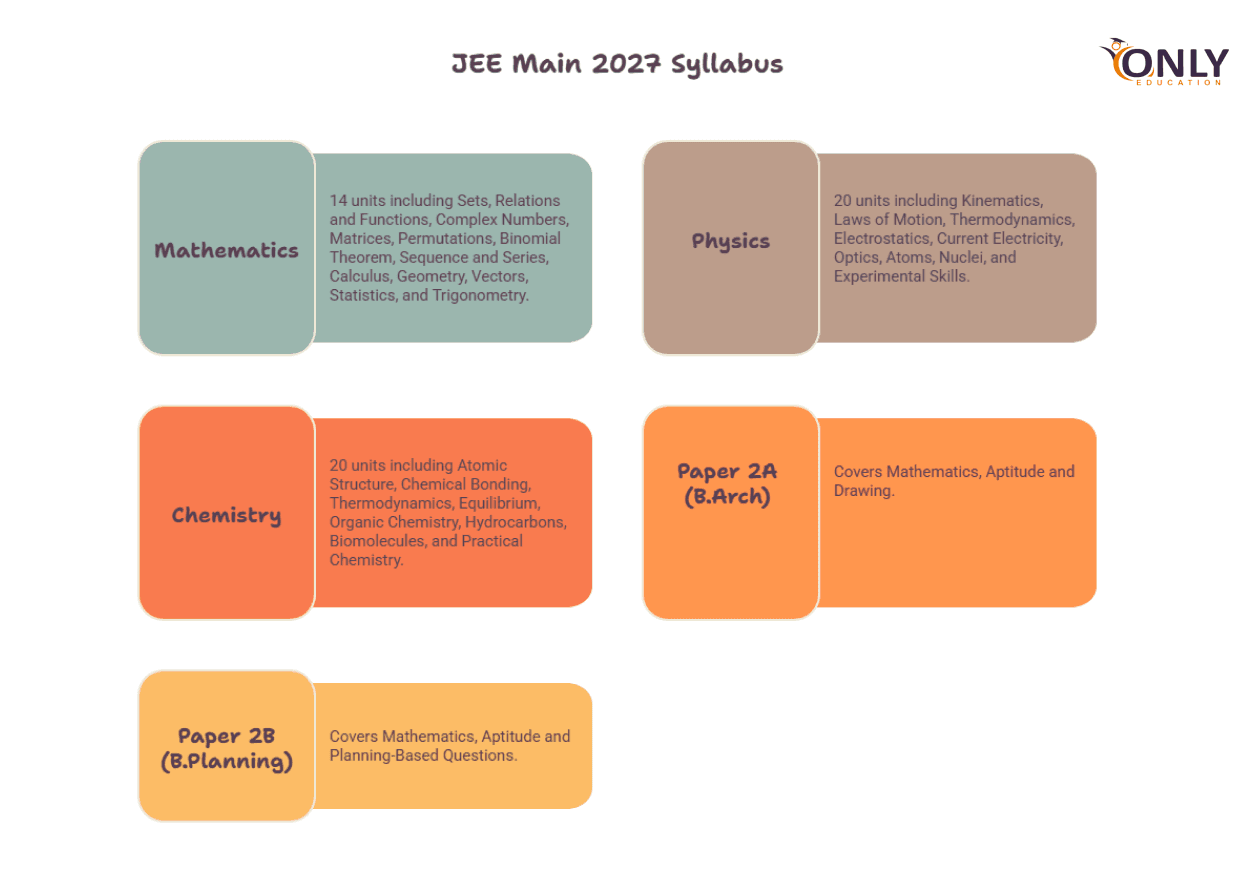
Chemistry (20): Some Basic Concepts in Chemistry; Atomic Structure; Chemical Bonding and Molecular Structure; Chemical Thermodynamics; Solutions; Equilibrium; Redox Reactions and Electrochemistry; Chemical Kinetics; Classification of Elements and Periodicity; p-Block Elements; d- and f-Block Elements; Coordination Compounds; Purification and Characterisation of Organic Compounds; Some Basic Principles of Organic Chemistry; Hydrocarbons; Organic Compounds Containing Halogens; Organic Compounds Containing Oxygen; Organic Compounds Containing Nitrogen; Biomolecules; Principles Related to Practical Chemistry.
Paper 2A (B.Arch): Mathematics, Aptitude and Drawing. Paper 2B (B.Planning): Mathematics, Aptitude and Planning-Based Questions.
Chapter-wise weightage warning: NTA publishes the syllabus, not chapter-weightage percentages. Coaching tables (for example, claims of 8% for electrostatics or 5% for coordination compounds) are estimates drawn from past papers, ideally five years with disclosed dates. Use them for revision order; never omit a unit: a historically 2% 2%-weighted unit might carry 8% in your paper.
JEE Main 2027 Marks vs Percentile vs Rank
Percentage describes marks: 180/300 = 60%. The percentile describes how many candidates in your shift scored at or below you: 95th percentile means 95% did so. Identical raw marks can yield different percentiles across shifts. Normalisation accounts for different paper difficulty:
Percentile = (Candidates in your shift scoring at or below you ÷ Total candidates in that shift) × 100
The final All India Rank (AIR) is calculated after both sessions, using the higher NTA score. A January percentile is not final AIR. For 2027, ties are resolved by mathematics, physics, and chemistry, then lower ratios of wrong to correct answers overall and in mathematics, physics, and chemistry, respectively. Age is no longer used; any remaining ties receive the same rank.
Approximate rank = [(100 − percentile) ÷ 100] × Total appeared candidates. In 2026, 15,38,468 appeared from 16,04,854 registered (NTA result notice, 20 April 2026). Recalculate for 2027's actual count. 99 vs 99.5 percentile may represent about 7,000 ranks; improving from 99.5 to 99.9 is especially demanding near the top. A movement from 90 to 95 percentile can yield a large rank improvement. This formula is an estimate, not an official rank prediction.
JEE Main Cutoffs: JoSAA 2026 Final-Round Closing Ranks
The following are JoSAA 2026 Round 5 closing ranks: Open category, gender-neutral, four-year B.Tech. HS = Home State; OS = Other State; AI = All India. Separate specialisations have separate cutoffs.
Computer Science and Engineering (CSE)
Institute | HS | OS |
| NIT Karnataka, Surathkal | 3,331 | 1,954 |
| NIT Tiruchirappalli | 4,015 | 1,373 |
| NIT Warangal | 4,034 | 2,581 |
| MNIT Jaipur | 6,143 | 5,868 |
| VNIT Nagpur | 8,632 | 7,419 |
| NIT Rourkela | 9,635 | 4,266 |
| IIIT Allahabad, IT | 5,420 AI | — |
| BIT Mesra, Ranchi | 24,247 AI | — |
| Punjab Engineering College | 29,864 | 15,088 |
| NIT Agartala | 81,209 | 24,527 |
| NIT Mizoram | 5,22,326 | 41,038 |
Mechanical Engineering
Institute | HS | OS |
| NIT Tiruchirappalli | 14,015 | 8,754 |
| NIT Karnataka, Surathkal | 14,997 | 12,307 |
| NIT Warangal | 17,462 | 14,049 |
| MNIT Jaipur | 20,624 | 18,965 |
| VNIT Nagpur | 22,724 | 23,449 |
| NIT Rourkela | 24,497 | 14,593 |
| BIT Mesra | 53,694 AI | — |
| Punjab Engineering College | 85,261 | 41,505 |
| NIT Agartala | 2,53,448 | 44,427 |
| NIT Mizoram | 8,81,407 | 57,367 |
Civil Engineering
Institute | HS | OS |
| NIT Rourkela | 29,440 | 26,464 |
| MNIT Jaipur | 29,378 | 34,145 |
| NIT Tiruchirappalli | 29,391 | 20,111 |
| NIT Warangal | 32,717 | 26,626 |
| NIT Karnataka, Surathkal | 33,461 | 23,975 |
| VNIT Nagpur | 41,858 | 37,933 |
| BIT Mesra | 64,296 AI | — |
| Punjab Engineering College | 1,24,344 | 58,279 |
| NIT Agartala | 2,91,086 | 57,920 |
| NIT Mizoram | 5,66,926 | 62,780 |
What the ranks show: NIT Trichy's CSE closed at 4,015 HS vs 1,373 OS, while its Civil HS rank was 29,391. Home-state quota, tied to your qualifying-state eligibility, and branch drastically change admission prospects. NIT Mizoram CSE closed at 5,22,326 HS vs 41,038 OS. NIT Warangal CSE (AI and Data Science) closed at 5,416 HS, compared with 4,034 for plain CSE; do not combine those branches. IIIT Hyderabad is a self-financed deemed university outside JoSAA and runs its own admissions; IIIT Allahabad participates. Previous closing ranks are guides, not guarantees.
The cited JoSAA seat matrix totals approximately 24,735 seats at 32 NITs, 10,634 at 26 IIITs and 11,379 at 56 GFTIs: 46,748 seats, or roughly one per 33 JEE Main 2026 appeared candidates. These totals were added from the matrix, not published as one JoSAA headline figure.
How to Set Your JEE Main 2027 Target Rank
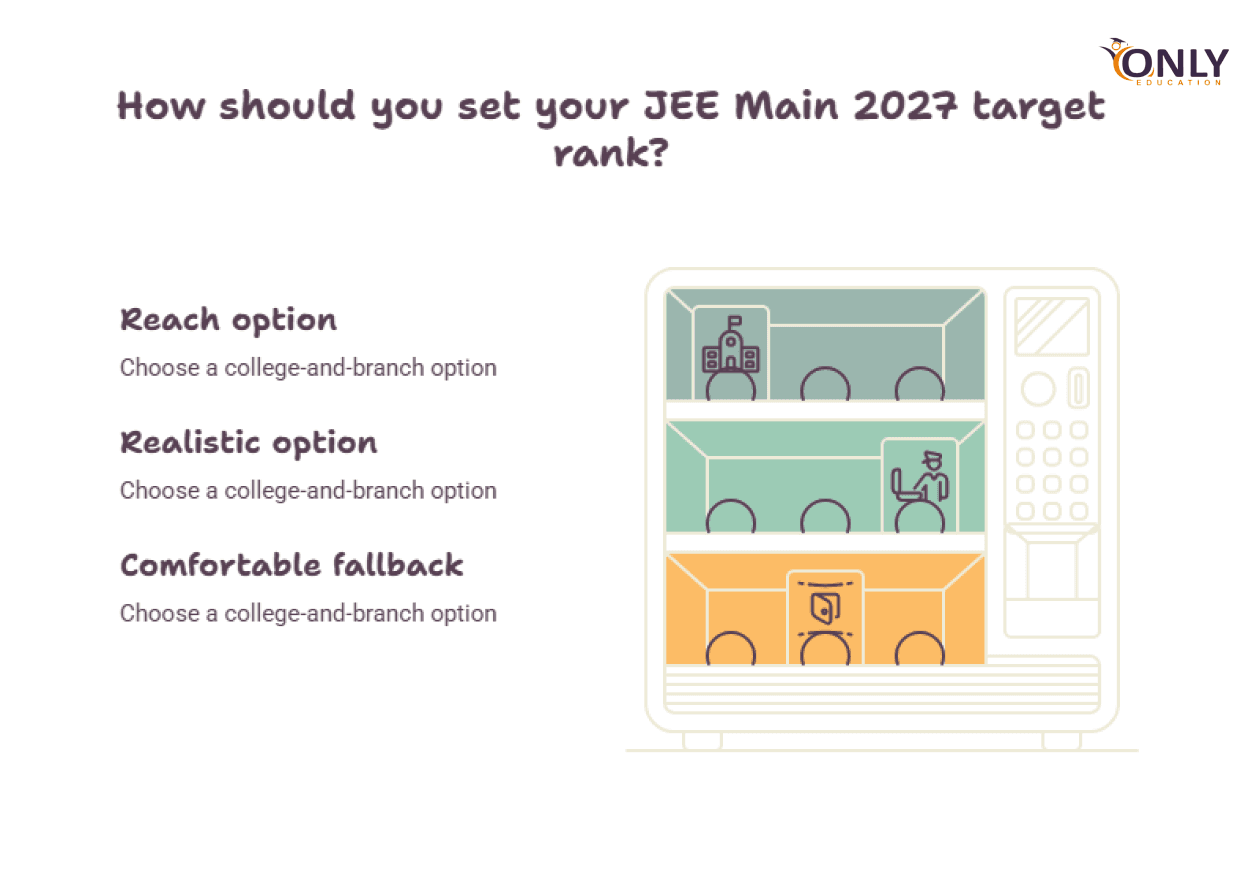
- Choose three college-and-branch options: reach, realistic and comfortable fallback.
- On josaa.nic.in, check the final-round closing rank by institute, branch, category and HS/OS quota. Round 1 may look more restrictive.
- Convert the rank: Target percentile = 100 − [(Target rank ÷ Appeared candidates) × 100].
- Compare scores at that percentile from two or three recent years. Because marks-to-percentile varies with difficulty, the source recommends using the lowest of those scores as a working mock-test target.
Example: Target rank 18,000, appeared candidates 14 lakh → approximately 98.71 percentile. Find its recent marks equivalent and practise full-length 300-mark timed mocks. These figures are illustrative. If your score goal is 210 but mocks show 175, find which subjects and units cause the 35-mark gap. January results also show whether April requires a 15-mark or 60-mark improvement. Aim safely inside last year's closing rank.
JEE Main 2027 Application Checklist
Today/tomorrow: Read and save NTA's bulletin (dates, category fee, photo/signature specifications); optionally create/verify MeriPehchaan; check Class 10 name/birth-date details against Aadhaar/PAN.
This week: Prepare specified photo/signature (live photograph required), scanned Class 10 certificate, applicable category/PwD documents; choose Paper 1/2A/2B and exam-city preferences.
Before 15 November: Submit and pay early; save application number, password, confirmation-page PDF and printout.
Later: Recheck permitted corrections 27–29 November (including applicable category, paper, name or photo fields); watch for the city slip listed as 30 December above (31 December in the source checklist) and the 13 January admit card. City slip tells you the city, not the venue admit-card details. The bulletin determines which fields can actually be edited.
Avoid: Duplicate forms (treated as unfair means; ask NTA about payment errors) and the ₹500 late window unless necessary.
Conclusion: JEE Main 2027 Aspirants Should Do the Next
JEE Main 2027 brings a ₹500 late application fee, confirmed city-slip and admit-card dates in the published schedule, and changes to where admission eligibility rules are provided. The syllabus remains unchanged, and candidates appearing in both sessions will have their higher NTA score considered.
Students should complete their JEE Main 2027 registration by 22 November 2026, verify their personal details and save their application credentials. MeriPehchaan is an optional registration route, not a compulsory requirement according to the cited documents.
For admission planning, compare JoSAA 2026 closing ranks based on your preferred college, branch, category and home-state quota. Remember that previous cutoffs are only a reference, and the 2027 JoSAA eligibility rules, including the 75% criterion, must be confirmed once published.
For accurate updates, regularly check jeemain.nta.nic.in and josaa.nic.in. Focus on consistent preparation, timed mock tests and realistic rank targets to improve your chances of securing admission to your preferred engineering college.