
NRI Quota MBBS 2026: Complete Process, Fees & Best Colleges Guide

NRI quota MBBS is a reserved admission category, typically around 15% of total seats in private medical colleges and deemed universities, set aside for Non-Resident Indians, Overseas Citizens of India (OCI), Persons of Indian Origin (PIO), and Indian students sponsored by an NRI relative. It exists to give Indian-origin families living abroad a fair, defined route into Indian medical education.
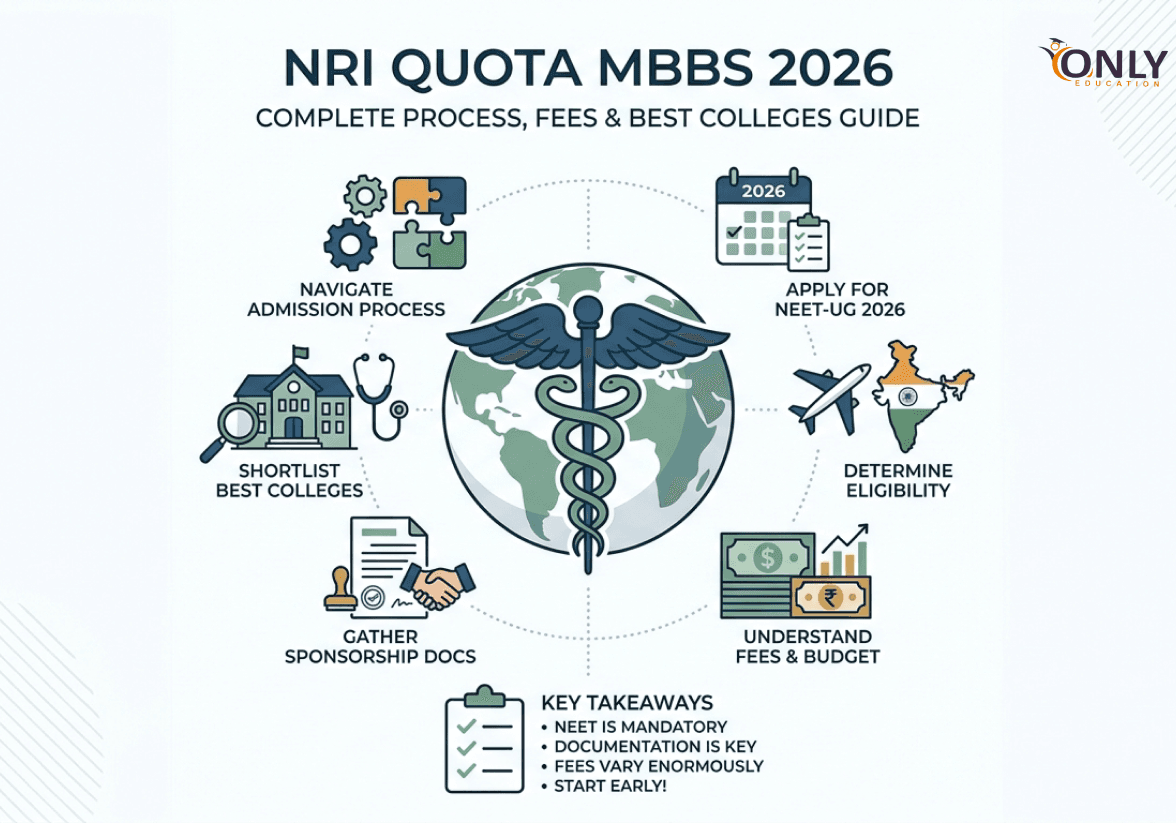
Getting an MBBS seat in India through the NRI quota can feel like navigating two systems at once Indian medical counselling and your own family's overseas paperwork. If you're a Non-Resident Indian, an OCI/PIO cardholder, or a "ward of NRI" trying to make sense of NEET eligibility, fee structures, and which deemed university actually delivers value for the money, this guide walks through the entire NRI quota MBBS 2026 process from eligibility to final admission with real fee ranges, not vague estimates.
What Is NRI Quota MBBS?
NRI quota MBBS is a reserved admission category, typically around 15% of total seats in private medical colleges and deemed universities, set aside for Non-Resident Indians, Overseas Citizens of India (OCI), Persons of Indian Origin (PIO), and Indian students sponsored by an NRI relative. It exists to give Indian-origin families living abroad a fair, defined route into Indian medical education.
The quota isn't a separate exam or a backdoor it's a parallel admission channel layered on top of the same NEET-UG requirement every other candidate faces. What changes is the fee structure (usually charged in USD), the sponsorship documentation, and in many colleges, a comparatively relaxed cutoff.
Who Counts as an "NRI" for This Quota?
- NRI (Non-Resident Indian): An Indian citizen who has lived abroad for employment, business, or education for a specified period.
- OCI (Overseas Citizen of India): A foreign citizen of Indian origin holding an OCI card.
- PIO (Person of Indian Origin): Largely merged into the OCI scheme now, but some older documentation still uses this term.
- Ward of NRI: An Indian-domiciled student whose parent, grandparent, or a defined blood relative is an NRI and agrees to sponsor the full course fee. This is the most common route families actually use.
How Does the NRI Quota Admission Process Work?
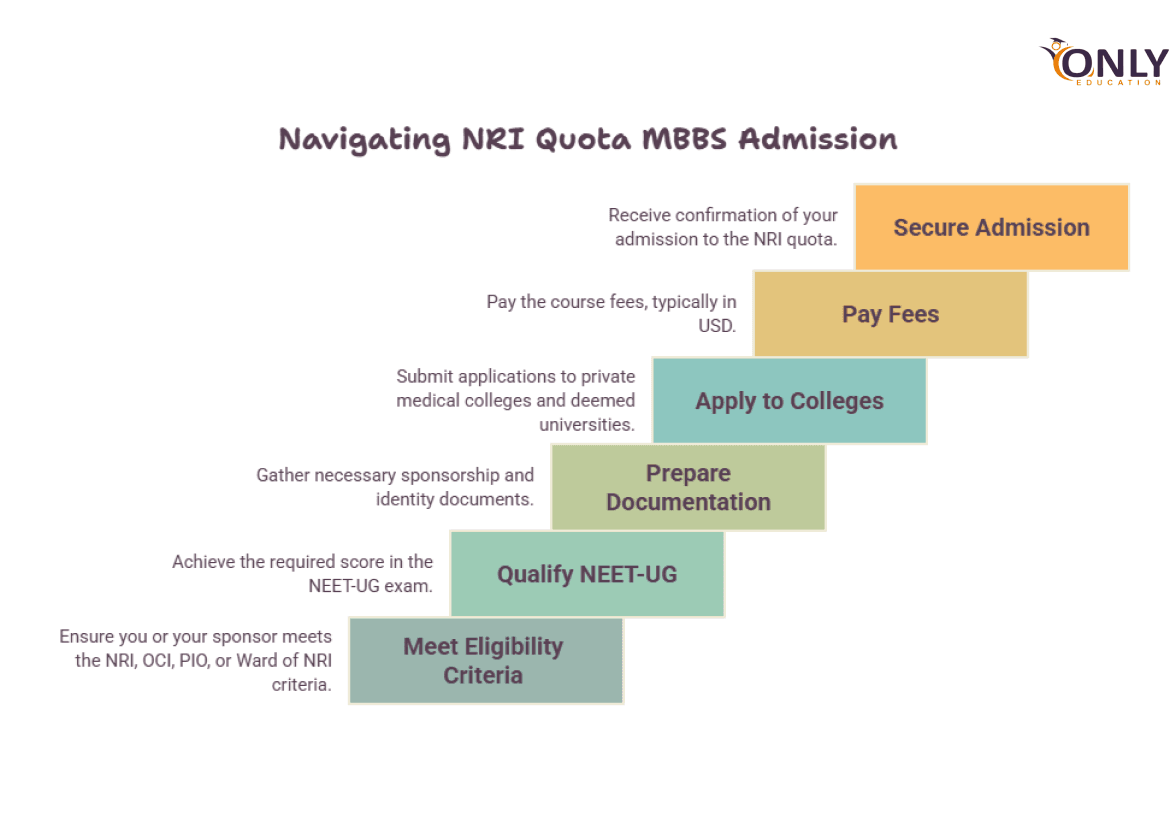
The NRI quota admission process runs alongside regular NEET-UG counselling: candidates first qualify NEET-UG, then register separately for NRI seats either through the Medical Counselling Committee (MCC) for deemed universities or through state-level NRI counselling for private colleges. The two tracks don't merge you may need to register on both portals depending on which colleges you're targeting.
In practice, three separate systems handle NRI seats:
- MCC (mcc.nic.in) for all deemed-to-be universities and central institutions with NRI seats.
- State counselling authorities such as DMER Maharashtra, KEA Karnataka, or Tamil Nadu's Directorate of Medical Education for private colleges' NRI quota within that state.
- Direct/management-linked NRI admission cells some deemed universities run their own NRI admission office alongside MCC counselling for document verification and sponsorship checks.
This is exactly why so many NRI families get confused: a seat at a Karnataka private college and a seat at a Karnataka-based deemed university can go through two entirely different counselling bodies, even though both colleges are in the same city.
Who Is Eligible for NRI Quota MBBS 2026?
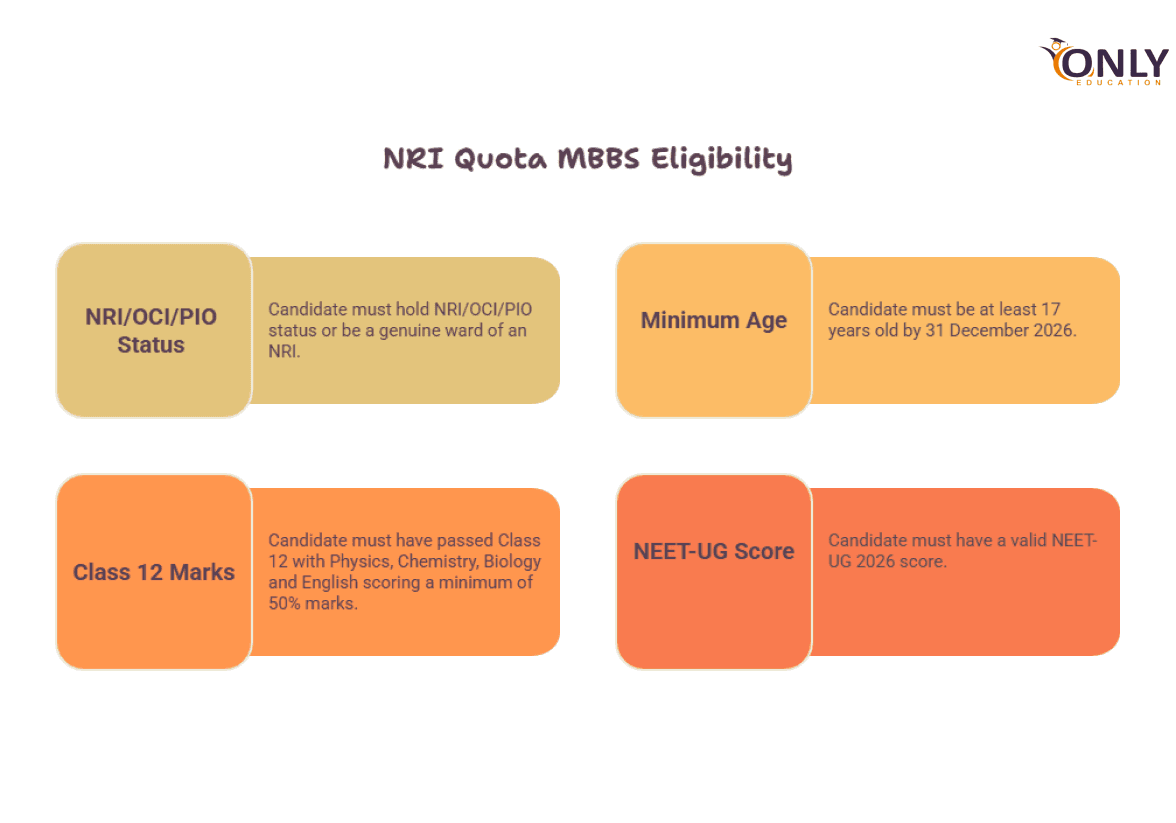
To be eligible for NRI quota MBBS 2026, a candidate must hold NRI/OCI/PIO status (or be a genuine ward of an NRI), be at least 17 years old by 31 December 2026, have passed Class 12 with Physics, Chemistry, Biology and English scoring a minimum of 50% marks, and have a valid NEET-UG 2026 score.
Eligibility checklist:
- Valid passport (candidate's own, or the sponsoring relative's, depending on the ward category)
- Class 12 with PCB/English, minimum 50% aggregate (45% for SC/ST/OBC in applicable states)
- Minimum age 17 years as of 31 December of the admission year
- Qualifying NEET-UG 2026 score at the applicable percentile
- Genuine blood-relation sponsorship proof if applying as a "ward of NRI" parent, grandparent, sibling of parent, or similarly defined relative depending on the college's policy
Ward of NRI clarification: If the student has grown up and studied in India but a parent works abroad, the student can usually still apply under the NRI quota as a "ward," provided the parent's NRI status is documented with passport and visa stamps, an employment or residence certificate, and often a notarized affidavit establishing the relationship. Colleges scrutinise this category closely because it's the one most prone to misuse.
Do NRI Quota Students Need a NEET Score?
Yes. Every NRI quota MBBS candidate must qualify NEET-UG in the admission year there is no exception, regardless of college type, state, or sponsorship status. NEET is the single national entrance exam for MBBS Colleges in India, and NRI quota does not bypass it; it only adjusts the fee structure and, in some cases, the qualifying threshold.
The minimum qualifying percentile for general-category NRI candidates is the 50th percentile (roughly 130–200+ marks out of 720, depending on the year's normalization), and the 40th percentile for SC/ST/OBC NRI candidates. Technically, any qualifying score makes you eligible but eligibility and admission chances are different things.
A realistic score expectation matters more than the bare minimum. Popular NRI-friendly deemed universities such as Kasturba Medical College Manipal, JSS Mysuru, SRM Chennai, and Amrita Kochi typically see competitive NRI applicants scoring 400–550+ marks, even though their technical cutoff is much lower. If you're aiming for a well-ranked college rather than just "a" seat, benchmark against actual admitted candidates, not the minimum eligibility line.
NRI candidates residing abroad can also take NEET-UG at international exam centres, including in the UAE, Qatar, Kuwait, Bahrain, Oman, Saudi Arabia, Nepal, Sri Lanka, Singapore, Malaysia, Thailand, and Nigeria so relocating to India solely for the exam isn't necessary.
NRI Quota MBBS Fees 2026 State & College-Wise
NRI quota MBBS fees in 2026 range from approximately ₹15–25 lakh per year in a handful of government college NRI seats to USD 25,000–85,000 per year (roughly ₹21 lakh to ₹70+ lakh) at private colleges and deemed universities, with the exact figure depending heavily on state, college ranking, and whether fees are regulated or not.
Three broad fee tiers exist:
- Government medical colleges with NRI seats (limited mainly Rajasthan, Maharashtra, Kerala, Punjab, Himachal Pradesh, Haryana, Puducherry): the cheapest route, sometimes ₹15–25 lakh/year, but seats are extremely scarce and NEET rank matters far more here.
- State-regulated private medical colleges: fee caps are enforced by a state fee regulation committee, typically landing in the ₹14–25 lakh/year range, though this varies widely by state.
- Deemed universities: these set their own fee structures independent of state fee caps, generally the most expensive tier, often USD 27,500–85,000/year depending on the institution's ranking and city.
Indicative State-Wise NRI Quota Fee Ranges (2026)
State/Category | Approx. Annual NRI Fee | Notes |
| Government colleges (Rajasthan, Kerala, Maharashtra) | ₹15–25 lakh | Very limited seats; NEET rank-driven |
| Karnataka mid-tier private | ₹14–20 lakh | KEA-regulated counselling |
| Karnataka top deemed universities | ₹22–35 lakh | MCC counselling, no state fee cap |
| Maharashtra private/deemed | ₹22–70 lakh | Wide range by ranking |
| Tamil Nadu deemed universities | USD 25,000–40,000/yr | Large number of deemed options |
| Punjab (unique model) | ~USD 20,000/yr equivalent | Fixed lump-sum for full course, comparatively affordable |
| Bihar private colleges | USD 25,000–35,000/yr | — |
Fee figures are indicative for 2026 and change annually always confirm the current-year fee circular directly with the college before applying.
What's Usually Included (and Excluded) in the Quoted Fee
- Tuition fee is the headline number, but colleges separately charge admission/registration fees, refundable caution deposits (often ₹1–2 lakh or equivalent), hostel and mess charges, and sometimes a one-time "development fee".
- NRI fees must generally be paid in USD via SWIFT transfer or from an NRE/NRO account, not domestic cash this is an RBI/FEMA compliance requirement, not a college preference.
- Refunds, where applicable, are typically credited only to NRO accounts.
NRI Quota MBBS Fees in Manipal 2026
Kasturba Medical College (KMC), Manipal a constituent college of Manipal Academy of Higher Education (MAHE), a deemed university charges NRI quota MBBS fees in the range of approximately USD 22,000 to USD 49,000+ per year depending on the fee circular in effect, with total course costs (including the internship year) often working out to USD 150,000–200,000 over the full 5.5-year program.
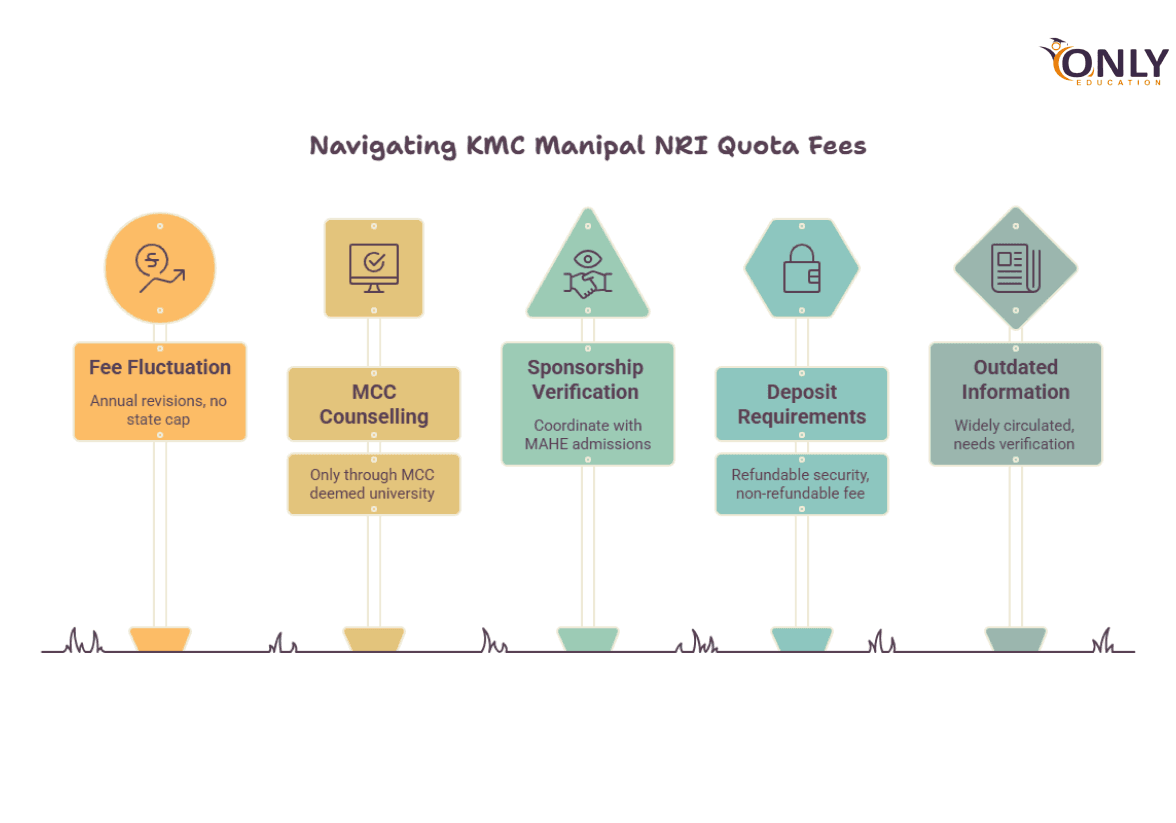
Reported figures for KMC Manipal's NRI quota vary by source and by year some circulars quote closer to USD 22,000–25,000/year, while others (reflecting a later or revised fee schedule) put Year-1 at around USD 49,000, with the total course fee near USD 197,000. This spread is normal for deemed universities, since fee structures are revised annually and aren't capped by any state authority.
Key points for Manipal specifically:
- 100% of KMC Manipal's 250 MBBS seats are filled through MCC Deemed University counselling there is no Karnataka state quota (KEA) route for this college.
- NRI applicants register on the MCC portal specifically under the "Deemed/Central University" counselling track and separately coordinate with MAHE's international admissions office for sponsorship document verification.
- A refundable security deposit (roughly ₹2 lakh for general category) and a non-refundable registration fee apply at the MCC stage.
- Because published NRI fee figures for Manipal genuinely differ across sources and years, always verify the current amount directly on apply.manipal.edu or with the KMC admissions office before budgeting this is the single most important step for this specific long-tail query, since outdated numbers circulate widely online.
How to Get an NRI Quota MBBS Seat in a Deemed University
To get an NRI quota MBBS seat in a deemed university, a candidate must qualify NEET-UG, register on the MCC portal under the deemed university counselling track, submit NRI/ward-of-NRI sponsorship documents for verification, participate in MCC's NRI-category choice filling and seat allotment rounds, and complete fee payment and document verification within the stipulated deadline.
Deemed universities are unique because, unlike private state colleges, their entire seat matrix, including the NRI quota portion, is filled centrally by MCC rather than by the state. That means:
- There's no separate "state NRI counselling" to register for if your target college is a deemed university.
- Choice filling happens on mcc.nic.in, where you select deemed universities and indicate the NRI category where prompted.
- Seat allotment is rank-based within the NRI applicant pool, not against the general merit list so an NRI-category NEET score that looks modest by open-category standards can still secure a seat.
- After provisional allotment, physical document verification at the college (or a designated centre) is mandatory before the admission is confirmed.
Practical tip: MCC runs Round 1, Round 2, a Mop-Up round, and often a Stray Vacancy round for deemed universities. NRI applicants who miss earlier rounds sometimes find better negotiating room or slightly relaxed cutoffs in the Stray Vacancy round, so it's worth staying engaged through the entire counselling calendar rather than exiting after Round 1.
Documents Required for NRI Quota MBBS Admission
Standard documentation includes the candidate's NEET-UG scorecard and admit card, Class 10 and 12 mark sheets, passport, proof of NRI/OCI/PIO status, a notarized sponsorship affidavit, and where the candidate is a "ward of NRI" an attested family tree and relationship certificate.
Checklist:
- NEET-UG 2026 admit card and rank/scorecard
- Class 10 marksheet (as date-of-birth proof) and Class 12 marksheet/certificate
- Transfer certificate and conduct/character certificate
- Valid passport (candidate and/or sponsoring relative)
- Visa and residence/employment proof of the sponsoring NRI relative
- NRI sponsorship affidavit, notarized
- Family tree certificate attested by a Tehsildar or equivalent authority (for ward-of-NRI cases)
- Embassy or consulate certificate confirming the sponsor's status, where required
- Passport-size photographs
- Category certificate (SC/ST/OBC), if applicable
- Income-tax or financial documentation of the sponsor, in some colleges
A note on the NRI certificate: Many state authorities and colleges require an NRI status certificate that is valid for only one year and must be renewed with updated proof of continued overseas residence plan document collection with this expiry window in mind, not just the admission deadline.
Step-by-Step Admission Guide
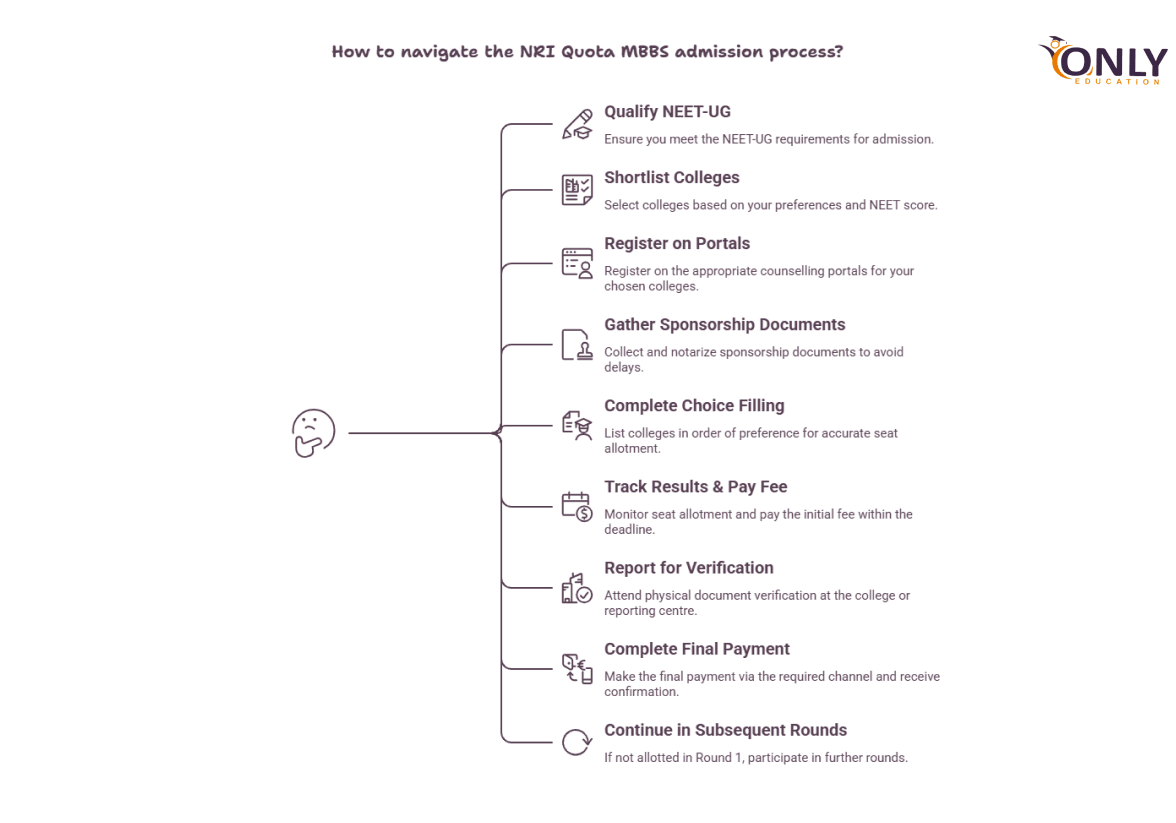
- Appear for and qualify NEET-UG 2026, at an Indian or an approved international exam centre.
- Shortlist colleges based on state vs deemed status, budget, and realistic NEET score expectations.
- Register on the relevant counselling portal(s) MCC for deemed universities, state portal(s) for private colleges in specific states.
- Gather and notarize sponsorship documents well before choice filling opens; this is the step most likely to cause delays.
- Complete choice filling, listing colleges in genuine order of preference under the NRI category.
- Track seat allotment results and, if allotted, pay the initial fee installment within the deadline to confirm the seat.
- Report for physical document verification at the college or the designated reporting centre.
- Complete final fee payment via the required USD/NRE-NRO channel and receive the admission confirmation.
- If not allotted in Round 1, continue in subsequent rounds (Round 2, Mop-Up, Stray Vacancy) rather than assuming the process is over.
Best Colleges for NRI Quota MBBS 2026
While there's no single "official" ranking of NRI quota colleges, the following deemed universities and private colleges are consistently popular with NRI families for their NMC recognition, clinical exposure, and structured NRI admission processes:
- Kasturba Medical College (KMC), Manipal MAHE deemed university, NIRF Top-10 medical college, 2,000+ bed teaching hospital.
- JSS Medical College, Mysuru well-regarded deemed university with strong clinical training infrastructure.
- SRM Medical College, Chennai established deemed university with a large, organised NRI admissions process.
- Amrita Institute of Medical Sciences, Kochi deemed university with modern facilities and consistent NRI intake.
- Sri Ramachandra Medical College, Chennai long-standing deemed university popular among Tamil Nadu-linked NRI families.
- Symbiosis Medical College for Women, Pune deemed university option in Maharashtra.
- GITAM Institute of Medical Sciences a newer but increasingly chosen deemed university for NRI seats.
When comparing colleges, weigh NIRF ranking, hospital bed strength and patient inflow (a proxy for clinical exposure), faculty-to-student ratio, NMC recognition status, and total cost of the full course not just the headline annual fee.
Government vs Private vs Deemed Comparison
Factor | Government (NRI seats) | Private Colleges | Deemed Universities |
| Seat availability | Very limited (select states only) | Moderate, state-regulated | Nationwide, larger NRI intake |
| Fee regulation | Government-set, lowest | State fee committee capped | Self-determined, uncapped |
| Typical annual fee | ₹15–25 lakh | ₹14–25 lakh (varies by state) | USD 27,500–85,000 |
| Counselling body | State counselling | State counselling authority | MCC (central) |
| NEET rank sensitivity | High competitive even within NRI pool | Moderate | Lower, but top colleges still competitive |
| Best suited for | Budget-conscious families with a strong NEET score | Mid-budget families wanting state-regulated fee certainty | Families prioritising brand, infrastructure, and pan-India acceptance |
Benefits of NRI Quota Admission
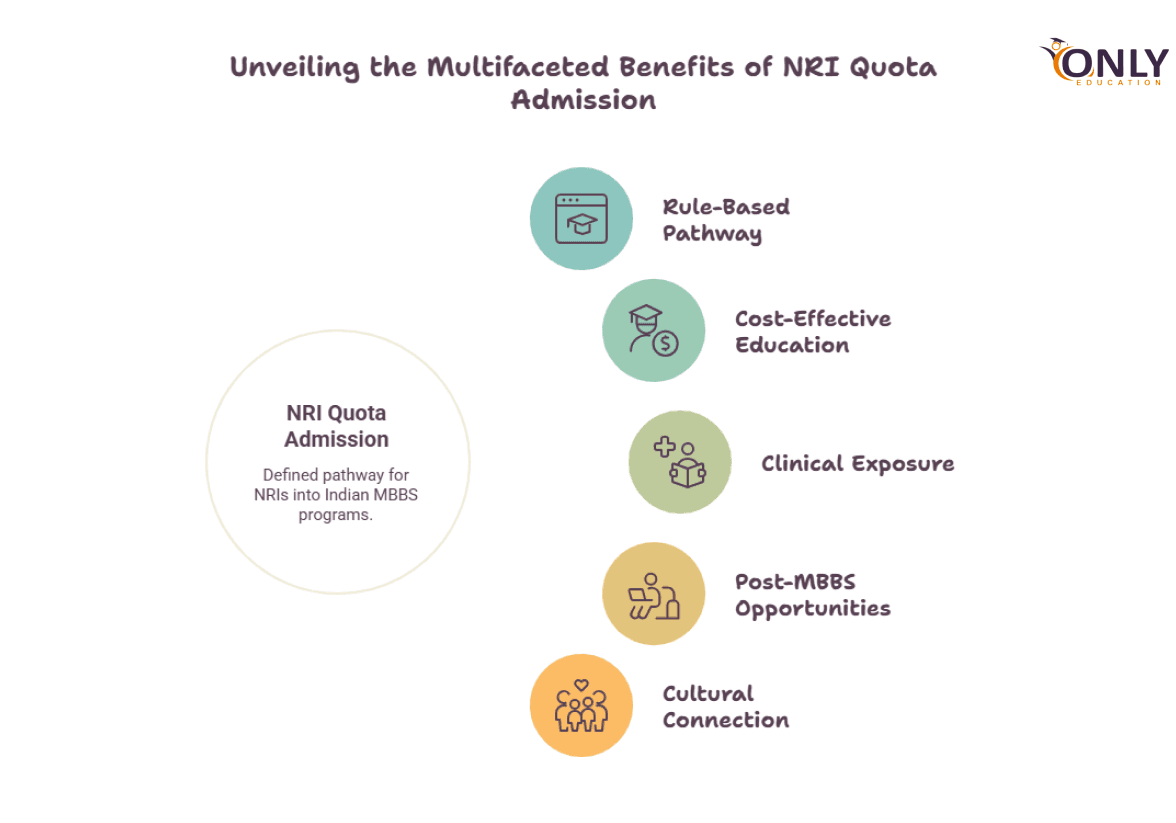
- A defined, rule-based pathway into Indian MBBS programs for Indian-origin students who studied or grew up abroad.
- Globally recognized MBBS degree at a fraction of the cost of medical education in the US, UK, or Australia.
- Access to India's clinical volume high patient inflow at teaching hospitals gives hands-on exposure that's harder to get in smaller foreign programs.
- Multiple post-MBBS pathways, including USMLE, PLAB, or AMC licensing routes for practicing abroad, alongside the option to work in India.
- Cultural and family connection many NRI families specifically want their children to train and, at least initially, live in India.
Common Mistakes to Avoid
- Assuming NRI quota bypasses NEET. It doesn't this is the most persistent misconception among first-time applicants.
- Missing state-specific counselling windows. In states like Karnataka, NRI quota counselling through KEA sometimes opens before general counselling missing that window is a common reason families lose access to a state's private-college NRI seats entirely.
- Incomplete or inconsistent sponsorship documentation. A mismatch between the affidavit, embassy certificate, and passport stamps is one of the top reasons document verification fails.
- Chasing brand name over value. A ₹10 lakh/year mid-tier private college and a ₹35 lakh/year deemed university don't necessarily differ proportionally in placement outcomes or license-exam pass rates evaluate clinical exposure and faculty quality, not just prestige.
- Working with unverified agents. Some intermediaries inflate fees, add undisclosed "processing charges," or steer families toward high-commission colleges rather than the best fit.
- Ignoring the NRI certificate's validity window. Letting a one-year NRI status certificate lapse mid-process can stall an otherwise-successful application.
Best Practices for a Smooth Admission
- Start document collection early sponsorship affidavits, embassy certificates, and family-tree attestations take weeks, not days.
- Target realistic NEET score bands for your shortlisted colleges rather than the bare minimum qualifying percentile.
- Compare fee-regulated private colleges against unregulated deemed universities before committing deemed universities aren't automatically "better," just differently priced.
- Register on every relevant portal (MCC and applicable state portals) if you're keeping both deemed and private-college options open.
- Verify current-year fees directly with the college, since published figures including for well-known institutions vary across sources and change annually.
- Stay through the full counselling calendar, including Mop-Up and Stray Vacancy rounds, before assuming a seat isn't available.
Future of NRI Quota Admissions in India
Fee transparency has become a bigger regulatory focus in recent years, with several state fee regulation committees actively capping private-college fees while deemed universities remain outside that oversight a gap that's likely to stay a point of policy discussion. Meanwhile, the number of NEET-UG international exam centres has expanded, making it progressively easier for NRI students to sit the exam without traveling to India. Expect continued growth in deemed-university NRI seat counts as more institutions attain deemed status, alongside tighter document-verification scrutiny of "ward of NRI" applications to curb misuse of the quota.
FAQs About NRI Quota MBBS 2026
1. What is the NRI quota MBBS fee in deemed universities?
NRI quota fees at deemed universities typically range from USD 27,500 to USD 85,000 per year, depending on the institution's ranking, city, and current fee circular always confirm the exact figure with the college directly, as deemed universities set their own fees without state caps.
2. Do NRI quota students need a NEET score?
Yes. Every NRI quota candidate must qualify for NEET-UG in the admission year; there is no MBBS admission route in India, including NRI quota, that bypasses NEET.
3. What is the NRI quota percentage in Indian medical colleges?
Private medical colleges and deemed universities generally reserve around 15% of total seats for NRI/OCI/PIO candidates and their sponsored wards, as per NMC guidelines.
4. Can a "ward of NRI" apply under the NRI quota?
Yes, if a parent or defined blood relative is a genuine NRI and agrees to sponsor the entire course fee, the Indian-domiciled student can apply as a ward of NRI, subject to notarized sponsorship documentation and family-tree attestation.
5. Does AIIMS have an NRI quota?
No, AIIMS has no general NRI quota across its campuses, with the exception of a small foreign-national seat allocation specifically at AIIMS Delhi; all other AIIMS seats are filled through the general NEET merit list.
6. What is the minimum NEET score required for NRI quota MBBS 2026?
The minimum qualifying threshold is the 50th percentile for general-category NRI candidates and the 40th percentile for SC/ST/OBC NRI candidates, though realistic admission to well-ranked colleges usually requires a meaningfully higher score.
7. Can NRI candidates take NEET-UG from outside India?
Yes, NTA conducts NEET-UG at international exam centres in countries including the UAE, Qatar, Kuwait, Bahrain, Oman, Saudi Arabia, Nepal, Sri Lanka, Singapore, Malaysia, Thailand, and Nigeria.
8. Which counselling body handles NRI quota seats in deemed universities?
The Medical Counselling Committee (MCC) handles NRI quota seat allotment for deemed universities and central institutions centrally through mcc.nic.in.
9. Are NRI quota fees paid in Indian Rupees or US Dollars?
NRI quota fees are typically required in USD, paid via SWIFT transfer or from an NRE/NRO account, in compliance with RBI/FEMA regulations, domestic cash payment is generally not accepted for this quota.
10. What documents are mandatory for NRI quota MBBS admission?
Mandatory documents include a valid passport, NEET-UG scorecard, Class 10 and 12 mark sheets, an NRI sponsorship affidavit, proof of the sponsor's NRI/OCI status, and for ward-of-NRI cases an attested family tree and relationship certificate.
11. Is the NRI quota MBBS fee the same every year?
No, NRI quota fees are revised annually by each college or deemed university and are not guaranteed to stay consistent. Candidates should verify the current fee circular before applying rather than relying on the previous year's figures.
12. Which states offer NRI quota seats in government medical colleges?
States including Rajasthan, Maharashtra, Kerala, Punjab, Himachal Pradesh, Haryana, and Puducherry offer a limited number of NRI seats in government medical colleges, generally at significantly lower fees than private or deemed institutions.
Conclusion
The NRI quota MBBS 2026 pathway gives Indian-origin families abroad a legitimate, structured route into Indian medical education but it rewards preparation. NEET-UG is non-negotiable, sponsorship documentation is where most applications stumble, and fee figures for even well-known colleges like Manipal genuinely vary by source and year. The families who navigate this smoothly are the ones who start documentation early, register on the correct counselling portal for their target college type, and verify current fees directly with the institution rather than relying on last year's numbers.
Planning your NRI quota MBBS 2026 application? Start by shortlisting 8–10 colleges across government, private, and deemed categories based on your realistic NEET score band, then begin sponsorship document collection immediately. It's the step with the longest lead time and the one most likely to delay an otherwise strong application.