
CAT 2026 Preparation Guide: Pattern, Syllabus, Strategy and Mock Plan


Quick answer
CAT 2026 is a computer-based test with 68 questions, 204 marks and three locked 40-minute sections: VARC, DILR and QA. It is conducted by IIM Indore on Sunday 29 November 2026. The shortest route to a better score is not more content but better choices: pick the right passages and sets, learn the Level 1 basics of every Quant chapter, take mocks regularly and spend as long analysing each one as you spent taking it.
CAT 2026 at a glance
| Item | Detail |
|---|---|
| Conducting IIM | IIM Indore |
| Exam date | Sunday, 29 November 2026, three slots (8:30 am, 12:30 pm, 4:30 pm) |
| Mode | Computer-based, in about 170 cities |
| Registration | 3 Aug to 22 Sep 2026 (closed); fee payment to 24 Sep |
| Fee | Rs 2,700 (General, EWS, NC-OBC); Rs 1,350 (SC/ST/PwBD) |
| Admit card | From 6 November; downloadable until exam day Revised from 4 Nov |
| Official mock | Free on iimcat.ac.in, same interface, timer, and calculator as the real test |
| Result | Not fixed; 2025’s came 24 days after the exam (24 December) |
Who can take CAT

- Graduation with 50% marks (or equivalent CGPA) for General, EWS and NC-OBC; 45% for SC, ST and PwBD.
- Final-year students and those awaiting degree results can apply, provided they complete the degree requirements and submit the required proof.
- There is no upper age limit.
- Candidates with disabilities were given 53 minutes 20 seconds per section in 2025. Check the 2026 bulletin for the current provision.
CAT eligibility only lets you sit the exam. Each IIM sets its own admission criteria, so meeting the 50% bar does not guarantee a shortlist.
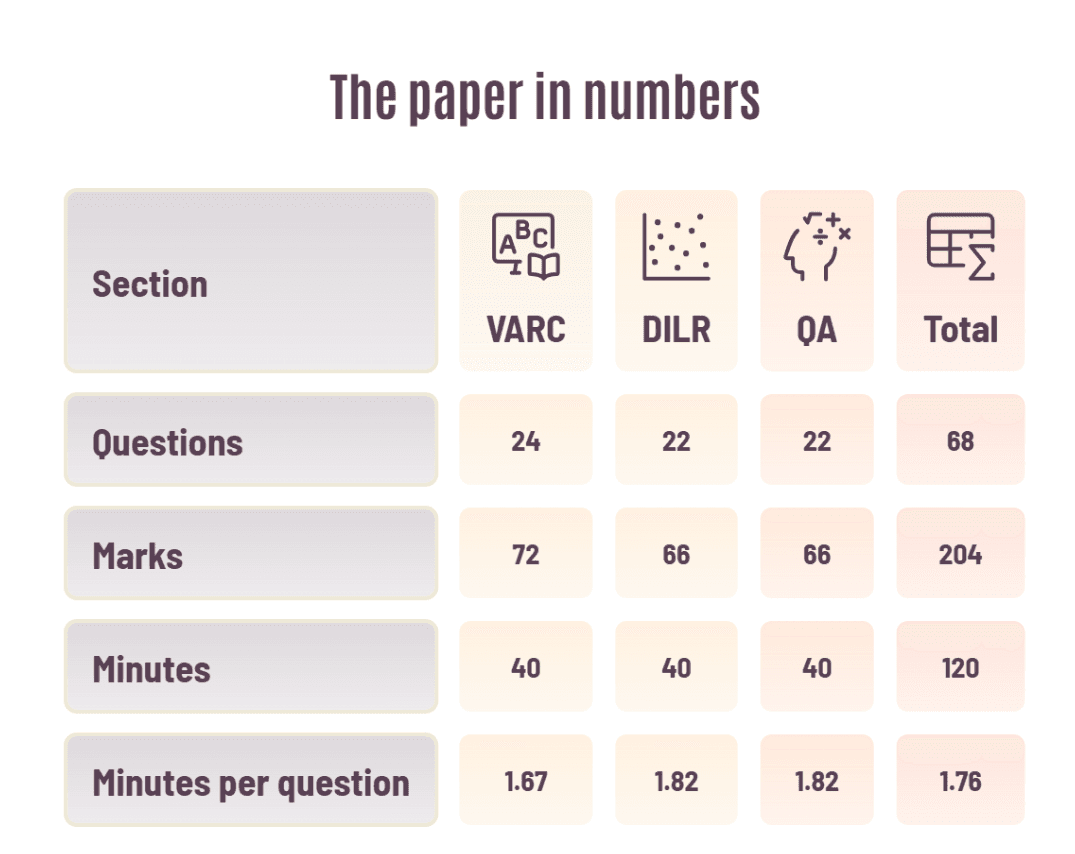
Minutes per question is our arithmetic. The order is fixed (VARC, DILR, QA) and you cannot move between sections or carry time forward.
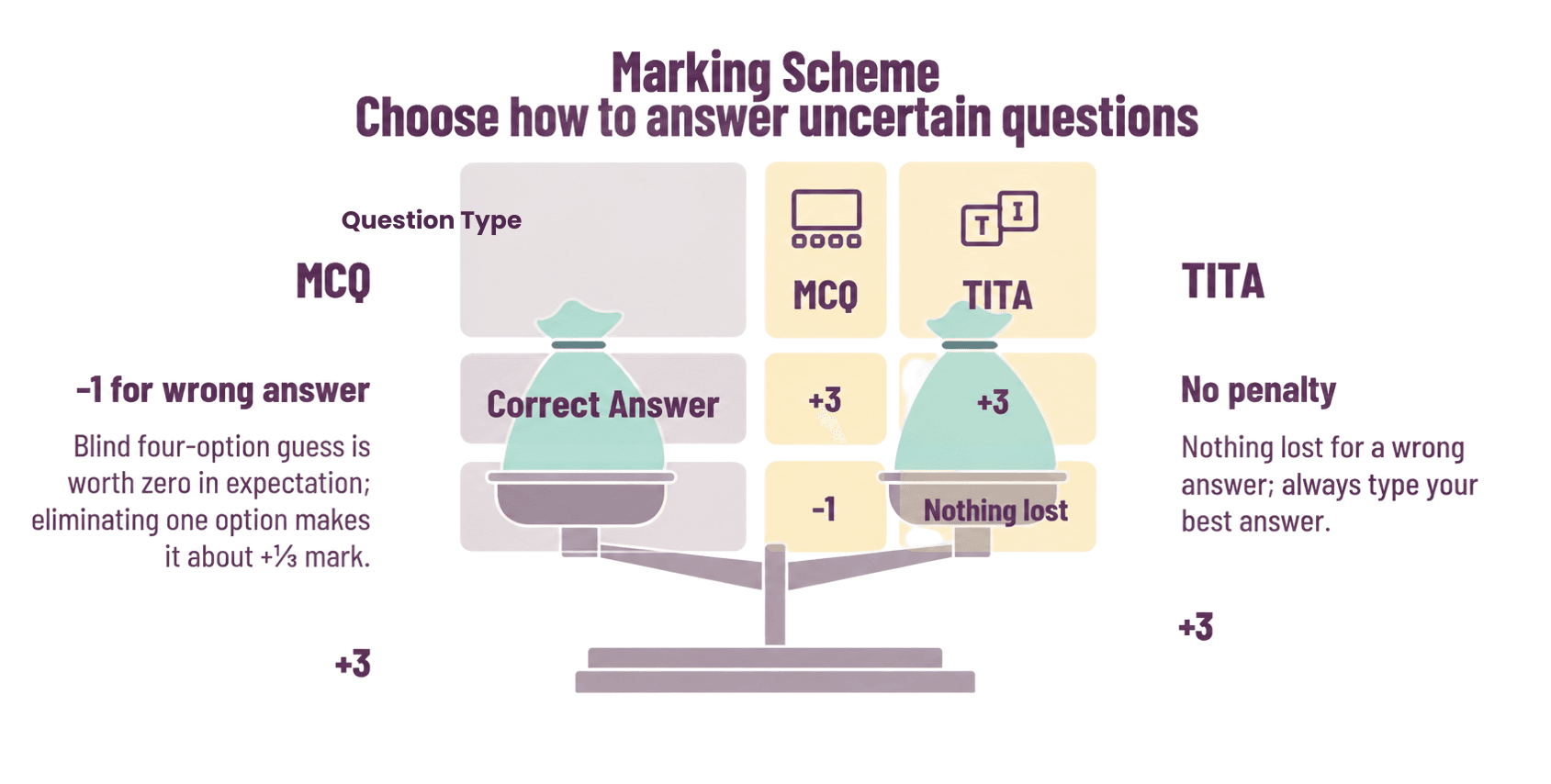
Marking. +3 for a correct answer, −1 for a wrong MCQ, and nothing lost for a wrong TITA (type-in-the-answer). With four options, a blind MCQ guess is worth zero in expectation (3 × ¼ − 1 × ¾). Eliminate one option and the same guess is worth about +⅓ mark. TITA has no penalty, so always type your best answer. Sources disagree on the TITA count (about 19 to 23 of 68), so do not plan around a number.
What CAT 2025 actually asked
CAT 2025 kept the 68-question format, and the topic split was broadly the same in every slot. Use it as a guide to priorities, not a prediction.
| Section | CAT 2025 pattern across slots |
|---|---|
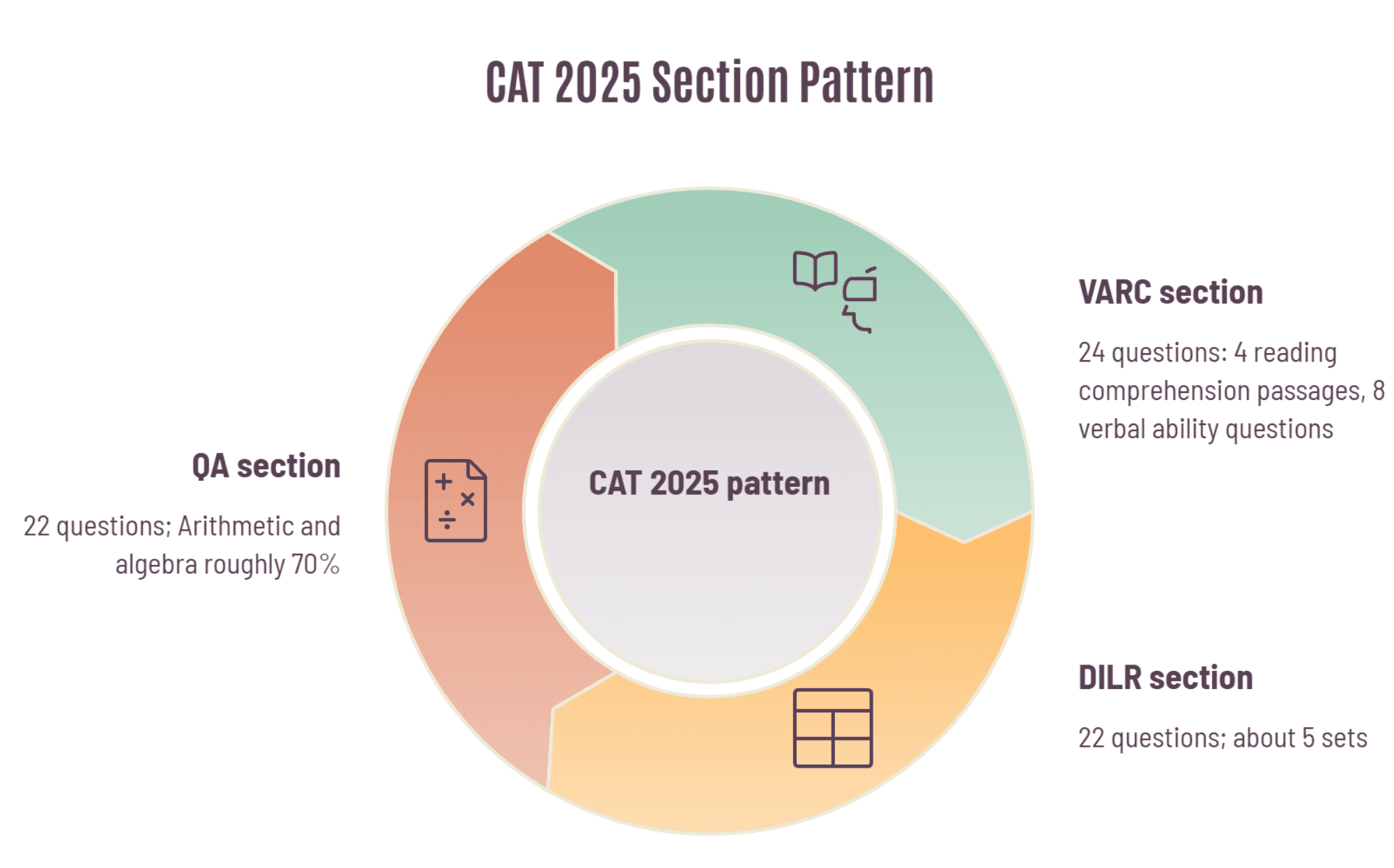
| VARC (24) | 4 reading comprehension passages = 16 questions (about two-thirds). 8 verbal ability questions: 2 each of para summary, para completion (MCQ), para jumbles and odd sentence out (TITA). Passages ran about 450–550 words and were inference-heavy; direct vocabulary questions were absent. |
| DILR (22) | About 5 sets: tables, graphs, arrangements, games and tournaments, distributions, Venn-type sets. Reported as the decisive section in most slots. |
| QA (22) | Arithmetic 8–10, Algebra 5–7, Geometry and mensuration 3–4, Number systems 1–2, Modern maths 1–4, depending on the slot and the analysis. About 7–9 TITA. |
Counts vary a little between analyses of the same slot, so we give ranges. Arithmetic and algebra together made up roughly 70% of QA.
Difficulty was rated moderate overall, with DILR the toughest section in several slots and QA or VARC in others. The pattern held in 2024 too: arithmetic was the largest QA share, and reading comprehension the largest VARC share. In other words, the weight sits where preparation is most learnable.
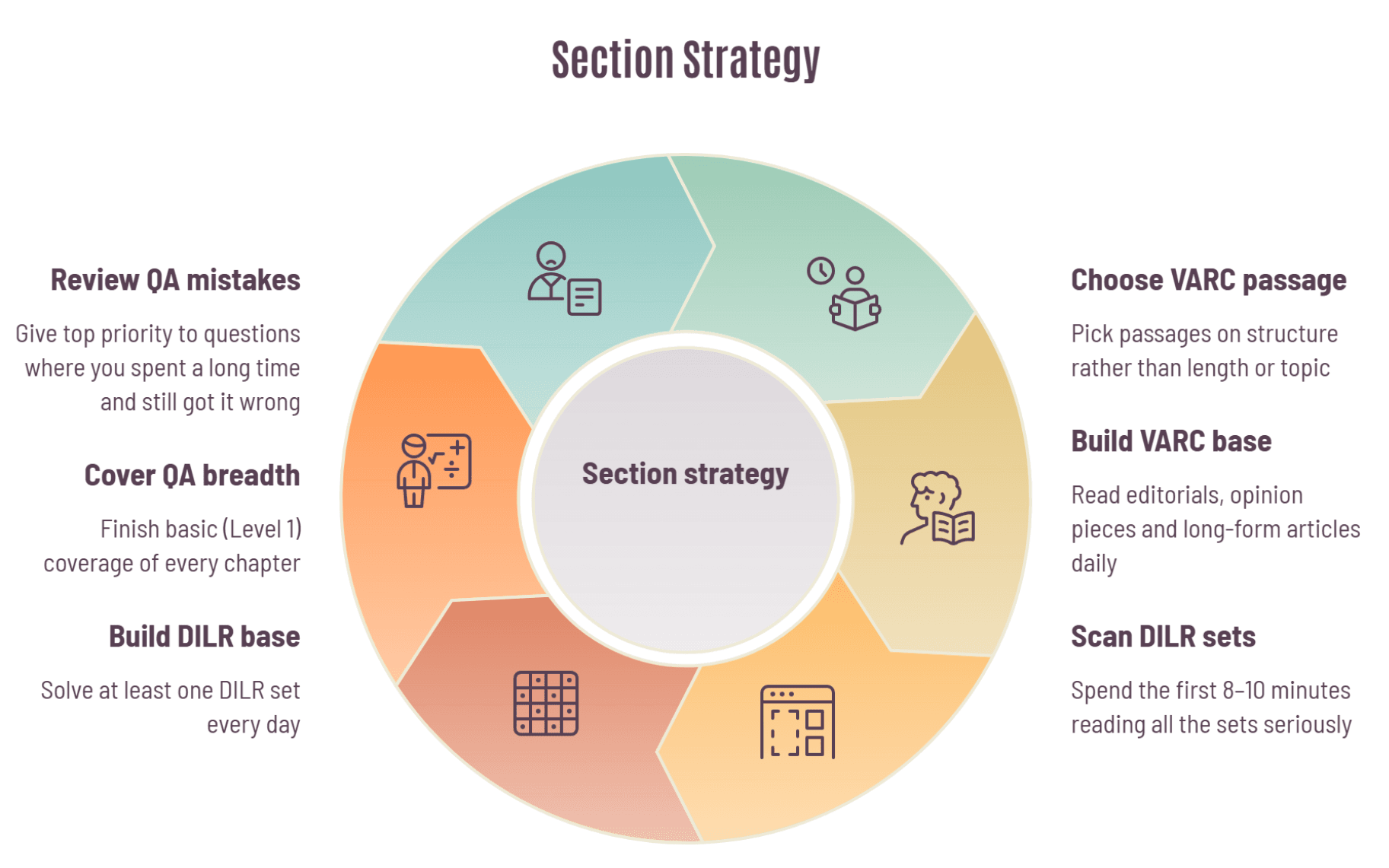
Section strategy
VARC: choose the passage by its structure
Pick passages on structure rather than length or topic. A long passage with a clear argument can be easier than a short abstract one. Start with the clearest, then a moderate one, and park any passage whose argument is still muddy after a careful read. For para summary, reject options that are too broad, too narrow, or add new information; for jumbles, look for mandatory pairs, pronouns, and the opening sentence; for odd sentence out, find the line that breaks the flow.
Build the base: read editorials, opinion pieces and long-form articles daily across economics, politics, science, psychology, history and art, and solve two RC passages a day. Aim to understand the author’s argument, not to read fast. Test your reading speed on a fresh passage every two weeks to make sure it is not slipping.
DILR: scan first, then commit
Spend the first 8–10 minutes reading all the sets seriously, enough to see the structure, the variables, and the likely entry point. A familiar topic can hide heavy casework, and a strange-looking set can be simple. If a set looks odd, give it 2–3 minutes to understand and leave once effort stops producing progress. Our arithmetic: 8–10 minutes is 20–25% of the section spent before the first answer, which is why the scan must be practised.
Build the base: solve at least one DILR set every day, and do not let mocks be your only DILR practice. Group sets by type (tables, arrangements, games, Venn, distributions) and track which types you tend to pick and finish.
QA: breadth first, then the expensive mistakes
Finish basic (Level 1) coverage of every chapter so you can attempt the easy and moderate questions from any area. Start with arithmetic and algebra, then geometry, number systems and modern maths. Use mocks to decide what to revise. Give top priority to questions where you spent a long time and still got it wrong, since they expose a knowledge gap and a time problem at once. Use options, estimation or simple values only when you understand why the shortcut works.
Where are you in the preparation?
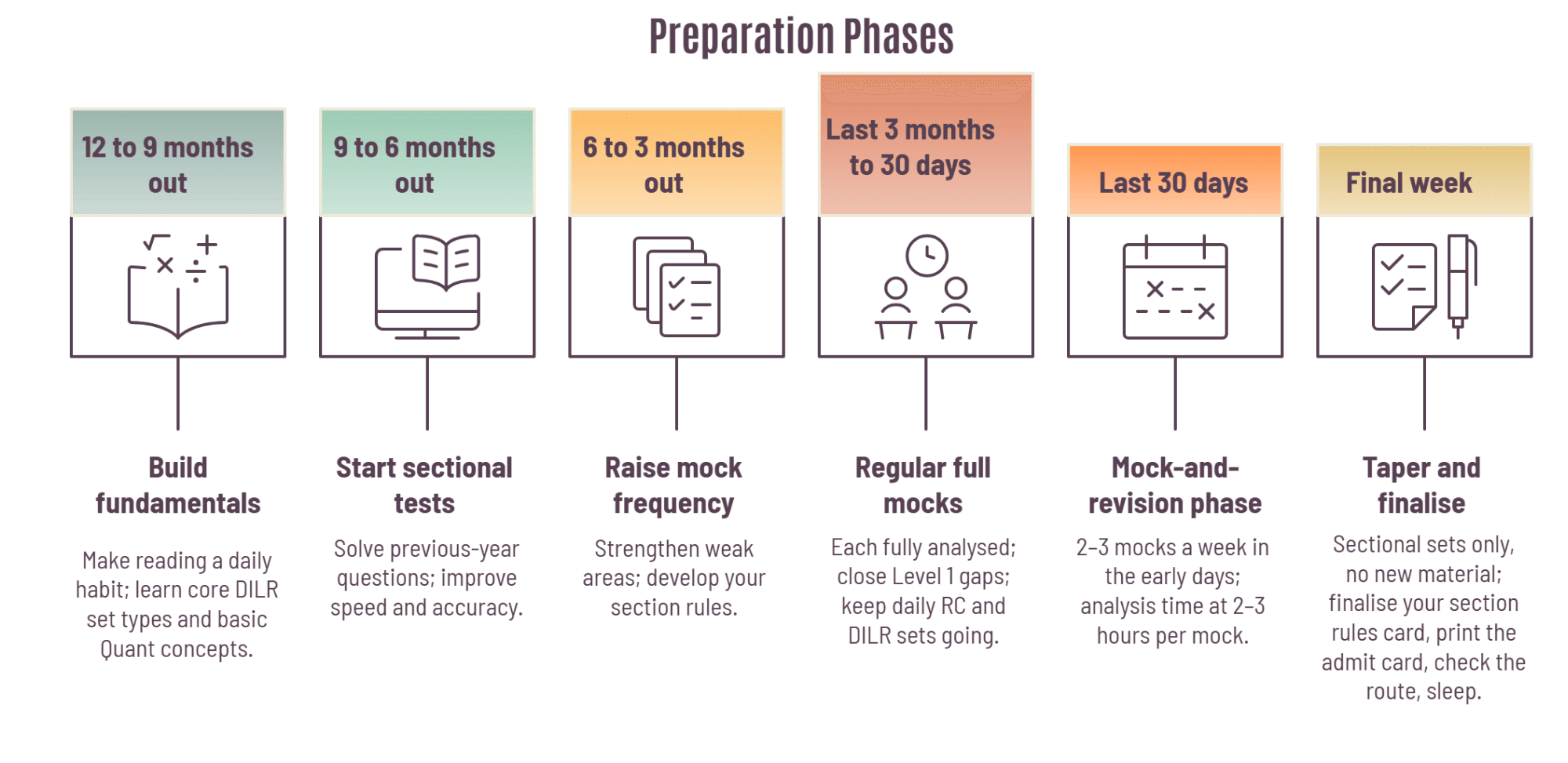
These phases are a general framework used by coaching and business-school guides. Adjust them to your starting point; none is official.
12 to 9 months out: Build fundamentals. Make reading a daily habit. Learn core DILR set types and basic Quant concepts.
9 to 6 months out: Start sectional tests. Solve previous-year questions. Improve speed and accuracy.
6 to 3 months out: Raise mock frequency. Strengthen weak areas. Develop your section rules.
Last 3 months to 30 days: Regular full mocks, each fully analysed. Close Level 1 gaps. Keep daily RC and DILR sets going.
Last 30 days: One coaching plan suggests 2–3 mocks a week in the early days, then sectional timed practice and a final mock-and-revision phase. Whatever your count, keep analysis time at 2–3 hours per mock.
Final week Taper: sectional sets only, no new material. Finalise your section rules card, print the admit card, check the route, sleep.
How many mocks? Estimates differ. One coaching guide suggests 20–25 full mocks for around the 85th percentile and 50+ for the 99th. In one study of two toppers, one took 28 mocks and the other 22. The consistent message is that analysis beats volume. Do not change your whole strategy after one bad mock, and do not treat any single mock score as your real percentile.
The mock routine that actually improves scores
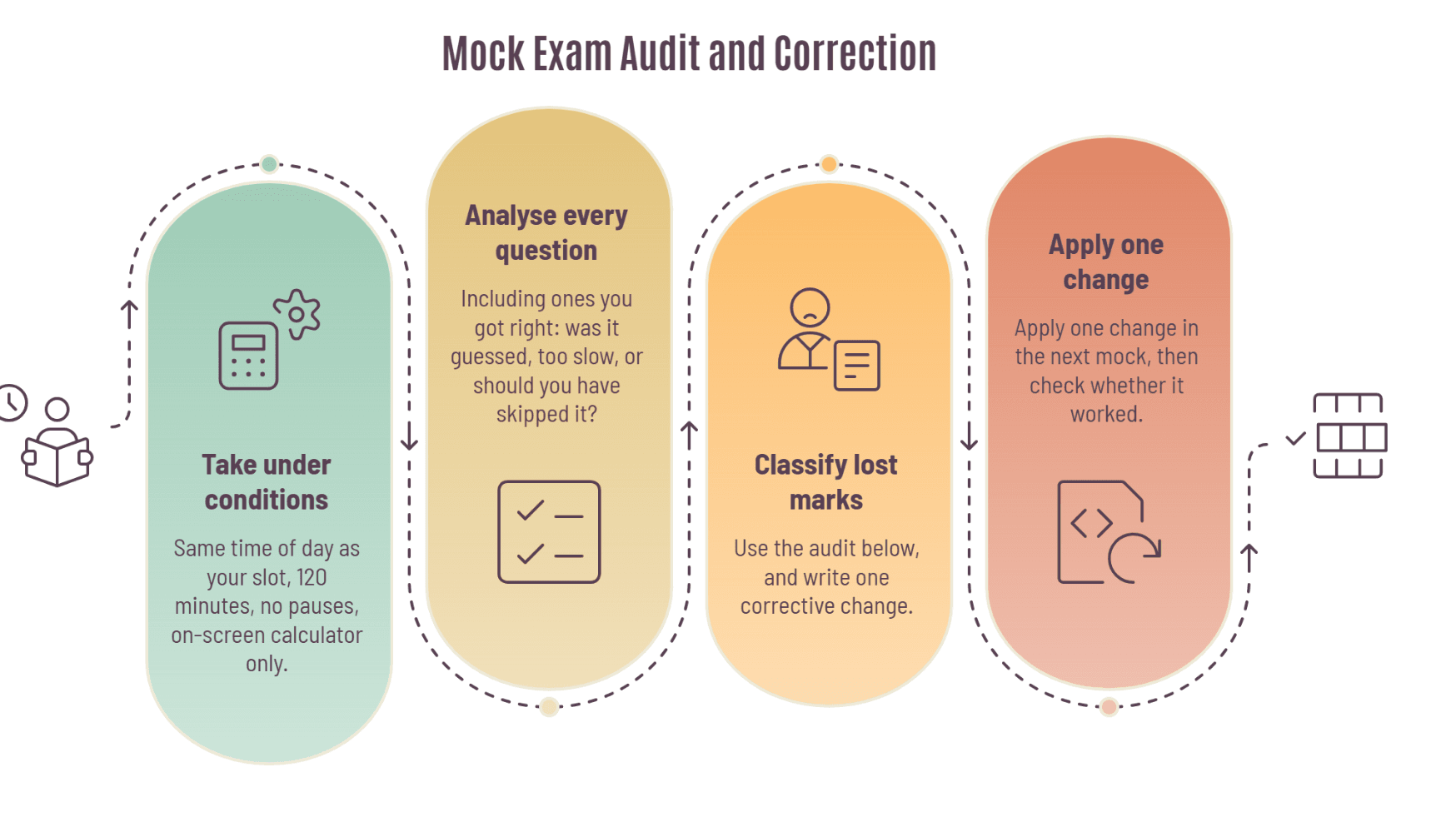
- Take it under exam conditions: same time of day as your slot, 120 minutes, no pauses, on-screen calculator only.
- Analyse every question, including ones you got right: was it guessed, was it too slow, should you have skipped it?
- Classify every lost mark using the audit below, and write one corrective change.
- Apply one change in the next mock, then check whether it worked.
| Cause | What it looks like | Fix |
|---|---|---|
| Conceptual gap | You did not know the method | Revise that topic from practice questions, then retest |
| Misreading | You solved a different question | Underline the ask on the scribble pad before solving |
| Calculation error | Right method, wrong number | Practise with the on-screen calculator; re-enter once on TITA |
| Rushing | You knew it; the clock scared you | Fix a leave-by time per question type |
| Poor selection | You picked a hard set or passage and stayed | Rank options in the first minutes; set a switch rule |
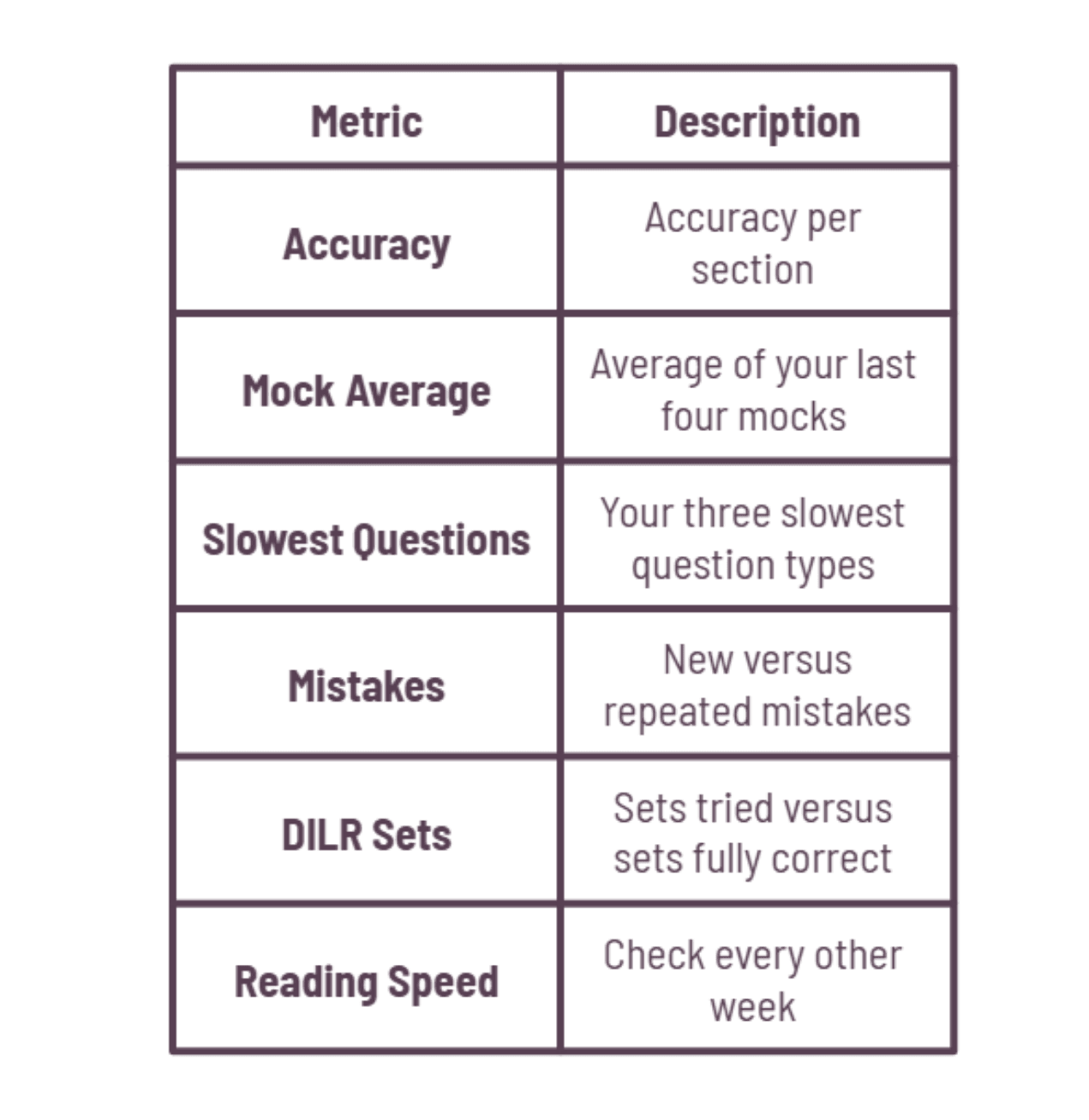
A weekly tracker. Fill one sheet every week: accuracy per section; the average of your last four mocks (one mock can mislead); your three slowest question types; new versus repeated mistakes; DILR sets tried versus sets fully correct; and a reading-speed check every other week. If your raw score holds but your mock percentile falls, the paper was probably harder, not your preparation worse.
Scores, percentiles and the crowd
Normalisation. CAT runs in three slots, so percentiles are computed from scaled scores that adjust for slot difficulty. The IIMs publish no marks-to-percentile table, so every figure below is an estimate.
- About 2.95 lakh registered and 2.58 lakh appeared in 2025. At that size, one percentile point is roughly 2,500 to 2,600 people (our arithmetic). Registration for 2026 was reported at about 2.84 lakh.
- CAT 2025 gave 100 percentile to 12 candidates and 99.99 to 26 more.
- Estimates for a 99 percentile in 2025 ranged from about 86 to 93 marks out of 204, depending on slot and source. One slot analysis put a 99 percentile at roughly 41–46 attempts with strong accuracy.
- Good-attempt ranges quoted for 2025 were about 14–17 questions in VARC (for 90+) and 9–13 in DILR (for 95+).
The lesson is consistent: high percentiles go to people who attempted around 40 questions well, not people who attempted 60.
After CAT: results, shortlisting and selection
Result: Not fixed for 2026. Reports range from the third week of December to the first week of January 2027; 2025’s came on 24 December.
Shortlisting: Each IIM shortlists using CAT percentile plus its own mix of academics (Class 10, 12 and graduation), work experience and diversity.
WAT and PI: A written ability test and a personal interview, with a group discussion at some institutes. Reports place these roughly between January and March 2027.
Final offer: Based on a composite score. Weightages differ by IIM: for example, one report lists CAT 25%, PI 50%, WAT/GD 10% and profile 15% for IIM Ahmedabad, and CAT 25%, PI 40%, WAT/GD 10% and profile 25% for IIM Bangalore.
Cut-offs also vary by IIM and category. The top three IIMs are generally reported to need about the 99th percentile or above, while many newer IIMs shortlist in the mid-90s (one report expects 94–95 for IIM Tiruchirappalli General, with lower cut-offs for reserved categories). Check each IIM’s own admission policy, since it changes every year.
Exam day
| Slot | Exam time | Reporting | Gate closes |
|---|---|---|---|
| 1 | 8:30 – 10:30 am | 7:00 am | 8:15 am |
| 2 | 12:30 – 2:30 pm | 11:00 am | 12:15 pm |
| 3 | 4:30 – 6:30 pm | 3:00 pm | 4:15 pm |
Reported by third parties. Your admit card has the final word.
- Bring the printed admit card and an original photo ID. In 2025, reports also listed two passport photographs; 2026 requirements are not confirmed in what we read.
- The IIMs say they have added face matching at select centres, alongside mobile jammers. Leave margin in your journey.
- No personal calculators; a basic on-screen one is provided. Slot and centre cannot be changed, according to sources.
- Write your section rules on paper before the day: when you leave a passage, a set or a question.
Before you rely on any date, open iimcat.ac.in and check. Several dates moved this cycle, and an article is a snapshot while the site is live. Topic splits, good-attempt ranges and percentile figures are estimates from coaching analyses of CAT 2025. Preparation phases, drills and arithmetic are ours. Figures are for the 2026 cycle unless marked 2025.