
CAT 2026: What Has Changed This Year? Fees, Dates, Pattern

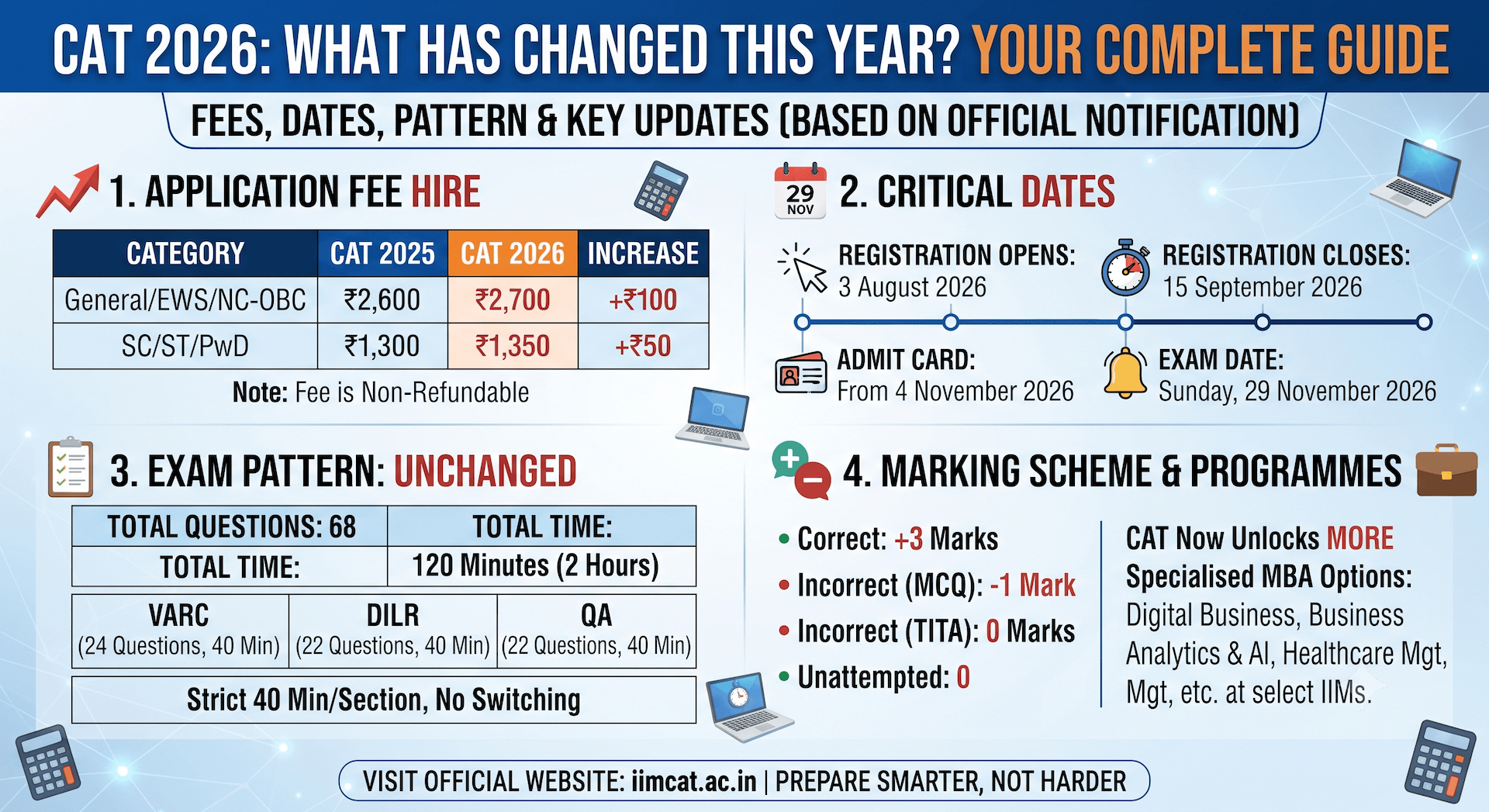
If you're planning to take the Common Admission Test 2026, the first question on your mind is probably simple: what's actually different this year? The CAT 2026 notification is out, and between a higher application fee, a confirmed exam date, and an expanding list of specialised management programmes, there's enough movement in this year's cycle to affect how you plan your preparation and application timeline.
The good news is that the core of CAT the exam that decides admission to the IIMs and hundreds of other B-schools across India hasn't been reinvented. The CAT 2026 exam pattern remains structurally the same as recent years, so your existing prep strategy still holds. What has shifted are the numbers around it: fees, dates, and the range of programmes CAT now unlocks.
This guide breaks down every confirmed change for CAT 2026, section by section, so you can register, prepare, and plan your B-school applications without missing a detail.
What Is CAT 2026?
CAT 2026 is the 2026 edition of the Common Admission Test, a national-level, computer-based management entrance exam that serves as the primary gateway into India's 21 IIMs and hundreds of other B-schools. It tests candidates on verbal ability, logical reasoning, data interpretation, and quantitative aptitude.
Every year, CAT is conducted by one of the IIMs on a rotational basis. For 2026, the exam falls on Sunday, 29 November, and continues to serve as the score that MBA aspirants across the country use to apply not just to IIMs, but to a widening list of institutes and specialised programmes that now accept CAT scores.
CAT 2026: What Has Actually Changed
The single confirmed change in the CAT 2026 notification is the application fee hike; everything else pattern, syllabus, and exam structure remains largely consistent with CAT 2025. Beyond the fee, the notification also confirms exam dates and a broader menu of programme options across participating IIMs.
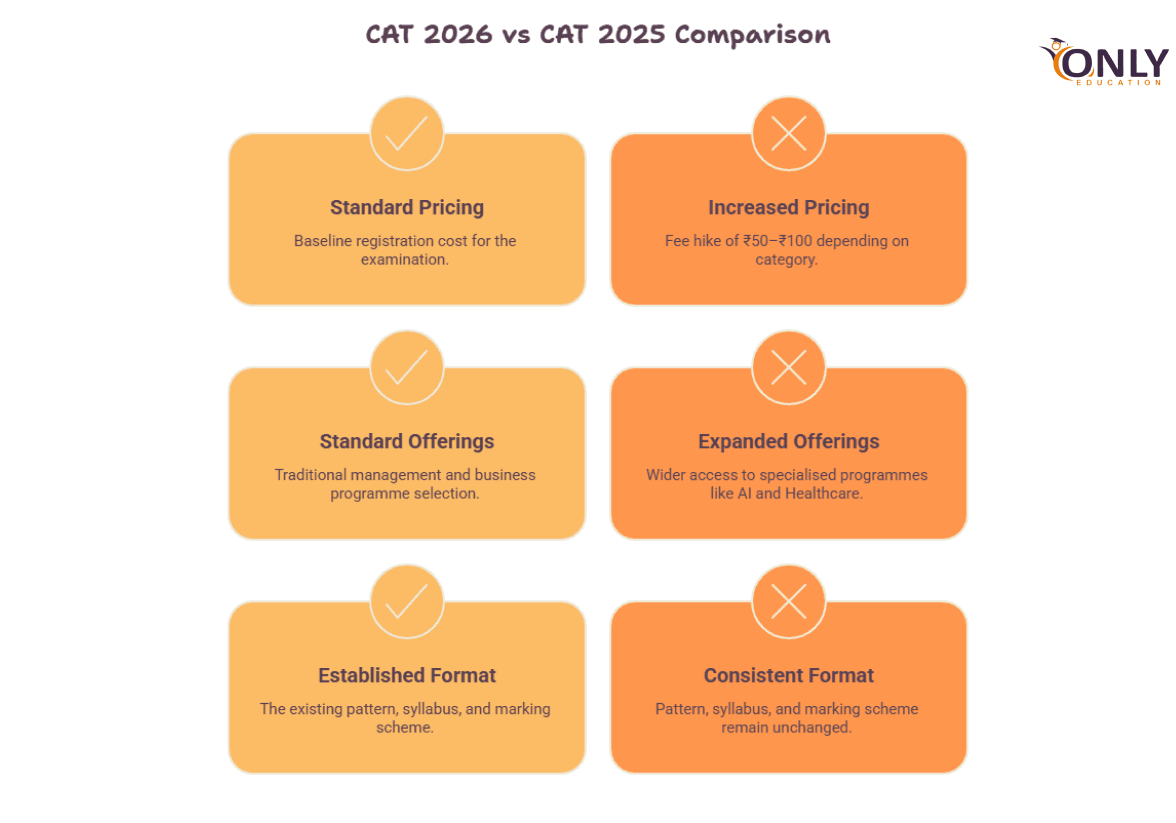
Here's the quick version before we go section by section:
- Application fee up by ₹50–₹100 depending on category
- Registration window: 3 August – 15 September 2026
- Exam date confirmed: 29 November 2026
- Wider access to specialised programmes (Business Analytics & AI, Digital Business, Healthcare Management, and more)
- Exam pattern, syllabus, and marking scheme remain unchanged
CAT 2026 Application Fee Full Breakdown
The CAT 2026 application fee is ₹2,700 for General, EWS, and NC-OBC candidates and ₹1,350 for SC, ST, and PwD candidates. This marks an increase from CAT 2025's fees of ₹2,600 and ₹1,300 respectively.
Category | CAT 2025 Fee | CAT 2026 Fee | Increase |
| ₹2,600 | ₹2,700 | +₹100 | |
| path, | ₹1,300 | ₹1,350 | +₹50 |
A few practical points to keep in mind:
- The fee is non-refundable, regardless of whether you sit for the exam.
- Payment is typically accepted via net banking, credit card, debit card, and UPI on the official portal.
- Always double-check your category selection before payment, since corrections after submission are usually not possible.
- The fee hike is modest in percentage terms, but it's still worth budgeting for alongside coaching, mock test series, and study material costs.
CAT 2026 Important Dates
Registration for CAT 2026 opens on 3 August 2026 and closes on 15 September 2026, with the exam scheduled for 29 November 2026. Admit cards are expected to be released in early November.
Event | Date |
| Registration Opens | 3 August 2026, 10:00 AM |
| Registration Closes | 15 September 2026, 5:00 PM |
| Admit Card Available | From 4 November 2026 |
| CAT 2026 Exam Date | 29 November 2026 (Sunday) |
| Result Declaration | First week of January 2027 |
| Score Validity | Till 31 December 2027 |
Applications are submitted exclusively on the official portal, iimcat.ac.in. Given the volume of candidates CAT attracts every year often exceeding two lakh registrations it's wise to complete your form well before the deadline rather than risk last-minute server congestion.
CAT 2026 Exam Pattern (Latest)
The CAT 2026 exam pattern follows the same structure as CAT 2025: a computer-based test with three sections, 68 questions, and a total duration of 120 minutes, with a strict 40-minute limit per section. Candidates cannot move between sections once the sectional timer starts, and time cannot be carried over from one section to the next.
Section-Wise Breakdown
Section | Expected Questions | Time Limit |
| Verbal Ability & Reading Comprehension (VARC) | 24 | 40 minutes |
| Data Interpretation & Logical Reasoning (DILR) | 22 | 40 minutes |
| Quantitative Aptitude (QA) | 22 | 40 minutes |
| Total | 68 | 120 minutes |
Key Structural Points
- Candidates must attempt VARC first, then DILR, and finally QA, in a fixed order with no switching between sections
- After the stipulated 40 minutes for a section are over, the screen automatically moves to the next section; no corrections or submissions are allowed after that.
- PwD candidates are granted additional time as per category-wise provisions.
- The exam includes both MCQs (Multiple Choice Questions) and TITA (Type-In-The-Answer, i.e., non-MCQ) questions across all three sections.
- VARC assesses command of English through reading comprehension passages and verbal reasoning tasks like para jumbles, sentence correction, and summary identification.
- DILR tests logical reasoning and data interpretation ability, while QA checks numerical and quantitative skills.
- The exam is conducted across multiple slots on the same day, and scores are normalised across slots to ensure a uniform assessment.
- An on-screen calculator is provided within the test interface, and candidates are permitted to leave questions unattempted rather than guess every one.
Note: CAT does not have a permanently fixed exam pattern; the conducting IIM reserves the right to adjust the number of questions, section order, or marking scheme each year. The breakdown above reflects the expected CAT 2026 pattern based on CAT 2025 and the official notification; always cross-check the final bulletin on iimcat.ac.in closer to the exam.
How CAT's Pattern Has Evolved
Until 2019, CAT had 100 questions across 180 minutes, with 60 minutes per section the longest and most comprehensive format the exam has used. From 2020 to 2023, the pandemic pushed IIMs to compress the exam to 120 minutes, and that shorter, sharper format has stuck. The total number of questions has also varied 76 in 2020, 66 in 2023, and 68 in 2024, showing that while the overall structure is stable, minor tweaks to question count do happen year to year.
CAT 2026 Marking Scheme
CAT 2026 awards +3 marks for every correct answer and deducts 1 mark for every incorrect MCQ response; TITA questions carry no negative marking. This keeps the total marks for the exam at 204.
Question Type | Correct Answer | Incorrect Answer | Unattempted |
| MCQ | +3 | −1 | 0 |
| TITA (Non-MCQ) | +3 | 0 | 0 |
Practical strategy implications:
- Since MCQs penalise wrong answers, only attempt them when you're reasonably confident otherwise, skipping is statistically safer than guessing.
- TITA questions carry zero risk for a wrong answer, so even an educated guess is worth attempting if you're close to the answer.
- Aiming for accuracy above 80% on attempted questions tends to protect your percentile better than maximising the number of questions attempted.
Eligibility Criteria for CAT 2026
To be eligible for CAT 2026, candidates need a bachelor's degree with at least 50% marks (45% for SC/ST/PwD candidates) from a recognised university. Final-year students and candidates with select professional qualifications can also apply.
- General, EWS, NC-OBC: Minimum 50% marks or equivalent CGPA in a bachelor's degree.
- SC, ST, PwD: Minimum 45% marks or equivalent CGPA in a bachelor's degree.
- Final-year undergraduates are eligible, provided they complete degree requirements by the deadline set by their target institute.
- Candidates holding or pursuing CA, CS, ICWA, or CMA qualifications are also eligible.
- There is no upper age limit for appearing in CAT; a candidate at any career stage can apply.
Reservation Norms for IIM Admissions
IIM admissions through CAT follow the Government of India's reservation policy, reserving seats for NC-OBC, SC, ST, EWS, and PwD candidates. The exact seat matrix can vary slightly by institute based on total intake.
Category | Reservation |
| NC-OBC (Non-Creamy Layer) | 27% |
| SC | 15% |
| ST | 7.5% |
| EWS | Up to 10% |
| PwD | 5% (horizontal, across categories) |
New-Age Programmes You Can Now Access via CAT
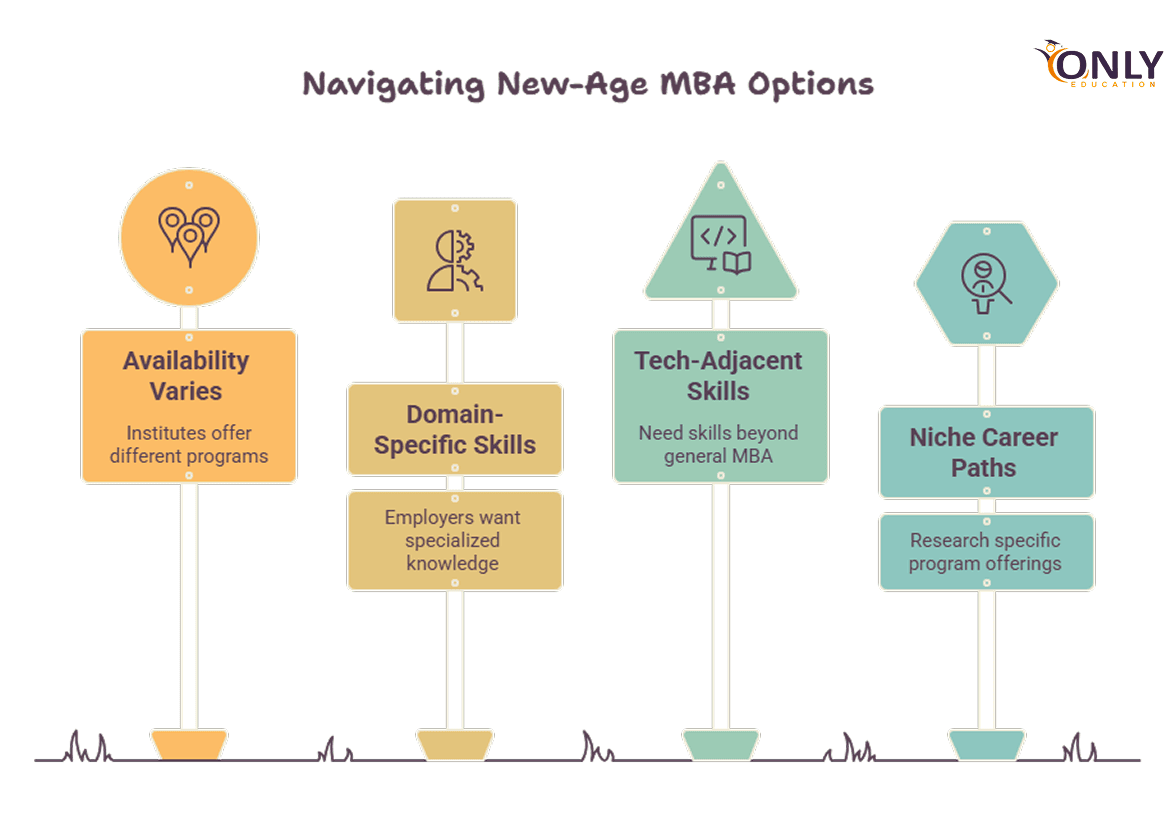
CAT 2026 continues to open doors beyond the classic two-year MBA, with IIMs expanding specialised, industry-aligned programme options. Availability differs by institute, so it's worth checking individual admission brochures before finalising your preference list.
Programmes now accepting CAT scores at various IIMs include:
- Business Analytics and AI
- Digital Business
- Healthcare Management
- Finance
- Sustainability
- Supply Chain Management
This shift reflects a broader trend in Indian management education: employers increasingly want graduates with domain-specific, tech-adjacent skills rather than a generalist MBA alone. If you're targeting a niche career path say, healthcare consulting or supply chain analytics it's worth researching which IIMs offer a dedicated programme rather than defaulting to the flagship MBA.
What Has NOT Changed in CAT 2026
There is no major change to the CAT exam pattern or syllabus for 2026 the exam continues to test the same three sections that have defined CAT for years. This is a reassuring constant for aspirants who've already built a preparation routine.
- Verbal Ability and Reading Comprehension (VARC)
- Data Interpretation and Logical Reasoning (DILR)
- Quantitative Aptitude (QA)
If you've been preparing with standard CAT material, previous years' papers, and mock tests built around this structure, you can continue that strategy without needing to relearn the exam from scratch.
CAT 2025 vs CAT 2026: Comparison Table
Parameter | CAT 2025 | CAT 2026 |
| General/EWS/NC-OBC Fee | ₹2,600 | ₹2,700 |
| SC/ST/PwD Fee | ₹1,300 | ₹1,350 |
| Number of Sections | 3 (VARC, DILR, QA) | 3 (VARC, DILR, QA) |
| Total Questions | 68 | 68 (expected) |
| Total Duration | 120 minutes | 120 minutes |
| Marking Scheme | +3 / −1 (MCQ), +3 / 0 (TITA) | +3 / −1 (MCQ), +3 / 0 (TITA) |
| Total Marks | 204 | 204 |
| Programme Options | Traditional MBA + select specialisations | Expanded specialisations across more IIMs |
| Test Cities | ~170 | ~170 |
How to Prepare for CAT 2026: Best Practices
Effective CAT 2026 preparation combines a fixed daily study routine, regular full-length mock tests, and disciplined sectional time management. Since the exam rewards accuracy over sheer speed, quality of practice matters more than volume.
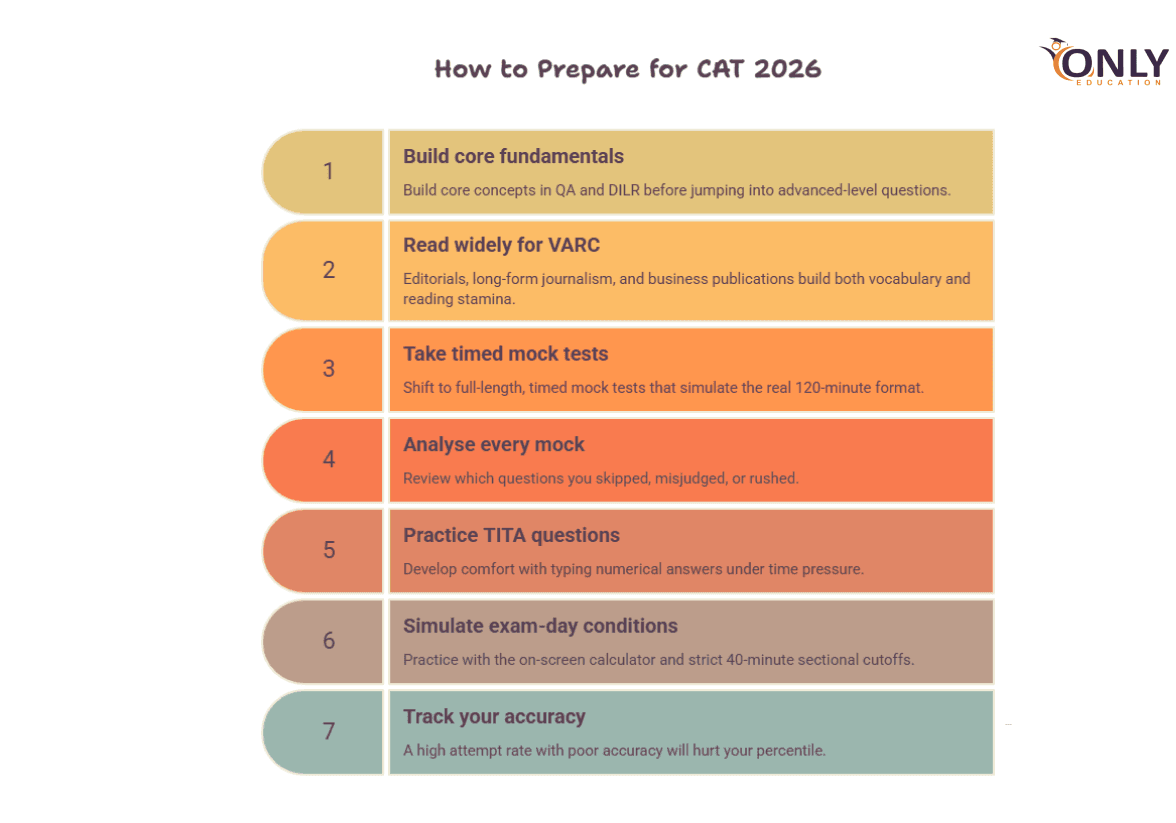
- Start with the fundamentals. Build core concepts in QA and DILR before jumping into advanced-level questions.
- Read widely for VARC. Editorials, long-form journalism, and business publications build both vocabulary and reading stamina.
- Take sectional mocks early, full mocks later. Once comfortable with individual sections, shift to full-length, timed mock tests that simulate the real 120-minute format.
- Analyse every mock thoroughly. Don't just check your score review which questions you skipped, misjudged, or rushed.
- Practice TITA questions deliberately. Since there's no negative marking, developing comfort with typing numerical answers under time pressure is a distinct skill worth building.
- Simulate exam-day conditions. Practice with the on-screen calculator, strict 40-minute sectional cutoffs, and no ability to revisit earlier sections exactly as the real test will run.
- Track your accuracy, not just attempts. A high attempt rate with poor accuracy will hurt your percentile more than a conservative, high-accuracy approach.
Common Mistakes CAT Aspirants Make
The most common CAT preparation mistakes are guessing on MCQs, ignoring weaker sections, and starting mock tests too late in the preparation cycle. Avoiding these missteps often matters more than chasing extra study hours.
- Random guessing on MCQs the −1 penalty adds up quickly across a 120-minute exam.
- Neglecting a weaker section in favour of a stronger one, which drags down overall percentile since all three sections carry sectional cutoffs at most institutes.
- Delaying full-length mocks until the final month, leaving no time to fix time-management issues.
- Skipping error analysis after mock tests, which means repeating the same mistakes.
- Underestimating VARC reading speed, especially for candidates from a strong quant/engineering background.
- Ignoring the application deadline and rushing the CAT 2026 registration form in the final days of the window.
Cost of Preparing for CAT 2026
Preparing for CAT 2026 can range from largely free (self-study with online resources) to ₹25,000–₹100,000+ for structured coaching, depending on the format and duration chosen.
- Self-study: Free to low-cost, using previous years' papers, YouTube content, and free mock test series.
- Online coaching programmes: Typically ₹10,000–₹40,000 for a full-length course with video lectures and mock tests.
- Classroom coaching: Often ₹40,000–₹1,00,000+, depending on the institute's brand and city.
- Mock test series (standalone): Usually ₹1,500–₹5,000 for a full series from leading test-prep providers.
- Application fee: ₹2,700 (General/EWS/NC-OBC) or ₹1,350 (SC/ST/PwD), on top of any coaching costs.
The right choice depends on your starting point candidates with strong fundamentals often do well with a mock-test-heavy, self-directed approach, while those needing structured guidance may benefit more from coaching.
Future of CAT: What to Expect Beyond 2026
CAT is likely to keep expanding beyond the traditional MBA gateway, with more IIMs offering specialised programmes and continued emphasis on computer-based, multi-slot testing at scale. The core three-section format has proven durable, so major structural change seems unlikely in the near term.
Expect continued incremental adjustments fee revisions, minor question-count tweaks, and a growing list of specialised programmes rather than a fundamental overhaul of what CAT tests or how it's delivered.
FAQs About CAT 2026
1. What is the CAT 2026 application fee?
The CAT 2026 application fee is ₹2,700 for General, EWS, and NC-OBC candidates and ₹1,350 for SC, ST, and PwD candidates, both non-refundable.
2. When does CAT 2026 registration open and close?
Registration opens on 3 August 2026 at 10:00 AM and closes on 15 September 2026 at 5:00 PM on iimcat.ac.in.
3. What is the CAT 2026 exam date?
CAT 2026 will be held on Sunday, 29 November 2026, in computer-based mode across three sessions.
4. Has the CAT 2026 exam pattern changed?
No. CAT 2026 is expected to follow the CAT 2025 pattern of 68 questions across three sections (VARC 24, DILR 22, QA 22) within a 120-minute test, 40 minutes per section.
5. What is the CAT 2026 marking scheme?
Correct answers earn +3 marks, incorrect MCQ answers deduct 1 mark, and TITA (non-MCQ) questions carry no negative marking, for a total of 204 marks.
6. How many sections are there in CAT 2026?
There are a total of three: Verbal Ability & Reading Comprehension (VARC), Data Interpretation & Logical Reasoning (DILR), and Quantitative Aptitude (QA).
7. Can I switch between sections during the CAT 2026 exam?
No, candidates must attempt VARC first, then DILR, then QA, with no switching allowed between sections once the sectional timer starts.
8. What is the minimum eligibility for CAT 2026?
A bachelor's degree with at least 50% marks (45% for SC/ST/PwD candidates), or final-year status with the degree completed by the admitting institute's deadline.
9. Is there an age limit for CAT 2026?
No, there is no upper age limit for appearing in CAT.
10. When will CAT 2026 results be declared?
Results are expected in the first week of January 2027, with scores valid until 31 December 2027.
11. How many test cities will CAT 2026 be held in?
CAT 2026 will be conducted in approximately 170 test cities across India.
12. Are new programmes available through CAT 2026?
Yes, beyond the traditional MBA, several IIMs now accept CAT scores for programmes in business analytics & AI, digital business, healthcare management, finance, sustainability, and supply chain management, though availability varies by institute.
Conclusion
CAT 2026 doesn't reinvent the exam; it adjusts the numbers around it. A modest fee hike, a confirmed exam calendar, and a wider spread of specialised programme options are the headline changes this year, while the exam pattern, marking scheme, and syllabus remain exactly what CAT aspirants have already been preparing for.
For candidates, that's largely good news: your existing prep strategy holds, but you now have more programme options to weigh once your score comes in. Use the confirmed dates above to plan your registration and mock-test schedule, and always verify the final details on the official CAT website before submitting your application.
Registration for CAT 2026 opens on 3 August 2026. Mark your calendar, start (or continue) your mock test practice, and visit iimcat.ac.in as soon as the registration window opens to avoid last-minute technical issues.
For better guidance and a clear understanding of the CAT admission process, reach out to OnlyEducation.