
JoSAA Round 3 Result 2026: IIT & NIT Seat Allotment Analysis

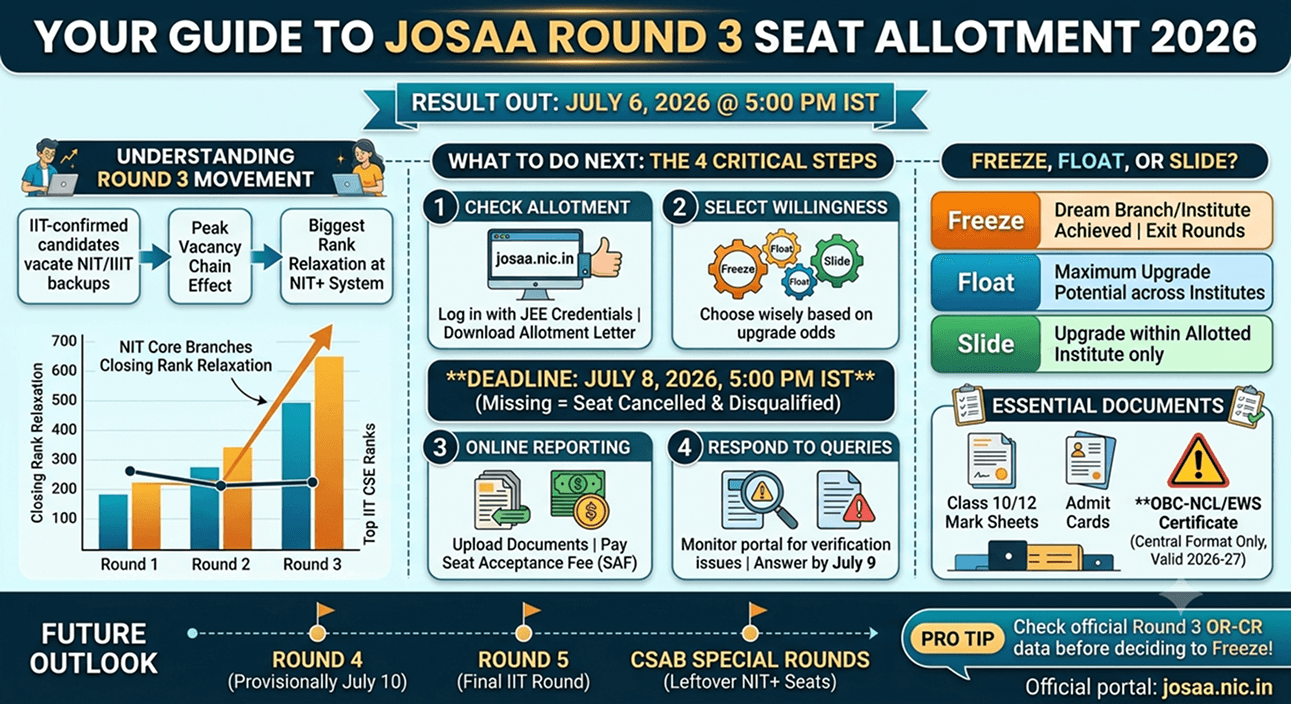
The JoSAA round 3 result 2026 was declared on July 6, 2026, at 5:00 PM IST, on the official portal, josaa.nic.in, and it's arguably the most consequential result in the entire five-round counselling cycle.
Introduction
The JoSAA round 3 result 2026 was declared on July 6, 2026, at 5:00 PM IST, on the official portal, josaa.nic.in, and it's arguably the most consequential result in the entire five-round counselling cycle. Round 3 is when the seat pool really starts to shift IIT-confirmed candidates vacate their backup NIT and IIIT choices, and that vacancy chain is what produces the year's biggest rank relaxations at the NIT+ system.
If you filled choices for JEE Main or JEE Advanced 2026, this is the round where your Round 2 "float" or "slide" selection either pays off with an upgrade or holds steady. This article walks through exactly how to check your result, what the opening and closing ranks tell you, the reporting steps you cannot afford to miss, and critically what happens if you don't respond within the window.
We've built this guide directly around what candidates are searching for right now, cross-checked against the official JoSAA schedule, so you get one place that answers the practical questions rather than sending you hunting across five tabs.
Key Takeaways
- Result date: JoSAA Round 3 Seat Allotment Result 2026 was released on July 6, 2026, at 5:00 PM IST.
- Reporting window: Online reporting document upload, willingness selection, and Seat Acceptance Fee (SAF) payment stays open from July 6 to July 8, 2026, 5:00 PM IST.
- Query deadline: Any document verification query raised by reporting officers must be answered by July 9, 2026, 5:00 PM IST.
- Biggest movement round: Round 3 typically delivers the sharpest closing-rank relaxation at NITs and IIITs, since IIT-bound candidates exit and free up their NIT backups.
- No response = seat lost. Missing the reporting deadline cancels your allotted seat and can remove you from further JoSAA rounds there is no grace period.
- Choices are locked. You cannot edit, add, or reorder your preference list during Rounds 1–5; refilling is possible only in CSAB Special Rounds.
- Five total JoSAA rounds are planned for 2026, with Round 4 provisionally expected around July 10, 2026, subject to confirmation.
What Is JoSAA Round 3 Seat Allotment?
JoSAA Round 3 is the third of five counselling rounds run by the Joint Seat Allocation Authority, which allots B.Tech and integrated seats at 23 IITs, IISc Bengaluru, 31 NITs, IIEST Shibpur, 26 IIITs, and dozens of government-funded technical institutes, covering 138 institutes in total for the 2026-27 academic year.
Round 3 allotments are generated from seats that opened up after Round 2 either because a candidate upgraded to a better seat, withdrew from counselling entirely, or failed to complete their reporting formalities in time.
Key entities involved:
- JoSAA (Joint Seat Allocation Authority): The central body coordinating IIT + NIT + system admissions.
- CSAB: Handles the NIT+ system query resolution and later runs special rounds for leftover NIT/IIIT/GFTI seats.
- Seat matrix: The institute-branch-category-quota grid against which every rank is matched.
- Opening rank / closing rank (OR-CR): The best and worst rank that got a seat in a given category-quota combination.
Candidates who chose Float or Slide after Round 2 remain "in play" for Round 3; those who chose Freeze are locked out of any further movement.
How Does JoSAA Round 3 Allotment Work?
JoSAA runs a computer-based matching algorithm every round that compares each candidate's locked preference list against available seats, ranked strictly by merit within each category and quota, then allots the best possible seat a candidate is eligible for among their still-active choices.
The mechanics, step by step:
- Seat pool refresh
Seats vacated through upgrades, withdrawals, or non-reporting in Round 2 are added back into the matrix.
- Preference matching
For every candidate still active (float/slide), the algorithm checks their locked choice list from top to bottom against the refreshed seat matrix.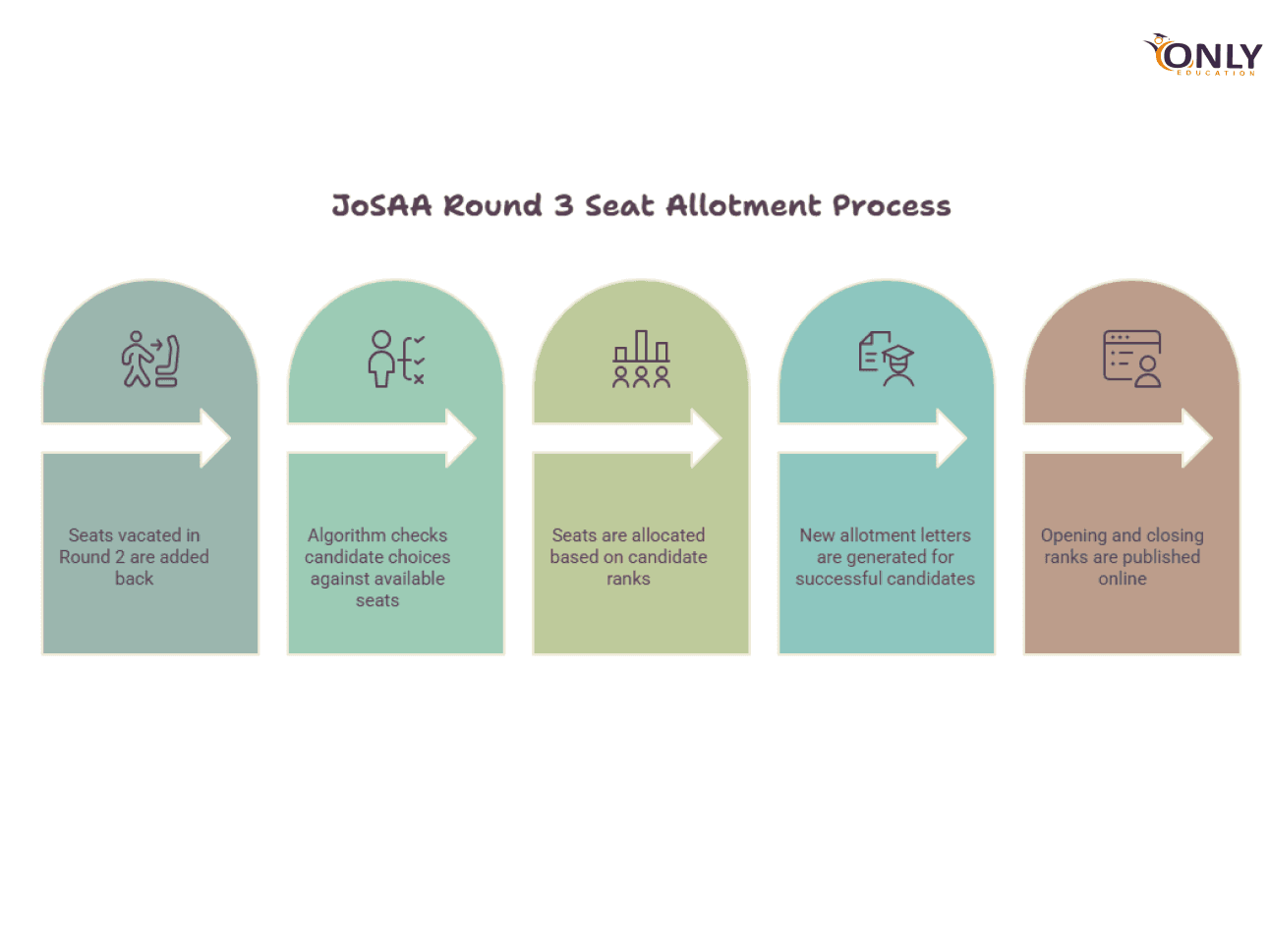
- Merit-based allocation
Within each institute-branch-category-quota cell, candidates are ranked purely by JEE Main CRL or JEE Advanced AIR (as applicable), and seats go to the best ranks first.
- Result generation
A fresh allotment letter is generated for every candidate who receives a seat, new or upgraded.
- OR-CR publication
Opening and closing ranks for every combination are published on josaa.admissions.nic.in, usually within hours of the allotment result.
Round 3 is the third of five counselling rounds, and it usually delivers the biggest jump in seat movement at NITs and IIITs, since IIT-allotted candidates typically confirm and exit in Rounds 1 and 2, freeing up their backup NIT/IIIT choices.
Why does IIT CSE barely move, but NIT ranks relax sharply?
At the top IITs, closing ranks for computer science stay almost flat across all five rounds because virtually every eligible candidate in that rank band wants that exact seat there's nobody left above them to vacate it. NIT seats behave differently: as IIT-allotted candidates confirm and exit, their NIT choices filled only as backups become available, producing genuine rank relaxation of roughly 8–15% by Round 3.
JoSAA Round 3 Seat Allotment: How to Check
Log in to josaa.nic.in with your JEE Main application number or JEE Advanced registration number and password, click "View Seat Allotment Result," and download your provisional allotment letter. The entire process takes under two minutes if your credentials are ready.
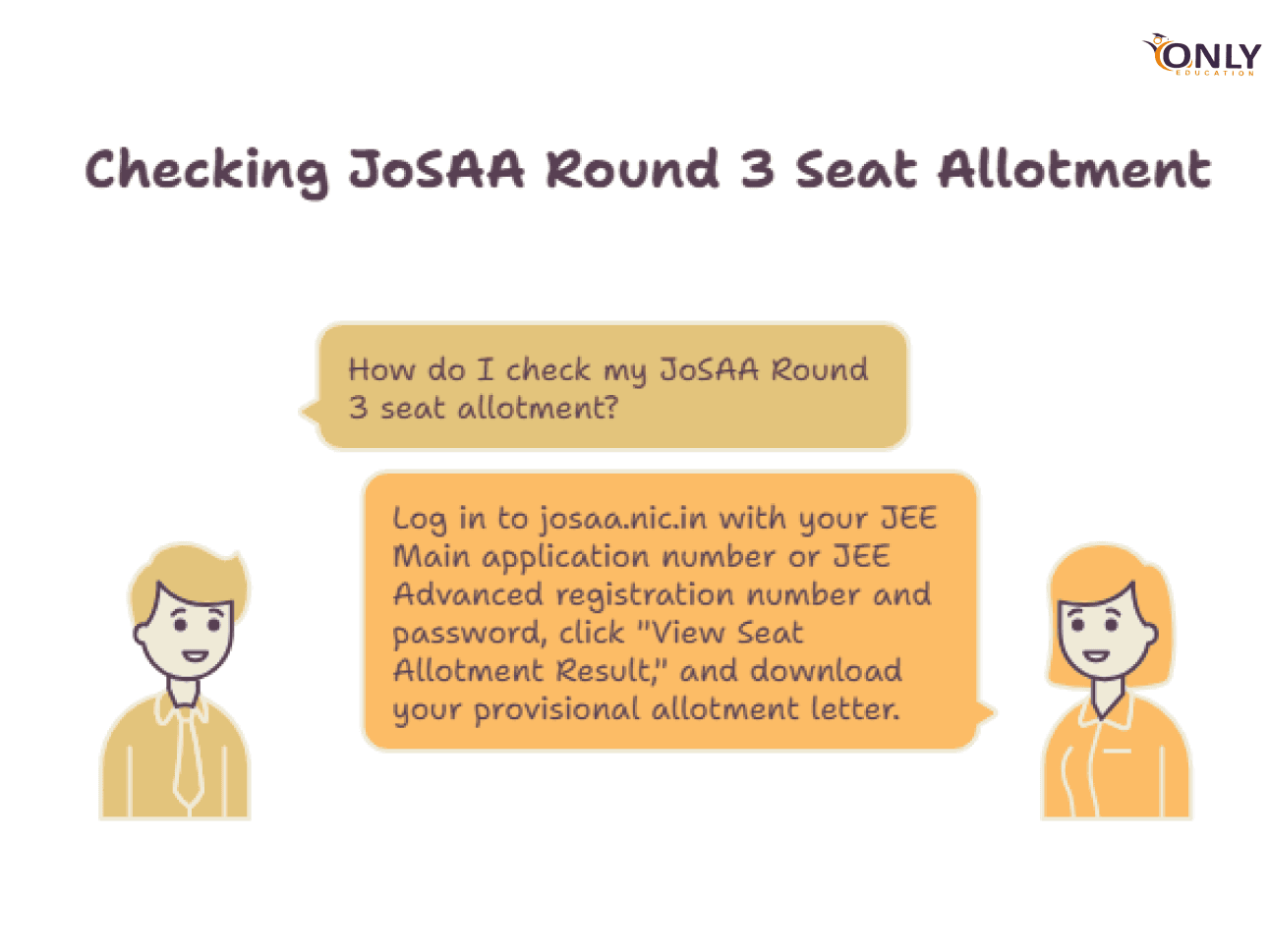
Step-by-step guide:
- Visit the official portal: josaa.nic.in.
- Locate and click the "View Seat Allotment Result" link on the homepage.
- Enter your JEE Main Application Number (or JEE Advanced Registration Number) and password.
- Complete the security PIN/captcha field.
- Your Round 3 allotment status will display: institute, branch, category, quota, and your opening/closing rank for that seat.
- Click "Download Allotment Letter" and save a copy; you'll need it for physical reporting.
- If allotted, proceed immediately to select your willingness option (freeze/float/slide) and begin online reporting.
If you see "No Allotment", you remain automatically eligible for Rounds 4 and 5 without any extra action; no re-registration is needed.
What to keep ready before logging in:
- JEE Main/Advanced application number and password
- A stable internet connection (server load peaks right after 5 PM on result day)
- Scanned copies of category/eligibility certificates, in case you're allotted a seat for the first time
JoSAA Opening & Closing Ranks Round 3: What Changed
Official Round 3 opening-closing ranks (OR-CR) for every institute, branch, category, and quota are published on josaa.admissions.nic.in alongside the allotment result; these are the only figures candidates should rely on for planning, since third-party estimates before the official release are approximations at best.
A few consistent patterns show up every year, and 2026 is no exception:
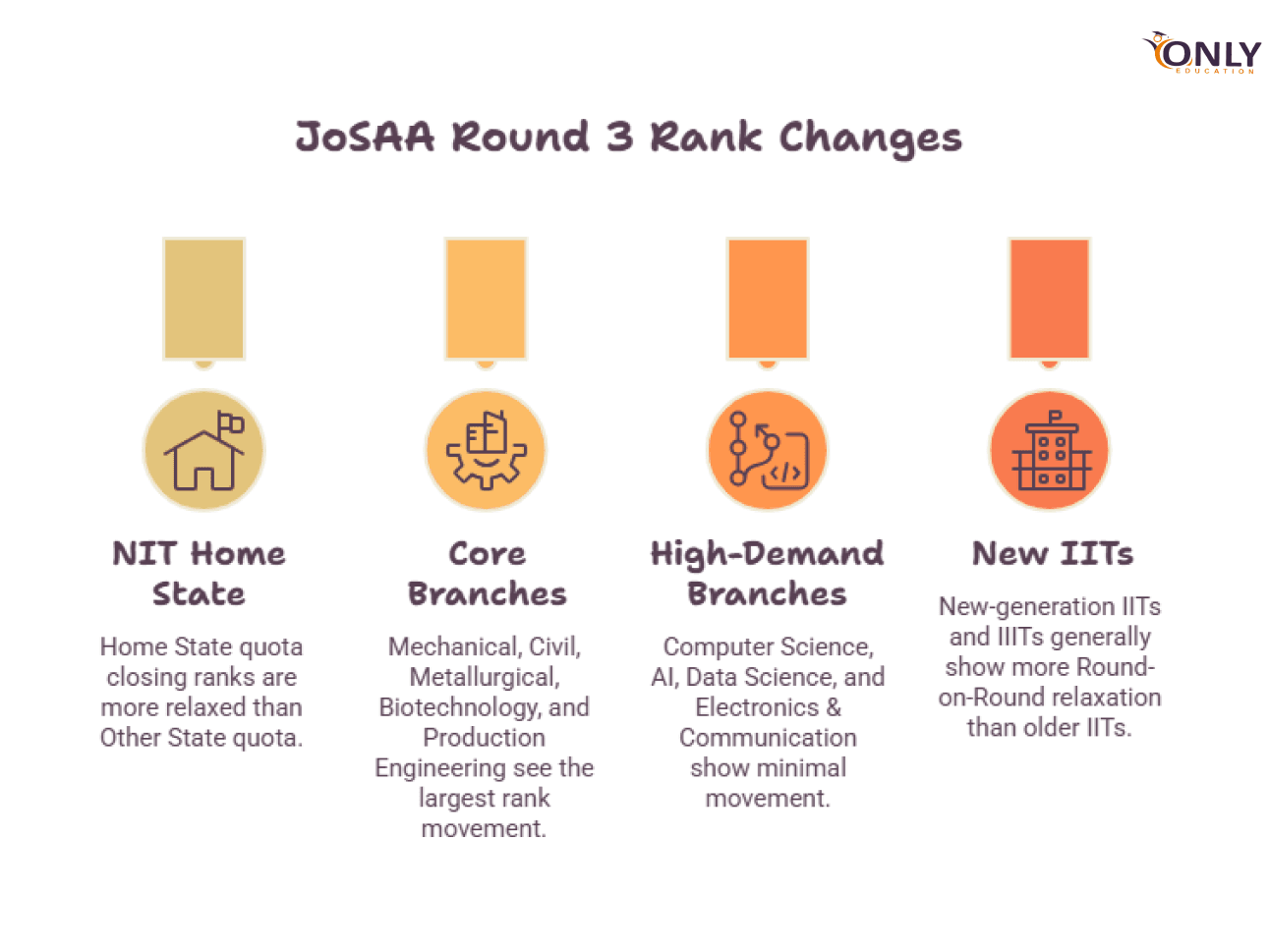
- NIT Home State quota closing ranks are typically 300 to 2,000 ranks more relaxed than the other state quotas for the same branch, depending on the institute and category.
- Core branches mechanical, civil, metallurgical, biotechnology, and production engineering see the largest rank movement between rounds because demand is comparatively lower.
- High-demand branches Computer Science, AI, Data Science, and Electronics & Communication show minimal movement across all rounds since near every eligible candidate in range prefers them.
- New-generation IITs and IIITs generally show more round-on-round relaxation than the older, "big five" IITs (Bombay, Delhi, Madras, Kanpur, and Kharagpur).
Compare your Round 3 closing rank against your Round 1 confirmed data (available on the official portal) to judge how much further relaxation, if any, is plausible in Rounds 4 and 5 before deciding to freeze.
Round 1 vs Round 2 vs Round 3: Cutoff Comparison
The table below illustrates the typical relaxation pattern seen historically as counselling progresses. Always cross-check with the live, official OR-CR data published on results day, since exact figures vary by branch, category, and year.
Institute Type | Round 1 Closing Rank Behaviour | Round 2 Movement | Round 3 Movement |
| Top IITs (CSE/EE) | Fixes almost immediately | Negligible | Negligible |
| Mid/New IITs (Core branches) | Moderate | Moderate relaxation | Noticeable relaxation |
| NITs CSE/ECE (OS quota) | Tight | Slight relaxation | Slight-to-moderate |
| NIT's Core branches (OS quota) | Wide open initially | Meaningful relaxation | Largest jump of all rounds |
| NIT's Home State quota | Already relaxed vs OS | Further relaxation | Further relaxation |
| IIITs (private-funded) | Wide range | Gradual | Continued gradual movement |
| GFTIs | Widest opening range | Continued relaxation | Continued relaxation |
Reading this table correctly: The pattern reflects relative movement, not literal rank numbers. A candidate's actual chance depends on their specific category, quota, gender pool (if applicable), and the branch's demand that year.
Why JoSAA Round 3 Matters
Round 3 matters because it is the midpoint of the counselling cycle where the seat-vacancy chain triggered by IIT confirmations peaks, meaning candidates who floated after Round 2 have their best statistical shot at an upgrade, while candidates with no allotment yet still have three more rounds of genuine opportunity.
Three reasons this round carries outsized weight:
- Peak vacancy chain effect By Round 3, most IIT-bound candidates have paid their SAF and confirmed, releasing their NIT/IIIT backups into the pool in volume.
- Decision-making pressure Candidates now have three real data points (Rounds 1, 2, 3) to judge whether further relaxation is likely, making the Freeze/Float/Slide call more informed than in Round 1.
- Document and deadline stakes rise First-time allottees in Round 3 must complete full reporting from scratch, and any lapse here removes them from all subsequent rounds, unlike earlier rounds where more cushion existed.
Freeze, Float, or Slide: Choosing the Right Option
Choose Freeze only if your Round 3 seat is genuinely your first preference and you want zero further movement; choose Float if you want to stay open to upgrades to any higher-preference choice, including a branch/institute change; choose Slide if you only want upgrades within the same institute (e.g., a better branch at the same NIT).
Option | What It Means | Best For |
| Freeze | Seat locks permanently; you exit all further rounds | You're 100% satisfied dream branch/institute achieved |
| Float | Eligible for upgrade to any better-preference seat, at any listed institute | You want maximum upgrade potential and haven't hit your top choice |
| Slide | Eligible for upgrade only within your currently allotted institute | You're happy with the institute but want a better branch there |
Once you select Freeze, the decision is final for the current JoSAA cycle there's no reversal. If you're even slightly unsure, defaulting to Float keeps every door open, since it costs nothing extra and never demotes you below your current seat.
Reporting Process: Documents, Fee & Deadlines
After Round 3 allotment, candidates must complete online reporting document upload, willingness selection, and Seat Acceptance Fee payment by July 8, 2026, 5:00 PM IST, and respond to any verification query by July 9, 2026, 5:00 PM IST; missing either deadline results in automatic seat cancellation.
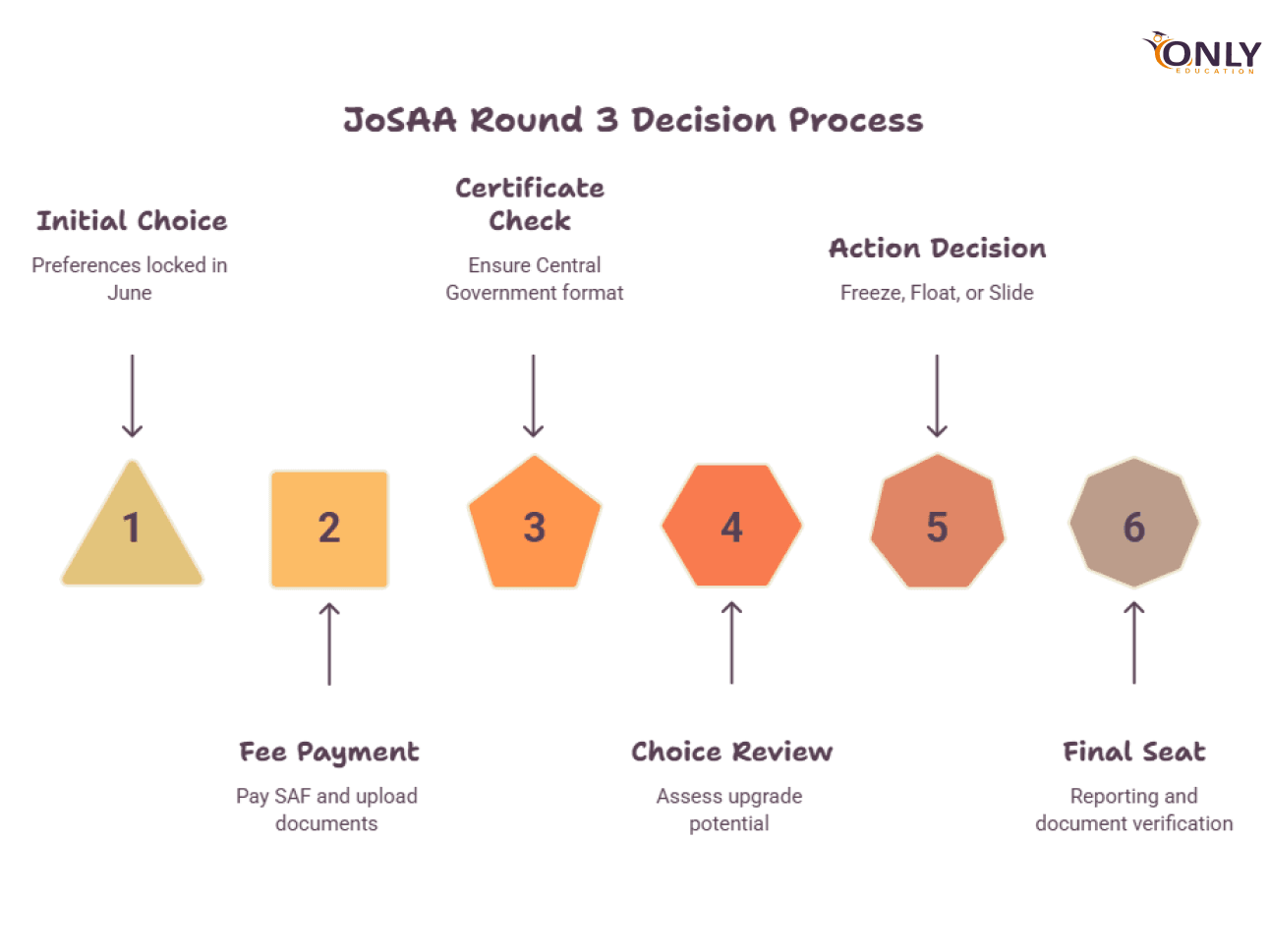
Step-by-step reporting checklist:
- Log in to josaa.nic.in and download your allotment letter.
- Select your willingness option Freeze, Float, or Slide.
- Pay the Seat Acceptance Fee (SAF) typically around Rs. 30,000 for first-time allottees (refundable/adjustable per JoSAA rules on withdrawal, subject to deductions).
- Upload required documents in the specified format.
- Monitor the portal for any verification query raised by reporting officers.
- Respond to queries before the July 9 deadline if any are raised.
- Report physically at your designated Reporting Centre (RC) separate centres exist for IITs versus the NIT+ system.
Documents typically required:
- JEE Main/Advanced admit card and scorecard
- Class 10 and 12 mark sheets and certificates
- Category certificate (SC/ST/OBC-NCL/EWS), where applicable
- PwD certificate, where applicable
- Passport-size photographs and signature scans
Critical certificate warning: OBC-NCL and EWS certificates must be in central government format only state-format certificates are rejected outright. EWS certificates must explicitly state validity for 2026-2027, and income must be below Rs. 8 lakh per annum. Certificates dated before the prescribed cutoff date are treated as invalid, so obtain a fresh certificate well before the reporting window if there's any doubt.
If you've already reported in Round 1 or 2: Candidates who upgrade in Round 3 generally don't need to re-upload documents or re-pay the SAF only a fresh willingness selection is required. Your already-paid SAF carries forward automatically to the new allotment.
What Happens If You Don't Respond to JoSAA Round 3?
If you don't complete online reporting fee payment, document upload, and willingness selection within the deadline, your Round 3 allotted seat is automatically cancelled, and depending on the circumstances, you may also be permanently disqualified from all subsequent JoSAA rounds, with no grace period or exception granted.
Break this down by scenario:
- First-time allottee who doesn't report at all: Seat is forfeited; the candidate typically loses eligibility for remaining rounds too, since non-reporting is treated as a lapse rather than a neutral non-response.
- Candidate who reported earlier but ignores a Round 3 upgrade query: Any specific verification query left unanswered by the July 9 deadline results in cancellation of that particular allotment.
- Candidate who simply forgets to select Freeze/Float/Slide: Without a willingness option recorded, the reporting process is considered incomplete, which carries the same cancellation risk as non-payment.
Bottom line: JoSAA does not accommodate late submissions under any circumstance, technical glitches included, unless JoSAA itself issues an official extension notice. If you're allotted a seat and want to keep any door open even one you're unsure about, always complete the fee payment and document upload; you can still evaluate Freeze vs Float only after the fee is secured, not instead of it.
Common Mistakes Candidates Make in Round 3
- Assuming Float means "no action needed". Floating still requires fee payment and document upload by the deadline; it only affects future upgrade eligibility, not your current reporting obligation.
- Uploading state-format OBC-NCL/EWS certificates. Only the central government format is accepted; state-format certificates are rejected without exception.
- Waiting until the last hour to pay the SAF. Portal traffic spikes near deadlines, and payment gateway failures near cutoff times leave no room for retries.
- Trying to edit the locked choice list. Preferences frozen after choice-locking in June cannot be modified in Rounds 1–5 under any circumstance; only CSAB Special Rounds allow fresh choice filling.
- Ignoring verification queries. A query left unanswered is treated identically to non-response and results in cancellation.
- Freezing prematurely out of anxiety. Freezing before checking whether your rank realistically has upgrade room left in Rounds 4–5 can lock in a seat you might have bettered.
- Not distinguishing Float from Slide. Selecting Slide when you actually wanted flexibility across institutes (not just within one) limits your own upgrade potential.
NIT Seat Allotment July 2026: Institute-Wise Snapshot
NIT seat allotment for July 2026 spans 31 National Institutes of Technology, with Home State quota candidates generally seeing more relaxed closing ranks than Other State quota candidates in the same branch, and core-engineering branches showing the sharpest Round 3 movement.
Broad groupings candidates typically track:
- Tier-1 NITs (Trichy, Warangal, Surathkal, Rourkela, and Calicut): Minimal movement in CSE/ECE; moderate movement in core branches.
- Tier-2 NITs (Allahabad, Kurukshetra, Jaipur, Durgapur, Jalandhar): Noticeable relaxation across most branches by Round 3.
- Newer/Smaller NITs (Manipur, Mizoram, Nagaland, Meghalaya, Sikkim, Puducherry, Arunachal Pradesh, Andhra Pradesh, Goa): Considerable opening range and continued relaxation through later rounds, often the best entry point for candidates outside metro-region ranks.
Home State candidates should always check quota-specific OR-CR separately from other state/all-India figures, since the two pools function almost like different admission tracks within the same institute.
Cost of JoSAA Counselling 2026
The main cost during JoSAA counselling is the Seat Acceptance Fee (SAF), typically around Rs. 30,000 for general-category candidates (with a partial reduction for SC/ST/PwD/female candidates as per the official fee structure), payable online during the reporting window; this is separate from the tuition and hostel fees charged by the allotted institute after physical reporting.
Cost components to budget for:
- Registration fee (paid earlier in the cycle, at initial JoSAA registration)
- Seat Acceptance Fee (SAF) due within the reporting window each time you're allotted a seat for the first time
- Institute-specific charges at physical reporting (varies by IIT/NIT/IIIT/GFTI)
- Document courier/attestation costs, if applicable, for certain certificate types
If you float or slide and later upgrade, your SAF carries forward; you are not charged again for the same admission cycle.
What's Next: Round 4, Round 5 & CSAB
After Round 3, JoSAA conducts Rounds 4 and 5 with Round 4 provisionally expected around July 10, 2026, subject to confirmation after which any remaining NIT+ system vacancies move into CSAB Special Rounds, which is also the only stage where candidates can refill or reorder their preference list.
Timeline of what typically follows Round 3:
- Round 3 reporting concludes (July 8–9 deadlines).
- Round 4 allotment provisionally around July 10, 2026, carrying forward further vacancy-driven movement.
- Round 5 allotment the final standard JoSAA round, representing the last major opportunity for IIT-side movement.
- CSAB Special Rounds for any NIT+ system (NIT, IIIT, GFTI) seats still vacant; this is the only point where fresh choice filling is permitted.
Strategic tip for CSAB: Only list branches genuinely better than your current seat CSAB choice filling should be treated as an upgrade tool, not a fallback safety net, since accepting a CSAB seat typically means forfeiting whatever you currently hold.
Expert Insights
- On the psychology of Freeze vs Float: Candidates who Freeze immediately after receiving any IIT/NIT seat in Round 3, without benchmarking against Round 1 and 2 data for their specific branch, sometimes lock in seats that would have relaxed further by Round 5 checking the round-on-round trend for your exact category/quota combination before freezing is worth the extra ten minutes.
- On documentation: The single most common reason for last-minute seat cancellation across JoSAA history isn't a missed fee payment it's a rejected category certificate due to wrong format or an expired validity date. Getting certificates right two rounds in advance removes the single biggest risk factor.
- On NIT branch selection: Candidates fixated on Computer Science at any cost often overlook that core branches at Tier-1 NITs (Trichy, Warangal, Surathkal) carry strong placement records too the branch-vs-institute trade-off deserves as much thought as the rank itself.
FAQs About JoSAA Round 3 Result 2026
1. When was the JoSAA Round 3 result for 2026 declared?
The JoSAA Round 3 Seat Allotment Result 2026 was declared on July 6, 2026, at 5:00 PM IST, on josaa.nic.in, based on choices locked earlier in the counselling cycle.
2. How do I check my JoSAA Round 3 result?
Log in to josaa.nic.in with your JEE Main/Advanced credentials, click "View Seat Allotment Result", and download your provisional allotment letter directly from your dashboard.
3. What is the last date to pay the seat acceptance fee for Round 3?
The reporting window, including SAF payment and document upload, closes on July 8, 2026, at 5:00 PM IST, with no extensions granted for late submissions.
4. What happens if I don't respond to my JoSAA Round 3 allotment?
Failing to complete reporting fee payment, document upload, and willingness selection results in automatic cancellation of your allotted seat and can disqualify you from further JoSAA rounds entirely.
5. Can I edit my choices after JoSAA Round 3?
No. Choice preferences are locked from the choice-filling period and cannot be edited, reordered, or deleted during Rounds 1 through 5; fresh choice filling is possible only in CSAB Special Rounds.
6. What is the difference between Float and Slide in JoSAA?
Float keeps you eligible for an upgrade to any higher-preference seat across institutes, while Slide restricts upgrade eligibility to a better branch within your currently allotted institute only.
7. Will NIT closing ranks improve further after Round 3?
Historically, yes NIT closing ranks typically continue relaxing through Rounds 4 and 5 as more IIT-bound candidates confirm and exit, though the magnitude varies by branch and category.
8. Is the Seat Acceptance Fee refundable if I withdraw?
JoSAA's official refund policy determines the exact deductions on withdrawal; candidates should check the current refund schedule on josaa.nic.in before withdrawing, since amounts and timelines change round to round.
9. Do I need to re-upload documents if my seat upgrades in Round 3?
No candidates who have already completed reporting and document verification in an earlier round generally only need to select a fresh willingness option when their seat upgrades.
10. What is the deadline for responding to verification queries in Round 3?
Any document verification query raised by JoSAA reporting officers after Round 3 allotment must be answered by July 9, 2026, at 5:00 PM IST.
11. How many total rounds does JoSAA 2026 counselling have?
JoSAA 2026 counselling is being conducted across five rounds, after which any remaining NIT+ system seats move to CSAB Special Rounds for further allocation.
12. What documents are essential before JoSAA Round 3 reporting?
Essential documents include your JEE Main/Advanced scorecard, Class 10 and 12 certificates, a Central Government-format category certificate (if applicable), and passport photographs/signature scans.
Conclusion
JoSAA Round 3 is where counselling genuinely starts to reward patience the vacancy chain from IIT confirmations means NIT and IIIT seats move the most in this exact round. Whether you've received an upgrade, a first-time allotment, or no seat yet, the priority list is the same: check your result immediately, understand what Freeze, Float, and Slide actually mean for your situation, and never let a document or fee deadline slip. Two more rounds and a CSAB Special Round remain after this one there is still real room to improve your outcome if you act correctly and just as much risk of losing what you have if you don't.
What to Do Right Now
- Log in to josaa.nic.in and check your Round 3 status.
- Compare your rank against the official Round 3 opening-closing ranks for your target branch and quota.
- Decide Freeze, Float, or Slide based on your actual upgrade odds not just anxiety.
- Complete fee payment and document upload well before July 8, 2026, 5:00 PM IST.
- Keep monitoring the portal daily for verification queries through July 9.