
Deemed vs Private University 2026: A Complete Guide

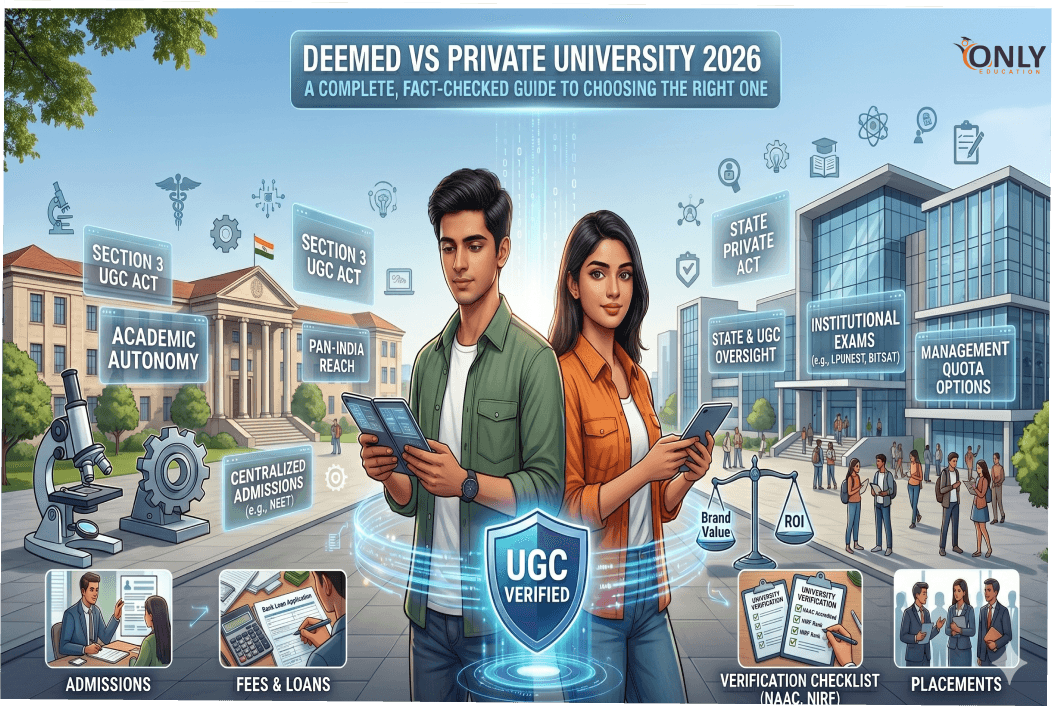
Every admission season, we counsel hundreds of families who ask the same question in different words: "Sir, deemed university achhi hai ya private?" The honest answer is that the label alone tells you very little, but understanding what the label legally means protects you from overpaying, from agents selling illegal "direct admission", and from joining an institution that quietly lost its recognition.
This guide is the most detailed comparison of deemed vs private universities in 2026 you'll find, covering the law, the fees, the admission process (including management quota and NRI quota routes), education loans, scholarships, placements, and a verification checklist we use with our own students.
1. What Is a Deemed-to-be University?
The official term is "institution deemed to be a university". It is a high-performing higher education institution that the central government declares by Gazette notification, on the advice of the UGC, to be treated as a full university under Section 3 of the UGC Act, 1956.
Think of it as a status earned through performance, not a university created from scratch. The institution already existed, proved excellence in teaching and research in a specialised field, and was then "deemed" equal to a university.
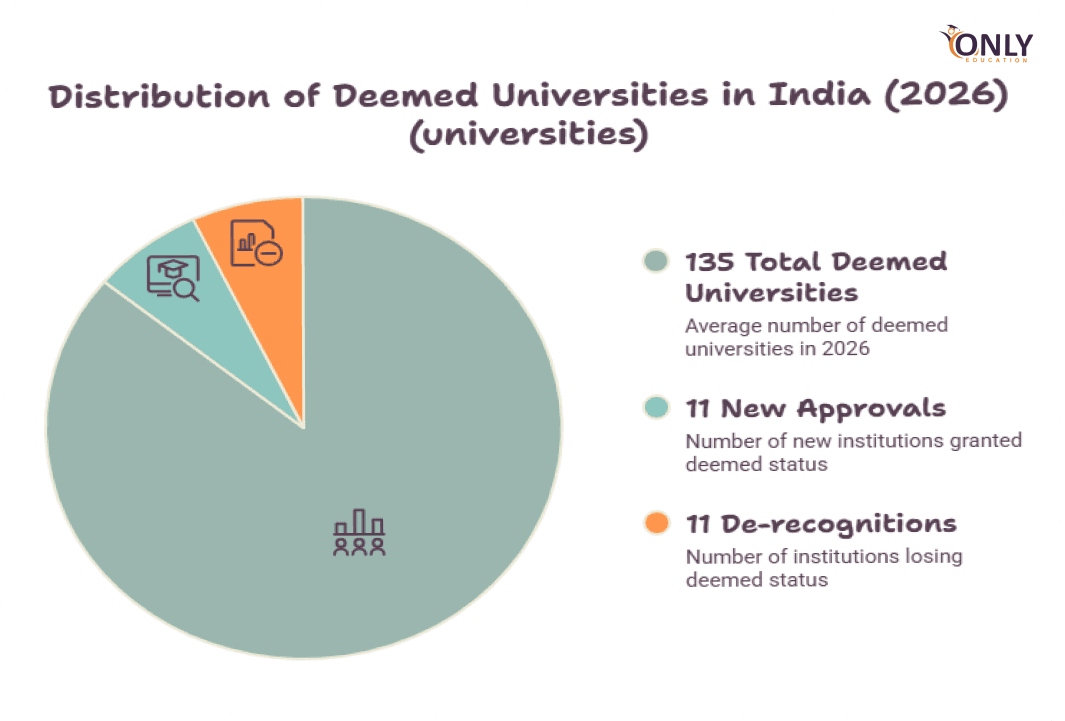
Quick history: The first deemed university in India was the Indian Institute of Science (IISc), Bengaluru, 12 May 1958. As of 2026, the UGC lists roughly 124 – 146 deemed universities (the count moves as new approvals and de-recognitions happen under the UGC (Institutions Deemed to be Universities) Regulations, 2023, notified 2 June 2023).
What a deemed university can do:
- Design its own curriculum, admission criteria, exam pattern and fee structure for full academic autonomy.
- Award its own degrees under Section 22 of the UGC Act (no affiliation needed).
- Apply to UGC for off-campus and even offshore centres.
- Launch new-age programmes (AI & data science, EV technology, and quantum computing) faster than state-bound institutions.
What it must do:
- Maintain NAAC accreditation and comply with the 2023 Regulations.
- Follow statutory councils for professional courses: NMC for medicine, AICTE for technical, BCI for law, etc.
Critical note for MBBS aspirants (2026): Since the 2022 NMC reform, every deemed-university MBBS/BDS/MD/MS seat is filled only through MCC's central deemed-round counselling on a valid NEET score. There is no state quota, no separate management quota, and no legal "direct admission" into deemed medical seats. Anyone promising otherwise is offering you a fraud, not a seat.
2. What Is a Private University?
A private university is created when a state legislature passes a specific act incorporating it. Once recognised under Section 2(f) of the UGC Act, 1956, it can legally award degrees.
The first private university in India was Sikkim Manipal University (notified 11 October 1995). As of 2026, India has over 400 UGC-recognised private universities, with Rajasthan, Gujarat, Uttar Pradesh and Haryana hosting the largest numbers.
What a private university can do:
- Award its own degrees, design its own syllabus, and run its own entrance exams (LPUNEST, CUCET, UPESEAT, SUAT, AUEE, etc.).
- Offer management quota and NRI quota seats in several states and courses (within the state regulator's framework; more on this in Section 5).
- Apply for UGC Section 12(B) status to become eligible for central grants (most remain self-financed).
What it must do:
- Operate within its incorporating state, a Rajasthan private university cannot freely open a campus in Karnataka without separate legal sanction. This geographic restriction is the single biggest structural difference from a deemed university.
- Comply with both UGC norms and the host state's higher-education rules.
- Get statutory-council approval (AICTE/NMC/BCI/PCI/INC/COA) for every professional programme.
3. Deemed vs Private University 2026: At-a-Glance Comparison Table
Parameter | Deemed-to-be University | Private University |
| Governing law | Section 3, UGC Act, 1956 | State Private University Act + Section 2(f), UGC Act, 1956 |
| Created by | Central Govt. notification on UGC advice | State Legislature |
| Count in India (2026) | ~124–146 | 400+ |
| Academic autonomy | Full (syllabus, fees, admissions, exams) | Moderate (UGC + state oversight) |
| Geographic reach | Pan-India presence possible with UGC approval | Restricted to home state |
| Fee regulation | Institution-set | Institution-set: some states run fee-review committees |
| Typical UG/PG fee band | ₹2 – 25 lakh/year (course-dependent) | ₹1.5 – 15 lakh/year (course-dependent) |
| MBBS admission | Only via MCC Deemed counselling (NEET) | State counselling authority (govt/management/NRI tiers) |
| Management/NRi quota | Not in regulated streams | Available in many states/courses |
| Examples | IISc, BITS Pilani, MAHE Manipal, VIT, SRM, Symbiosis, Amrita, KIIT, TISS, Bharati Vidyapeeth | Amity, LPU, Chandigarh University, OP Jindal, Ashoka, Shiv Nadar, UPES |
| Degree validity | Fully valid (Section 22) | Fully valid (Section 22) |
Sources: ugc.gov.in; UGC (Institutions Deemed to be Universities) Regulations 2023; PIB higher-education data, mid-2026.
4. The Legal Difference: Section 3 vs Section 2(f) Why It Actually Matters to You
Most blogs skip this. Don't; it has rupee-and-career consequences.
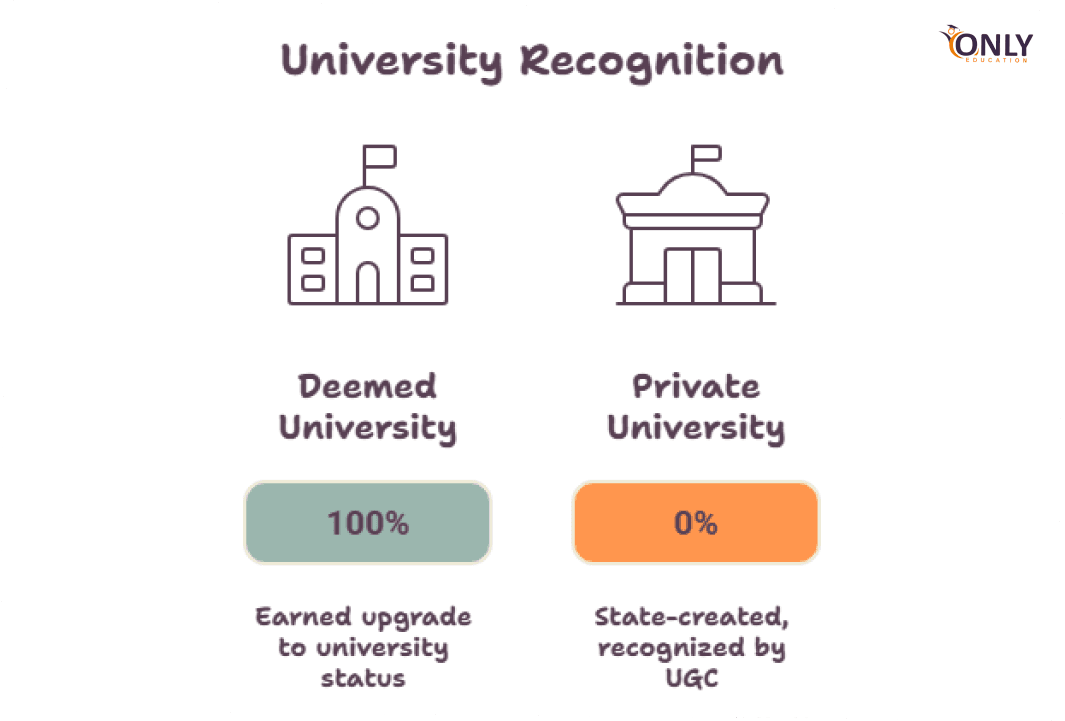
- Section 3 lets the Centre elevate an existing high-performing institution to university status. It is an earned upgrade.
- Section 2(f) defines "university" for UGC purposes; a state-created enters that definition once UGC recognises it.
Four practical consequences:
- Reach: A deemed university can (with UGC approval) operate beyond one state; a private university is locked to its incorporating state.
- Speed: Deemed universities revise syllabi, launch programmes and change fees through their own academic council; no state filing is pushed.
- Oversight: Private universities answer to two masters: the UGC and the state regulator. That extra oversight can mean slower innovation but sometimes better fee discipline.
- Risk: Both can lose recognition. UGC has de-recognised or downgraded multiple deemed universities over the past decade, and its February 2026 fake-university list names 32 institutions, some posing as "deemed". Verification (Section 13) is non-negotiable.
5. Admission Process 2026: How You Actually Get In
5.1 Deemed University Admission Process 2026
Course | Route |
| MBBS / BDS / MD / MS | NEET and MCC central deemed counselling only. Registration → choice filling → allotment → document verification → reporting. No state or management quota. |
| B.Tech | Institutional exams (BITSAT, VITEEE, SRMJEEE, MET) or JEE Main score |
| MBA | CAT / XAT / NMAT / CMAT / GMAT + GD-PI |
| Law | CLAT / LSAT-India / institutional test |
| Other UG/PG | CUET-UG/PG or institutional aptitude test |
Deemed university application form 2026 tip: Most institutional exams open applications between November and March for the July intake. Missing the application window is the #1 avoidable error. Calendar every deadline the day you shortlist.
5.2 Private University Admission Process 2026
- Multiple entry routes: own entrance exam, national exam scores, or direct merit on 10+2 / graduation marks.
- Professional courses: national exams remain mandatory by statute, NEET for medicine, and JEE Main/CLAT where the state or council requires it.
- Management quota admission in private universities: legal in many states for engineering, MBA, allied health and (via the state counselling authority) medicine provided it's documented, the fee is the notified management-tier fee, and the admission flows through official channels. Capitation fees, cash payments and "guaranteed seats" are illegal under the law and are prosecutable.
- NRI quota admission: available in both state-private medical colleges (via state counselling) and several private universities for other streams; requires sponsor/NRI documentation and the notified NRI fee tier.
5.3 Low Score? Your Legitimate Options (2026)
If your NEET/JEE/CAT score is below top-college cut-offs, your legal options are deemed-university seats via central counselling (allotment depends on smart choice-filling, not just rank), private-university management-tier seats through official routes, or a gap year. There is no fourth "agent route". If you want help mapping your exact score to realistic colleges, professional admission guidance for deemed universities and private university seats can save you both money and a wasted year; see the counselling option at the end of this article.
6. Fees Comparison 2026 + Education Loans & Scholarships
6.1 Deemed University Fees vs Private University Fees, 2026
Course | Deemed University (per year) | Private University (per year) |
| B.Tech / Engineering | ₹2.5 – 6 lakh | ₹1.5 – 4 lakh |
| MBA / PGDM | ₹4 – 25 lakh (full programme) | ₹3 – 15 lakh (full programme) |
| MBBS | ₹15 – 25 lakh | ₹8 – 18 lakh (state-private tiers vary sharply) |
| B.A. LL.B. | ₹2 – 5 lakh | ₹1.5 – 4 lakh |
| BSc Nursing / Allied Health | ₹1.5 – 4 lakh | ₹1 – 3 lakh |
Reality check: the old rule "deemed = costlier" is breaking down. Some deemed universities (Jamia Hamdard, Sri Devaraj Urs) sit at the affordable end, while flagship private universities charge premium fees for hostel-city campuses. Always compare the total programme cost (tuition + hostel + mess + one-time deposits) for the specific course, never the category label.
6.2 Education Loan for Deemed University / Private University Fees
- Nationalised and private banks lend against the official admission/allotment letter.
- Loans up to ₹7.5 lakh are typically collateral-free under the Credit Guarantee Fund Scheme; higher amounts need collateral or a co-applicant.
- Interest concessions exist for girl students at several banks; a moratorium normally runs for the course duration + 6–12 months.
- Pro tip: apply at the bank branch nearest to either your home or the campus; processing is faster where the bank can verify locally.
6.3 Scholarships in Private & Deemed Universities 2026
- Merit scholarships: 10–100% tuition waivers tied to entrance-exam percentile or board marks (LPU, Amity, Chandigarh University, BITS, VIT and others publish slabs each cycle).
- Need-based aid: income-linked waivers; requires an income certificate + ITR.
- Government schemes: National Scholarship Portal (NSP), state post-matric scholarships, AICTE Pragati (girls) and Saksham (PwD) for technical courses.
- Rule: Scholarship terms must appear in the offer letter; a verbal "We'll adjust it later" is worth nothing.
7. Degree Recognition & Validity: India, Government Jobs, and Abroad
Both are equally valid if UGC recognition is current. A degree from a UGC-recognised deemed or private university is accepted for the following:
- Government jobs: UPSC, SSC, state PSCs, PSUs, banking (IBPS/SBI), defence.
- Higher studies in India: PG, PhD, NET/JRF eligibility.
- Higher studies abroad: valid, subject to credential evaluation (WES, ECE) by the foreign institution where NAAC grade and NIRF rank often matter more than the deemed/private label.
- Professional registration: NMC (medicine), BCI (law), and other councils provided the programme itself was council-approved.
The 2026 caveat: recognition is not permanent. UGC has acted against underperforming, or deemed, universities before, and its latest fake-university list (February 2026) names 32 illegal institutions across 12+ states. Delhi alone hosts 10. A degree from any of these is legally worthless. Verify before you pay (Section 13).
8. Autonomy, Curriculum & NEP 2020: Who Innovates Faster?
Aspect | Deemed University | Private University |
| Syllabus revision | Anytime, via own Academic Council | UGC norms + statutory-council approval |
| New course launch | Faster, direct pathway | Needs state + UGC consent |
| Exam pattern | Fully internal | Internal, UGC-aligned credit framework |
| Interdisciplinary programmes | High flexibility | Growing fast under NEP 2020 |
Under NEP 2020, both categories are converging: multidisciplinary degrees, multiple entry/exit points, the Academic Bank of Credits (ABC), and four-year UG honours programmes are now common to both. Deemed universities are still usually first movers on frontier programmes (AI & Data Science, EV Technology, Quantum, Sustainability); the best private universities follow within a cycle or two.
9. Top Deemed & Private Universities in India 2026
Best deemed universities 2026 (by stream):
- Engineering / B.Tech: BITS Pilani, VIT Vellore, SRM IST, MIT (MAHE Manipal), Sathyabama
- Medical / MBBS: KMC Manipal, KMC Mangalore, Sri Ramachandra (Chennai), Amrita, JSS Mysuru, Bharati Vidyapeeth, DY Patil Pune
- MBA: Symbiosis (SIBM/SCMHRD), XIM, NMIMS, MAHE
- Research / Science: IISc Bengaluru (consistently India's #1 in NIRF), TISS, Homi Bhabha NI
Best private universities 2026 (by stream):
- Engineering: Chandigarh University, LPU, Shiv Nadar, UPES, Chitkara
- MBA: Amity, LPU, CU, Bennett, OP Jindal (for law-adjacent management)
- Law: OP Jindal Global, Bennett, UPES School of Law
- Liberal Arts: Ashoka, Krea, FLAME
Always re-verify the current NIRF band and NAAC grade for the year you apply positions shift annually.
10. Placements & ROI: Which Pays Back Faster?
Placements follow the institution, not the category. Use this 4-point ROI test on any college:
- Median CTC (not highest package) from the official placement report.
- Placement percentage of eligible students and how "eligible" is defined.
- Recruiter repeat rate: do the same top companies return every year?
- Total programme cost ÷ median CTC: a ratio under 1.5 is healthy for engineering/MBA; over 3 demands serious thought.
A ₹16-lakh B.Tech with a ₹4.5-lakh median CTC has a weaker ROI than an ₹8-lakh B. Tech with a ₹6-lakh median regardless of what is deemed public and what is private. The headline "₹1 crore package" in advertisements typically represents one student in a thousand; decide on medians, not outliers.
11. NAAC, NIRF & Accreditation: The Layer Most Students Miss
- NAAC grade (A++/A+/A): mandatory for deemed universities under the 2023 Regulations; a strong quality proxy for private universities.
- NIRF 2026 rank band: voluntary participation, heavily watched by recruiters.
- NBA accreditation: programme-level quality marker for engineering/technical courses.
- Statutory council approval: NMC, DCI, BCI, PCI, INC, AICTE, and COA are non-negotiable for professional degrees. A "university" running an unapproved law or nursing programme produces an unusable degree even if the university itself is genuine.
One-line rule we give every student: a NAAC A++ private university beats a NAAC B-deemed university for almost every practical purpose.
12. Myths Busted + Scam Warning Signs (Read Before Talking to Any Agent)
Myths:
- "Deemed universities aren't real universities." False full degree powers under Section 3.
- "Private degrees aren't valid for government jobs." False validity if UGC-recognised under Section 2(f).
- "Deemed is always costlier." False bands overlap heavily in 2026.
- "Private universities don't do research." False. Shiv Nadar, OP Jindal, Ashoka and others rank for research output.
- "Direct admission without NEET in deemed medical colleges is possible if you pay" Categorically illegal since 2022.
Scam warning signs (any one = walk away):
- "Guaranteed seat" before counselling results exist.
- Cash or transfer to a personal/agency account instead of the university's official account.
- "Block the seat today; documents later."
- Fee quoted above the officially notified tier ("the rest is a donation").
- Refusal to give anything in writing on university letterhead.
13. The 5-Step Verification Checklist Before You Pay a Single Rupee
- UGC list check: find the institution under the correct category (deemed/private/state/central) on ugc.gov.in.
- Fake-university check confirms it's not on the February 2026 fake list (32 institutions).
- Statutory council check: verify the specific programme with NMC / BCI / AICTE / COA / INC / PCI / DCI, as applicable.
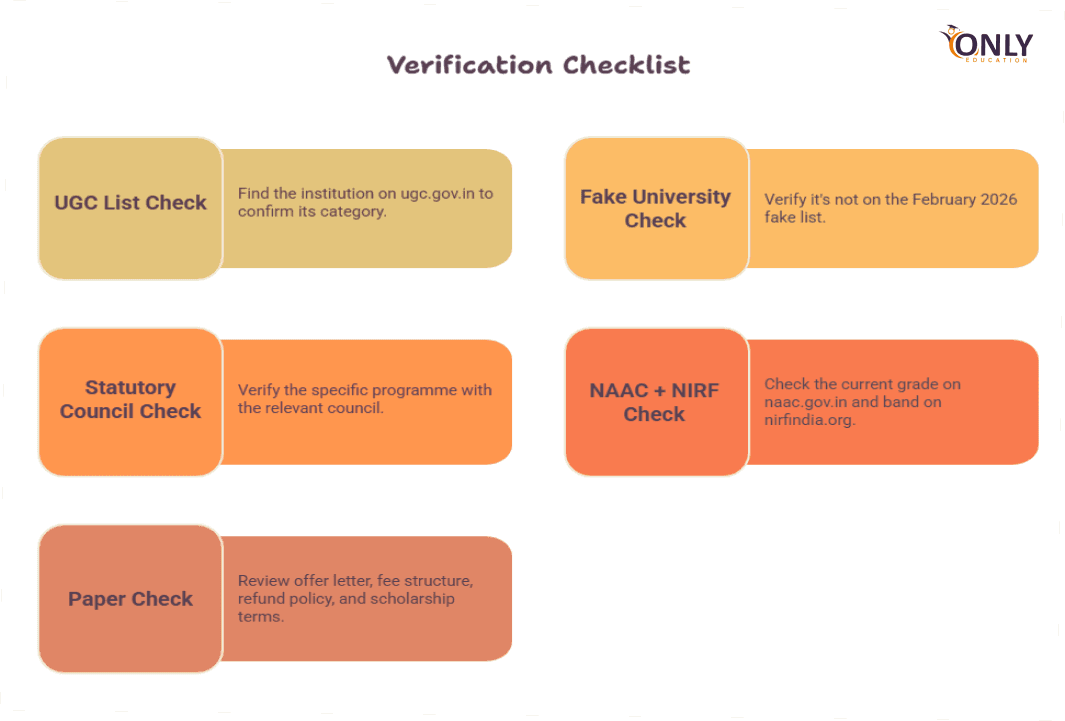
- NAAC + NIRF: Check the current grade on naac.gov.in and the current band on nirfindia.org
- Paper check offer letter, full fee structure, refund policy and scholarship terms on official letterhead, paid only into the university's official account with a system-generated receipt.
Ten minutes of verification have saved our students lakhs of rupees and, in two cases we know of, entire careers.
14. Deemed vs Private University: Which Should You Choose? (Decision Framework)
Choose a deemed university if…
- You want a pan-India brand with specialist depth (research, medicine, engineering).
- Your NEET rank opens MCC-deemed-round medical seats, and your budget supports the fee band.
- You want faster-updating, industry-aligned curricula.
Choose a private university if…
- You want strong infrastructure and a competitive fee in or near your home state.
- You prefer multiple admission routes (own exam / merit / national score) and predictable timelines.
- You're targeting NEP-style interdisciplinary or liberal programmes.
Choose government if you can:
- If your score clears IIT/NIT/AIIMS/government-college cut-offs, take it nothing matches government value-for-fees in 2026. The deemed/private question only begins where the government option ends.
15. Frequently Asked Questions
1. What is the main difference between a deemed and a private university in India in 2026?
A deemed university is declared by the central government under Section 3 of the UGC Act, 1956, with full academic autonomy; a private university is created by a state legislative act and recognised under Section 2(f), with more UGC and state oversight and a home-state operating limit.
2. Is a deemed or private university degree valid for government jobs?
Yes, degrees from any currently UGC-recognised deemed or private university are valid for UPSC, SSC, PSU, banking and state government recruitment and for higher studies in India and abroad.
3. Which is cheaper, a deemed or a private university?
Neither, categorically. Fee bands overlap in 2026; compare the total programme cost of the specific course at the specific institution.
4. Is BITS Pilani deemed public or private? Is Amity deemed or private?
BITS Pilani is a deemed-to-be university (Section 3). Amity is a state private university (state acts in UP and other states). Always check the UGC list rather than assuming from the brand.
5. Can a deemed university open a campus in another state?
Yes, with UGC approval for off-campus centres. A private university generally cannot operate outside its incorporating state without separate legal sanction.
6. Is management quota admission to a private university legal?
Yes, where the state framework permits it, the fee is the notified management-tier fee, and the admission flows through official channels with proper documentation. Capitation fees and "guaranteed seats" for cash are illegal.
7. Is direct admission to a deemed university MBBS seat possible?
No. Since 2022, every deemed-university MBBS/BDS seat is filled only through MCC's central counselling on a NEET score. Any "direct admission" offer is fraud.
8. How do I check if a university is fake in India?
Search the UGC's official 'Deemed' and 'Private' lists on ugc.gov.in and cross-check the latest fake-university notification (32 institutions as of February 2026). For professional courses, also verify the programme with the relevant statutory council.
9. Can I get an education loan for deemed university fees?
Yes, banks lend against the official admission letter; loans up to ₹7.5 lakh are typically collateral-free, with higher amounts requiring collateral or a co-applicant.
10. Does NEP 2020 change the deemed vs private comparison?
It narrows the academic gap; both now offer multidisciplinary degrees, multiple entry/exit points and the academic bank of credits, but the legal distinctions (autonomy, geographic reach, and admission routes) remain.
11. What happens if my university loses UGC recognition?
Existing students are usually allowed to complete their programme, but new admissions stop and the brand value drops. This is exactly why prepayment verification matters.
12. Which is better for placements: deemed or private?
The specific institution decides this, not the category. Compare median CTC, placement percentage of eligible students, and recruiter repeat rate from the official placement report.
Conclusion
The smartest question isn't "deemed or private?" It's "Which specific institution, with which UGC status, NAAC grade, NIRF rank, council approval and median placement, fits my score, course and budget?"
The legal status tells you about governance. Accreditation tells you about quality. Placements tell you about outcomes. Read all three together.
Want a personalised shortlist? Our counsellors map your entrance score, budget and target cities to a realistic, verified list of deemed and private universities with official fees confirmed in writing before you commit.
Book your free counselling now: +91 6262929248