
JEE Main 2026 Cutoff: Category-Wise & State-Wise Complete Official Guide


The National Testing Agency has officially released JEE Main 2026 category-wise qualifying cutoff percentiles on April 20, 2026, along with the Session 2 result. General category: 93.4123549 | OBC-NCL: 80.9232583 | EWS: 82.4164528 | SC: 63.9172792 | ST: 52.0174712. All categories have recorded their highest-ever cutoffs.
1. What Is the JEE Main 2026 Cutoff?
The JEE Main 2026 cutoff is the minimum qualifying percentile that a candidate must secure across both exam sessions to become eligible for two critical next steps: JEE Advanced 2026 (the gateway to IITs) and JoSAA counseling for admission to National Institutes of Technology (NITs), Indian Institutes of Information Technology (IIITs), and Government-Funded Technical Institutes (GFTIs).
There are two distinct types of JEE Main cutoffs that every aspirant must understand clearly:
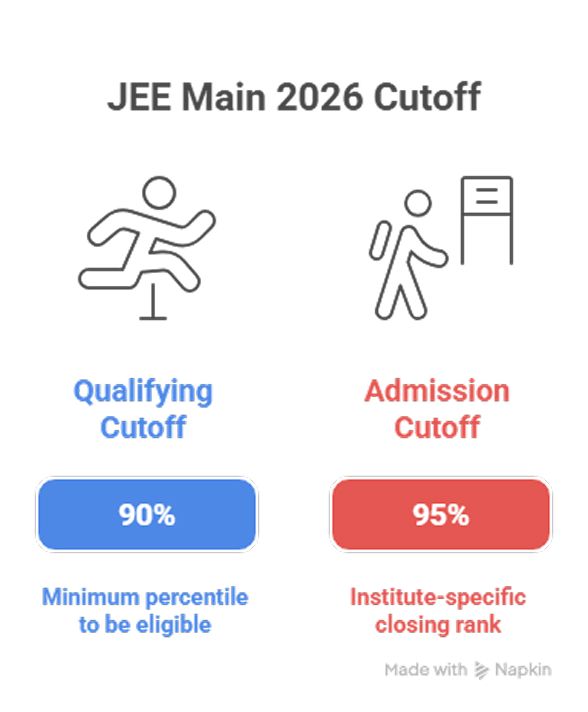
Type 1: Qualifying Cutoff (NTA Released)
This is the minimum percentile released by the National Testing Agency (NTA) along with the final result. It is category-wise and uniform across the entire country. Clearing this cutoff makes you eligible for JEE Advanced 2026 (subject to the overall top 2.5 lakh rank limit) and for JoSAA counseling. The qualifying cutoff for 2026 has been officially released on April 20, 2026.
Type 2: Admission Cutoff (JoSAA Released)
This is the institute-specific closing rank that determines actual admission to a particular NIT, IIIT, or GFTI for a specific branch and category. JoSAA releases this cutoff after each of its six counseling rounds. The admission cutoff varies for Home State (HS) and Other State (OS) quotas and changes every round depending on seat availability and applicant pool.
Key Insight: Simply clearing the NTA qualifying cutoff does not guarantee admission to a top NIT. You must also secure a rank low enough (i.e., a sufficiently high score) to fall within the JoSAA admission cutoff for your preferred institute-branch-category combination.
2. Official JEE Main 2026 Category-Wise Qualifying Cutoff
The National Testing Agency officially released the JEE Main 2026 qualifying cutoff percentile on April 20, 2026, along with the Session 2 scorecard at jeemain.nta.nic.in. The cutoffs have risen for every single category compared to 2025, marking a sustained upward trend driven by record-high participation (over 13 lakh candidates in Session 1 alone) and better-prepared aspirants.
| Category | Official Cutoff Percentile 2026 | 2025 Cutoff | Change (YoY) | Historical Note |
| General (UR) | 93.4123549 | 93.1023262 | +0.31 | Highest ever recorded |
| OBC-NCL | 80.9232583 | 79.4313582 | +1.49 | First time crossing 80 |
| EWS | 82.4164528 | 81.33 | +1.08 | Highest post-EWS introduction |
| SC | 63.9172792 | 62.1136472 | +1.80 | Highest ever for SC category |
| ST | 52.0174712 | 46.6975840 | +5.32 | Largest single-year rise |
| PwD | 0.0096 | 0.0018700 | — | Horizontal reservation (near-zero) |
Important: The cutoff figures above are for JEE Advanced eligibility (qualifying cutoff) only. For actual admission to NITs and IIITs, candidates must additionally clear the JoSAA admission cutoff, which is significantly more competitive and varies by institute, branch, and home/other-state quota.
The OBC-NCL cutoff crossing the 80th percentile for the first time is a landmark; just four years ago, in 2022, it was at the 67th percentile. The ST category witnessed the largest single-year jump (+5.32 percentile points), signaling sharply rising competition even within reserved categories.
3. Number of Qualifying Candidates Per Category for JEE Advanced 2026
Consistent with previous years, the top 250,000 candidates from JEE Main 2026 qualify for JEE Advanced 2026, which is scheduled for May 17, 2026. This total is distributed across categories in proportion to the national reservation policy:
| Category | Reservation % | Approx. Qualifying Seats | Cutoff Percentile (2026) |
| General (UR) | 40.50% | 101,250 | 93.4123549 |
| OBC-NCL | 27.00% | 67,500 | 80.9232583 |
| SC | 15.00% | 37,500 | 63.9172792 |
| ST | 7.50% | 18,750 | 52.0174712 |
| GEN-EWS | 10.00% | 25,000 | 82.4164528 |
| PwD | 5% (horizontal) | 12,500 | 0.0096 |
The total number of candidates who qualified for JEE Advanced 2026 stands at approximately 250,182, consistent with the mandated top-2.5 lakh limit. These candidates will now sit for JEE Advanced on May 17, 2026, competing for seats at the 23 IITs across India.
4. Year-Wise JEE Main Cutoff Trend: 2021–2026
Studying the JEE Main year-wise cutoff trend from 2021 to 2026 reveals a clear and consistent upward trajectory across all categories. Understanding this trend is critical for aspirants preparing for JEE Main 2027 and for gauging the competitive landscape.
| Year | General (UR) | OBC-NCL | EWS | SC | ST |
| 2026 | 93.4123549 | 80.9232583 | 82.4164528 | 63.9172792 | 52.0174712 |
| 2025 | 93.1023262 | 79.4313582 | 81.33 | 62.1136472 | 46.6975840 |
| 2024 | 93.2362181 | 79.6757881 | 81.3295368 | 60.0923182 | 46.6975840 |
| 2023 | 90.7788642 | 75.6229025 | 75.3193394 | 54.5652537 | 44.3345172 |
| 2022 | 88.4121383 | 67.0090297 | 63.1114141 | 43.0820954 | 26.7771328 |
| 2021 | 87.8992241 | 68.0234447 | 66.2214845 | 46.8825338 | 34.6728999 |
Key Takeaways from the Trend Analysis
- The General category cutoff rose from 87.89 in 2021 to 93.41 in 2026 a gain of nearly 6 percentile points in five years, indicating steadily rising competition.
- The OBC-NCL cutoff has seen the steepest growth jumping from 67.00 in 2022 to 80.92 in 2026, a rise of nearly 14 percentile points in four years.
- The SC category cutoff has nearly doubled since 2022 (43.08 → 63.91), reflecting far stronger participation and preparation quality among SC candidates.
- The ST category showed a historic 5.32-point jump from 2025 to 2026 the largest single-year rise for any major category.
- 2022 was a trough year for most reserved categories before a sharp recovery, likely due to exam disruptions and changes in exam pattern.
- The cutoff for the EWS category dipped in 2022, then recovered strongly, now surpassing OBC-NCL for the first time, which is worth noting for aspirants choosing between categories.
"The OBC-NCL cutoff breaching 80 percentile for the first time in 2026, from just 67 in 2022, is the most dramatic indicator of rising competition broader than the general category trend itself."
5. JEE Main 2026 Marks vs Percentile Analysis
A common question among aspirants is: "How many marks do I need to score to clear the JEE Main 2026 cutoff?" The answer depends on the NTA normalisation process, which accounts for exam difficulty across multiple shifts and sessions. The table below provides an approximate marks-vs-percentile mapping for JEE Main 2026:
| Approximate Marks (out of 300) | Expected Percentile | Eligible Category |
| 200+ | 99.5+ | Top 0.5% IIT-level |
| 185–199 | 99.0–99.5 | Top IITs / NIT Trichy CSE |
| 165–184 | 97.0–98.9 | Top NITs (CSE/ECE) |
| 145–164 | 95.0–96.9 | Mid-tier NITs, Top IIITs |
| 125–144 | 93.0–94.9 | Just clears General cutoff |
| 110–124 | 88.0–92.9 | Clears OBC/EWS cutoff |
| 90–109 | 78.0–87.9 | OBC-NCL cutoff range |
| 75–89 | 65.0–77.9 | SC cutoff range |
| 60–74 | 50.0–64.9 | ST cutoff range |
| Below 60 | Below 50 | Does not qualify (except PwD) |
⚠ Disclaimer: The marks-vs-percentile mapping above is approximate and based on historical normalisation patterns. Actual figures vary depending on exam difficulty, the number of candidates per shift, and NTA's official normalisation formula. Always refer to the official NTA scorecard for your precise percentile.
6. JEE Main 2026 State-Wise Cutoff Explained
Many aspirants search specifically for "JEE Main 2026 state-wise cutoff", and it's important to clarify what this actually means. The NTA qualifying cutoff (released April 20, 2026) is national in scope; it applies uniformly to all candidates regardless of their state. There is no separate state-wise qualifying percentile set by NTA.
However, state-wise variation becomes critical at the admission stage through JoSAA counselling because of the Home State (HS) and Other State (OS) quota system:
Understanding Home State (HS) vs Other State (OS) Quota
Each NIT reserves a portion of its seats for candidates who are domiciled in the state where the NIT is located (home state quota) and the rest for candidates from other states (other state quota). This is a crucial distinction that significantly affects your admission chances:
| Quota Type | Seats Reserved | Who Is Eligible? | Typical Closing Rank vs OS |
| Home State (HS) | 50% of sanctioned seats | Candidates domiciled in NIT's home state | Higher (more relaxed) |
| Other State (OS) | 50% of sanctioned seats | Candidates from all other states | Lower (more competitive) |
State-Wise Strategy: Which States Have Easier HS Quotas?
States that host newer or less-sought-after NITs generally have more relaxed HS quota cutoffs. Conversely, states with premier NITs (e.g., Rajasthan for NIT Jaipur, Tamil Nadu for NIT Trichy, and Karnataka for NIT Surathkal) will have highly competitive cutoffs even under the home state quota.
| NIT (Home State) | CSE HS Closing Rank (General) [2025 trend] | CSE OS Closing Rank (General) [2025 trend] |
| NIT Trichy (Tamil Nadu) | 1,500 | 800 |
| NIT Warangal (Telangana) | 2,200 | 1,200 |
| NIT Surathkal (Karnataka) | 2,800 | 1,800 |
| NIT Calicut (Kerala) | 3,500 | 2,200 |
| MNIT Jaipur (Rajasthan) | 4,500 | 2,500 |
| NIT Rourkela (Odisha) | 4,000 | 3,200 |
| VNIT Nagpur (Maharashtra) | 5,500 | 4,000 |
| NIT Uttarakhand | 22,000–39,700 | 12,989–24,586 |
| NIT Manipur | 35,000+ | 18,000+ |
Note on State-Wise Cutoffs: The figures above are based on JoSAA 2025 closing ranks and are indicative estimates for 2026 planning purposes. Official JEE Main 2026 state/NIT-wise admission cutoffs will be released by JoSAA after counselling rounds are conducted (expected June–July 2026).
State Counselling for Non-NIT Engineering Colleges
Apart from JoSAA, every state runs its own centralised counselling for state government engineering colleges. Candidates who qualify for JEE Main 2026 but do not secure NIT/IIIT seats participate in state-level counselling based on JEE Main scores. Key state counseling boards include
- MHT-CET / Maharashtra: Uses both JEE Main score and MHT-CET for state colleges.
- JOSAA (Central): For NITs, IIITs, and GFTIs, it covers all states centrally.
- JAC Delhi: For Delhi Technological University and affiliated colleges.
- UPSEAT / UP: AKTU and affiliated colleges in Uttar Pradesh.
- KCET (Karnataka): Karnataka state engineering counselling.
- TGEAPCET (Telangana) & AP EAMCET (Andhra Pradesh).
- WBJEE (West Bengal): JEE Main score accepted alongside WBJEE.
7. Expected NIT Cutoff 2026: Branch & Category-Wise
The NIT admission cutoff for 2026 will be officially published by JoSAA during counselling rounds (expected June–July 2026). Based on JoSAA 2025 trends and the fact that the 2026 qualifying cutoff has risen, the following are expected NIT admission cutoff ranks for key branches:
Top NITs Expected CSE Closing Rank (General-OS)
NIT | CSE (Gen-OS) | ECE (Gen-OS) | Mechanical (Gen-OS) | Civil (Gen-OS) |
| NIT Trichy | <1,000 | 2,000 | 7,000 | 10,000 |
| NIT Warangal | 1,200 | 3,000 | 8,500 | 13,000 |
| NIT Surathkal | 2,000 | 4,500 | 10,000 | 16,000 |
| NIT Calicut | 2,500 | 5,500 | 11,500 | 17,000 |
| MNIT Jaipur | 3,000 | 6,000 | 13,000 | 20,000 |
| NIT Rourkela | 3,500 | 7,000 | 14,000 | 22,000 |
| VNIT Nagpur | 4,000 | 8,500 | 15,000 | 24,000 |
| NIT Allahabad | 5,000 | 9,500 | 16,000 | 25,000 |
Expert Tip: For top NITs, the expected rank for CSE under Other State (OS) quota is below 5,000, while mid-tier NITs may accept ranks up to 8,000–10,000 for CSE. The home-state quota is generally available at 20–50% higher ranks (more relaxed). Always apply for the home state quota if eligible; it can make a significant difference in your allotment chances.
8. IIIT & GFTI Expected Cutoff 2026
Beyond NITs, IIITs (Indian Institutes of Information Technology) and GFTIs (Government-Funded Technical Institutes) also admit students through JoSAA counseling on the basis of JEE Main 2026 ranks. These are excellent options, especially for candidates who may miss NIT cutoffs narrowly.
Top IIITs' Expected CSE Closing Rank (General)
| IIIT | CSE Closing Rank (Gen) Expected |
| IIIT Hyderabad | 500–800 |
| IIIT Bangalore | 1,500–2,500 |
| IIIT Delhi | 2,000–3,500 |
| IIIT Allahabad | 4,000–7,000 |
| ABV-IIITM Gwalior | 8,000–12,000 |
| IIIT Lucknow | 12,000–20,000 |
| IIIT Kota | 18,000–28,000 |
| IIIT Sri City | 20,000–35,000 |
Notable GFTIs
GFTIs such as the School of Planning and Architecture (SPA), National Institute of Foundry and Forge Technology (NIFFT) Ranchi, Sant Longowal Institute of Engineering (SLIET), and others offer quality government-funded education at lower cutoff ranks. CSE at GFTIs typically sees general category closing ranks in the range of 30,000–80,000, making them valuable options for candidates outside the NIT-IIIT range.
9. JoSAA Counselling 2026 What Happens Next?
All candidates who have cleared the JEE Main 2026 qualifying cut-off are eligible to participate in JoSAA (Joint Seat Allocation Authority) 2026 counselling for admission to NITs, IIITs, and GFTIs. JoSAA also handles seat allocation for IITs for candidates who clear JEE Advanced 2026.
JoSAA 2026 Expected Timeline
| Event | Expected Date (Tentative) |
| JEE Main 2026 Session 2 Result & Cutoff Released | April 20, 2026 |
| JEE Advanced 2026 | May 17, 2026 |
| JEE Advanced Result | Early June 2026 |
| JoSAA Registration Opens | June 2026 |
| JoSAA Round 1 Seat Allotment | Late June 2026 |
| JoSAA Round 6 (Final) Allotment | Mid July 2026 |
| CSAB Special Rounds (if any) | July–August 2026 |
JoSAA Counselling Process: Step by Step
- Register at josaa.nic.in using your JEE Main / JEE Advanced roll number.
- Fill choices of institute-branch-category combinations in order of preference. Fill as many choices as possible; more choices = more allotment opportunities.
- Lock choices before the deadline. Unlocked choices are treated as the last saved selection.
- Check Round 1 allotment. If satisfied, accept, pay the seat acceptance fee, and report to the institute. If not, choose "Float" (upgrade if a better option opens) or "Slide" (within the same college, a better branch).
- Participate in subsequent rounds if you chose Float/Slide. Allotments can improve in later rounds.
- Do NOT exit counselling prematurely; better allotments commonly come in Rounds 4–6.
10. Key Factors Affecting JEE Main 2026 Cutoff
The JEE Main cutoff is not a fixed number; it is recalculated every year based on several dynamic variables. Understanding these factors helps aspirants preparing for future attempts set realistic targets:
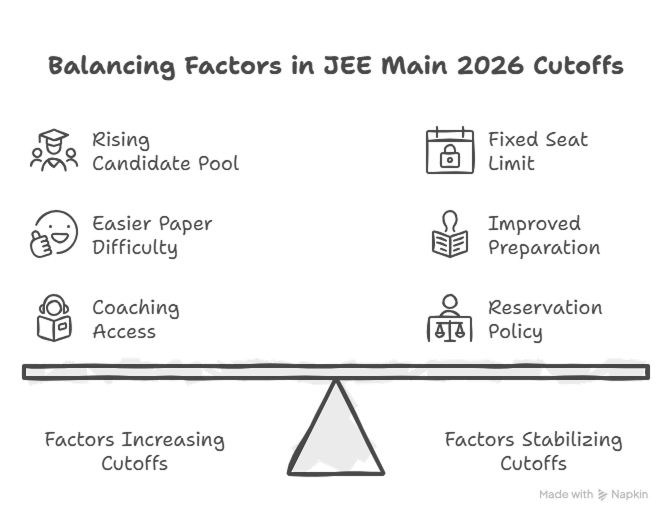
1. Total Number of Registered & Appeared Candidates
Session 1 of JEE Main 2026 saw 13,04,653 candidates appear out of 13,55,293 registered, one of the highest ever appearances. More candidates competing for the same 2.5 lakh JEE Advanced seats naturally drive the qualifying percentile higher. The consistent 10–13% year-on-year growth in registration is the single biggest driver of rising cutoffs.
2. Difficulty Level of Both Sessions
NTA uses a statistical normalisation formula to equate scores across different shifts and sessions of varying difficulty. If a paper is perceived as easier by the majority, the raw marks required to achieve a given percentile will be higher, effectively raising the cutoff in raw mark terms (though the percentile threshold remains the same as announced).
3. Fixed Number of JEE Advanced Seats
The top-2.5 lakh limit for JEE Advanced eligibility is a hard ceiling that has not increased proportionally with the rising candidate pool. This structural constraint ensures that the qualifying percentile will continue to creep upward as more students score in the high percentile range.
4. Improved Coaching and Access to Resources
The proliferation of high-quality online coaching platforms, free video resources, and AI-powered preparation tools has dramatically raised the average preparation level among aspirants, particularly from Tier-2 and Tier-3 cities and rural areas. This improved baseline preparation quality pushes overall score distributions upward.
5. Reservation Policy and Category Distribution
NTA's pre-determined reservation percentages (general 40.5%, OBC 27%, SC 15%, ST 7.5%, and EWS 10%) remain constant year to year. However, the intra-category competition increases as more candidates from reserved categories prepare rigorously, as evidenced by the SC cutoff nearly doubling since 2022.
Conclusion & Next Steps for JEE Main 2026 Qualifiers
The JEE Main 2026 cutoff, officially released by NTA on April 20, 2026, sets new benchmarks across every category. With General at 93.41, OBC-NCL at an all-time high of 80.92, SC at a record 63.91, and ST surging to 52.01, the message is clear: competition is intensifying year by year, and aspirants must set their targets higher with every passing cycle.
If you have cleared the qualifying cutoff, here is your immediate action plan:
- Download your official JEE Main 2026 scorecard from jeemain.nta.nic.in and note your All India Rank (AIR), Category Rank, and JEE Advanced qualification status.
- If you have qualified for JEE Advanced, begin focused IIT-level preparation immediately; the exam is on May 17, 2026.
- Simultaneously, start building your JoSAA choice list using previous years' closing ranks as a guide. Use the JoSAA official mock seat allotment (available before counseling opens) to test your choices.
- Check your home state eligibility for NITs in your state. Home state quotas offer significantly relaxed cutoffs.
- Explore IIIT and GFTI options in parallel. Many IIITs (especially IIIT Hyderabad and IIIT Delhi) offer outstanding academic environments comparable to top NITs.
- Monitor the official JoSAA portal at josaa.nic.in for counseling opening dates and registration instructions.
11. Frequently Asked Questions (FAQs)
Q1. What is the JEE Main 2026 cutoff for the general category?
The official JEE Main 2026 cutoff for the General (Unreserved) category is the 93.4123549 percentile, released by NTA on April 20, 2026. This is the highest-ever cutoff recorded for the general category and represents an increase from 93.1023262 in 2025.
Q2. What is the JEE Main 2026 cutoff for OBC-NCL?
The official OBC-NCL cutoff for JEE Main 2026 is the 80.9232583 percentile, which is historic in that it is the first time the OBC-NCL cutoff has crossed the 80th percentile. In 2022, the OBC cutoff was just the 67th percentile, showing the dramatic rise in competition within this category.
Q3. Is the JEE Main cutoff the same for all states?
The NTA qualifying cutoff (for JEE Advanced eligibility) is uniform and national; there is no state-wise variation in this cutoff. However, admission cutoffs for NITs and IIITs through JoSAA vary by institute, branch, category, and home state/other state quota. So a candidate from Maharashtra applying to NIT Nagpur under the Home State quota will face a different (relaxed) closing rank than another state candidate.
Q4. How many candidates qualified for JEE Advanced 2026?
Approximately 250,182 candidates have qualified for JEE Advanced 2026 from JEE Main 2026. JEE Advanced 2026 is scheduled for May 17, 2026.
Q5. What is the JEE Main 2026 cutoff for SC and ST categories?
The official JEE Main 2026 cutoff for the SC category is 63.9172792 percentile (highest ever for SC) and for the ST category is 52.0174712 percentile (a historic jump of 5.32 points from 2025's 46.69 percentile).
Q6. What is the difference between JEE Main qualifying cutoff and admission cutoff?
The qualifying cutoff (released by NTA) is the minimum percentile to be eligible for JEE Advanced / JoSAA counseling. The admission cutoff (released by JoSAA during counseling) is the closing rank at which seats in a specific NIT-branch category are filled. You need to clear both the qualifying cutoff to enter the process and then the admission cutoff to actually secure a seat.
Q7. When will JoSAA 2026 counseling begin?
JoSAA 2026 counseling is expected to begin in June 2026, after the JEE Advanced & JEE Mains 2026 result (tentatively early June 2026). The exact dates will be announced by JoSAA on its official portal josaa.nic.in.
Q8. Can I get a seat in an NIT if I just barely clear the qualifying cutoff?
Clearing the qualifying cutoff (e.g., 93.41 for General) makes you eligible to participate in JoSAA counseling, but it does not guarantee an NIT seat. NIT admission cutoffs are far more competitive; even the newer NITs have closing ranks of 30,000–80,000 for CSE in the General category. If your rank is very high (poor score), you may still get admission to GFTIs or newer NITs in less competitive branches like civil or metallurgy.
Q9. What is the EWS cutoff for JEE Main 2026?
The official JEE Main 2026 EWS (Economically Weaker Section) cutoff is the 82.4164528 percentile. Notably, the EWS cutoff (82.41) is now higher than the OBC-NCL cutoff (80.92) for the first time, indicating intense competition within the EWS category. Candidates must have a valid EWS certificate to claim this reservation.
Q10. Will the JEE Main 2027 cutoff be even higher?
Based on trend analysis from 2021 to 2026, it is highly likely that cutoffs will continue rising in 2027, particularly if candidate registration numbers continue growing. The general category cutoff has risen approximately 1 percentile per year on average (post-2022), and the same pattern is expected to continue unless there is a dramatic change in the exam pattern or seat capacity.