
Re-NEET UG 2026 Guide: Top Medical Colleges in India by Rank, Score & NIRF Rating

NEET UG 2026 exam, held on May 3, 2026, was cancelled by the NTA on May 12 following paper-leak allegations and a CBI probe. A re-examination, called Re-NEET UG 2026
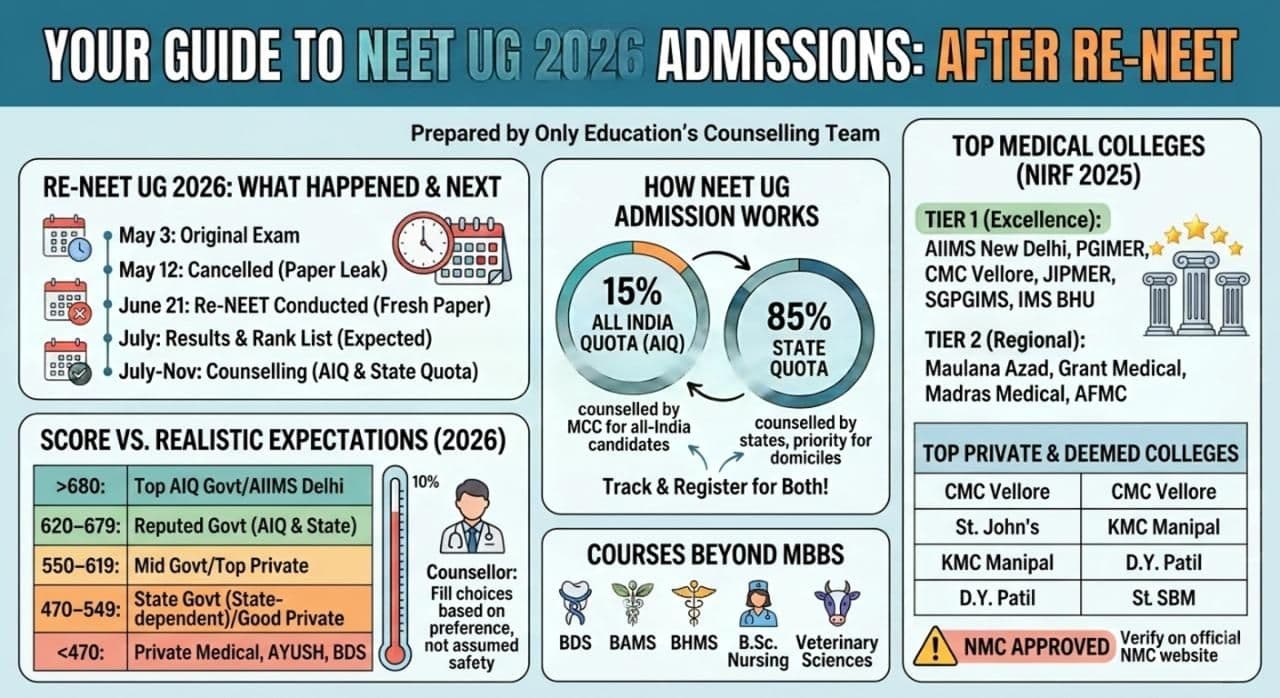
Every year, more than twenty lakh students sit for NEET UG to compete for a seat in one of India's medical, dental, or AYUSH colleges. The 2026 cycle has been anything but routine: the original exam was cancelled over a paper leak, and a fresh Re-NEET UG 2026 exam was conducted on June 21. Clearing the exam whichever attempt gets you there is only step one. The college you land in shapes the next decade of your career: clinical training quality, postgraduate prospects, and ultimately, the kind of doctor you become.
This guide, prepared by Only Education's counselling team, covers the full picture for the 2026 admission cycle: exactly where things stand after the Re-NEET exam, how the quota system actually works, which colleges are genuinely worth targeting at different score levels, and how to avoid the mistakes that cost students a good seat every single year.
Re-NEET UG 2026: What Happened and What Comes Next
The original NEET UG 2026 exam, held on May 3 for over 2.27 million candidates, was cancelled by the NTA on May 12 after a CBI-investigated paper leak. The Re-NEET UG 2026 exam was conducted on June 21, 2026, in offline pen-and-paper mode from 2:00 PM to 5:15 PM under heightened security (biometric authentication, GPS-tracked transport, and police escorts). Candidates did not need to re-register, paid no extra fee, and sat a completely fresh question paper, not a repeat of the cancelled one.
Here's the timeline in full, so you can see exactly where things stand. Rajasthan Police recovered a guess paper containing roughly 140 questions identical to the actual May 3 exam, with evidence suggesting the leaked material had circulated as early as April 27 days before the test. The NTA cancelled the exam on May 12 with government approval and referred the matter to the CBI. Original application data, exam city, and admit card details carried forward automatically for the re-exam, and the application fee already paid was either retained or refunded depending on the candidate's choice.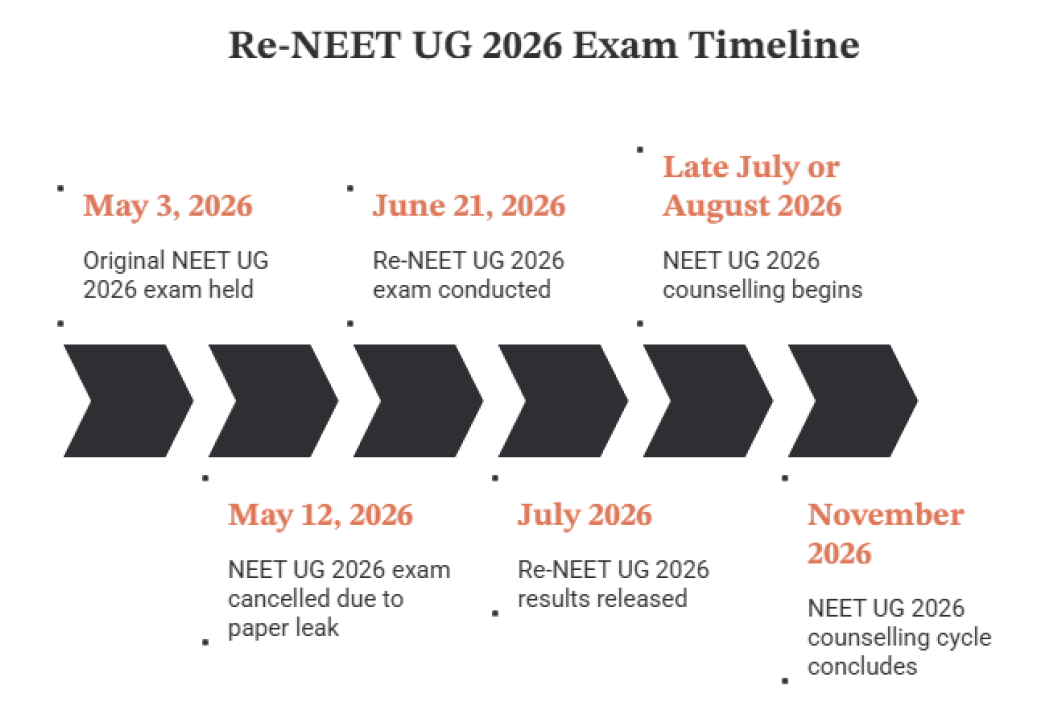
Where things stand as of June 21, 2026: The Re-NEET exam has just been conducted. The result is expected in July 2026, commonly the second or third week, after which the NTA will release the scorecard, qualifying cut-off, and merit list. Counselling, run by the MCC for AIQ seats and by state authorities for state-quota seats, is expected to begin shortly after, likely in late July or August 2026, and the full cycle (Round 1, Round 2, Mop-Up, and Stray Vacancy) is expected to run into November 2026, a compressed version of the usual schedule.
This matters for how you plan the months ahead: with results and counselling pushed later than a normal year, the entire post-exam window is tighter, so being counselling-ready in advance, documenting organised AIQ and state-quota registrations planned, and pre-drafting choice lists matters more than ever this cycle.
What to do right now: Keep checking neet.nta.nic.in and mcc.nic.in directly rather than relying on forwarded messages or social media "leak" claims. Even around the re-exam itself, NTA and PIB Fact Check had to publicly debunk a viral video falsely claiming the re-NEET paper had leaked. Don't let unverified claims affect your judgement during counselling either verify everything at the source.
How NEET UG Admission Actually Works: AIQ vs State Quota
NEET UG seats are split into two pools: 15% All India Quota (AIQ), counselled centrally by the MCC and open to candidates from any state, and 85% State Quota, counselled by individual state authorities with priority typically given to home-state domiciles. A serious aspirant must register for and track both simultaneously.
1. All India Quota (AIQ): 15% of Seats
The MCC conducts AIQ counselling for 15% of government medical college seats nationwide, plus 100% of seats at central institutions such as AIIMS campuses, JIPMER, BHU, AMU, Delhi University-affiliated colleges, ESIC institutes, and AFMC. Any NEET-qualified candidate, regardless of home state, can compete for these seats purely on AIQ rank.
2. State Quota: 85% of Seats
The remaining 85% of government seats, plus most private and deemed-university seats, are counselled by each state's own medical education or health department. Eligibility usually depends on a domicile certificate proving residence in that state, though specific rules and how strictly they're enforced vary significantly by state.
3. Reservation Categories & Domicile Rules
Both AIQ and state quota counselling apply reservation for SC, ST, OBC, EWS, and PwD categories as per central or state policy. If you belong to a reserved category, your effective competing rank within that category can be very different from your overall rank always check category-wise rank lists during counselling, not just the general merit list.
Counsellor's tip: Register for MCC and your home-state counselling portal on the same day registrations open. We see students lose entire rounds every year simply because they assumed one registration covered both it doesn't.
Top Government Medical Colleges in India
As per the official NIRF 2025 Medical Ranking, AIIMS New Delhi holds Rank 1 nationally, followed by PGIMER Chandigarh, CMC Vellore, JIPMER Puducherry, and SGPGIMS Lucknow. These rankings are based on five weighted parameters published annually by the Ministry of Education.
How NIRF Ranking Is Calculated
The National Institutional Ranking Framework scores every participating medical institution out of 100 across five parameters: Teaching, Learning & Resources (TLR); Research and Professional Practice (RPC); Graduation Outcomes (GO); Outreach and Inclusivity (OI); and Perception. Understanding this matters because a college can rank highly on research output (RPC) while scoring lower on perception, or vice versa the overall rank is a blend, not a single metric like clinical exposure alone.
Tier 1: National Institutes of Excellence
- AIIMS New Delhi NIRF Rank 1. India's top-ranked medical institute, with the most competitive AIQ-only admission in the country.
- PGIMER Chandigarh NIRF Rank 2. Premier postgraduate-focused institute with strong research output.
- Christian Medical College (CMC), Vellore: NIRF Rank 3. India's top-ranked private/minority institution, renowned for primary care training and ethics.
- JIPMER Puducherry NIRF Rank 4: a central institute with full AIQ admission and strong clinical infrastructure.
- Sanjay Gandhi PGIMS, Lucknow NIRF Rank 5. Leading UP-based postgraduate and super-speciality centres.
- Institute of Medical Sciences, BHU, Varanasi: NIRF Rank 6. Combines central-university academics with strong hospital infrastructure.
- NIMHANS, Bengaluru: NIRF Rank 7. India's leading institute for neurosciences and mental health.
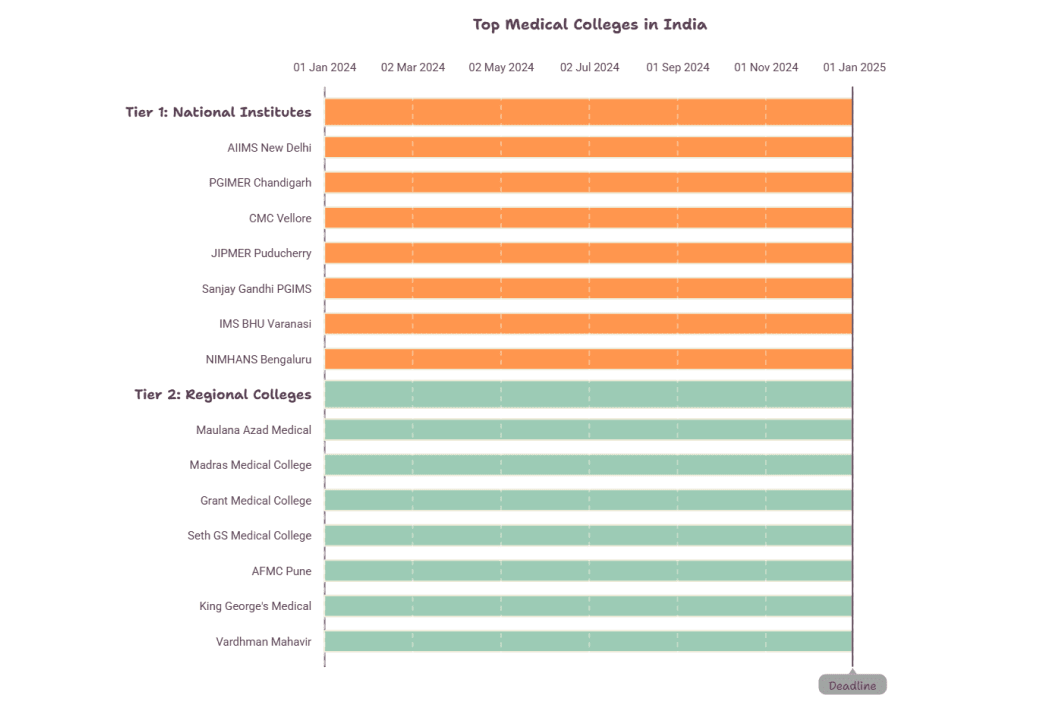
Tier 2: Respected Regional Government Colleges
- Maulana Azad Medical College, New Delhi, is known for high clinical volume via Lok Nayak and GB Pant Hospitals.
- Madras Medical College, Chennai: NIRF Rank 16; one of South India's oldest and most respected colleges, affiliated with the Rajiv Gandhi Government General Hospital.
- Grant Medical College, Mumbai, established 1845, affiliated with the Sir JJ Group of Hospitals; one of Asia's oldest medical institutions.
- Seth GS Medical College, Mumbai, paired with KEM Hospital; strong practical training and alumni network.
- Armed Forces Medical College (AFMC), Pune, blends MBBS education with a defence services commitment; admission requires NEET plus a separate selection process.
- King George's Medical University, Lucknow: NIRF Rank 8; major UP teaching hospital network.
- Vardhman Mahavir Medical College & Safdarjung Hospital, Delhi: NIRF Rank 22; very high patient-load clinical exposure.
Data note: Rankings above reflect the official NIRF 2025 Medical Ranking published by the Ministry of Education. The NIRF is republished annually, so always cross-check the current year's list at nirfindia.org before finalising any decision.
Top Private & Deemed Medical Colleges Worth Considering
Not securing a government seat doesn't end the journey. CMC Vellore, St John's Bengaluru, Kasturba Medical College Manipal, and a handful of other NMC-accredited deemed universities offer training quality comparable to many government colleges at a materially higher fee.
| College | Location | Known For |
|---|---|---|
| Christian Medical College (CMC) | Vellore, Tamil Nadu | NIRF Rank 3 nationally; research, ethics, primary-care training |
| St. John's Medical College | Bengaluru, Karnataka | Patient-centred care, strong community medicine programme |
| Kasturba Medical College, Manipal | Manipal, Karnataka | NIRF Top 10; large multi-specialty hospital network |
| Sri Ramachandra Institute | Chennai, Tamil Nadu | Modern infrastructure, broad specialty mix |
| Dayanand Medical College & Hospital | Ludhiana, Punjab | Strong North India clinical reputation |
| PSG Institute of Medical Sciences | Coimbatore, Tamil Nadu | Good faculty-to-student ratio, moderate fees for a private college |
| KIMS Bhubaneswar | Bhubaneswar, Odisha | Fast-growing infrastructure, strong Eastern India presence |
| Dr. D. Y. Patil Vidyapeeth | Pune, Maharashtra | Large hospital, established private brand |
Always verify, every time: Confirm any private college's current NMC approval status on the official NMC website before paying any fee or accepting a seat offer. Approval status can change year to year.
NEET UG Score vs Realistic College Expectations
A score above 680 puts AIIMS Delhi and top AIQ government colleges in range. 620–679 typically opens most reputed government colleges. 550–619 covers mid-tier government plus strong private options. 470–549 is realistic for state-quota government seats (state-dependent) and good private colleges. Below 470, private medical, AYUSH, or BDS colleges become the practical path.
| NEET UG Score Range | Realistic Expectations |
|---|---|
| 680 – 720 | AIIMS Delhi, top AIQ government colleges |
| 620 – 679 | Reputed government medical colleges (AIQ & state) |
| 550 – 619 | Mid-tier government colleges; strong private colleges |
| 470 – 549 | State-quota government seats (state-dependent); top private colleges |
| Below 470 | Private medical colleges, AYUSH, and BDS colleges |
These bands shift every year based on paper difficulty, total applicants, and seat expansion and 2026 carries extra uncertainty because results now come from the Re-NEET exam held on June 21, on a fresh paper, after the original May 3 exam was cancelled. Treat this table as a planning framework, not a guarantee, and always cross-check against the official MCC and state seat matrix and previous-round cut-off data once the Re-NEET result and counselling schedule are released.
Counsellor's tip: Always fill in choices for your maximum possible score, not your "safe" estimate. A handful of additional marks can shift your all-India rank by hundreds of positions in a 20-lakh-candidate field.
How to Evaluate Any Medical College Beyond Its Name
Brand reputation is a starting point, not a decision criterion. Here's what actually predicts the quality of your six years.
1. NMC Recognition Non-Negotiable
Only ever consider NMC-approved colleges. Verify current status directly on the NMC website before accepting any offer. Recognition can be conditional or under review even for well-known names.
2. Hospital Affiliation & Patient Load
Clinical training quality tracks almost directly with patient volume. Colleges attached to high-footfall government hospitals Maulana Azad's Lok Nayak Hospital, Seth GS's KEM Hospital, and Madras Medical College's Rajiv Gandhi Government General Hospital expose students to a breadth of real-world cases that low-footfall private hospitals simply cannot match.
3. Faculty Credentials & Research Output
Look at published research, postgraduate teaching reputation, and how many faculty are actively practising versus purely administrative.
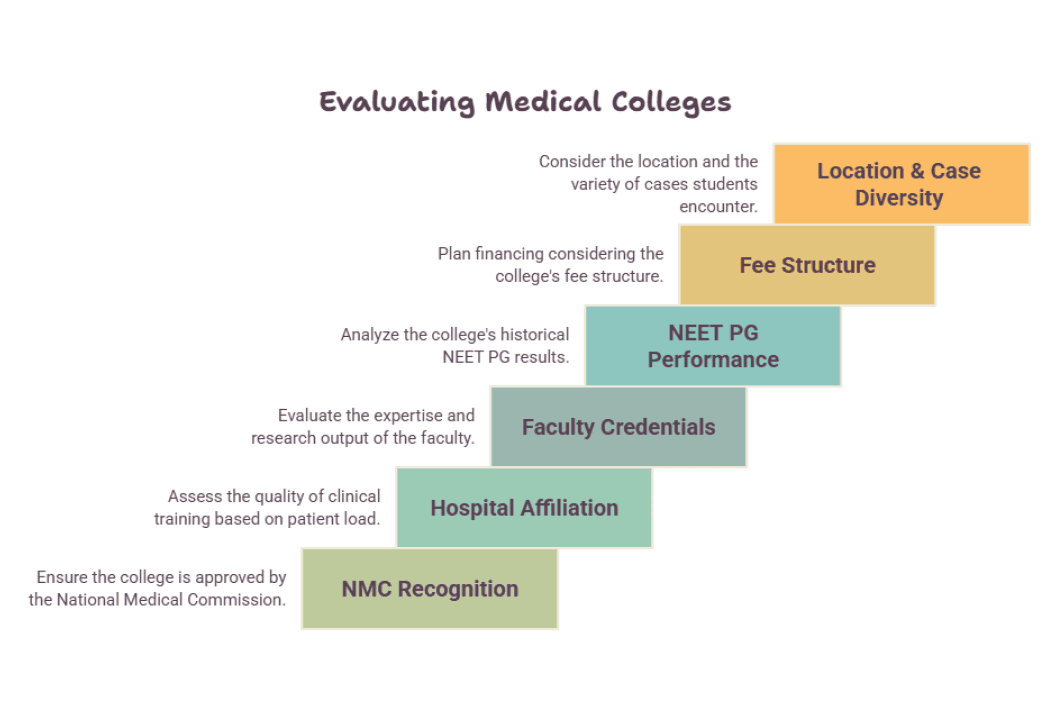
4. NEET PG Performance
A college's historical NEET PG result is one of the most honest indicators of how well it actually teaches, not just how prestigious its name sounds. Ask current students or check verified alumni discussions rather than relying on the college's own marketing.
5. Fee Structure & Financial Planning
Government college fees typically range from roughly ₹10,000 to ₹50,000 per year. Reputable private and deemed colleges can charge anywhere from ₹10 lakh to ₹25 lakh or more per year. Plan financing, including education loans and scholarship eligibility, before counselling starts, not after you've locked a choice.
6. Location & Case Diversity
Metro colleges offer diverse case exposure and stronger networking; Tier-2 city colleges often mean lower competition for hands-on procedures and closer faculty attention. Neither is objectively better; it depends on what kind of training experience you want.
Courses You Can Pursue Through NEET UG Beyond MBBS
NEET UG is the single entrance gateway not just for MBBS but also for BDS, BAMS, BHMS, BUMS, BNYS, B.Sc. Nursing, and B.V.Sc. & A.H. If your MBBS rank isn't competitive, these are genuine, respected healthcare careers, not fallback options.
- BDS (Bachelor of Dental Surgery): strong urban private-practice potential
- BAMS (Ayurvedic Medicine & Surgery): growing demand in integrative and preventive healthcare
- BHMS (Homoeopathic Medicine & Surgery) widely practised, especially across semi-urban and rural India
- BUMS (Unani Medicine & Surgery): niche but respected specialisation
- BNYS (Naturopathy & Yogic Sciences) fast-emerging wellness-sector career
- B.Sc. Nursing strong domestic and international demand, including overseas placement pathways
- B.V.Sc. & A.H. (Veterinary Sciences): animal healthcare, food safety, One Health careers
NEET UG Counselling 2026: Step-by-Step Process
NEET UG counselling runs in four stages: registration & fee payment, choice filling & locking, seat allotment, and document verification/reporting, repeated across Round 1, Round 2, a mop-up round, and a stray vacancy round. MCC handles AIQ and central institutes; your state authority handles state-quota seats separately, on a separate portal, on a separate timeline.
- Register separately on the MCC portal (mcc.nic.in) for AIQ and on your state's counselling portal for state-quota seats.
- Pay the counselling/security deposit fee for AIQ; this has historically been around ₹10,000 for government colleges and considerably higher (often ₹2 lakh) for deemed universities; confirm current amounts on the official portal, as fees can change.
- Fill and lock your choices in order of genuine preference, not assumed safety. Choices can be reordered until you lock them but cannot be added back once the locking deadline passes.
- Check the seat allotment result when published; if allotted, decide whether to accept and report or float to the next round (rules on floating vary by round and category).
- Complete document verification and physically report to the allotted institute within the specified window; missing this deadline can forfeit the seat entirely.
- Repeat through subsequent rounds (Round 2, Mop-Up, Stray Vacancy) if you choose to upgrade or are not allotted a seat in earlier rounds.
Common Counselling Mistakes That Cost Students a Seat
- Registering for only AIQ or only state quota, not both, is the single most common and costly error.
- Missing the choice-locking deadline, which can leave your application incomplete for that round.
- Filling choices based on "safe" guesses instead of genuine preference order, leading to a worse allotment than the rank actually allowed.
- Not arranging the security deposit and required documents in advance, causing last-minute scrambles during a short reporting window.
- Accepting a private/deemed seat without verifying current-year NMC approval status.
- Ignoring category-wise rank lists and only checking the general merit cut-off.
- Believing unverified "leak" or rumour content on social media instead of checking neet.nta.nic.in and mcc.nic.in directly: multiple fake Re-NEET 2026 leak claims were already debunked by PIB Fact Check around the June 21 exam, and similar misinformation tends to resurface during results and counselling too.
MBBS Fees in India: Government vs Private vs Deemed
| College Type | Typical Annual Fee | What You're Paying For |
|---|---|---|
| Government | ₹10,000 – ₹50,000 | Subsidised education: you mainly pay for hostel/mess/exam fees |
| Private (NMC-approved) | ₹10 – 25 lakh+ | Infrastructure, smaller batches, often shorter waitlists |
| Deemed University | ₹15 – 25 lakh+ | Research focus, modern facilities, NRI/management quota seats |
Always model the full six-year cost of tuition plus hostel, exam, and miscellaneous fees against your realistic NEET PG prospects from that college before committing, particularly for private and deemed options.
Career Pathways After MBBS
An MBBS degree is a foundation, not a ceiling. Common pathways include:
- MD/MS Postgraduate specialisation: Medicine, Surgery, Paediatrics, Obstetrics & Gynaecology, Psychiatry, Radiology, and more
- Super-specialisation (DM/MCh): Cardiology, Neurosurgery, Nephrology, Oncology, and other advanced fields
- Private practice or hospital tie-ups for long-term income stability and community-level impact
- Public health & policy MPH programmes, WHO roles, government health missions
- Medical research clinical trials, pharmaceutical R&D, academic medicine
- International licensure (USMLE (USA), PLAB (UK), AMC (Australia) open pathways to practise abroad
Final Word: Make an Informed Decision, Not a Rushed One
Every counselling season, thousands of students lock in a seat purely out of panic just to "secure something." Given the disruption to the 2026 exam cycle, that pressure will likely be even higher this year. Resist it where you can.
The right college isn't always the most famous one. It's the one that gives you genuine clinical training, a financial commitment your family can sustain without strain, verified NMC recognition, and an environment where you'll actually grow into a competent, confident doctor.
Only Education's counsellors have guided thousands of NEET aspirants through both preparation and post-result decision-making. If you have questions about NEET UG 2026 counselling, college shortlisting, or seat selection strategy, our team is here to help you think it through with clarity rather than panic.
6. FAQ
1. Is the NEET UG 2026 exam cancelled?
The original NEET UG 2026 exam, held on May 3, 2026, was cancelled by the NTA on May 12 following paper-leak allegations and a CBI probe. A re-examination, called Re-NEET UG 2026, was conducted on June 21, 2026, in offline OMR mode with a completely fresh question paper. Candidates did not need to re-register; original applications carried forward automatically.
2. When will the Re-NEET UG 2026 result be declared?
The Re-NEET UG 2026 result is expected in July 2026, commonly the second or third week, though the NTA has not announced an exact date. Check neet.nta.nic.in directly for the official confirmation rather than relying on unofficial predictions.
3. When will NEET UG 2026 counselling start?
Counselling typically begins about a month after results are declared. Given the Re-NEET disruption, the 2026 counselling cycle is expected to begin in late July or August 2026 and run through November 2026, but exact dates must be confirmed on mcc.nic.in once officially announced.
4. What is a good NEET UG score for a government medical college?
As a rough planning guide, scores above 620 generally open access to reputed government colleges via AIQ or state quota, though exact cut-offs vary every year by category, state, and paper difficulty.
5. What is the difference between AIQ and State Quota?
All India Quota (15% of seats) is centrally counselled by the MCC and open to any NEET-qualified candidate nationwide. The state quota (85% of seats) is counselled by individual states, usually prioritising candidates with that state's domicile.
6. How many medical colleges are there in India?
India has over 800 NMC-recognised medical colleges offering roughly 1.29 lakh MBBS seats combined across government, private, and deemed institutions, based on the latest published NMC seat matrix.
7. Which is the No. 1 medical college in India?
As per the official NIRF 2025 Medical Ranking, AIIMS New Delhi holds Rank 1 nationally.
8. Can I get an MBBS seat with a 500 score in NEET?
It's possible but limited typically through state-quota government seats in less competitive states or private/deemed colleges, depending on the year's cut-off and your category.
9. What is the NIRF ranking, and how is it calculated?
NIRF (National Institutional Ranking Framework) is the Ministry of Education's official annual institutional ranking, scored across five parameters: Teaching/Learning/Resources, Research/Professional Practice, Graduation Outcomes, Outreach/Inclusivity, and Perception.
10. What documents are required for NEET UG counselling?
Commonly required documents include the NEET admit card and scorecard, Class 10 and 12 mark sheets, a category/caste certificate (if applicable), domicile certificate (for state quota), a passport-size photo, and a valid photo ID. Always confirm the exact list on the relevant counselling portal.
11. Is NRI quota legal in Indian medical colleges?
Yes, NRI quota is a legally recognised category at many private and deemed universities, reserved for NRI candidates or their sponsored relatives, typically at a higher fee structure than the general or management quota.
12. What happens if I don't report after seat allotment?
Failing to report and complete document verification within the specified window typically results in forfeiture of the allotted seat, and in some cases, a penalty or debarment from further rounds. Rules vary by counselling authority.
13. Can I change my domicile state for NEET counselling?
Domicile is generally based on long-term residence, parental government service, or specific state-defined criteria; it cannot be changed simply for counselling convenience. Check your specific state's domicile rules well before counselling begins.
14. What is the difference between MBBS and BDS through NEET UG?
An MBBS leads to a medical doctor degree with a broader clinical scope, while BDS (Bachelor of Dental Surgery) is a dedicated dental qualification. Both are accessed through the same NEET UG exam but counselled separately.
15. Are private medical college degrees as valid as government college degrees?
Yes, as long as the college holds valid NMC recognition, the MBBS degree carries identical legal and professional validity regardless of whether the college is government, private, or deemed.
16. What is the mop-up round in NEET counselling?
The mop-up round is an additional counselling round conducted after Round 1 and Round 2 to fill seats that remain vacant, open to both already registered and newly eligible candidates depending on the authority's rules that year.
17. How many attempts are allowed for NEET UG?
There is currently no fixed cap on the number of attempts for NEET UG, though candidates must meet the prevailing age and eligibility criteria set by the NTA for each cycle.
18. What is the NEET UG eligibility criteria?
Broadly, candidates must have completed Class 12 (or equivalent) with physics, chemistry, biology/biotechnology, and English as core subjects, meeting the minimum qualifying marks prescribed by the NTA for their category.
19. Can I get AYUSH admission through NEET UG?
Yes, BAMS, BHMS, and BUMS admissions across India are conducted through NEET UG scores via the respective AYUSH counselling authorities (AACCC for central seats, state bodies for state-quota seats).
20. What is the security deposit for NEET counselling?
Security deposits have historically been around ₹10,000 for government college AIQ counselling and significantly higher (often around ₹2 lakh) for deemed university seats; these are typically refundable, but amounts should be confirmed on the current year's official portal.
21. How is NEET UG rank different from NEET UG percentile?
Percentile reflects your relative performance against all candidates in your exam session, while rank is your absolute position in the merit list percentile stays comparatively stable across small score changes, while rank can shift sharply, especially near dense score clusters.
22. Was the Re-NEET 2026 paper the same as the cancelled May 3 exam?
No. The Re-NEET UG 2026 exam on June 21 used a completely fresh question paper, not a repeat of the cancelled May 3 paper. The exam pattern stayed the same 180 questions for 720 marks, +4 for a correct answer and -1 for an incorrect one, but the actual questions were entirely new.
23. Should I take a drop year if I don't get a good medical college?
This is a deeply personal decision involving score potential, financial situation, and mental readiness for another year of preparation. There's no universally "right" answer, and it's worth discussing with a counsellor who can assess your specific position rather than following generic advice.