
JEE Main 2027 Mock Tests: How to Practise Smarter When You Run Out of Papers

Quick answer
Once you have finished the available mocks, stop repeating papers. Take chapter-wise tests while you are still studying, combined-chapter and timed tests for revision, and full-length mocks under real conditions in the final stretch. After every test, spend about an hour on analysis and build your next test around the weakest chapters. JEE Main 2027 Session 1 begins on 20 January 2027.
JEE Main 2027 Session 1 begins on 20 January 2027, roughly ten weeks away. By this stage, many aspirants have attempted a large number of mock tests. Then a familiar problem appears: the questions start to look repeated, the answers feel memorised, and the score goes up without the understanding going up with it.
This guide covers why mock tests matter, why fixed test series eventually stop helping, and how to build a practice routine around what you have actually studied, not around whatever papers happen to be available.
Key dates to keep in mind
| Event | Date |
|---|---|
| Regular registration deadline (Session 1) | 22 November 2026, up to 11:50 PM |
| Late-fee window | 23 to 26 November 2026 |
| Application correction window | 27 to 29 November 2026, up to 11:50 PM |
| Exam city slip/admit card | 30 December 2026 / 13 January 2027 Reported |
| Session 1 exam | 20, 21, 22, 23, 24 and 28 January 2027 |
NTA first listed 22–24 and 28–30 January and later revised the Session 1 dates, so always confirm on jeemain.nta.nic.in. If you have not applied yet, read our guides on JEE Main 2027 registration, dates, fees and syllabus, and on what to do if you made a mistake in your application. See also our live photo mismatch guide and the JEE Main exam page.
Why mock tests matter for JEE Main
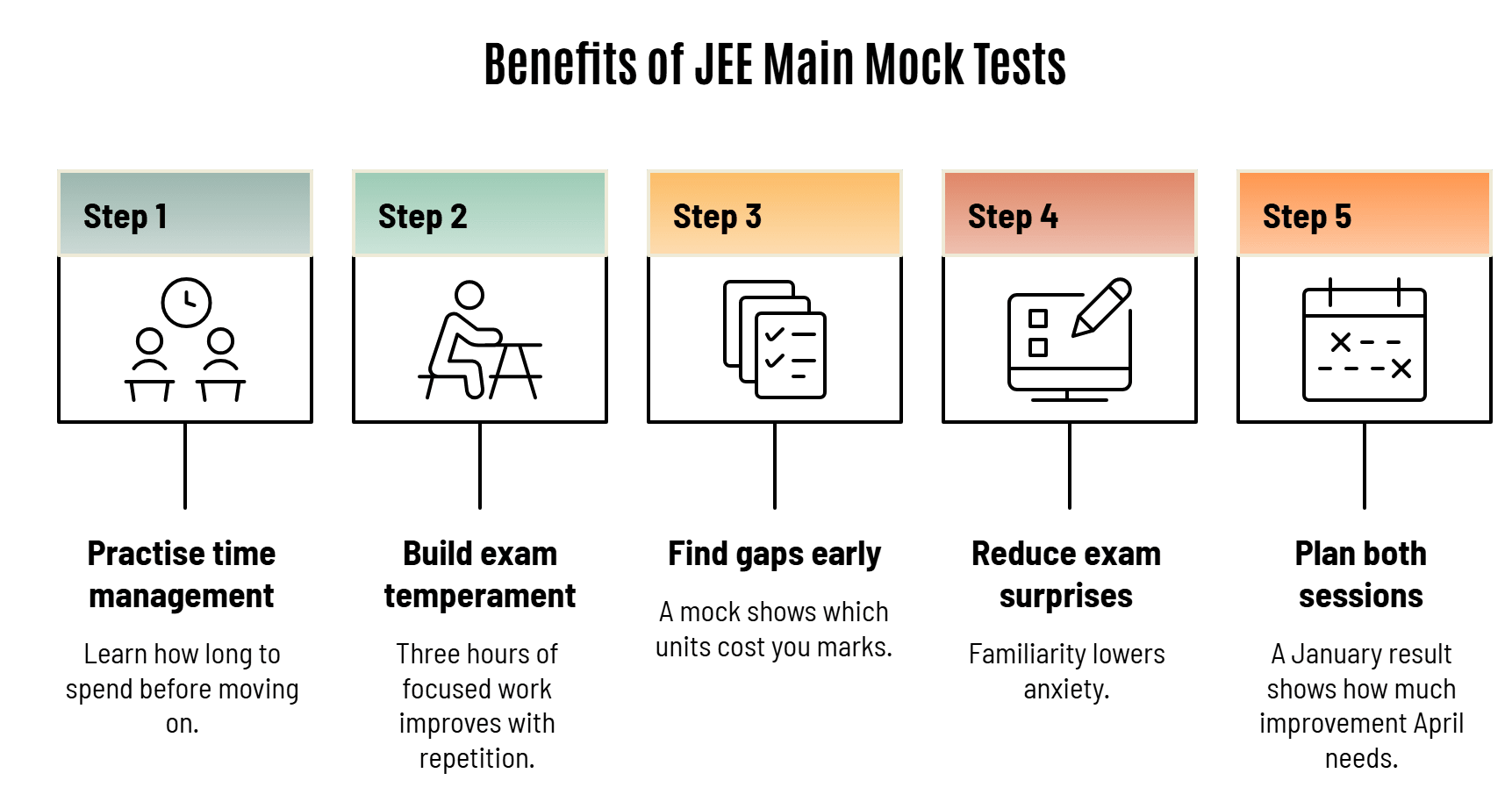
JEE Main Paper 1 is a three-hour computer-based test covering Mathematics, Physics and Chemistry. Knowing the syllabus is only half the job; the other half is performing under exam conditions. A good mock helps you:
- Practise time management. You learn how long you can spend on a question before moving on.
- Build exam temperament. Three hours of focused work is a skill that improves with repetition.
- Find gaps early. A mock shows which units cost you marks while there is still time to fix them.
- Reduce exam-day surprises. Familiarity with the interface, question types, and marking scheme lowers anxiety.
- Plan for both sessions. A January result shows how much improvement April needs, and the higher NTA score of your two sessions counts.
The problem with fixed test series
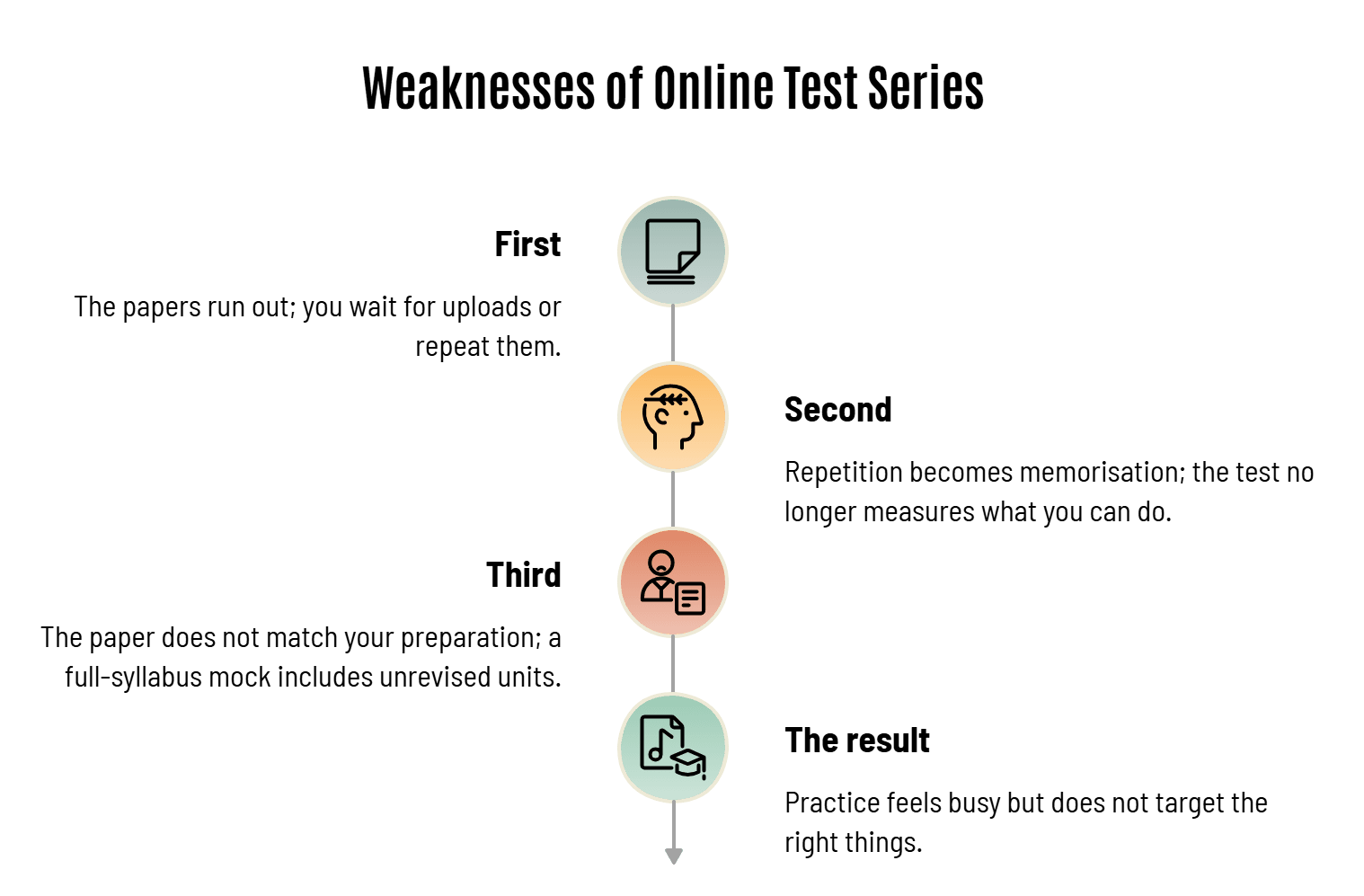
Most online test series publish a set number of papers, and you work through them. That model has three weaknesses.
- The papers run out. Once you finish the list, you either wait for new uploads or start repeating papers.
- Repetition becomes memorisation. If you remember the answer, the test no longer measures what you can do.
- The paper does not match your preparation. If you studied Thermodynamics and Kinetic Theory this week, a full-syllabus mock still has dozens of questions from units you have not revised, so your score reflects what you have not studied rather than what you have.
The result is practice that feels busy but does not target the right things.
A better approach: practise what you studied, when you studied it
The loop: study, select the topics, take a test, analyse mistakes, practise weak areas, repeat.
The key difference is the second step. Instead of taking whichever paper is next in the list, you decide the scope of the test yourself. That is the idea behind Only Test Series.
How Only Test Series works for JEE Main aspirants
1. Take a ready-made test
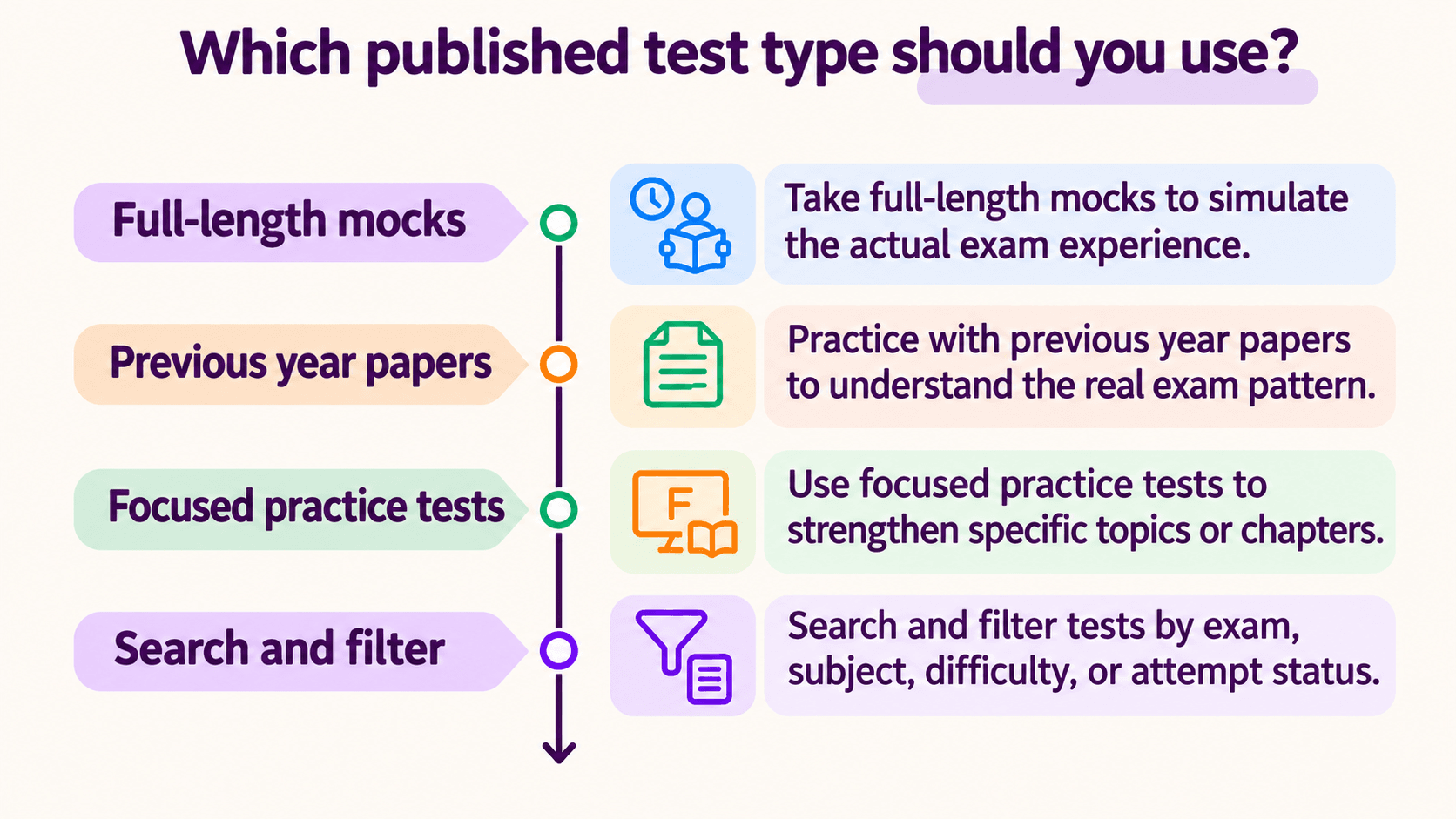
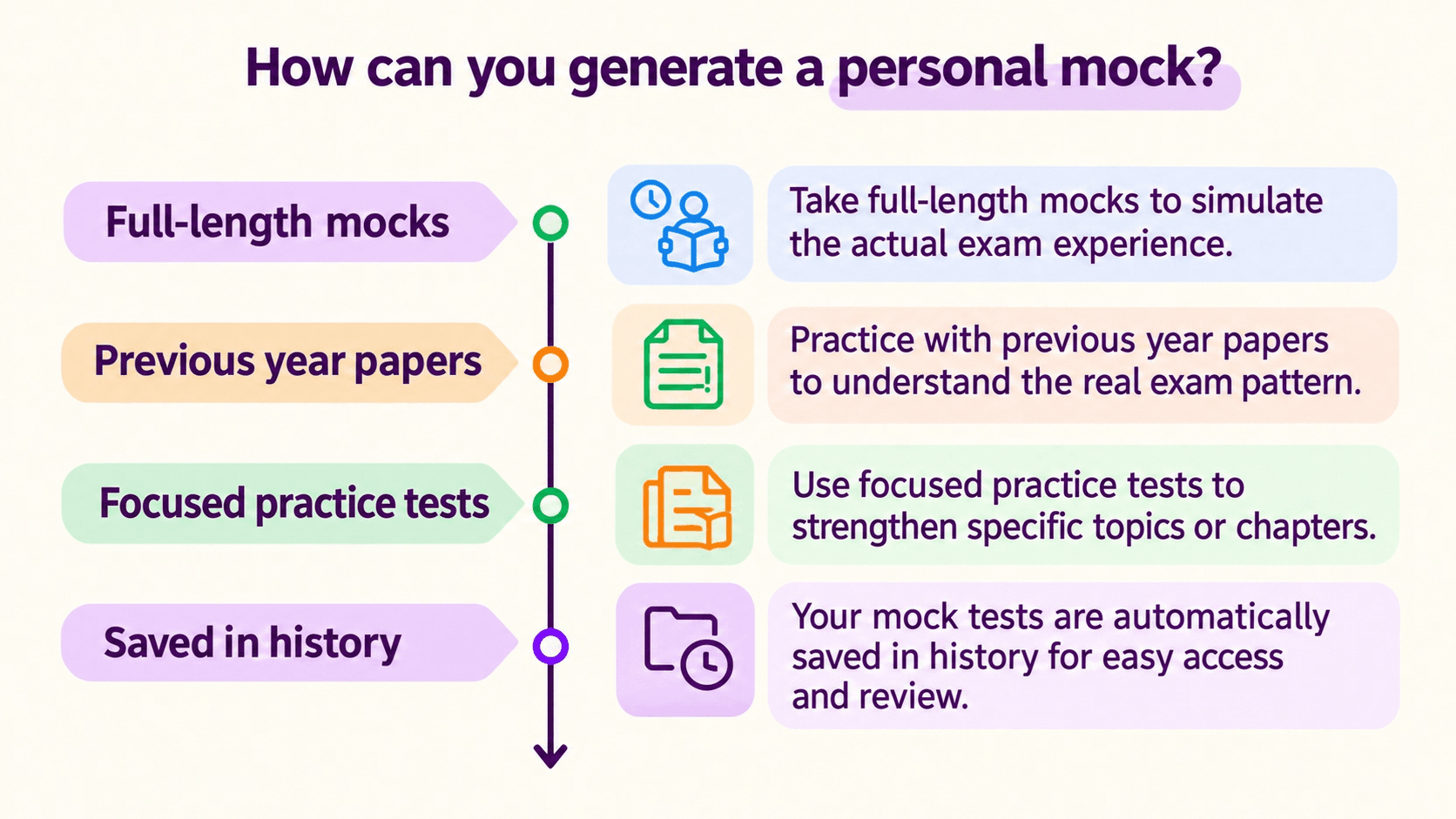
Use published tests when you want a standard, exam-style experience: full-length mocks with sections, time limits, and marking schemes; previous year question papers (PYQs), so you can see how real papers are framed; and chapter-wise and topic-wise tests for focused practice. You can search and filter tests by exam, test type, subject, difficulty, and whether you have already attempted them.
2. Create your own custom practice test
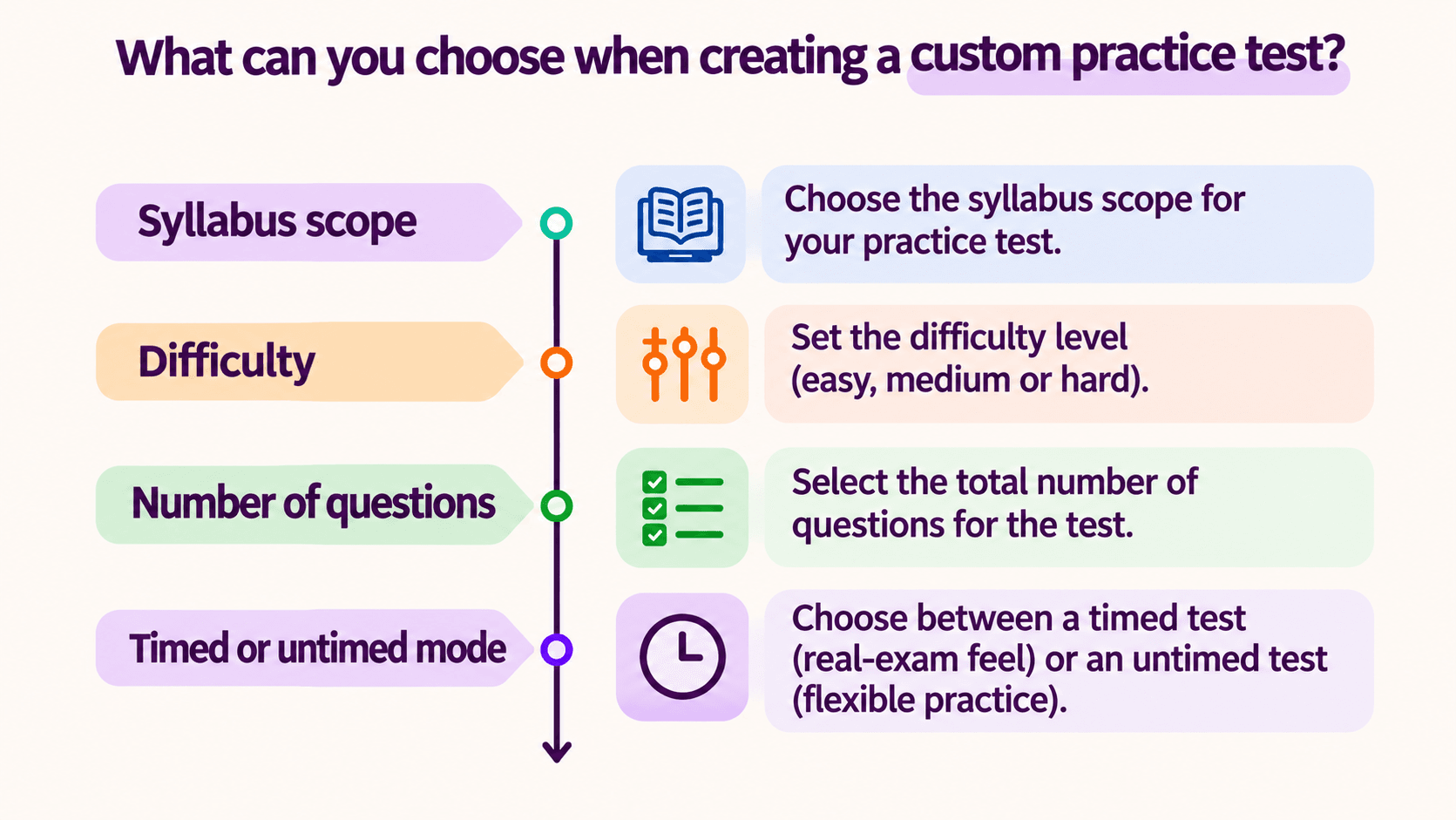
You can generate a private practice test by choosing:
- Syllabus scope: browse subjects, chapters, and topics, and pick what you want to be tested on.
- Difficulty: easy while learning a topic, moderate during revision, hard in the final stretch.
- Number of questions: a quick 10-question check or a longer paper.
- Timed or untimed mode: untimed to think deeply, timed to build speed.
Before generating, a question availability preview shows how many questions exist for your selection and flags any shortage. If you have just finished several chapters, a combined test is more revealing than separate single-chapter tests; check the platform for the exact multi-select options.
3. Generate a personal mock
Finished the published mocks? You can generate a private full-length mock that follows the expert exam pattern and prioritises questions you have not seen before. The number of fresh papers depends on how many unseen questions are available, so it is a way to keep going, not an unlimited supply. Your practice papers and personal mocks are saved in your history.
What happens after the test: turning results into improvement
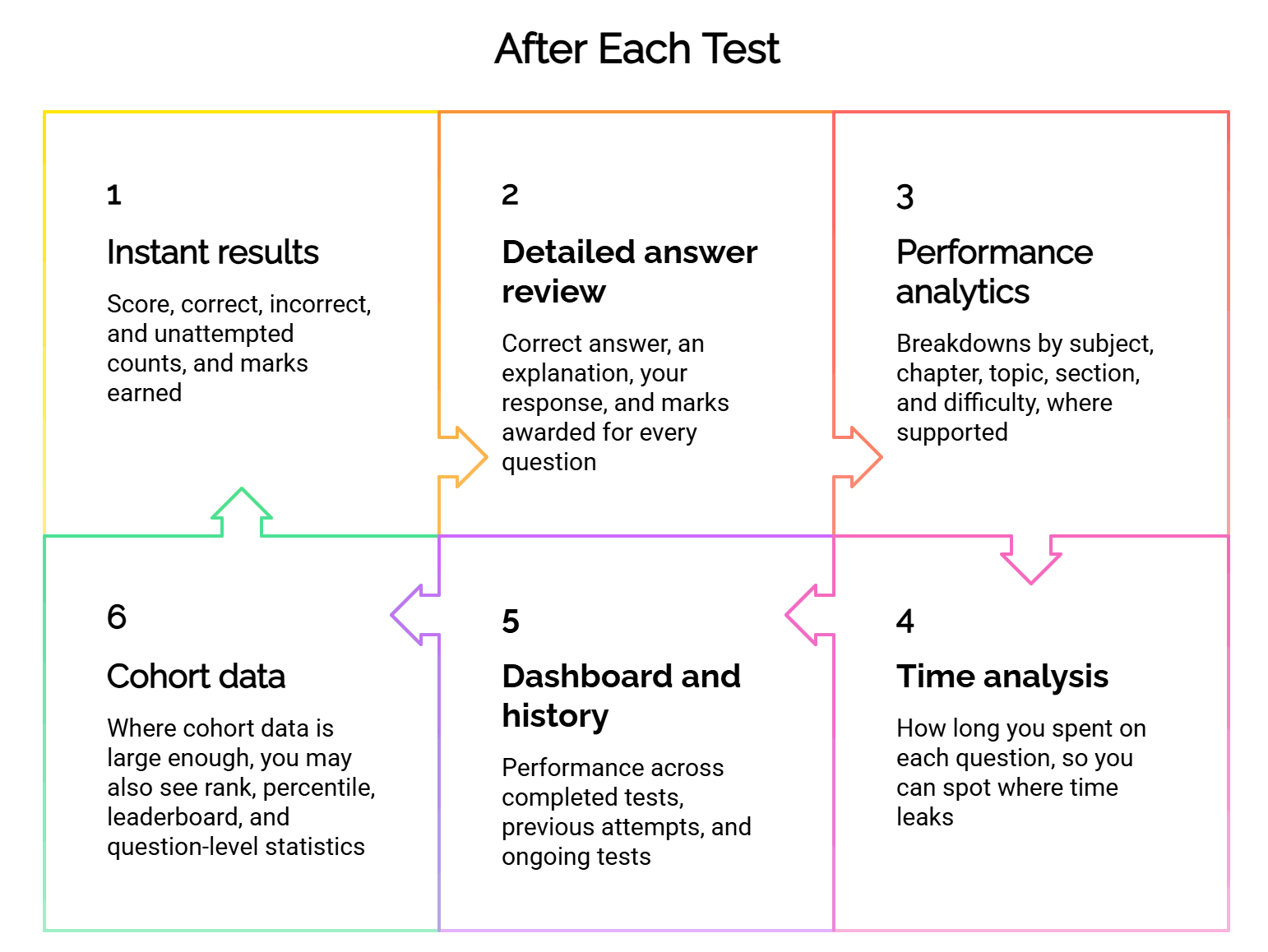
A score alone doesn't tell you what to do next. After each test, Only Test Series shows you:
- Instant results: your score, correct, incorrect, and unattempted counts, and marks earned.
- Detailed answer review: the correct answer, an explanation, your response, and the marks awarded for every question.
- Performance analytics: breakdowns by subject, chapter, topic, section, and difficulty, where supported.
- Time analysis: how long you spent on each question, so you can spot where time leaks.
- Dashboard and history: performance across completed tests, previous attempts, and ongoing tests.
Where cohort data is large enough, you may also see rank, percentile, leaderboard, and question-level statistics. These appear only once enough evaluated attempts exist for a test, so do not treat them as always available.
A simple 10-week mock test plan for Session 1
Adjust this to your own pace and board-exam commitments.
Weeks 1 to 3: build the base. After each chapter, take a short, untimed or lightly timed custom test at easy-to-moderate difficulty. Aim to understand every mistake, not just to score.
Weeks 4 to 6: combine and revise. Create custom tests that combine several recently studied chapters at moderate difficulty. Add timed mode to build speed. Note your weakest 2 or 3 topics after every test.
Weeks 7 to 8: full-length practice. Take full-length mocks under real conditions: the same slot as your exam (9 am to noon or 3 pm to 6 pm), no breaks, no phone. Solve PYQs alongside to get used to the question style.
Weeks 9 to 10: target and polish. Use your analytics to create hard-difficulty tests on weak chapters. Generate a personal mock if you have used up the published ones. In the last few days, prioritise revision and rest over heavy testing.
How to analyse a mock test
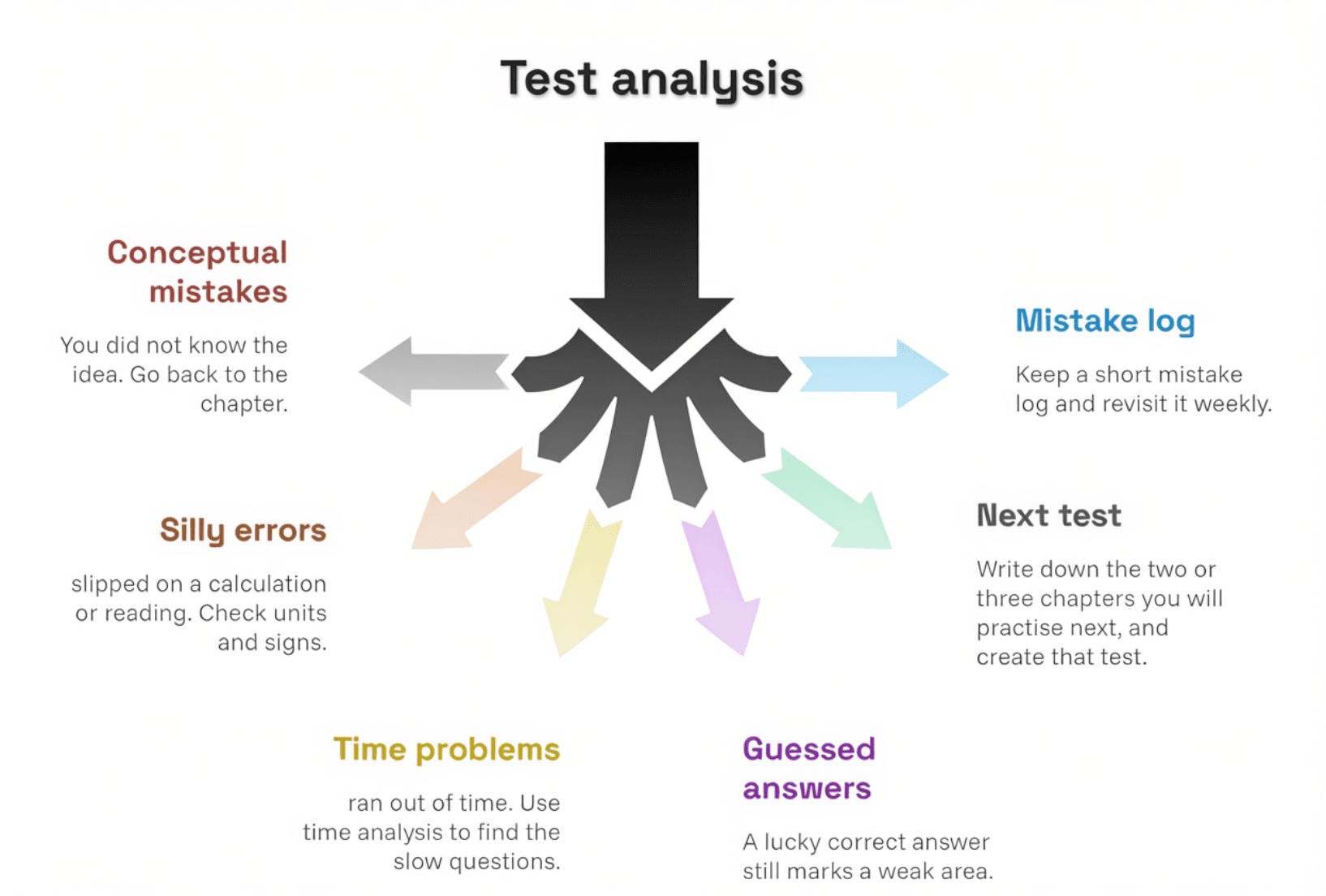
An hour on analysis is worth more than taking another paper. After every test, ask:
- Which mistakes were conceptual? You did not know the idea. Go back to the chapter.
- Which were silly errors? You knew it but slipped on a calculation or reading. Check units and signs.
- Which were time problems? You knew it but ran out of time. Use time analysis to find the slow questions.
- Which did you guess? A lucky correct answer still marks a weak area.
- What is the next test? Write down the two or three chapters you will practise next, and create that test.
Keep a short mistake log and revisit it weekly. Patterns appear quickly.
Common mock test mistakes to avoid
Memorising instead of learning. Repeating papers tests memory.
- Chasing scores. A low score in week 5 that teaches you something is worth more than a high score that teaches you nothing.
- Only taking full-length papers. Chapter-level tests fix specific weaknesses better.
- Skipping the review. Without analysis, a mock is just a three-hour exercise.
- Ignoring time. Practise in timed mode regularly so the real clock does not surprise you.
- Testing too late. Start early enough to act on what the results tell you.
Try a free chapter test
You do not need to commit to anything. Go to OnlyTestSeries.com, pick a JEE Main chapter, and try a free chapter test. Check your results, look at your weak areas, then create your next test around them. For registration dates, syllabus, eligibility, and JoSAA updates, follow Only Education and check the official websites, jeemain.nta.nic.in and josaa.nic.in.
Final Word:
The students who improve fastest are not always the ones who take the most mocks. They are the ones who take the right test at the right time, understand why they lost marks, and then practise exactly that. With JEE Main 2027 Session 1 about ten weeks away, build your own practice loop now: study, test, analyse, improve, repeat. Ready to start? Try a free JEE Main chapter test on OnlyTestSeries.com.