
Study in USA from India 2026: Universities, Costs, Visa & Scholarships

Study in USA remains the single most searched study-abroad goal for Indian students, and 2026 is shaping up to be a year of both opportunity and recalibration. Visa scrutiny has tightened, tuition keeps climbing, and yet American universities still dominate global rankings and still offer some of the strongest career outcomes anywhere in the world.
Study in USA remains the single most searched study-abroad goal for Indian students, and 2026 is shaping up to be a year of both opportunity and recalibration. Visa scrutiny has tightened, tuition keeps climbing, and yet American universities still dominate global rankings and still offer some of the strongest career outcomes anywhere in the world.
If you're an Indian student or a parent trying to make sense of tuition numbers, SEVIS fees, I-20s, and F-1 interviews this guide walks through everything in one place: what it actually costs in 2026, how the visa process works step by step, which universities are worth the investment, and where the real scholarship money is hiding. No fluff, no recycled numbers from 2022 just a practical, current roadmap you can act on today.
Already know you want to apply? Skip ahead and compare verified study-abroad consultants for the USA on OnlyEducation to get a free university shortlist, application support, and visa guidance matched to your profile.
What Does "Study in USA" Mean for Indian Students in 2026?
Studying in the USA means enrolling full-time in an SEVP-certified American college or university on an F-1 student visa, pursuing an undergraduate, graduate, or doctoral degree, and gaining access to America's research infrastructure, faculty networks, and post-study work pathways like OPT.
For Indian students specifically, this involves three moving parts that have to align: admission (getting an offer and I-20 from a US institution), finance (proving you can pay for it), and immigration (securing an F-1 visa). None of these can be skipped, and in 2026 all three have gotten more demanding than they were even two years ago.
The US remains home to more than 4,000 higher education institutions, ranging from small liberal arts colleges to massive public research universities, giving Indian students far more variety in cost, class size, and specialization than most other study-abroad destinations offer.
Why Study in USA: Key Benefits
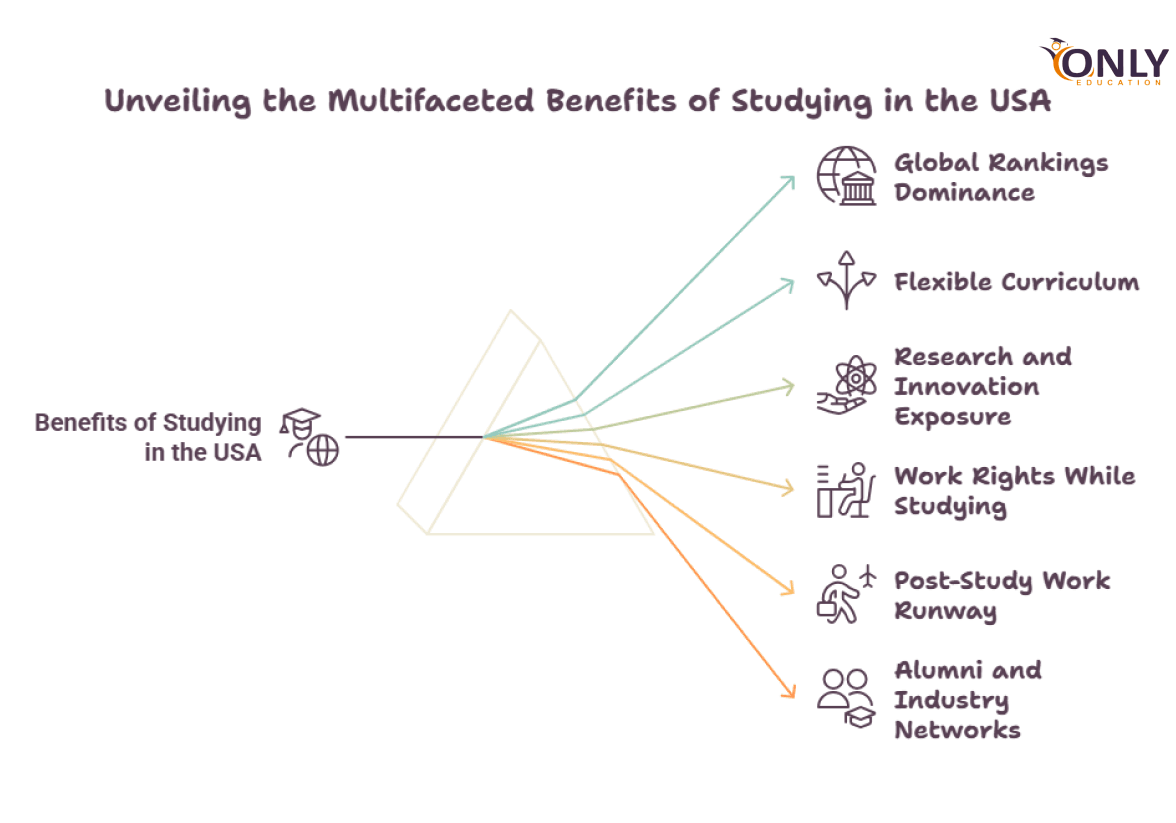
The USA offers Indian students unmatched access to globally top-ranked universities, cutting-edge research facilities, flexible curricula, strong industry connections, and a structured path to work experience through CPT and OPT factors that together produce a high long-term return on investment despite the steep upfront cost.
Academic and Career Benefits
- Global rankings dominance: A large share of the world's top-ranked universities by QS and THE metrics are American institutions, spanning STEM, business, medicine, and the humanities.
- Flexible curriculum: Unlike rigid degree structures in many countries, US programs allow credit transfers, minors, and interdisciplinary electives.
- Research and innovation exposure: US universities lead global R&D spending, giving graduate students access to funded labs, publications, and industry-sponsored research.
- Work rights while studying: F-1 visa holders can work up to 20 hours per week on campus during semesters, and full-time during scheduled breaks.
- Post-study work runway: Standard OPT gives 12 months of US work authorization after graduation; STEM graduates can extend this to 36 months total enough time for multiple H-1B lottery attempts.
- Alumni and industry networks: Proximity to hubs like Silicon Valley, Boston's biotech corridor, and New York's finance sector gives students direct access to recruiters and referral networks.
The ROI Angle
For a STEM master's graduate funding their degree through an education loan, full loan recovery typically takes 3–5 years of US employment, given that entry-level STEM salaries in 2026 commonly range from $85,000 to $130,000 annually. Over a full career, the earnings premium compared to an equivalent India-based role can be substantial which is why, despite rising costs, demand from Indian applicants hasn't slowed as much as tuition sticker shock might suggest.
Top Universities in USA for Indian Students
MIT, Harvard, Stanford, UC Berkeley, Carnegie Mellon, University of Michigan, Columbia, UT Austin, Purdue, and Arizona State University are consistently among the most popular choices for Indian students in 2026, balancing global rankings with strong Indian student communities and assistantship availability.
Elite Research Universities (Highest Global Rankings)
University | Known Strength | Notable For Indian Students |
| MIT | Engineering, Computer Science | Top-ranked globally, strong research funding |
| Harvard University | Business, Law, Public Policy | Large Indian alumni network |
| Stanford University | STEM, Entrepreneurship | Silicon Valley proximity |
| UC Berkeley | Engineering, Data Science | Strong public research funding |
| Carnegie Mellon University | Computer Science, Robotics | Highest Indian student enrollment in the US |
| Columbia University | Business, Journalism, STEM | High international student ratio |
High-Value Public Universities (Better ROI on Tuition)
University | Why It's Popular |
| University of Texas at Austin | Strong tech and engineering pipeline, lower in-state-adjacent costs |
| Purdue University | Renowned STEM and aerospace programs, large Indian community |
| Arizona State University | High research output, strong visa approval track record |
| University of Illinois Urbana-Champaign | Top-ranked engineering, accepts Spring intake |
| University of North Texas | Growing Tier 1 research status, budget-friendly |
Universities with the Largest Indian Student Populations
Carnegie Mellon, NYU, Johns Hopkins, and the University of Texas at Austin consistently host some of the largest Indian student communities in the country, which many applicants find valuable for cultural familiarity, mentorship, and campus support networks.
Practical tip: Don't chase brand name alone. A STEM master's from a well-ranked public university with an assistantship often delivers a better financial outcome than an unfunded seat at a prestigious private school.
Not sure which universities actually fit your profile and budget? Get a personalized, data-backed university shortlist from a verified consultant on OnlyEducation instead of guessing off a rankings list.
Cost of Studying in USA from India 2026
The total annual cost of studying in the USA from India in 2026 generally ranges from $35,000 to $70,000 (approximately ₹30–60 lakh), covering tuition, housing, food, insurance, and incidental expenses though costs can go as low as ₹20 lakh with strong funding or exceed ₹80 lakh at top private universities in expensive cities.
Tuition Fees by Program Type (Annual, Indicative)
Program | Public University | Private University |
| Bachelor's (UG) | $15,000 – $35,000 | $35,000 – $65,000 |
| Master's (MS/STEM) | $18,000 – $35,000 | $30,000 – $55,000 |
| MBA | $25,000 – $60,000 | $50,000 – $90,000+ |
| PhD | Often fully funded via assistantship | Often fully funded via assistantship |
Cost of Living (Monthly, Indicative)
Expense | Metro Cities (NYC, SF, Boston) | Mid-Size / College Towns |
| Accommodation (shared) | $900 – $1,800 | $500 – $1,000 |
| Food & groceries | $350 – $600 | $250 – $450 |
| Local transport | $80 – $150 | $40 – $100 |
| Utilities & phone | $150 – $250 | $100 – $180 |
| Total monthly | $1,500 – $2,800 | $900 – $1,700 |
One-Time and Mandatory Costs
- SEVIS I-901 fee: USD 350
- Visa application (MRV/DS-160) fee: USD 185
- Health insurance (university-mandated): $500–$3,500 per year depending on the plan
- Pre-departure costs (English tests, GRE/GMAT, application fees, flights): roughly ₹1.5–3 lakh combined
- Hidden first-90-days costs (security deposit, winter clothing, a laptop, initial furniture): budget an extra ₹2.5–5 lakh that most cost calculators skip entirely
Ways to Lower the Real Cost
- Choose a public university in a lower cost-of-living state (Texas, Indiana, North Carolina, or Arizona) over a private school in a metro city.
- Secure a Teaching or Research Assistantship (TA/RA), which frequently covers tuition and pays a monthly stipend.
- Apply for a health insurance waiver if you hold an equivalent private international student plan.
- Live off-campus with roommates instead of university-provided single housing.
- Apply for merit scholarships at the time of admission; most institutional aid is allocated automatically to top applicants, not through a separate application.
Bottom line: A well-funded STEM master's at a public university with a graduate assistantship can realistically bring the total cost down to ₹15–25 lakh a fraction of the "sticker price" quoted on university websites.
Want an accurate cost estimate for your specific profile? Request a free, personalized cost and funding plan from a study-abroad expert on OnlyEducation before you finalize your university list.
US Student Visa (F-1) Process 2026: Step-by-Step
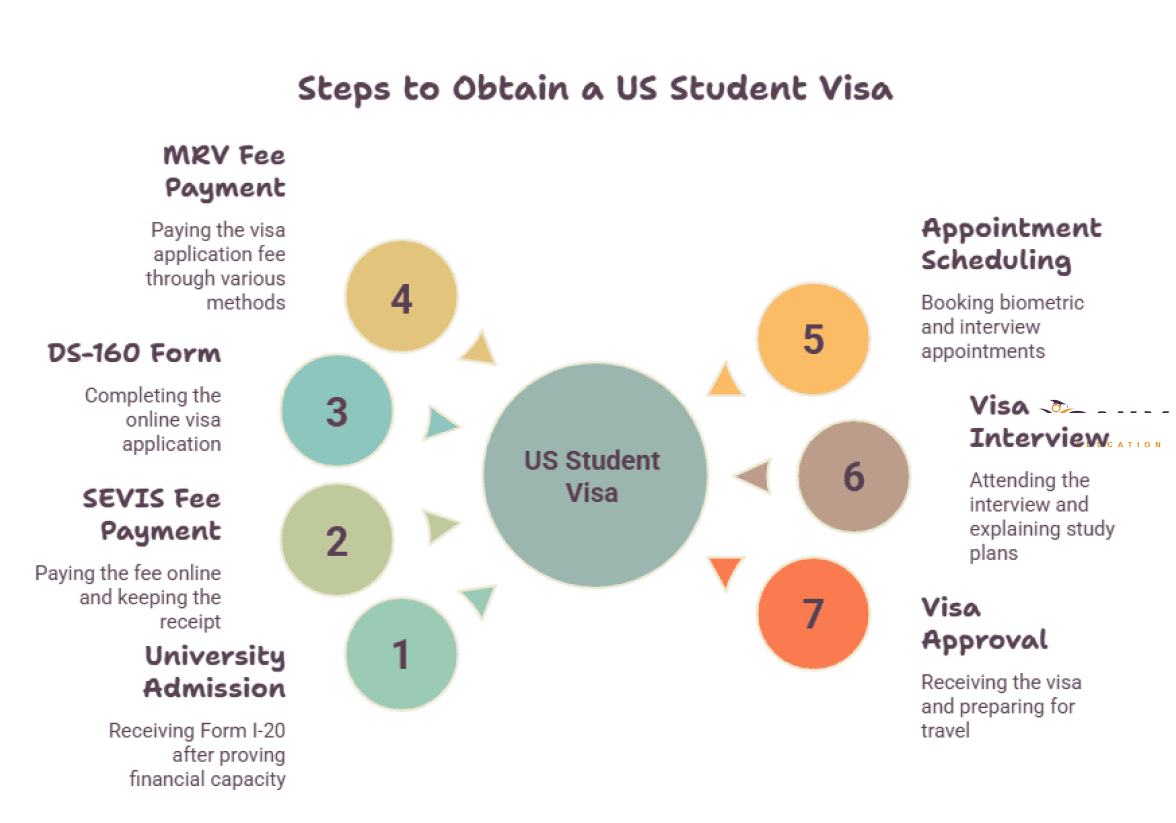
To get an F-1 student visa, Indian applicants must receive an I-20 from an SEVP-certified university, pay the SEVIS fee, complete the DS-160 form, pay the MRV application fee, schedule a biometric appointment, and attend a consular interview demonstrating genuine student intent, English proficiency, and sufficient financial proof.
Step-by-Step Guide
- Get admitted and receive Form I-20 issued only after you show the university proof of funds covering your first year of tuition and living costs.
- Pay the SEVIS I-901 fee Currently USD 350, paid online at fmjfee.com. Keep the receipt; you'll need it at the interview.
- Complete the DS-160 form The online non-immigrant visa application, submitted via the CEAC portal.
- Pay the MRV (visa application) fee, currently USD 185, payable via NEFT, IMPS, or designated bank counters.
- Schedule your biometric appointment and interview, available at US consulates in Delhi, Mumbai, Chennai, Kolkata, and Hyderabad. In 2026, wait times of one to two months are common in major cities, so book early.
- Attend the visa interview Be ready to clearly explain your choice of course and university, your funding source, and your intent to return to India after your studies.
- Receive your visa and prepare to travel Once approved, you can enter the US up to 30 days before your program start date.
Documents You'll Need
- Valid passport (with at least six months' validity beyond your intended stay)
- Form I-20 signed by both you and your school
- SEVIS fee receipt and DS-160 confirmation page
- Passport-size photo meeting US visa specifications
- Academic transcripts, standardized test scores (GRE/GMAT, IELTS/TOEFL)
- Financial documents: bank statements, fixed deposits, education loan sanction letter, or scholarship award letter typically showing liquid funds of $50,000–$80,000, depending on the university's total cost of attendance
- Statement of Purpose and any supporting admission correspondence
Visa Fee Snapshot
Fee | Amount (USD) | Approx. INR |
| SEVIS I-901 | $350 | ₹30,000–₹33,000 |
| MRV/DS-160 application | $185 | ₹16,000–₹18,000 |
| Total mandatory visa cost | ~$535 | ~₹46,000–₹49,000 |
Indian applicants are generally exempt from the separate visa issuance fee, though this and all figures should always be verified on the official US Department of State student visa page before payment, since fees and processing rules are revised periodically.
Preparing for your F-1 interview? Book a mock visa interview and document review with a specialist through OnlyEducation to walk in fully prepared and avoid last-minute rejections.
Scholarships and Funding Options
Indian students can fund a US degree through university-based assistantships (TA/RA/GA), merit and need-based institutional scholarships, and external fellowships like the Fulbright-Nehru Master's Fellowship, the Tata Scholarship for Cornell, and STEM-focused awards such as MPOWER's Udaan scholarship.
University-Based Funding (Graduate Students)
- Teaching Assistantship (TA): Assist professors with coursework in exchange for a tuition waiver plus a monthly stipend.
- Research Assistantship (RA): Support faculty research projects; usually comes with tuition support and a stipend.
- Graduate Assistantship (GA): Administrative roles (international office, library, career services) offering similar benefits to TA/RA but often overlooked by applicants worth asking about directly.
Stipends for these roles commonly range from $1,500 to $3,000 per month, which can offset a significant share of annual living costs.
External Scholarships Worth Targeting
Scholarship | Who It's For | Coverage |
| Fulbright-Nehru Master's Fellowship | Graduate students, leadership potential | Tuition, airfare, living stipend |
| Tata Scholarship for Cornell | Indian undergraduates admitted to Cornell | Substantial need-based aid |
| MPOWER Udaan India STEM Scholarship | Indian STEM students | Up to $5,000 |
| Inlaks Shivdasani Scholarship | Postgraduate study, all fields | Significant tuition support |
| University-specific merit aid | Based on GPA/GRE/GMAT scores | Varies, often automatic at admission |
Practical Advice on Funding
- Apply early most assistantships for a Fall intake are allocated by March, well before formal offer letters go out for many programs.
- Reach out to professors directly if you're targeting a research assistantship; faculty often shortlist candidates from students who've emailed them months in advance.
- Treat education loans as a complement to, not a substitute for, scholarship research even partial funding meaningfully reduces loan burden and interest paid over time.
Looking for scholarships and loan options that fit your course? Compare funding guidance from top study-abroad consultants on OnlyEducation and get matched with the right one for free.
Intakes: Fall vs Spring vs Summer
US universities admit international students across three intakes Fall (August/September), Spring (January), and Summer (May) with Fall being the most competitive but also the most advantageous for Indian students due to wider program availability, more scholarships, and earlier eligibility for summer internships.
Intake | Timing | Best For | Trade-off |
| Fall | August–September | Most programs, most funding, most assistantships | Most competitive; earliest deadlines (Nov–Dec) |
| Spring | January | Backup option; some universities (NYU, USC, Purdue) accept it well | Fewer scholarships; delayed CPT internship eligibility |
| Summer | May | Limited certificate/research programs | Narrowest choice of courses and universities |
Why Fall Usually Wins
Curricular Practical Training (CPT) the authorization that lets F-1 students take internships requires roughly nine months of enrollment before it can be used. A student starting in Fall 2026 completes that window by May 2027 and can intern that summer. A student starting in Spring 2027 only completes one semester by that point and misses the summer internship cycle entirely often pushing back their first real industry experience by a full year. For students targeting tech, engineering, or finance roles, this single detail is frequently the deciding factor between Fall and Spring.
Eligibility and Documents Checklist
Undergraduate applicants need a completed Class 12 certificate and often SAT/ACT scores; graduate applicants need a bachelor's degree, GRE or GMAT scores where required, English proficiency scores, letters of recommendation, and a Statement of Purpose.
Undergraduate Eligibility
- Completed Class 12 (10+2) with strong academic transcripts
- SAT or ACT scores (increasingly optional at some universities, but recommended)
- English proficiency: IELTS (6.5+), TOEFL iBT (79–100+), PTE, or Duolingo English Test
- Letters of recommendation and extracurricular records
Graduate Eligibility
- Bachelor's degree in a relevant field with a competitive GPA
- GRE (for most MS programs) or GMAT (for MBA programs) check per-program requirements, as many have gone test-optional
- English proficiency scores as above
- Statement of Purpose, resume/CV, and 2–3 letters of recommendation
Financial Documents for the I-20 and Visa
- Bank statements (often showing 2–3 years of financial history)
- Fixed deposit certificates
- Education loan sanction letter from an Indian or international lender
- Scholarship or assistantship award letters, if applicable
Post-Study Work: CPT, OPT & STEM Extension
F-1 students can gain US work experience through Curricular Practical Training (CPT) during their studies and Optional Practical Training (OPT) after graduation 12 months standard, extendable to 36 months total for STEM-designated degrees giving graduates a multi-year runway to work in the US before needing employer H-1B sponsorship.
The Three Work Authorization Types
- On-campus employment: Up to 20 hours/week during semesters, full-time during scheduled breaks available from day one without separate authorization.
- CPT (Curricular Practical Training): Off-campus internships tied directly to your degree curriculum, usable after roughly one academic year of enrollment.
- OPT (Optional Practical Training): Post-graduation work authorization 12 months for any F-1 graduate, with an additional 24-month extension exclusively for STEM-designated degrees, bringing the total to 36 months.
Why the STEM OPT Extension Matters
The 36-month STEM OPT window gives graduates multiple attempts at the H-1B visa lottery while already working and earning in the US a structural advantage non-STEM graduates don't have. This is one of the biggest reasons Indian students increasingly favor STEM-designated business and analytics programs over traditional non-STEM tracks, even within the same university.
How to Choose the Right University
Choose a US university by weighing program ranking, total cost versus available funding, location and cost of living, Indian/international student community size, and critically whether the program is STEM-designated for OPT eligibility, rather than ranking alone.
A Practical Decision Framework
- Program fit over overall rank: A university ranked lower overall but top-10 in your specific field often delivers better outcomes than a generalist "brand name" school.
- STEM designation: Confirm whether your specific program (not just the department) is classified as STEM under the CIP code system this single detail affects your OPT eligibility by 24 months.
- Total cost vs. funding realism: Compare sticker-price tuition against realistic assistantship or scholarship availability for international students in that specific program.
- Location and industry proximity: A school near your target industry hub (tech, finance, biotech) often means stronger internship and placement pipelines.
- Visa and international support services: Look at the university's international student office resources, F-1 compliance guidance, and CPT/OPT processing turnaround times.
- Indian student community: Not essential, but a meaningful factor for first-time international students seeking mentorship and cultural familiarity.
Common Mistakes Indian Students Make
The most frequent and costly mistakes are applying too late for assistantships, underestimating hidden first-year costs, choosing a non-STEM program without understanding its OPT limitations, and being underprepared for the financial-proof questions in the visa interview.
- Applying late for funding: Most graduate assistantships are allocated by March for Fall intake applying after this window means competing for leftover funds only.
- Ignoring Graduate Assistantship (GA) roles: These administrative positions offer benefits similar to TA/RA roles but are frequently overlooked simply because students don't know to ask about them.
- Underbudgeting hidden costs: Security deposits, winter clothing, laptops, and furniture routinely add ₹2.5–5 lakh that generic cost calculators don't include.
- Choosing a non-STEM track without realizing the OPT trade-off: A 12-month OPT window versus a 36-month one is a major career-planning difference that many applicants only discover after enrolling.
- Weak financial documentation: Visa officers scrutinize the source and seasoning of funds a bank balance that appeared suddenly right before the interview raises more questions than it answers.
- Treating the visa interview as a formality: Genuine student intent and clear ties to India (family, career plans, property) need to come across naturally, not memorized.
- Skipping health insurance waiver research: Students who don't check waiver eligibility often pay for a duplicate insurance plan unnecessarily.
Future of Study in USA: What Changes in 2026–2027
Expect continued tuition inflation of roughly 4–8% annually, tighter and slower visa processing at Indian consulates, growing emphasis on STEM-designated programs for OPT eligibility, and a gradual shift among Indian applicants toward high-ROI public universities over prestige-driven private ones.
Several dynamics are worth watching heading into the 2026–2027 admissions cycle:
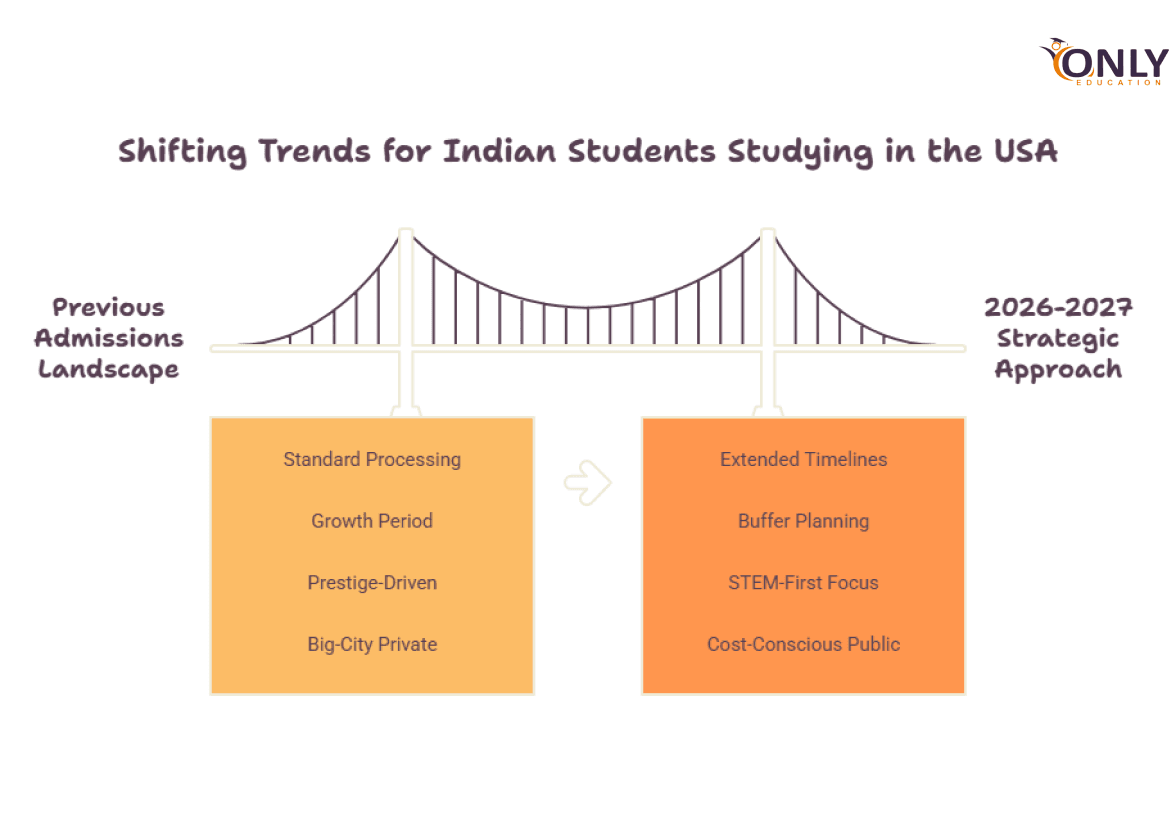
- Visa processing timelines: Interview wait times of one to two months in major Indian cities have become common, making early application and interview scheduling more important than in previous years.
- Rising scrutiny on admissions numbers: After a period of policy tightening, Indian student admits saw a notable dip in 2025 compared to the prior year's growth applicants should build extra buffer time into their timelines and avoid assuming the process will move quickly.
- STEM-first strategy: More business, analytics, and even some humanities-adjacent programs are being restructured to qualify for STEM designation, reflecting how central the 36-month OPT window has become to student decision-making.
- Cost-consciousness: With tuition inflation outpacing average family budgets, more Indian students are prioritizing public universities, assistantship-heavy programs, and mid-size cities with lower costs of living over big-city private schools.
- Diversification of scholarships: Funding is broadening beyond pure academic merit toward leadership potential, industry-specific grants, and STEM-targeted awards worth tracking closely if your profile fits a niche category.
Expert Insights
Education counselors who work with Indian applicants each cycle consistently flag three patterns:
- Fall intake advantage is underrated. The nine-month CPT eligibility clock means a Fall start effectively puts a student a full year ahead of a Spring starter in terms of real internship and job-market experience a detail rarely explained clearly by applicants until it's too late to change.
- Total cost of attendance, not tuition alone, should drive the university shortlist. Two programs with similar published tuition can have wildly different real costs once assistantship availability, city cost of living, and health insurance policies are factored in.
- The financial documentation trail matters more than the total amount. Consular officers are typically less concerned with exactly how much money a family has and more concerned with whether the funds have a clear, consistent, and traceable history sudden large deposits close to the interview date are a common red flag counselors advise against.
FAQs About Study in USA from India
1. How much does it cost to study in the USA from India in 2026?
The total annual cost typically ranges from $35,000 to $70,000 (approximately ₹30–60 lakh), covering tuition, accommodation, food, insurance, and incidental expenses. Costs can be lower with a public university and assistantship, or considerably higher at private universities in major metro cities.
2. What is the F-1 visa fee for Indian students in 2026?
The mandatory visa costs total approximately $535 a $350 SEVIS I-901 fee plus a $185 MRV/DS-160 application fee. Indian applicants are generally exempt from the separate visa issuance fee, but figures should be confirmed on the official US Department of State site before payment.
3. Which intake is best for Indian students Fall or Spring?
Fall (August–September) is generally the better choice. It offers the widest range of programs, the most scholarships and assistantships, and allows students to complete their CPT eligibility window in time for a first summer internship an advantage Spring intake students typically miss.
4. How much bank balance is required for a US student visa?
Applicants must typically demonstrate liquid funds covering at least one full year of tuition and living costs, generally $50,000–$80,000, though the exact figure depends on your specific university's total cost of attendance as listed on your I-20.
5. What is OPT and how long can I work in the US after graduation?
Optional Practical Training (OPT) is a work authorization for F-1 graduates lasting 12 months for any field, extendable to 36 months total for STEM-designated degrees through an additional 24-month STEM OPT extension.
6. Can international students work while studying in the USA?
Yes. F-1 visa holders can work up to 20 hours per week on campus during academic semesters and full-time during scheduled breaks. Off-campus work requires separate authorization through CPT or OPT.
7. Is a GRE or GMAT mandatory to study in the USA?
Not always. A growing number of MS and MBA programs have gone test-optional, but competitive programs at top-ranked universities may still require or strongly recommend GRE (for MS) or GMAT (for MBA) scores. Always check the specific program's current policy.
8. What are the cheapest ways to study in the USA?
Choosing a public university in a lower cost-of-living state, securing a teaching or research assistantship, opting for shared off-campus housing, and applying for a health insurance waiver are the most effective ways to reduce total costs sometimes bringing the annual out-of-pocket expense down to ₹15–25 lakh.
9. How early should I start preparing to study in the USA?
Most counselors recommend starting 10–18 months before your target intake enough time to complete standardized tests, build a strong Statement of Purpose, secure letters of recommendation, and account for the F-1 visa's processing timeline.
10. What is a STEM-designated degree and why does it matter?
A STEM-designated degree is a program officially classified under specific CIP codes tied to science, technology, engineering, or mathematics. Graduates from these programs qualify for the 24-month STEM OPT extension on top of standard 12-month OPT a major factor in long-term US work eligibility.
11. Do I need a separate visa for an MBA versus a Master's program?
No. Both use the same F-1 student visa category, provided the program is full-time and at an SEVP-certified institution. MBA admissions follow round-based deadlines rather than a single application date, but the visa process itself is identical.
12. Can Indian students get a full scholarship to study in the USA?
Fully-funded opportunities exist, particularly through PhD assistantships, the Fulbright-Nehru Fellowship, and select need-based aid at well-endowed private universities but full scholarships for master's and undergraduate programs are competitive and limited. A combination of partial scholarships, assistantships, and loans is the more common funding path.
Conclusion
Studying in the USA from India in 2026 is still one of the strongest global education investments available but it rewards careful planning far more than it used to. The gap between an applicant who budgets ₹25 lakh with an assistantship and one who ends up owing ₹70 lakh unprepared often comes down to a handful of decisions: which intake you choose, whether your program is STEM-designated, how early you apply for funding, and how well you understand the real, all-in cost before you commit.
Reading about universities, costs, and visas gets you informed. It doesn't get you admitted. The next move that actually determines your outcome is getting your specific profile grades, budget, target course, and timeline in front of someone who can turn it into a shortlist, an application plan, and a visa strategy.
That's exactly the gap OnlyEducation is built to close.
Apply Smarter: Get Matched With a Verified USA Study-Abroad Consultant
Instead of piecing together advice from a dozen blogs and forums, OnlyEducation's All-Abroad platform lets you compare and connect directly with top-rated, verified study-abroad consultants who specialize in US admissions, F-1 visas, and scholarship applications in one place, for free.
Why Start Your Application on OnlyEducation
- Compare consultants side by side ratings, reviews, service offerings, and specializations (MS, MBA, UG, PhD) before you commit to one.
- Get a free profile evaluation find out realistically which universities you qualify for based on your grades, test scores, and budget, not just rankings.
- Book visa and SOP support access mock F-1 interviews, document reviews, and Statement of Purpose editing from consultants who work with Indian applicants every cycle.
- Track scholarships and funding matched to your course instead of searching scattered scholarship pages, get a curated list relevant to your specific program and profile.
- Move at your own pace sign up, browse consultants, and only book paid services when you're ready. No pressure, no obligation to commit upfront.
How It Works
- Visit www.onlyeducation.in/all-abroad and create your free profile.
- Browse verified consultants filtered by destination (USA), course level, and city.
- Shortlist and connect with one or more consultants to compare their guidance and offerings.
- Get your personalized plan university list, cost estimate, scholarship matches, and a visa timeline built around your target intake.
Whether you're aiming for Fall 2026 or already planning ahead for Spring 2027, the earlier you connect with the right consultant, the more scholarship deadlines, assistantship windows, and visa interview slots you'll actually be able to use.