
NCERT Textbook Revisions Spark Maratha Protest at Azad Maidan, Mumbai

Published 9 Jun 20263 min read
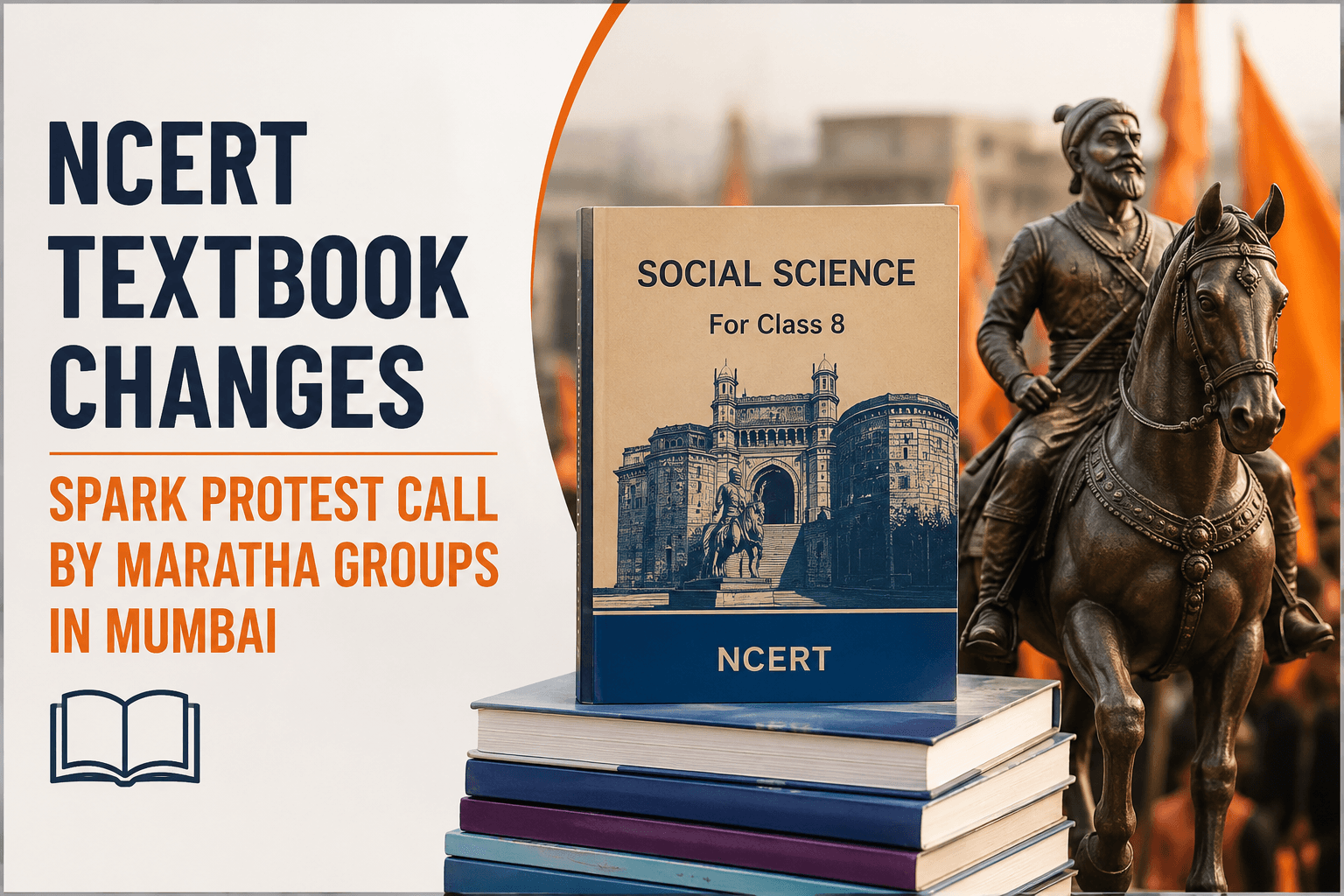
A fresh controversy has erupted over the National Council of Educational Research and Training's (NCERT) recent school textbook revisions, with the Maratha Kranti Morcha (MKM) calling for a major demonstration at Azad Maidan in Mumbai. The protest, which has rapidly gained momentum across Maharashtra, centers on allegations that key historical references to the Maratha Empire have been altered or significantly reduced in newly revised NCERT textbooks.
What Triggered the Protest
The Maratha Kranti Morcha has alleged that NCERT's revised textbooks — particularly the Class 8 history textbook — have either shortened or modified crucial sections related to the Maratha Empire and its rulers. The agitation is being led by Raje Mudhoji Bhosale, who has openly questioned the rationale behind these changes and accused the revision process of distorting historical understanding among students across India.
Bhosale stated that the Maratha Empire is not merely a chapter in regional history — it is a foundational part of India's broader national heritage. He argued that reducing or altering references to Maratha rulers in school textbooks sends the wrong message to young students and risks creating an incomplete or skewed narrative of Indian history.
Shivaji Maharaj at the Centre of the Controversy
The most sensitive aspect of the controversy is the representation of Chhatrapati Shivaji Maharaj, one of the most revered figures in Indian history. The MKM has emphasized that Shivaji Maharaj embodies the ideals of self-governance, military courage, administrative innovation, and cultural pride. Any dilution of his legacy in school textbooks, the group argues, is not just historically inaccurate — it is culturally unacceptable.
The issue has resonated deeply across Maharashtra, with multiple organizations and community groups extending their support to the protest call. What began as a focused criticism of specific textbook changes has quickly evolved into a broader conversation about historical representation and cultural identity in Indian education.
Key Demands of the Protesters
The protesting groups have put forward clear demands. They are calling on NCERT to immediately review the recent textbook revisions and restore the original content related to the Maratha Empire. Additionally, they are demanding greater transparency in the textbook revision process — urging authorities to involve historians, educators, and community representatives before any changes are implemented and published.
MKM has also called for a formal consultation mechanism that ensures historically significant content is not modified without adequate academic and community review.
The Broader Debate on Textbook Revisions
This controversy is part of a long-standing national debate around school curriculum updates and historical representation in India. Education experts and curriculum developers often argue that textbook revisions are necessary to incorporate new research, correct factual errors, and present more balanced perspectives. However, such updates — particularly those involving culturally significant figures, empires, or events — frequently trigger strong public reactions.
Critics of the revision process argue that changes are sometimes made without sufficient consultation, leading to public distrust. Supporters of curriculum reform, on the other hand, contend that history textbooks must evolve alongside academic understanding and should not remain static.
The NCERT textbook controversy in Maharashtra underscores the delicate balance that education authorities must maintain between academic revision and cultural sensitivity. As the protest builds ahead of the planned Azad Maidan demonstration, authorities are expected to monitor the situation carefully. The outcome of this agitation is likely to shape future discussions on how India's educational content is developed, reviewed, and aligned with public sentiment — particularly on subjects as emotionally significant as history.