
NEET PG 2026 College Shortlist: How to Compare Branch, Fees and Training

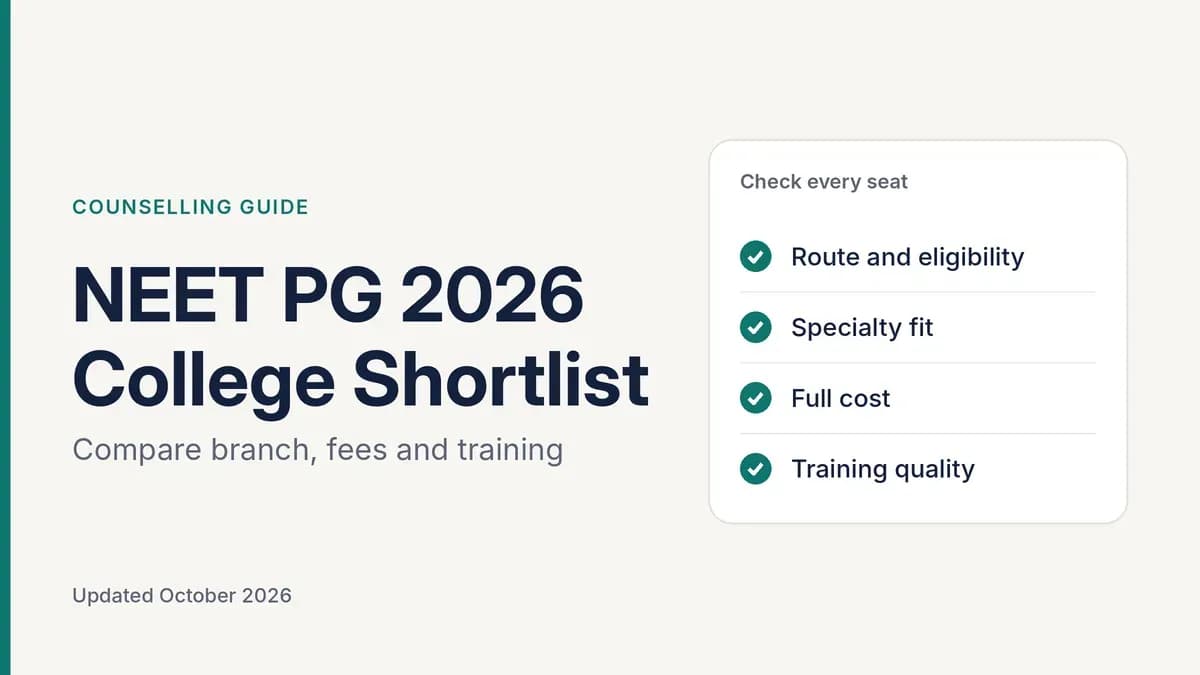
A good NEET PG 2026 college shortlist is a list of specific seats you are eligible for, can afford, and would genuinely join. Check every seat in this order: admission route and eligibility, specialty fit, full cost, and department training. A famous college name or last year's closing rank cannot answer these four questions on its own.
The 4 checks for every seat on your NEET PG choice list:
- Route and eligibility: Which counselling authority fills this seat, and do you qualify for its quota?
- Speciality fit: Would you be willing to train in this branch for three years?
- Affordability: Can you pay the first instalment on joining day and the full course fee?
- Training quality: Will the department give you supervised, hands-on learning?
Key terms used in this guide:
Term | Plain meaning |
MCC | Medical Counselling Committee, the central body that runs All India Quota, deemed university and central institute PG counselling |
AIQ (All India Quota) | The 50% share of seats in state government colleges filled through central counselling, open to candidates from any state |
Quota | A category of seats reserved for a defined group, such as state domicile, NRI or management |
Seat matrix | The official list of seats available in a counselling round, by college, course, quota and category |
Closing rank | The last rank that was allotted a particular seat in a particular round and year |
Deemed university | A self-governing university whose PG seats are filled through MCC counselling, usually with higher fees |
INI-CET | A separate entrance exam for AIIMS and some other national institutes; NEET PG ranks do not apply to these seats |
DNB | Diplomate of National Board, a PG qualification offered in accredited hospitals through NBEMS |
Compare seats, not college names
Write every option on your NEET PG college list as one full seat: institution + campus + course + quota + counselling authority. MD General Medicine and MD Microbiology at the same college are two different career decisions. The same course under a different quota can also carry different eligibility, fees, and conditions.
Which authority fills which seat:
Route | Seats it covers | Where to check |
MCC (central counselling) | 50% All India Quota seats in government colleges, deemed universities, central internal quota and DNB seats | MCC PG Medical Counselling |
State counselling | The state's share of government seats and most private college seats in that state | That state's current PG prospectus and seat matrix |
INI-CET (separate exam) | AIIMS, JIPMER, NIMHANS, PGIMER, SCTIMST and other listed national institutes | AIIMS Exams |
As of 15 October 2026, the MCC page lists four final 2026 seat matrices: All India Quota (MD/MS), Deemed (MD/MS), Central Internal Quota (MD/MS) and DNB. It also shows that Round 1 choice filling as resumed. Keep a separate record for each route, because each has its own rules.
Do not use your NEET PG rank to predict an INI-CET seat. INI-CET is a different exam. For the January 2027 session, the exam is scheduled for 1 November 2026, as reported by Medical Dialogues from the AIIMS prospectus. Confirm every date on the AIIMS exams before you plan around it.
Decide which specialities you can actually accept
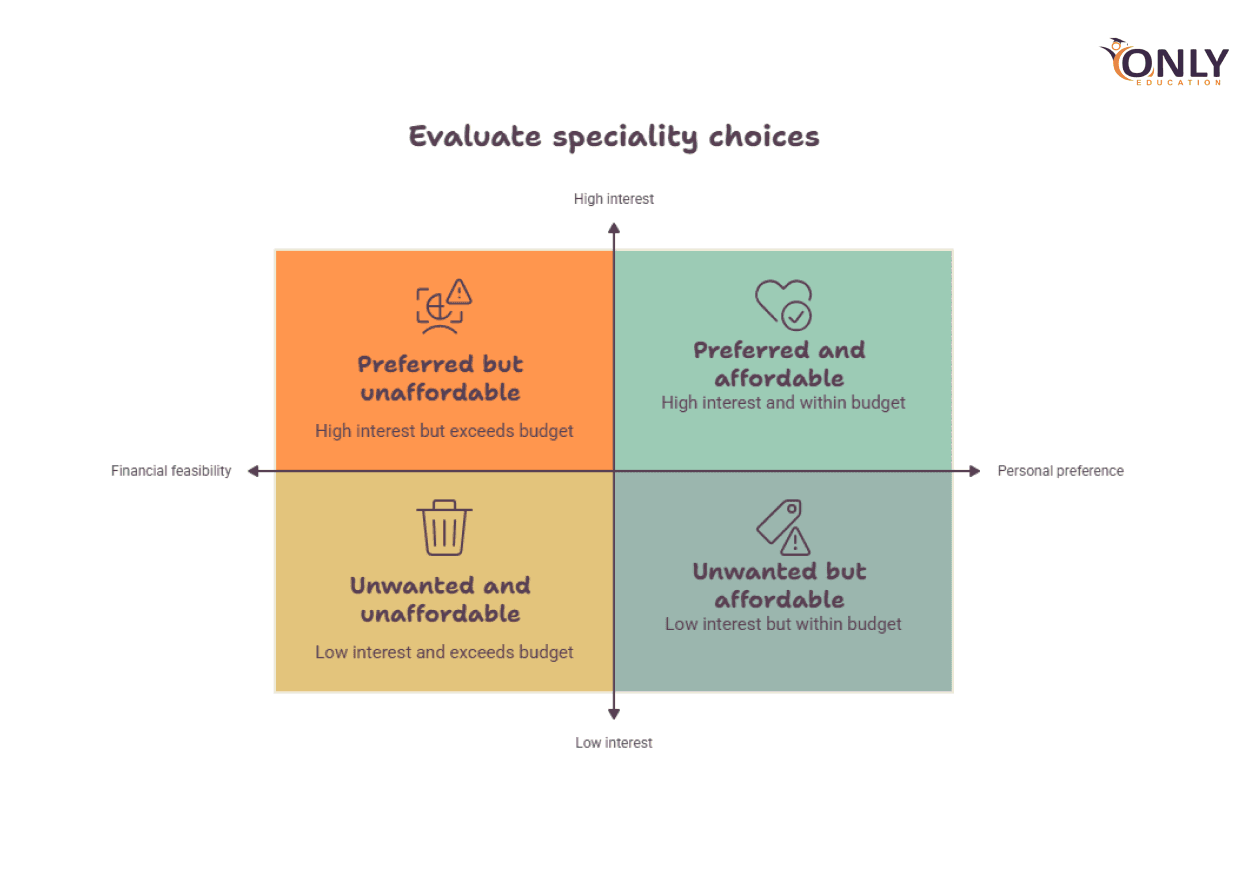
Sort every MD, MS or DNB branch into three groups before you look at colleges: preferred, acceptable, and will not join. Justify each choice by the daily work involved, not by an assumed salary or social status.
Ask yourself which kind of work you enjoy over three years:
- Sustained patient contact, such as general medicine or paediatrics
- Procedures and operating, such as the surgical branches
- Diagnostic interpretation, such as radiodiagnosis or pathology
- Laboratory work, such as microbiology or biochemistry
- Community and public health work, such as community medicine
- Teaching and academic research, possible in most branches
These interests overlap. Treat them as a starting point for discussion with seniors and mentors, not a test that assigns your speciality.
Two rules keep the shortlist honest. An affordable seat in a branch you do not want is still a poor choice. A preferred branch with a payment you cannot manage should not enter your final NEET PG choice list just because it might be allotted.
Read the whole fee row, not one "college fee"
A single "college fee" figure hides what you must pay, and when. The 2026–27 MD fees at KMC Manipal and KMC Mangalore, both deemed university campuses under MAHE, show why. These are published General-category figures and include a refundable caution deposit. They are not NRI-category fees and do not include living costs.
Campus and course | First instalment (on joining) | Total course fee (3 years) |
| KMC Manipal MD Radiodiagnosis | ₹34,01,000 | ₹1,01,83,000 |
| KMC Mangalore MD Radiodiagnosis | ₹34,01,000 | ₹1,01,83,000 |
| KMC Manipal MD General Medicine | ₹27,95,000 | ₹83,65,000 |
| KMC Mangalore MD General Medicine | ₹27,95,000 | ₹83,65,000 |
| KMC Manipal MD Microbiology | ₹14,13,000 | ₹42,19,000 |
| KMC Mangalore MD Microbiology | ₹14,10,000 | ₹42,10,000 |
Sources: KMC Manipal MD/MS Admissions 2026 fee document and KMC Mangalore MD/MS Admissions 2026 fee document, pages 1–2. The Mangalore document is marked "Updated on 07 October 2026 at 3 PM".
How one row breaks down (MD General Medicine): the first instalment is ₹17,30,000 tuition plus ₹10,55,000 other fees plus a ₹10,000 caution deposit, giving ₹27,95,000. The later instalments add ₹34,60,000 in tuition and ₹21,10,000 in other fees, giving the ₹83,65,000 total.
This table does not tell you which campus or branch trains better. It only shows the payment comparison you must make before judging affordability.
Scholarships: MAHE's merit scholarship page for PG programmes lists programme-fee scholarships for some MD branches, with seats limited by its policy. Check your eligibility separately, and never subtract an award you have not received in writing.
Build two budgets: the course budget and the joining budget
You need two separate numbers for every seat. The course budget covers the full training period. The joining budget is the cash you must have on reporting day, before any stipend, refund or loan money arrives.
Budget item | What to record |
Course charges | Tuition, other compulsory fees, instalment due dates and refundable deposits |
Counselling deposits | The counselling authority's security deposit and whether and when it is refunded |
Living costs | Hostel or rent, meals, utilities, transport and relocation |
Training costs | Required equipment, books, exam fees and thesis expenses |
Expected income | Stipend terms in writing and confirmed scholarships, with payment dates |
Risk costs | Withdrawal penalties, forfeited deposits and any service bond |
Joining the cash gap | Amount due on joining, minus money already in your account |
Worked example: suppose you are offered KMC Manipal MD General Medicine. The first instalment is ₹27,95,000. If you have ₹20,00,000 ready, your joining gap is ₹7,95,000 before hostel and travel. A stipend paid monthly later does not close that gap on joining day. This is not a loan recommendation.
Count a refundable deposit only once. Keep it in the cash-needed column until it is actually returned, and note the expected refund separately.
Investigate the department you will actually train in
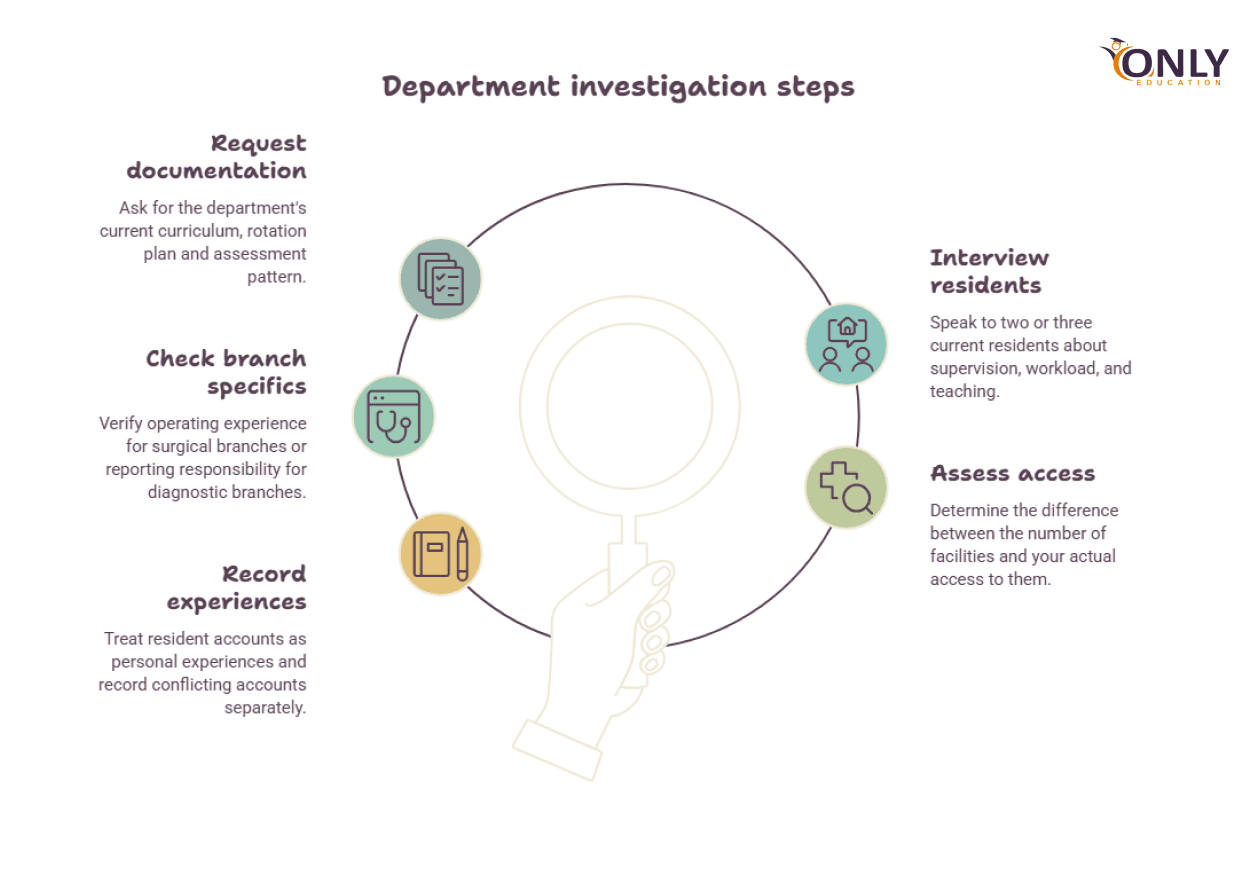
A campus brochure shows the hospital, but not how much supervised work one resident gets. For each shortlisted seat, ask for the department's current curriculum, rotation plan and assessment pattern. Then speak to two or three current residents of that department.
Questions to ask residents:
- Who supervises procedures, and how quickly does responsibility increase?
- How are patients and cases shared among residents in the same year?
- What does a difficult night duty look like, and who is available for help?
- Is there protected teaching time, such as case presentations and journal clubs?
- How are thesis guides assigned, and how often do you get feedback?
Branch-specific checks:
- Surgical branches: step-by-step supervised operating experience across the three years
- Diagnostic branches: reporting responsibility, case discussions, and supervision of reports
- Every branch: the difference between the number of facilities and your actual access to them
Treat resident accounts as named personal experiences, not audited data. If two accounts conflict, record both and ask the department to clarify. Do not average opinions into an invented score.
Use closing ranks only as labelled evidence
A past closing rank is useful only when it carries six labels: year, round, quota, category, course and campus. Without them, the number cannot be compared with your rank. Take ranks from the counselling authority's own published allotment results, not from screenshots or forwarded lists.
Label your worksheet needs | Example entry |
| Year and round | 2025, Round 2 |
| Counselling authority and quota | MCC, Deemed university |
| Category | Open |
| Course and campus | MD Radiodiagnosis, KMC Manipal |
| Closing rank | Copied from the official allotment list for that exact row |
A past allotment does not promise the same result in 2026. Seat numbers, other candidates' choices, and the rules can all change. Use history to build a range of acceptable choices, and never treat any NEET PG college predictor result as a guarantee.
Avoid universal tables such as "AIR 500 means this college". They hide the round, quota, and category that decide whether the comparison applies to you.
Resolve bonds, refunds and eligibility before you lock choices
For every seat, read the current counselling and institute documents on four points: withdrawal rules, fee refunds, joining conditions, and any service bond. A service bond is a written promise to work for a set period, often in government service, or pay a penalty. Record the exact clause, the document name, its date, and the authority that issued it.
A rule from another state, another quota or last year's brochure is not a substitute. Rules for state seats come from that state's counselling authority:
- Karnataka: the Karnataka Examinations Authority (KEA) runs state PG medical counselling
- Maharashtra: the State Common Entrance Test Cell runs state PG medical counselling
- Every other state on your list: use that state's current PG prospectus
Do not treat these four things as the same: where you studied MBBS, your domicile (official state of residence), your in-service status, and your quota eligibility. Each state defines them in its own prospectus.
Ask unresolved questions in writing. A seat with an open question about cost or eligibility goes into a needs clarification group, not your final choice list.
Turn your research into an ordered NEET PG choice list
Put every seat through three filters, in this order, before you rank anything:
- Eligible: you qualify for this quota under the current rules
- Affordable: you can meet both the joining budget and the course budget
- Acceptable: you would genuinely join this branch at this campus
Rank only the seats that pass all three by your real preference. Follow the counselling authority's current instructions for choice filling and locking, then save the locked choice list and its acknowledgement page.
Shortlist worksheet (one row per seat):
| Field | What the student should enter |
|---|---|
| Course and campus | Exact specialty, college and campus |
| Route and quota | MCC/State/INI-CET + applicable quota |
| Source and date | Official fee/prospectus/seat-matrix source + date checked |
| First payment | Amount needed at joining/admission |
| Total budget | Full course cost + estimated living/training expenses |
| Training evidence | Resident feedback, rotations, case/procedure exposure, supervision |
| Obligations | Bond, service rules, withdrawal/refund conditions, penalties |
| My rank | Your preference order for this seat |
For current registration, choice filling, and reporting dates, always return to the responsible counselling authority rather than an evergreen guide. For related reading, browse ONLY EDUCATION's article collection.
End with one question for every seat: "If this is the seat I am allotted, am I ready to join it?" A good shortlist answers 'yes' for every choice before allotment day.
Frequently asked questions
Should I choose the branch or the college first in NEET PG counselling?
Decide your acceptable branches first, then compare colleges within them. A top college in a branch you will not enjoy is a weak choice for a three-year residency.
What is the difference between AIQ, state quota, and deemed university seats?
AIQ seats are the 50% share of government college seats filled centrally by MCC. State quota seats are filled by each state's counselling authority under its own domicile rules. Deemed university seats are filled through MCC and usually carry much higher fees.
Can I get an AIIMS or PGIMER seat with my NEET PG rank?
No. AIIMS, JIPMER, NIMHANS, PGIMER, SCTIMST, and other listed national institutes admit through INI-CET, a separate exam run by AIIMS New Delhi. Plan for it separately on AIIMS Exams.
How much does an MD cost in a deemed university?
It varies widely by branch and campus. For the three branches in the table above, KMC Manipal's published 2026–27 General-category totals run from ₹42,19,000 (MD Microbiology) to ₹1,01,83,000 (MD Radiodiagnosis). Pre-clinical branches cost less. Always add living costs and check the current fee document.
Are previous years' NEET PG closing ranks reliable?
They are useful evidence, not predictions. Use only ranks labelled with year, round, quota, category, course, and campus, taken from official allotment results.
Is the MCC security deposit refundable?
The counselling authority's rules decide when a deposit is refunded or forfeited. Read the current MCC Information Bulletin before you lock choices, because these rules can change each year.
Do deemed universities pay a stipend to PG residents?
Many publish stipend details, but amounts and terms differ by institution and year. Get the current written stipend terms from the institute, and do not count on money you have not confirmed.
When was NEET PG 2026 held?
NEET PG 2026 was conducted on 30 August 2026 by the National Board of Examinations in Medical Sciences (NBEMS). For results and scorecard details, check the official NBEMS website.