
The Counselling PDF You Opened May Not Be Your Result

One counselling website can publish a brochure, schedule, seat matrix, merit list, provisional result, final result, allotment letter and reporting notice within a few days.
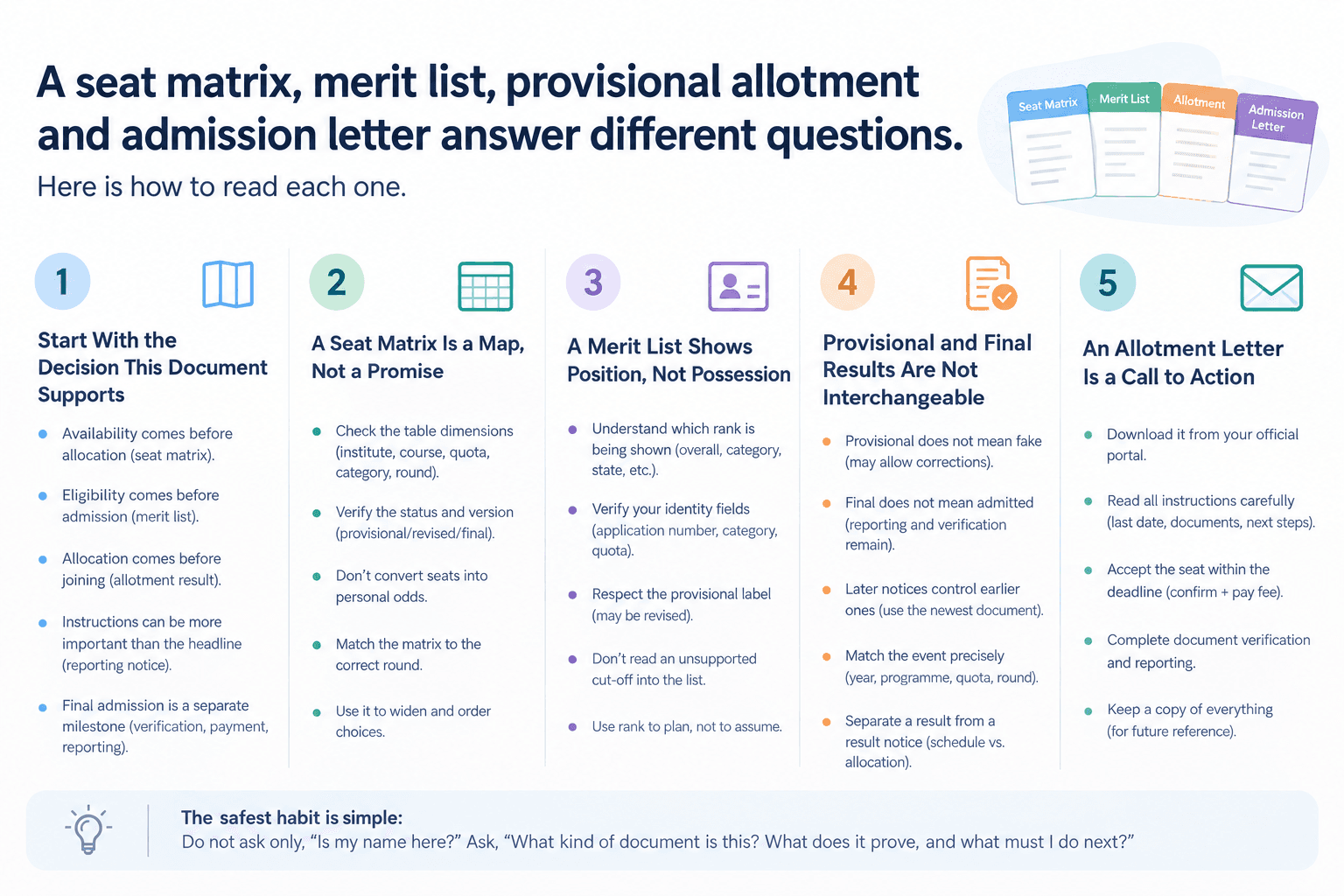
A seat matrix, merit list, provisional allotment and admission letter answer different questions. Here is how to read each one.
One counselling website can publish a brochure, schedule, seat matrix, merit list, provisional result, final result, allotment letter and reporting notice within a few days. They may all contain colleges, courses, categories and dates, but they do not give you the same right or require the same action.
Disclosure: This story was prepared with the assistance of an AI writing program and verified against the official sources linked below. It is provided for editorial review and should be checked once more against the reader’s own counselling authority before use.
The safest habit is simple: do not ask only, “Is my name here?” Ask, “What kind of document is this? What does it prove, and what must I do next?”
1. Start With the Decision This Document Supports
- Availability comes before allocation. A seat matrix helps you see which options are in the pool for a course, institute, quota, category and round. It does not tell you that one of those seats belongs to you.
- Eligibility comes before admission. A merit or rank list usually shows who is eligible and in what relative order the authority will consider candidates. It does not guarantee that every listed person will receive a seat.

- Allocation comes before joining. An allotment result records a seat assigned under a particular round’s rules. You may still need to accept it, pay a fee, upload documents or report to the institution.
- Instructions can be more important than the headline. The result may say you received a seat, but the linked reporting notice tells you how to keep it. Missing that later step can undo the value of the result.
- Final admission is a separate milestone. In some systems, admission is confirmed only after document verification, payment and reporting are complete. Treat every earlier document as one stage in a chain, not the entire journey.
2. A Seat Matrix Is a Map, Not a Promise
- Read the dimensions of the table. A useful seat matrix identifies the institute, programme or branch, quota, category and counselling round. If even one of those dimensions is wrong for you, the displayed number may not describe your competition.
- Check the status and version. Authorities may label a matrix provisional, revised or final, and a later version can add, remove or redistribute seats. Save the publication date and version used while arranging choices.
- Do not convert seats into personal odds. A visible seat count does not reveal how other candidates will order their preferences or how category and upgrade rules will affect movement. It is an input for planning, not a prediction engine.
- Match the matrix to the correct round. A Round 2 or Round 3 matrix can look different from the opening round because candidates accept, upgrade, resign or fail to report. Never use an old matrix as if it describes the current choice window.
- Use it to widen and order choices. The practical value of a matrix is to identify realistic options you are genuinely willing to join. It should support a preference strategy, not tempt you to add a college you have not researched.
3. A Merit List Shows Position, Not Possession
- Understand which rank is being shown. A document may list an overall rank, category rank, state rank or another programme-specific order. The rank relevant to allocation depends on the authority’s published rules.
- Verify your identity fields. Check your application number, spelling, category, quota and displayed eligibility status against your records. A mismatch should be raised through the official grievance route within the permitted period.
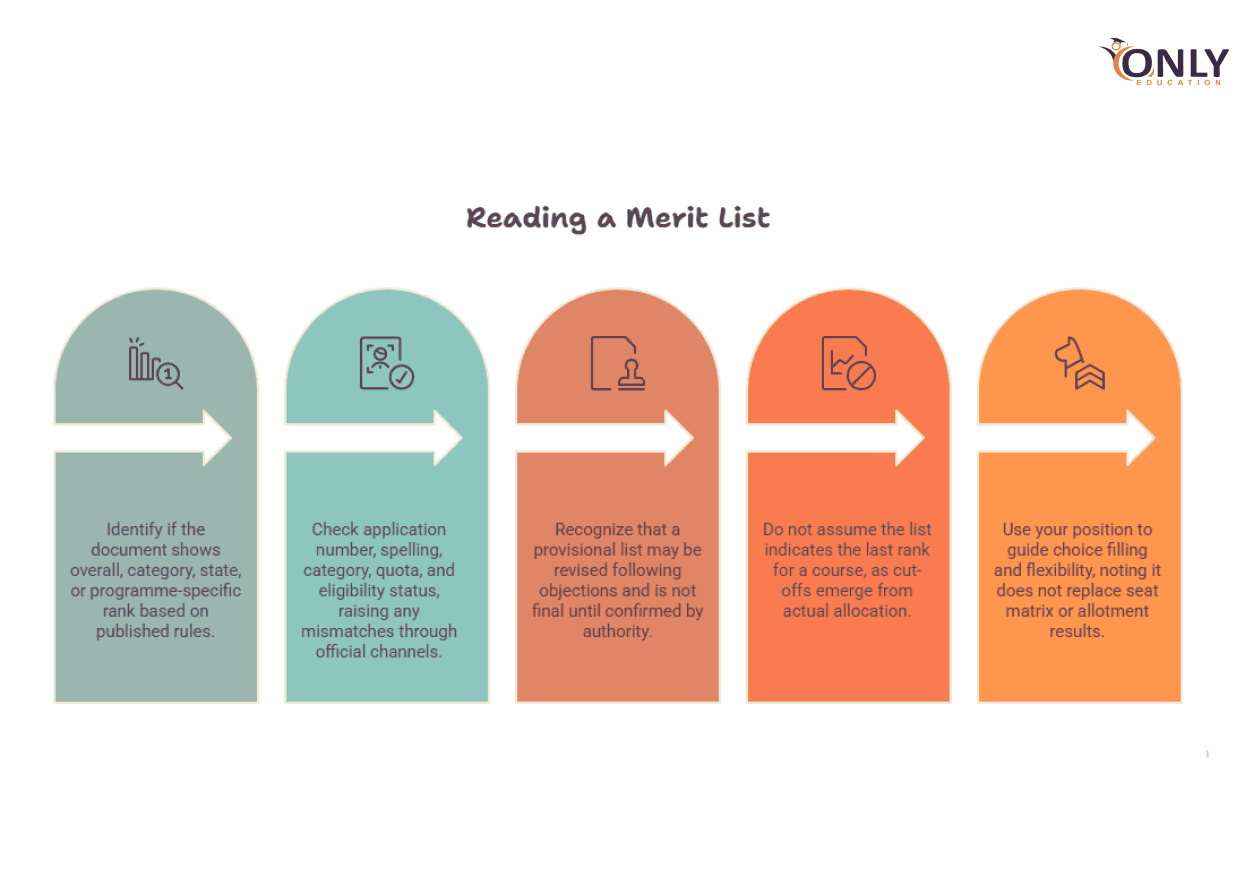
- Respect the provisional label. A provisional merit list may be followed by objections and a revised or final list. It is useful, but you should not describe it as final until the authority does.
- Do not read an unsupported cut-off into the list. A merit list tells you the order of candidates, not automatically the last rank that will receive every course or college. Cut-offs emerge from actual allocation and can move across rounds.
- Use rank to plan, not to assume. Your position can guide how widely you fill choices and how much flexibility you keep. It cannot replace the seat matrix, choice rules or round-specific allotment result.
4. Provisional and Final Results Are Not Interchangeable
- Provisional does not mean fake. It usually means the authority has not yet given the document final controlling status and may allow corrections or grievances. You should still read it immediately because it may trigger a deadline.
- Final does not mean admitted. A final allotment can settle the allocation for that round while reporting and document verification remain incomplete. Look for the candidate letter and joining instructions before assuming the process is over.
- Later notices control earlier ones. If a revised or final result is published, compare it with the provisional version and use the newest controlling document. Keep the old copy for history, not for current action.
- Match the event precisely. Check the academic year, programme, quota, round and result type before searching for your candidate number. Counselling portals often keep older documents visible, making the correct PDF from the wrong cycle surprisingly easy to open.
- Separate a result from a result notice. One file may explain the schedule and another may contain the allocation, while the candidate login produces your individual record. Read all linked official material before deciding what the result requires.
5. An Allotment Letter Is a Call to Action
- Download it from your official account. A candidate-specific allotment letter may show the institution, programme, quota, round and reporting conditions that apply to you. Save the original file instead of relying on a forwarded screenshot.
- Find every deadline. Acceptance, fee payment, document upload and reporting can have different cut-offs. Put all of them into a checklist rather than remembering only the final date.
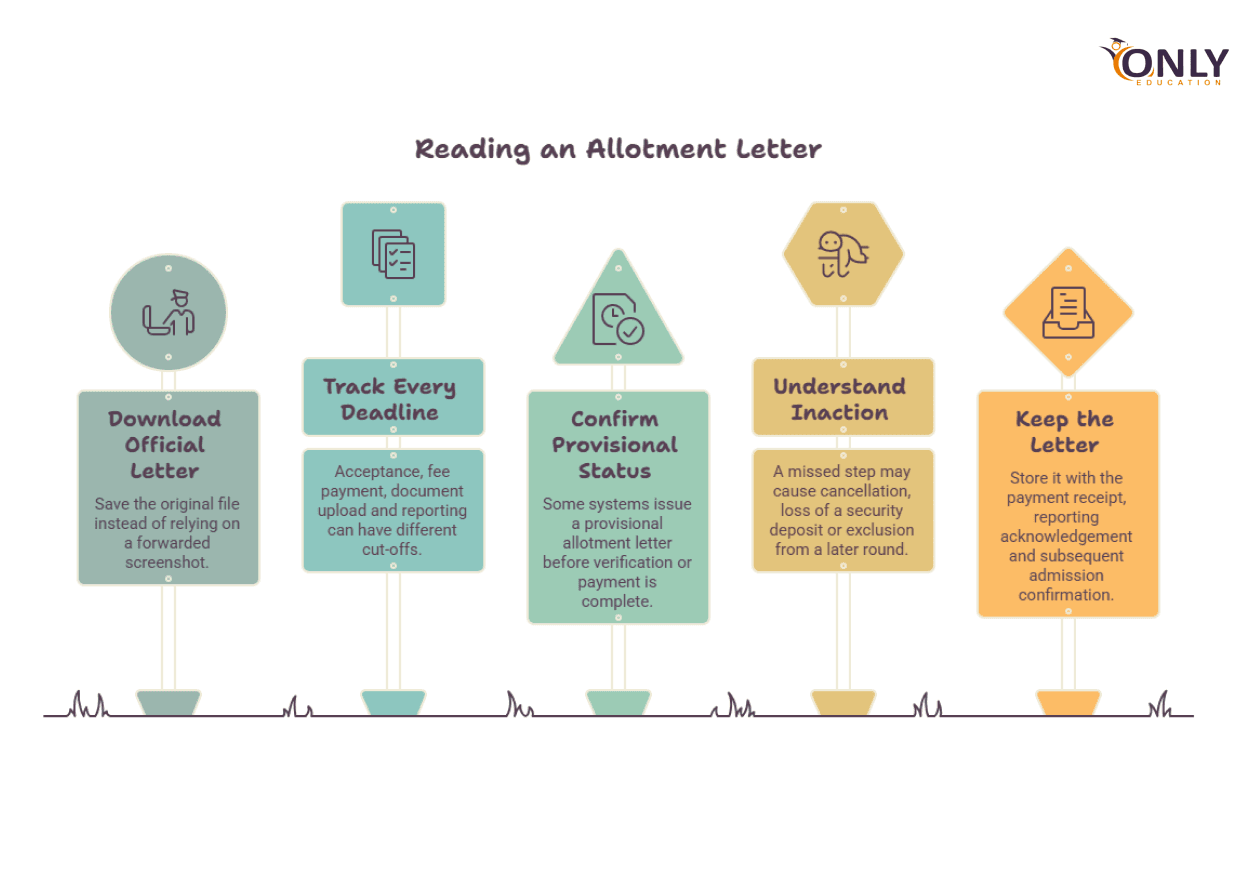
- Check whether the seat remains provisional. Some systems issue a provisional allotment letter before verification or payment is complete. The word “allotted” alone does not always mean the institution has completed admission.
- Read the consequence of inaction. A missed step may cause cancellation, loss of a security deposit or exclusion from a later round, depending on the applicable rules. Do not borrow consequences from another examination or last year’s brochure.
- Keep the letter after joining. It helps establish the round and conditions under which the seat was offered. Store it with the payment receipt, reporting acknowledgement and subsequent admission confirmation.
6. Reporting and Verification Turn Allocation Into Admission
- Treat reporting as a separate process. The counselling authority may allocate the seat while the college verifies originals and completes institutional admission. Two official systems may therefore require attention on the same day.
- Prepare originals and copies early. The reporting notice normally identifies certificates, photographs, identity documents and eligibility records to carry or upload. Build the folder before the result so a short reporting window does not become a crisis.
- Confirm the payment channel. Use only the method listed by the official authority or institution and save the receipt. If fee information is unclear, verify it with the allotted college before transferring money.
- Ask for acknowledgement. Preserve the portal status, signed reporting slip, fee receipt or admission letter showing that your action was accepted. A successful transaction message alone may not prove that document verification is complete.
- Check what follows verification. The current MCC NEET-PG 2026 scheme separates allotment and publication of the result from physical reporting, verification and admission. Other authorities may structure the process differently, so apply the rules for your programme and year.
7. Vacancy Language Can Hide Conditions
- A vacancy is not always an empty chair. A vacancy list can include seats that are unallotted, newly added, returned, resigned or conditionally expected to open. The label beside the seat matters as much as the number.
- MCC distinguishes clear-cut and virtual vacancies. In its NEET-PG 2026 scheme, clear-cut vacancies are Round 1 seats that were not allotted. That is different from a seat currently held by someone seeking an upgrade.
- A virtual vacancy depends on another result. MCC describes it as a seat held by a Round 1 candidate who opted for an upgrade; it becomes available only if the candidate moves to a higher preference. It should not be treated as a guaranteed vacancy.
- Definitions do not travel automatically. Another counselling authority may use different labels or assign different consequences to a vacancy. Check the current official brochure instead of applying an MCC definition everywhere.
- Your choice strategy should survive movement. Include only options you would genuinely accept and arrange them in your real preference order. A fluctuating vacancy list is a reason to plan broadly, not a reason to place an unwanted college higher.
8. Build a Five-Minute Verification Workflow
- Start from the authority’s homepage. Navigate to the notice or counselling section instead of trusting a forwarded document link. This helps you identify corrections, extensions and newer results.
- Match five identifiers. Confirm the programme, academic year or session, state or national quota, category and round. If one identifier does not match, stop before taking action.
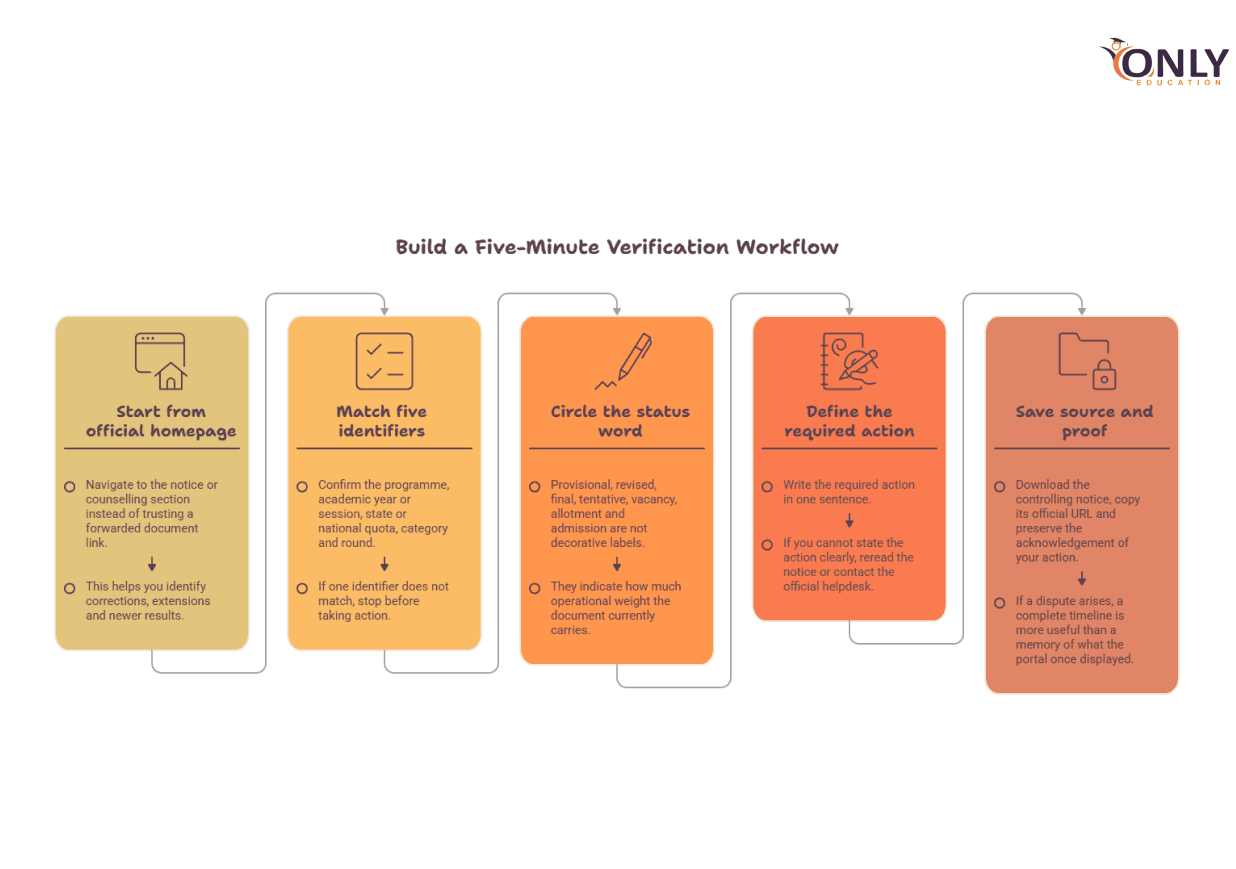
- Circle the status word. Provisional, revised, final, tentative, vacancy, allotment and admission are not decorative labels. They indicate how much operational weight the document currently carries.
- Write the required action in one sentence. For example: “Pay the acceptance fee and report online before the stated time.” If you cannot state the action clearly, reread the notice or contact the official helpdesk.
- Save the source and proof. Download the controlling notice, copy its official URL and preserve the acknowledgement of your action. If a dispute arises, a complete timeline is more useful than a memory of what the portal once displayed.
9. Keep a Document Chain That Tells the Whole Story
- Begin with rules and schedules. Store the brochure, counselling scheme and revised calendars in one authority-specific folder. These documents explain what later results mean and which deadlines control them.
- Separate public files from personal documents. Keep seat matrices and merit lists apart from login-generated allotment letters and receipts. This reduces the chance of sharing a document containing personal data.
- Use numbered filenames. A sequence such as 01-rules, 02-schedule, 03-seat-matrix, 04-merit-list and 05-allotment creates an instant timeline. Add the publication date when two versions share the same title.
- Mark superseded files. Do not delete an old provisional result, but rename it clearly after a final or revised document appears. You preserve history without accidentally acting on outdated information.
- Finish with admission proof. Your folder should end with the reporting acknowledgement, fee receipt and admission or joining confirmation available in your system. That record is more meaningful than a screenshot of the original seat matrix.
Final Thought
Counselling rarely fails students because they cannot open a PDF. It fails them when they give the wrong PDF the wrong meaning.
A seat matrix is possibility. A merit list is position. An allotment is a decision for one round. Reporting and verification turn that decision into admission.
Learn that sequence once, and every counselling portal becomes easier to read.
If this guide helped you identify a document you were unsure about, share the document type not your personal details in a response, and follow Only Education for more verified student guides.
Direct Official References
- MCC PG Medical Counselling: https://mcc.nic.in/pg-medical-counselling/
- MCC NEET-PG 2026 Information Bulletin and Counselling Scheme: https://cdnbbsr.s3waas.gov.in/s3e0f7a4d0ef9b84b83b693bbf3feb8e6e/uploads/2026/10/202610082121348550.pdf
- MCC PG Counselling 2026 Schedule: https://cdnbbsr.s3waas.gov.in/s3e0f7a4d0ef9b84b83b693bbf3feb8e6e/uploads/2026/10/202610071411981089.pdf