
MD/MS or DNB: Choosing the Training Behind the Qualification

Most candidates treat DNB as the consolation prize they accept when the rank does not land an MD seat. The official documents tell a more complicated story. One route is capped by a regulator at a fraction of the other's cost and pays a compulsory stipend; the other trains you in a hospital held to higher minimum standards on almost every measure that matters. This is an attempt to put real numbers on both sides and to be honest about the point where the numbers run out.
The question is not which degree is better
Every counselling season I watch the same argument go round. One side says a DNB is just as good as an MD and anyone who says otherwise is a snob. The other side says a DNB is a second-class qualification and you will regret it. Both camps argue about the certificate, and the certificate is the least interesting part of this.
For practicing as a specialist, the two qualifications do the same job. The real differences are four, and all of them are about the programme behind the qualification rather than the letters at the end of it: what you pay and what you are paid, who sets and marks your exit examination, what kind of hospital you spend three years inside, and one condition in the NMC Act that decides whether your degree is equivalent for a teaching post.
Three of those four favour the DNB more often than people expect. The fourth is a trap that nobody mentions at counselling.
Everything below comes from the documents both systems publish, and where there is no official answer, I say so rather than filling the gap. The most useful thing I found was not a missing number but a published one: a figure everybody quotes in this argument, which measures something other than what they think it measures.
What actually differs?
| MD / MS | DNB | |
|---|---|---|
| Who awards it? | A state health university, under the NMC | The National Board of Examinations in Medical Sciences, a single national body |
| Where you train | A medical college with an attached teaching hospital | An accredited hospital. Roughly 3 in 4 of the seats in central counselling are in private hospitals |
| Who sets your exit exam? | Your own university, with internal and external examiners | NBEMS, one common paper for the whole country |
| Course length | 3 years | 3 years |
| Registration as a specialist | Yes | Yes. |
| Eligible for NEET SS | Yes | Yes, on the same footing. |
| Equivalent for a medical college faculty post | Yes | Conditionally. It depends on your training hospital's bed count. |
How many seats are we talking about?
The NMC's seat matrix dated 29 September 2026 lists 58,466 MD, MS and Diploma seats for 2026-27, rising to 63,177 once DM and MCh are counted. Against that, the DNB matrix in central counselling carries 9,201 seats.
One correction worth making, because the 9,201 figure gets quoted carelessly: that matrix is not all DNB degrees. Parsing it row by row, 6,731 of those seats are DNB or DrNB degree seats and 2,470 are the NBEMS post-MBBS Diploma a shorter, different qualification that is not a DNB. The two reconcile exactly to 9,201. So the DNB degree pool in central counselling is about a quarter smaller than the headline number suggests.
The Health Minister told the Lok Sabha on 7 August 2026 that India has 86,360 postgraduate medical seats in total. That reply does not break the figure into NMC and NBEMS shares, and the state-level numbers in it sit on a different basis from the NMC matrix, so I am not going to subtract one from the other and present the result as an official split. If you see that subtraction quoted anywhere, it is somebody's arithmetic, not a published figure.
Passing the exam is no longer the constraint.
One piece of context changes how you should read every rank in this article. For NEET PG 2025, on the Health Ministry's direction, the qualifying percentile was cut at the third round of counselling:
| Category | Original criterion | Score | Revised criterion | Revised score |
|---|---|---|---|---|
| General and EWS | 50th percentile | 276 | 7th percentile | 103 |
| General PwBD | 45th percentile | 255 | 5th percentile | 90 |
| SC, ST, OBC, including their PwBD | 40th percentile | 235 | 0th percentile | minus 40 |
That last figure is not a misprint. NEET PG awards 4 marks for a correct answer and deducts 1 for a wrong one, so a candidate can finish below zero, and at the 0th percentile the cut-off falls to the lowest score anyone actually obtained. In effect, every reserved-category candidate who sat the paper became eligible to be allotted a postgraduate seat.
Draw the obvious conclusion. When a system drops its entry bar from the 50th percentile to the 7th to fill seats, the examination has stopped being what limits entry to postgraduate medicine. The seat matrix is doing that, and the shortage was never of qualified candidates.
For the current cycle, 2,63,544 candidates sat NEET PG on 30 August 2026. The paper is now marked out of 720 rather than 800, and the original cut-offs are 262, 244 and 226 for the three category groups. As of the middle of October no reduction has been notified for 2026 and counselling is still at Round 1 but in both 2024 and 2025 the reduction came only at Round 3, so a candidate below the line now should not assume the line is final.
What the numbers do establish is the shape of the choice. DNB is not a fringe route it is about three in every ten seats in central counselling. But it is a much smaller system than MD/MS, spread across more than twice as many hospitals, which is where this article ends up.
Whether DNB is even an option depends on your speciality.
This is the part I had not expected, and I have not seen it published anywhere.
Across everything, DNB degree seats are 10.3% of combined MD/MS and DNB capacity. That number is close to useless, because the figure in the specialty you actually want ranges from 2% to 86%.
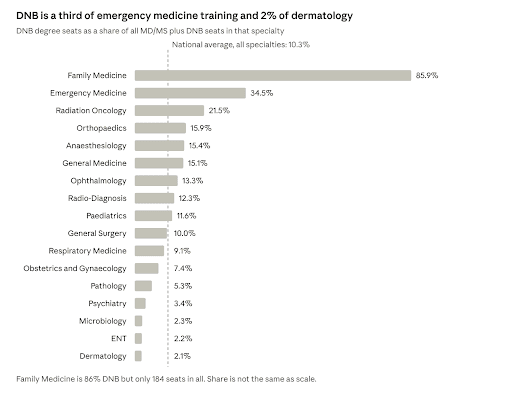
My own computation. MD/MS from the NMC seat matrix dated 29 September 2026; DNB degree seats from the MCC final DNB matrix uploaded 15 October 2026.
Read down that chart as a candidate and the strategy writes itself.
If you want Dermatology, DNB is not a fallback. There are 41 DNB seats in the country against 1,875 MD seats. The same is true of ENT at 47 seats, Microbiology at 44 and Psychiatry at 56. In these specialties the DNB route barely exists, and any advice to "keep DNB as a backup" is advice to apply for something that is not there. This is also part of why Dermatology ranks are brutal: the overflow valve other specialties have is simply absent.
If you want Emergency Medicine, DNB is a third of all training in the country 347 seats against 659. Ruling out DNB in Emergency Medicine means discarding a third of your options, and the specialty grew up inside private hospitals, which is where NBEMS accredits.
Family Medicine is a special case. It is 86% DNB, but on only 184 seats in total. The share is dramatic; the scale is small. A high share is not the same as a real choice, and I have put that caution on the chart itself.
The broad clinical specialties sit in the middle, between roughly 10% and 16% General Medicine, Anaesthesiology, Orthopaedics, Paediatrics, General Surgery. In those, DNB is a genuine second route with real volume behind it, and the rest of this article is mostly about them.
One caveat on how these shares are built: the MD/MS figures come from the NMC's national matrix and the DNB figures from the MCC counselling matrix. Because DNB broad-specialty seats are filled through central counselling, that is effectively the national DNB pool but the two are compiled by different bodies on different dates, so treat the percentages as close rather than exact.
The money, done properly
Start with the one comparison where both sides of the equation come from a single official document, so there is nothing to argue about.
The DNB arithmetic
NBEMS caps what an accredited hospital may charge a trainee. From its Accreditation Information Bulletin for the January to May 2026 cycle, Table 18:
| Head | Maximum per year |
|---|---|
| Tuition | Rs 75,000 |
| Library | Rs 15,000 |
| Annual appraisal | Rs 15,000 |
| Accommodation, only if the hospital provides it | Rs 20,000 |
| Ceiling | Rs 1,05,000, or Rs 1,25,000 with accommodation |
Two things sit outside that ceiling and are worth knowing before you budget. Electricity and other consumables can be charged on actual cost by the hospital. And since the 2024 admission session NBEMS collects only the first year's fee, at counselling; the remaining two years are paid by the candidate directly to the hospital with NBEMS, in its own words, having no involvement. The prescribed ceiling still applies but the body that set it is no longer the one handling the money.
The same bulletin, clause 5.11, is unambiguous about the other side: "Paying stipend to the NBEMS trainees by the accredited hospitals/medical institutions is compulsory." Clause 5.12 then sets the floor.
| Post-MBBS DNB, broad specialty | Monthly | Annual |
|---|---|---|
| Year 1 | Rs 43,000 | Rs 5,16,000 |
| Year 2 | Rs 45,000 | Rs 5,40,000 |
| Year 3 | Rs 47,000 | Rs 5,64,000 |
| Three-year total | Rs 16,20,000 |
So run the three years:
Rs 16,20,000 received, minus Rs 3,15,000 to Rs 3,75,000 paid, leaves you between Rs 12,45,000 and Rs 13,05,000 ahead.
And that is the floor on both sides. The fee is a ceiling the hospital may not exceed; the stipend is a minimum it must pay, and the bulletin adds that the hospital must pay the NBEMS figure or the state government basic stipend, whichever is higher. A DNB trainee in a state that pays well gets the better of the two.
For super-speciality the floor is higher still: DrNB pays Rs 49,000, Rs 51,000 and Rs 53,000 by year; FNB starts at Rs 51,000.
Now the MD/MS side, with its sourcing shown
Here the two halves come from different institutions, because no single document gives both. I am labelling each one rather than blending them into a false average.
| Document | Figure | |
|---|---|---|
| Government college tuition | UCMS Delhi published fee structure | Rs 30,000 a year, roughly Rs 1.9 lakh for the whole degree including university charges |
| Government college stipend | Grant Government Medical College and JJ Hospital, Mumbai, stipend sheet 2025 | Rs 92,470 rising to Rs 94,135, about Rs 33.59 lakh over three years |
| Private college tuition | Mahatma Gandhi Medical College Jaipur notification, 12 November 2025 | Rs 63 lakh a year for Dermatology, Rs 1.89 crore for the degree. Anatomy at the same college: nil |
| Private college stipend | — | This is the gap. See below |
A government seat is plainly the best financial outcome available: nominal fees and a real salary. Nobody disputes that, and it is why the ranks close where they do.
The interesting comparison is the other one.
What the comparison actually shows
| Route | Three-year tuition | Three-year stipend | Net |
|---|---|---|---|
| DNB, accredited hospital | Rs 3.75 lakh, capped | Rs 16.20 lakh, compulsory floor | + Rs 12.45 lakh |
| MD, private college, high-demand branch | Rs 1.89 crore | Owed parity, enforcement unclear | − Rs 1.89 crore, before stipend |
That is roughly a fifty-fold difference in what you pay for a postgraduate qualification in the same specialty, and the cheaper route is the one that pays you.
The stipend gap, stated honestly
On paper there is no gap. Clause 5.4 of the Post Graduate Medical Education Regulations, 2023 requires PG students at all institutions to be paid at par with government college students in that state. Private colleges are inside that rule.
In practice the NMC's own published stipend file roughly 482 college entries, with reports received up to February 2026 contains colleges that have written in the stipend column that they are not providing one. I could not find an NMC penalty imposed on any college for underpaying a postgraduate resident, as distinct from failing to disclose.
So the honest line for a candidate weighing a private MD against a DNB seat is this. Your DNB stipend is a number a regulator has fixed and the hospital must pay. Your private-college stipend is a number a regulator has promised. Those are not the same kind of number, and the difference is worth pricing into the decision.
The exam is looser on paper, feared in practice, and impossible to measure
The DNB exit examination has a lower bar written into its own rules than the MD/MS examination does. It also has a reputation among residents for failing people in numbers that would be a scandal anywhere else. Both of those are true at once and the figures that reconcile them are published, just not anywhere a candidate would think to look.
Start with the rules, because they are published in full and they are not what most candidates assume.
| DNB (NBEMS) | MD/MS (NMC) | |
|---|---|---|
| Who sets and marks the paper | NBEMS centrally, one common paper for the whole country | Your own university, with its own internal and external examiners |
| Theory pass mark | 200 out of 400, aggregate of 4 papers | 50% aggregate and at least 40% in every single paper |
| Minimum in each paper | None, only the aggregate counts | 40%, no exceptions |
| Grace marks | Up to 8 marks for a candidate scoring 192 to 199 | None. The regulation says no grace mark is permitted either for theory or for practical |
| Practical pass mark | 150 out of 300 | 50% aggregate in practical, clinical and viva |
| If you fail one half | You reappear in that half | You reappear in both halves |
Read that table again, because it points the opposite way to the folklore. The aggregate is the same 50% on both sides. MD/MS then demands 40% in every paper on top, so a candidate who is strong in three papers and weak in one fails MD/MS and passes DNB. MD/MS forbids grace marks in terms; DNB hands out up to 8 of them to anyone who lands in the 192 to 199 band. Fail your practical in MD/MS and the whole examination goes with it, theory included.
So whatever is driving the gap in outcomes, it is not the pass mark. That matters, because the pass mark is the one explanation that would have been reassuring. What is left is the part of the exam that differs structurally: a DNB candidate's paper is set and marked by a national body that has never seen them, while an MD/MS candidate is examined in their own department, partly by their own teachers. Which of those is the better test of a doctor is a fair argument. Which produces more passes is not really in doubt.
What the pass rates actually are
You will be told, often, that DNB pass rates are a secret. They are not quite. They are not in the examination bulletins, not in the result notices, and not on the exam pages I looked in all three. They are in the NBEMS annual reports, with candidate counts, a year or more after the event.
| Session | Appeared | Passed | Pass rate |
|---|---|---|---|
| 2017-18, broad specialty | 6,611 | 4,359 | 65.9% |
| 2022-23, broad and super | 8,816 | 5,072 | 57.5% |
| 2023-24, broad and super | 11,693 | 8,399 | 71.8% |
The 2017-18 report goes to specialty level: Psychiatry 79 passed of 123, Radiodiagnosis 333 of 524, Radiotherapy 60 of 110, Tuberculosis and Respiratory Diseases 125 of 169.
So the honest headline is that roughly three in ten DNB candidates do not clear the exit examination, and in a bad year it is four. That is a real number with a real denominator behind it, and it is a long way from the reassurance you will get at a counselling desk.
Three cautions on reading that table. The percentages are mine: the reports print the counts, and in 2017-18 the total appeared sits in the table while the total passed sits in the executive summary. The later two years fold super specialties in with broad, so they are not strictly comparable with 2017-18. And none of it is ever broken down by hospital, which is the only cut that would tell a candidate anything about the place they are about to spend three years.
The number does not mean what it looks like
Here is the part that changed how I read all of the above.
The DNB final examination is not sat only by DNB trainees. Clause 4.3.2 of the examination bulletin lets any MD or MS holder from a recognized Indian university apply for the DNB final in the same broad specialty. They sit the identical paper. Both groups pay the same Rs 5,250 examination fee.
And the MD/MS candidates arrive exempt from everything that constitutes DNB training. No thesis the thesis requirement binds "all DNB trainees", and only DNB trainees are barred from the exam for missing the deadline. No Formative Assessment Tests. No training completion certificate. They supply proof that they passed their MD/MS, and that is the whole of it.
So the published DNB pass rate is computed across a mixed population: people who completed three years of NBEMS training plus a thesis, and people who trained in a medical college and turned up for an extra qualification. NBEMS has never published the split. The NBEMS President said at the 2024 convocation that of about 9,500 candidates that year, 4,500 already held an MD or MS that figure is press-reported rather than published, and its total matches no year in the annual reports, so treat it as an indication rather than a measurement.
Even at a fraction of that, the conclusion holds and it is the single most useful thing in this article: the DNB pass rate is not a measurement of DNB training. It describes a cohort, a large part of which trained somewhere else entirely. Anyone using it to argue that DNB training is weak or strong is using the wrong instrument.
One document is worth more than the statistics here, because it comes from the hospitals rather than the board. On 16 December 2021 the Association of National Board Accredited Institutions, the association of the hospitals that run DNB courses, wrote to the President of NBEMS about the Orthopedics examination, describing "a very high failure rate to the extent of above 90% in June 2021 session" and, for December 2020, "only 31% of candidates passing the exam." They asked for an inquiry before the results were declared. When the institutions delivering the training complain in writing to the body examining it, that is worth more than any percentage.
Two rules worth knowing before you sit it
The attempt structure has a trap in it that is easy to miss in a 130-page bulletin.
- Theory attempts are not capped. The bulletin sets no limit on how many times you may reappear in theory.
- Practical attempts are capped at three and the clock starts whether you turn up or not. The bulletin is explicit that the practical examination of the session in which you clear theory is a mandatory first attempt, counted as your first "irrespective of whether the candidate choose to appear or remain absent." Absence after submitting your application counts as an attempt.
- Exhaust all three and you go back to the beginning. Candidates who fail to qualify the practical in all permissible attempts are "required to reappear in the theory examination."
So there is no absolute time limit on a DNB, but there is a loop. Clear theory while unprepared for the practical and you have burned attempt one by doing nothing.
The thesis is the other gate, and here DNB is genuinely the stricter route. For the June 2026 session, a trainee who did not submit a thesis by 1 May 2026 was not eligible to sit the theory paper at all. Worse, the result is "declared only after acceptance" of the thesis if NBEMS does not accept it, the result is withheld even after you have passed. MD/MS has no equivalent withholding clause; there, the dissertation carries 20 marks inside the practical examination and is assessed by an external examiner from outside the state.
MD/MS makes up the difference in volume of requirements rather than severity of gates. Before an MD/MS student may sit finals they must also have presented at a conference or published a first-author paper, completed certified courses in research methodology, ethics and BCLS/ACLS, maintained a weekly e-log book, and served the mandatory District Residency Programme posting. I could find no DNB equivalent for any of those.
The one condition nobody mentions at counselling
Here is the thing I most wish someone had told me before I started reading the regulations: a DNB is not simply equivalent to an MD or MS. It is equivalent on a condition, and the condition is about the hospital you train in, not about you.
For clinical practice and registration, none of this matters. A DNB is a recognized postgraduate qualification, you register as a specialist, you practice. It is also a feeder qualification for NEET SS on the same footing as MD/MS, so the super-specialty door is equally open. If you intend to be a consultant and never teach, you can skip this section.
If you might ever want a faculty post in a medical college, read it twice.
The condition sits in primary legislation, not in a circular that could change next year. Section 37(2) of the National Medical Commission Act, 2019 provides that a postgraduate qualification granted by the National Board of Examinations is equivalent in all respects to the corresponding qualification granted under the Act but only where the DNB was obtained in a medical institution with an attached hospital, or in a hospital having 500 beds or more. Where it was not, the holder is required to undergo one year of senior residency in a medical college for the purpose of teaching eligibility.
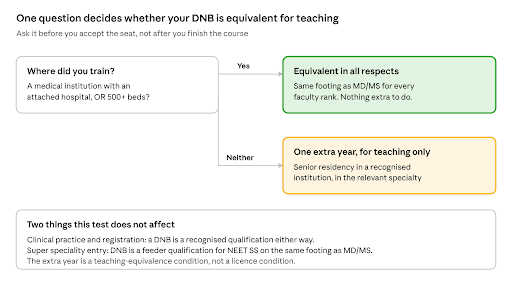
Drawn from NMC Act 2019 s.37(2) and MIQF 2025 reg 7(2), notified 30 June 2025
So the honest answer to "MD/MS or DNB?" is not "DNB is equivalent." It is: a DNB from a large teaching hospital is equivalent; a DNB from a small one costs you a year.
What changed in 2025, and why most of what you will read online is now wrong
The faculty eligibility rules were rewritten. The Minimum Qualifications for Appointment of Teachers in Medical Institutions Regulations, 2025 MIQF 2025, notified in the Gazette on 30 June 2025 replaced the Teachers Eligibility Qualifications Regulations of 2022. Almost every blog post, forum answer and coaching handout discussing DNB teaching eligibility still cites the 2022 regulations. Those are superseded.
The 2025 regulations are, on the whole, better for DNB holders than what came before:
- The extra-year penalty is now narrowed to broad specialty qualifications, and the senior residency must be "in the relevant specialty" rather than anywhere.
- The Assistant Professor entry now cross-refers to regulation 8, which expressly names the Diplomate of National Board. An older ambiguity, under which some appointing committees read the requirement as MD/MS only, is closed on the face of the regulation.
- DNB is listed by name in the tables governing broad specialty teaching posts, and DrNB in the tables governing super specialty posts. Neither is an afterthought in the drafting.
- An earlier three-year junior residency penalty from the 2017 rules is gone.
One qualification is expressly shut out: FNB on its own does not make you teaching faculty. That carve-out was added by a Gazette note of 14 November 2022 and survives. A Fellowship is a fine thing to hold; it is not a route into a medical college faculty by itself.
The 500-bed condition is not a dead letter
It would be easy to assume a provision like this is never enforced. It is.
In Dr. Rajan Vashisht v. State of Himachal Pradesh (CWP 12206 of 2024, decided 28 June 2025), the Himachal Pradesh High Court dismissed a claim by a holder of a DrNB in Cardiology who sought to be treated as eligible without satisfying the condition. The petition failed. A candidate who had completed a full super-specialty programme found the bed-count condition standing between them and the post they wanted.
That is one High Court decision, and a different bench on different facts could reason differently. But it shows the condition is live, argued and applied which is the only question that matters when you are choosing a seat.
And from July 2026, your employer decides
The last piece is the most recent and the least discussed. In July 2026 the NMC devolved the determination of teaching eligibility to the appointing colleges themselves. A formal reference to the Postgraduate Medical Education Board now carries a fee of Rs 29,500.
In practice this means the person reading your file is a selection committee at a medical college, not a regulator. Two colleges may read the same DNB certificate differently, and the cheap route to certainty no longer exists. If you are banking on teaching eligibility, that is an argument for training somewhere whose bed count puts the question beyond argument in the first place.
The hospital, not the certificate
This is the section I would read first if I were choosing.
Both systems publish, in full, the minimum a hospital must have before it may take postgraduate trainees. I sat the two documents side by side NBEMS's accreditation bulletin and the NMC's Minimum Standard of Requirements for Post-Graduate Courses and the differences are not small, not subtle, and almost never discussed at counselling.
| Requirement | DNB (NBEMS) | MD/MS (NMC) |
|---|---|---|
| Smallest eligible hospital | 100 beds, for 2 courses. 200 beds for unlimited courses. 10 beds for Ophthalmology | A medical college meeting the full undergraduate standard; a standalone PG institute needs 220 beds |
| Bed occupancy floor | None found anywhere in the 178-page bulletin | 80% across the hospital, 75% in the department, through the year |
| Dedicated departmental ICU | Specialty by specialty, no general rule | At least 15% of departmental beds, exclusive to that department |
| Faculty-to-student ratio | Not specified. Seat numbers are discretionary, decided on case load and consultant count | Fixed. Professor 1:3 in government colleges, 1:2 in private; Associate Professor 1:2 and 1:1 |
| Minimum faculty to start a course | 2 consultants, one senior and one of either grade | 1 Professor plus 1 Associate or Assistant Professor |
| How faculty are graded | Years in practice: 8 for Senior Consultant, 5 for Junior | Academic cadre, with teaching experience and publication requirements |
| Private practice by your teachers | Not restricted | Prohibited during college hours, with 75% attendance mandatory |
| Outpatient volume, general medicine type department, 2 seats | 4,000 to 5,000 a year | Not less than 60 a day |
| Must the hospital publish its workload? | No obligation | Yes, on its own website, department by department |
Two things cut against that table. The outpatient line needs a conversion, because NBEMS states its figure annually and NMC states its daily: 60 a day across roughly 300 working days is about 18,000 a year, three to four times the NBEMS floor. And the departmental bed minimums sometimes run the other way. NBEMS requires 30 beds in a General Medicine department taking 2 trainees where NMC requires 20, and 30 in Psychiatry where NMC requires 8. On that one measure NBEMS is the stricter of the two, and anyone telling you the DNB floors are uniformly lower has not read both documents.
The clause that stopped me
Buried in the accreditation bulletin is a definition with no counterpart anywhere in the NMC rules. NBEMS defines "General Beds" as those earmarked beds whose patients "shall be accessible at all times for supervised clinical work to NBEMS trainees," whose data "shall be accessible to NBEMS trainees for research purposes." The requirement is that a department have a minimum of 30% beds in this category. The same 30% floor applies to patients.
Read that as a candidate rather than as a regulator. It is an explicit, official acknowledgement that in the hospital where you will spend three years, up to 70% of the patients need not be available to you for supervised clinical work or for your research. They are paying customers of a private hospital, and the consultant who admitted them is under no obligation to hand them to a trainee.
There is no analogous clause in the NMC regulations, and there does not need to be. In a government medical college every patient is a teaching patient. That is what the institution is for.
I want to be fair about what this clause is. It is a floor, not a description. Plenty of accredited hospitals will run far above 30%, and a good unit with a committed consultant will give you more than any regulation requires. But a floor tells you what the system will tolerate, and this is the only place in either rulebook where a trainee's access to patients is rationed by percentage.
Most DNB hospitals are very small
I counted the institutions in the official MCC seat matrices for the 2026 cycle, and the structural picture is stark.
DNB seats are delivered through 1,472 distinct institutions, against 645 for MD/MS roughly 2.3 times as many places, offering about a quarter as many seats. The arithmetic of that is unavoidable: the units are tiny.
- The median DNB institution has 4 seats in total, across every specialty it runs.
- 38% have 2 seats or fewer.
- 59% have 4 seats or fewer.
- Only 5% have 20 or more. The largest single institution in the matrix has 59.
- 993 of the 1,472 are private hospitals; 479 are government.
A medical college has a resident body. A hospital with 4 DNB seats has you, and perhaps three other people, one of whom is in a different specialty. There is no one a year ahead of you to ask at 2am. There is no cohort to revise a centrally-set national paper with. When people argue about why DNB pass rates are what they are, this is the fact underneath the argument, and it is the one I would weigh most heavily.
Nobody expects you to teach
One more documented difference, and it matters if you want an academic career.
The NMC regulations require that postgraduate students "shall essentially be required to participate in the teaching and training programme of undergraduate students and interns." It is not optional, and it follows from the stated purpose of MD/MS, which the regulations describe as producing a competent specialist and medical teacher.
I searched the entire NBEMS accreditation bulletin for any equivalent and found none. Every reference to teaching runs the other way consultants owing trainees 10 hours a week, 5 didactic and 5 at the bedside, on top of their clinical load. That is not an oversight. Most DNB hospitals are private hospitals with no MBBS programme, so there are no undergraduates to teach.
The two routes are designed to produce different things. MD/MS is built, by regulation, to produce medical teachers. DNB is built to produce consultants. Neither is the wrong answer. But if your plan ends in a faculty post, one route gives you three years of mandatory teaching experience and the other gives you none, and that sits on top of the bed-count condition in the previous section.
What you cannot check, and what to do about it
The NMC requires every college to publish its clinical workload outpatients, inpatients and surgeries, department by department on its own website. There is no equivalent obligation on an NBEMS-accredited hospital, and NBEMS publishes neither its inspection findings nor hospital-wise results.
So a candidate comparing two MD/MS colleges can look up the numbers. A candidate comparing two DNB hospitals cannot, and must ask instead. Ask the current trainees, not the administration: how many beds does the department actually run, how many are "General", how many consultants teach, and how many residents sat the last exit exam and cleared it. That last question is the one no published source will answer for you.
So which one, actually?
If you can get a government MD/MS seat in the specialty you want, take it. It is cheaper than a DNB, it carries no bed-count condition, and the training environment has higher floors on almost every measure. Everything else in this article is about what to do when that door is shut.
And for most candidates it is shut. So the question becomes: where does a DNB actually sit?
MCC does not publish cutoffs it publishes allotment lists, which is not the same thing. So I took the official Round 1 allotment file from the 2025 cycle, pulled out every open-category allotment, and separated the three routes by quota code.

My own computation from the official MCC Round 1 allotment file, NEET-PG 2025 (1,301 pages, 21 November 2025). Open category only, 15 specialties with n of 19 or more per cell.
In all 15 specialties the ordering is identical: government MD/MS, then DNB, then paid deemed MD/MS. A DNB seat typically closes at a median rank 2 to 6 times worse than a government MD/MS seat in the same specialty General Medicine 997 against 6,019, Orthopaedics 5,639 against 22,482. But in every single specialty, a DNB seat closes at a better rank than a deemed-university MD/MS seat.
So the line you will hear at counselling, "DNB closes at worse ranks than MD/MS," is half true, and the false half is the half that matters. It is true against government MD/MS. It is false against deemed MD/MS, which is the comparison a mid-rank candidate is actually making.
Be suspicious of anyone quoting you raw closing ranks here. The worst allotted rank in the MD/MS pool is far worse than in the DNB pool, because the MD/MS pool contains expensive deemed seats that go to six-figure ranks when nobody else will pay for them. Comparing closing ranks across the undifferentiated MD/MS pool makes DNB look more competitive than it is. Median is the honest comparator, which is why I have used it.
This is 2025 data, because 2026 Round 1 allotment falls on 24 October 2026, five days after I am writing this.
A worked example
Take a candidate at open-category rank 20,000 who wants to be an ophthalmologist.
Government MD Ophthalmology has a median of 8,162, so that is out of reach in Round 1. The two live options are a DNB in Ophthalmology, median 20,363, which is almost exactly this candidate's rank, or a deemed-university MD, median 56,773, which they would comfortably get.
The deemed seat is the easier one to obtain and the worse one to take. From the money section: three years of DNB costs Rs 3,15,000 to Rs 3,75,000 in fees and pays a stipend floor of Rs 16,20,000, leaving the trainee somewhere around Rs 12,45,000 to Rs 13,05,000 ahead. A deemed MD runs to tens of lakhs in tuition alone. Same degree-holder at the end, in the same clinic, with a seven-figure gap between them.
The case for the deemed seat is not financial. It is that you can look up the college's published clinical workload, that nobody will ever ask about its bed count, and that you will have a resident cohort around you. Those are real. Decide whether they are worth what they cost.
Five things to check before you accept a DNB seat
- How many beds does the hospital have? If it is 500 or more, or there is a medical college attached, the equivalence question never arises. If it is under 500 with no attached college, you are accepting a one-year cost on any future teaching post. Get the number in writing.
- How many residents are in the whole hospital? The median accredited institution has 4 seats across all specialties. Ask how many people will be a year ahead of you in your department, because that is who teaches you at 2am.
- Is the stipend actually being paid, in full, monthly? NBEMS makes it compulsory and sets the floor. Compulsory and paid are not the same thing. Ask current trainees, not the office.
- What is the real case load, and how much of it is yours? The 30% General beds floor is the key number. Ask trainees what share of admissions they actually clerk and operate on.
- Do you want to teach? If yes, the bed count in point 1 is not a detail. It is the decision.
What I am not telling you
The specialty matters more than the route. A DNB in Radio-Diagnosis at a large hospital will serve you better than an MD in a subject you did not want, at any price. None of the analysis above overrides that.
And one limit worth naming plainly. I have compared the two systems using the documents they publish and computed what I could from the official files. Neither NBEMS nor the NMC publishes anything that measures training quality, supervision or case mix so that comparison, the one everyone actually argues about, is not in here. It is not in anyone's article, because the data does not exist.
Questions candidates actually ask
1. Is a DNB equal to an MD or MS?
For clinical practice and registration, yes, with nothing to add. For a faculty post in a medical college, only if you trained in a medical institution with an attached hospital or in a hospital of 500 beds or more. Train anywhere smaller and you owe one extra year of senior residency in the relevant specialty before you are treated as equivalent for teaching.
2. Can I do DM or MCh after a DNB?
Yes. DNB is a feeder qualification for NEET SS on exactly the same footing as MD/MS. The bed-count condition has nothing to do with super-specialty entry it applies only to teaching eligibility.
3. Is the course longer?
No. Three years for post-MBBS candidates on both routes.
4. Will I definitely be paid a stipend?
NBEMS makes it compulsory and sets the floor at Rs 43,000, Rs 45,000 and Rs 47,000 a month across the three years Rs 16,20,000 in all. Compulsory and actually paid are not the same thing. Ask current trainees whether it arrives in full and on time, not the administration.
5. Is the DNB exit exam harder to clear?
Its written rules are looser, not tighter: no per-paper minimum, where MD/MS demands 40% in every single paper, and grace marks are available, where the MD/MS regulations forbid them outright. The outcomes are another matter. NBEMS annual reports put the pass rate at 65.9% in 2017-18, 57.5% in 2022-23 and 71.8% in 2023-24, so roughly three in ten candidates do not clear it. Read that with care, though: the cohort includes MD/MS holders sitting the exam for an extra qualification, so it is not a clean measure of DNB training.
6. How many attempts do I get?
Theory is uncapped. The practical is capped at three, and the first is counted in the session you clear theory whether you sit it or not absence still burns an attempt. Fail all three and you are sent back to the theory examination.
7. Can I become a professor with a DNB?
Yes. MIQF 2025 names the Diplomate of National Board directly in the faculty eligibility tables, closing an older ambiguity. Two things still apply: the 500-bed condition, and the fact that since July 2026 the appointing college decides your eligibility rather than the NMC.
8. Does an FNB count for a faculty post?
Not on its own. That exclusion is express, and it has survived the 2025 rewrite. A Fellowship is worth holding; it is not a route into a medical college faculty by itself.
9. Is DNB even available in my specialty?
This varies more than almost anything else in the decision. Dermatology has 41 DNB seats in the whole country, ENT 47, Microbiology 44 in those, DNB is not a realistic fallback. Emergency Medicine has 347, about a third of all training in the specialty. Check your own specialty before you build a plan around a backup that may not exist.
10. Should I take a DNB or a deemed-university MD/MS?
On money this is not close. A DNB pays a stipend floor of Rs 16,20,000 over three years against fees of Rs 3,15,000 to Rs 3,75,000; a deemed MD charges tens of lakhs in tuition and pays nothing to offset it. The case for the deemed seat is that you can look up its published workload, nobody will ever query its bed count, and you will have a resident cohort around you. Decide whether those are worth the gap.
11. Do I have to write a thesis?
Both routes require one. The DNB gate is the stricter of the two: miss the submission deadline and you cannot sit the examination at all, and if NBEMS does not accept the thesis your result is withheld even after you have passed. In MD/MS the dissertation carries 20 marks inside the practical and is assessed by an examiner from outside the state.
12. Will I teach undergraduates?
In MD/MS, yes the regulations require postgraduate students to take part in teaching undergraduates and interns. In DNB, almost never, because most accredited hospitals run no MBBS programme at all. If you want an academic career, that is three years of teaching experience you either build or do not.
13. If I check only one thing before accepting a DNB seat, what should it be?
The hospital's bed count, in writing. It decides the equivalence question in the first answer above, and it is the one fact nobody volunteers at counselling.