
MBA Admissions 2026–27 in India: Exams, Eligibility, Process, Fees & Top Colleges

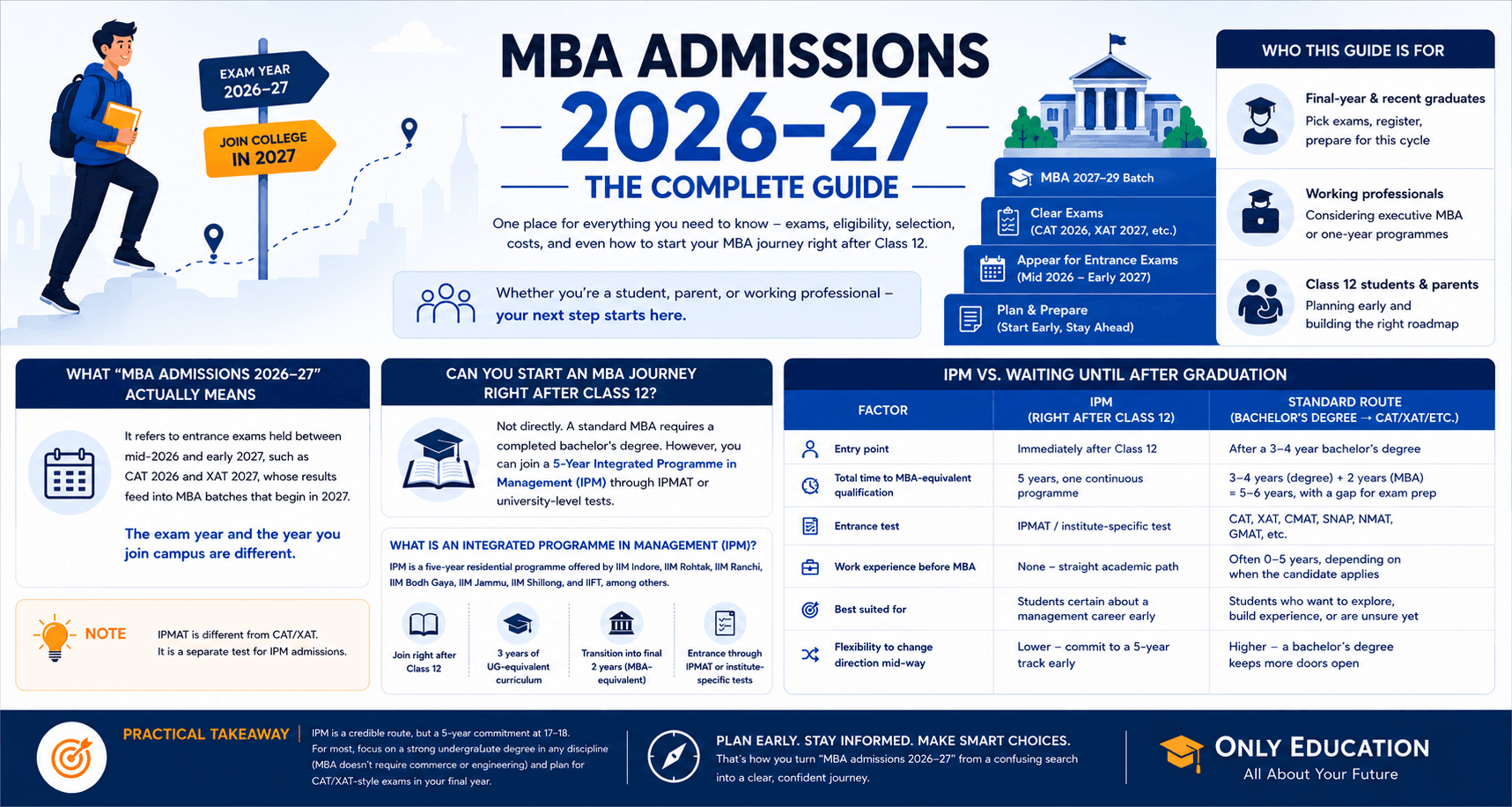
If you've searched "MBA admissions" hoping for a straight answer, you've probably found ten pages that each cover a different slice of the picture: one exam's dates here, one college's process there. This guide puts the whole 2026–27 admission cycle in one place: which exams matter, who is eligible, how selection actually works beyond the score, what it will cost, and because Only Education hears from students as young as Class 12 asking this question: what does "MBA admission" even mean if you haven't graduated yet.
Whether you're a final-year student about to register for CAT, a parent trying to help your child plan years in advance, or a working professional weighing an executive MBA, you'll find a clear next step here.
What "MBA Admissions 2026–27" Actually Means
MBA admissions 2026–27 refers to entrance exams held between mid-2026 and early 2027, such as CAT 2026 and XAT 2027, whose results feed into MBA batches that actually begin college in 2027. In other words, the exam year and the year you join campus are different, which is the single biggest source of confusion for first-time applicants.
CAT 2026, for example, is conducted in November 2026, but a candidate who clears it joins their MBA programme in mid-2027 as part of the "2027–29 batch. "XAT, similarly, is dated by the year of the exam (XAT 2027 is written in January 2027) rather than the year of joining. When you see IIMs referring to "Admission 2027", this is what they mean: the exams you take in the 2026–27 window.
Who This Guide Is For
- Final-year graduates and recent graduates who need to pick exams, register, and prepare for this cycle.
- Working professionals considering an executive MBA or a one-year programme.
- Class 12 students and parents who are asking "MBA admission" as a search query but are really asking, "What should we be planning for, starting now?"
If you fall into that last group, the next section is written specifically for you.
Can You Start an MBA Journey Right After Class 12?
Not directly a standard MBA requires a completed bachelor's degree. However, several IIMs and universities run five-year Integrated Programmes in Management (IPM) that admit students straight out of Class 12 and combine an undergraduate degree with an MBA-equivalent postgraduate qualification, entered through the IPMAT or similar university-level tests.
What Is an Integrated Programme in Management (IPM)?
IPM is a five-year residential programme offered by institutes including IIM Indore, IIM Rohtak, IIM Ranchi, IIM Bodh Gaya, IIM Jammu, and IIM Shillong (each institute runs its own admission test or shares a common one), plus IIFT's IPM track. Students join immediately after Class 12, complete three years of an undergraduate-equivalent curriculum, and transition into the final two years, which are broadly equivalent to a standard MBA/PGP. The entrance route for most IIM-run IPMs is the IPMAT, a separate, quantitative-and-verbal-aptitude test distinct from CAT it is not covered in the CAT/XAT calendar below.
IPM vs. Waiting Until After Graduation
Factor | IPM (right after Class 12) | Standard route (bachelor's degree → CAT/XAT/etc.) |
| Entry point | Immediately after Class 12 | After a 3–4 year bachelor's degree |
| Total time to MBA-equivalent qualification | 5 years, one continuous programme | 3–4 years (degree) + 2 years (MBA) = 5–6 years, with a gap for exam prep |
| Entrance test | IPMAT / institute-specific test | CAT, XAT, CMAT, SNAP, NMAT, GMAT, etc. |
| Work experience before MBA | None straight academic path | Often 0–5 years, depending on when the candidate applies |
| Best suited for | Students who are certain about a management career very early | Students who want to explore other fields, build work experience, or aren't sure yet |
| Flexibility to change direction mid-way | Lower you commit to a 5-year track early | Higher a bachelor's degree keeps more doors open |
Practical takeaway for parents and Class 12 students: IPM is a legitimate, credible route but it's a five-year commitment made at 17–18, before most students have explored other options. For most families, a stronger Class 12 strategy is to focus on getting into a good undergraduate programme (in any discipline MBA does not require a commerce or engineering background) and start planning seriously for CAT/XAT-style exams in the final year of that degree. If your child is genuinely set on management as a career this early, IPM is worth researching separately; if not, there's no urgency to decide anything MBA-specific until the final undergraduate year.
MBA Eligibility Criteria in India 2026–27
Most Indian MBA/PGDM programmes require a bachelor's degree of at least three years' duration, in any discipline, from a UGC-recognised university, with a minimum of 50% aggregate marks (45% for SC/ST/PwD/reserved categories at most institutes). Final-year students awaiting results can generally apply, provided they complete their degree with the required marks before admission.
A few additional points worth knowing:
- There is generally no upper age limit for exams like CAT.
- Work experience is not mandatory for most full-time MBA programmes, though it is factored into selection at several IIMs and is typically required for executive MBA programmes.
- Minimum-percentage rules and reserved-category relaxations vary slightly by exam and institute; always confirm on the specific exam's or college's official notification before assuming eligibility.
MBA Entrance Exam Calendar 2026–27
This is the core reference table for the cycle. Dates marked "expected" are based on historical patterns and preparatory-source reporting; treat them as planning estimates until the conducting body's official notification is out, and always cross-check on the official website before your registration deadline.
Exam | Conducting body | 2026–27 exam date | Registration window | Approx. fee (general category) | Colleges primarily unlock |
| CAT 2026 | IIM (rotates; IIM Indore in 2026) | November 29, 2026 | Aug 3 – Sep 15, 2026 (confirmed) | ₹2,700 (₹1,350 reserved) | 21 IIMs, FMS, SPJIMR, MDI, IIFT, IIT MBA programmes, 100+ other B-schools |
| XAT 2027 | XLRI Jamshedpur (for XAMI) | January 3, 2027 | Jul 15 – Dec 6, 2026 (confirmed) | ₹2,200–2,300 | XLRI, XIMB, IMT, IMI, TAPMI, 150–250+ B-schools |
| NMAT by GMAC 2026 | GMAC | Exam window: Nov 2 – Dec 20, 2026 | Aug 20 – Oct 10, 2026 (expected) | ₹3,000 | NMIMS, XIMB, K J Somaiya, TAPMI, SDA Bocconi |
| SNAP 2026 | Symbiosis International (Deemed University) | Dec 13, 19 & 26, 2026 (confirmed) | Aug 21 – Nov 25, 2026 (expected) | ₹2,550/test + ₹1,000 per institute | 17+ Symbiosis institutes (SIBM Pune, SCMHRD, SIBM Bengaluru) |
| CMAT 2027 | National Testing Agency (NTA) | Jan 24, 2027 (expected) | Mid-Oct 2026 (expected) | ₹2,500 (male) / ~₹1,250 (female), expected | 1,000+ AICTE-approved B-schools incl. JBIMS, SIMSREE, Welingkar |
| MAT (Sept 2026 session) | AIMA | PBT: Sep 13, 2026; CBT: Sep 20, 2026 (confirmed for this session) | Closed for Sept; MAT runs 4x/year (Feb, May, Sep, Dec) | ₹2,300 (single mode) | 500+ MBA colleges nationally |
| IBSAT 2026 | ICFAI Foundation | Expected last week of December 2026 | From July 1, 2026 | ₹1,800 | IBS Hyderabad and other IBS campuses |
| MAH MBA CET | Maharashtra State CET Cell | 2026 session already concluded; the next cycle is typically Feb–May. | Varies by cycle | ₹1,000–1,500 | JBIMS, SIMSREE, Welingkar, PUMBA, SIES |
| GMAT | GMAC | On-demand (multiple dates year-round) | Rolling | $275 (test centre) / $300 (online) | Indian and international B-schools that accept GMAT |
Fees and dates are approximate and change with official notifications; always verify on the exam's official website (iimcat.ac.in, xatonline.in, cmat.nta.nic.in, mba.com/exams/nmat, snaptest.org, mat.aima.in) before you pay or plan around them.
1. CAT 2026 For the IIMs
CAT remains the exam nearly every serious MBA aspirant sits, because it's accepted not just by all 21 IIMs but by FMS Delhi, SPJIMR, MDI Gurgaon, IIFT, and the IIT MBA programmes as well. It's a computer-based test held in three slots on a single Sunday, testing Verbal Ability & Reading Comprehension, Data Interpretation & Logical Reasoning, and Quantitative Ability. Results are typically declared in the first week of January of the following year.
2. XAT 2027 For XLRI and XAMI Institutes
XAT is the only major national exam with a dedicated Decision Making section, which several aspirants find harder to "coach" for than pure quant or verbal it rewards judgment as much as speed. Unlike CAT's multi-slot format, XAT is held in a single sitting for all candidates nationwide, which some students prefer because there's no cross-slot normalisation to worry about.
3. NMAT, SNAP, CMAT, MAT, and Other National Exams
If your target list includes NMIMS, Symbiosis institutes, JBIMS, or Welingkar, you'll likely need NMAT, SNAP, or CMAT specifically CAT and XAT scores are not accepted everywhere. NMAT's multi-week testing window is unusual among Indian MBA exams and gives candidates more scheduling flexibility than a single-day test.
4. State-Level MBA Entrance Exams
If you're targeting government or government-aided MBA colleges in a specific state MAH MBA CET for Maharashtra, TANCET for Tamil Nadu, KMAT for Kerala, PGCET for Karnataka, or TG/AP ICET for Telangana and Andhra Pradesh these are usually far cheaper to write (₹650–₹1,500) and lead to some of the lowest-fee, well-regarded MBA programmes in the country, such as JBIMS and Anna University's management programmes.
5. GMAT and GRE for India-Based B-Schools
GMAT is compulsory for most international B-schools but is also accepted by a growing number of Indian institutes (including several IIM executive programmes and top private colleges) as an alternative to CAT/XAT. It's considerably more expensive than any Indian exam, so it usually makes sense only if you're also considering international applications or a programme that explicitly prefers GMAT.
The MBA Admission Process, Step by Step
The MBA admission process in India typically runs: confirm eligibility → shortlist target exams and colleges → register and prepare → take the exam(s) → clear the cutoff and get shortlisted → go through Written Ability Test/Group Discussion and Personal Interview rounds → receive and accept the final offer → complete fee payment and document verification.
- Confirm eligibility. Check your degree, percentage, and category against each target exam's specific criteria they're not identical across exams.
- Shortlist exams based on target colleges, not the other way round. Decide which colleges genuinely interest you first, then work out which exam(s) they accept.
- Register within each exam's window and pay attention to correction windows most exams allow limited edits after the form closes.
- Prepare with a realistic timeline. Most successful CAT candidates start structured preparation 6–8 months before the exam.
- Sit the exam(s). Many aspirants take more than one national exam to widen their options CAT plus one or two of XAT/CMAT/SNAP is common.
- Clear the shortlisting cutoff. Cutoffs are sectional and overall, and vary sharply by category and institute a strong overall percentile alone doesn't guarantee a call if a sectional cutoff is missed.
- Go through WAT/GD/PI rounds. This is where a large share of the final decision actually happens (see the next section).
- Receive the offer, complete the Expression of Interest/fee formalities, and submit documents for verification original mark sheets, category certificates, and identity proof are typically required at this stage.
How IIMs and Top B-Schools Actually Select Candidates
Clearing a cutoff only earns an interview call it does not itself secure admission. Most IIMs build a final merit list using a weighted combination of the entrance exam score, academic record (Class 10, Class 12, and graduation marks), work experience, a Written Ability Test (WAT), a Personal Interview (PI), and diversity factors like gender and academic background.
This is the part of the process most competitor content skips entirely, and it's also where many strong scorers lose seats they expected to get. Weightage formulas differ from IIM to IIM and are revised most years, so treat any specific numbers as illustrative rather than fixed but the pattern is consistent:
- The entrance score typically decides who gets shortlisted for an interview, not who gets the final seat.
- At the final selection stage, exam score weightage is usually reduced (often to somewhere between 30–55% of the total, depending on the institute) and redistributed across WAT, PI, academic consistency across Class 10/12/graduation, and work experience.
- Some IIMs also factor in academic and gender diversity, giving a modest weightage boost to candidates from under-represented academic backgrounds (e.g., non-engineering graduates) or genders in a given cohort.
- Newer IIMs that coordinate a shared shortlisting and interview process commonly referred to as the Common Admission Process (CAP) publish a combined merit-list formula each year covering all participating institutes.
Practical implication: A 99-percentile CAT score with a patchy academic record and a weak interview can lose out to an 96-percentile candidate with a consistent academic history and a strong WAT-PI performance. If you're preparing for this cycle, budget real time for WAT and PI practice not just exam-taking speed.
MBA Fees in India 2026–27: What Different Colleges Really Cost
Total two-year MBA fees in India range from roughly ₹50,000 at some online/state programmes to over ₹30 lakh at the most expensive private institutes, with the top IIMs sitting around ₹20–27.5 lakh and government-run institutes like FMS Delhi charging as little as ₹2–3 lakh for a comparable degree.
College category | Approx. total 2-year fee | Notes |
| Top IIMs (Ahmedabad, Bangalore, Calcutta) | ₹26–27.5 lakh | Includes tuition, hostel, and academic resources; personal expenses extra |
| Other established IIMs (Lucknow, Kozhikode, Indore, Mumbai) | ₹20–25 lakh | |
| Newer/"baby" IIMs | ₹12–22 lakh | Fees have risen steadily as these institutes mature |
| FMS Delhi | ₹2–3 lakh | Among the best fee-to-outcome ratios in the country, but very limited seats via CAT |
| IIT MBA programmes | ₹8–15 lakh | - |
| Top private colleges (XLRI, SPJIMR, MDI, NMIMS, Symbiosis) | ₹18–32 lakh | - |
| Other private MBA/PGDM colleges | ₹4–18 lakh | Wide range research placement outcomes carefully before assuming value |
| State government/university MBA programmes | ₹50,000–5 lakh | Often excellent value if you're eligible for state quota seats |
Two things worth remembering: fee figures above are indicative and change annually and always confirm the current figure directly on the institute's admissions page before budgeting and a lower headline fee doesn't automatically mean lower value; several government-fee institutes (FMS Delhi being the most-cited example) post placement outcomes competitive with mid-tier IIMs.
CAT vs XAT vs CMAT vs GMAT: Which Exam Should You Take?
There's no single "best" exam the right one depends entirely on which colleges you're targeting and how much time you have to prepare for more than one.
- Choose CAT if an IIM, FMS, SPJIMR, MDI, or IIFT is on your list it's non-negotiable for those institutes and worth prioritising even if you also sit other exams.
- Choose XAT if XLRI or an XAMI institute is a genuine target, and if you think you'll perform well on judgment-based Decision Making questions rather than pure speed-based sections.
- Choose CMAT if your list leans toward AICTE-approved private and state-affiliated B-schools its huge acceptance base (1,000+ colleges) makes it a strong "safety net" exam alongside CAT/XAT.
- Choose NMAT or SNAP specifically if NMIMS or a Symbiosis institute is a real target CAT/XAT scores won't get you into either.
- Choose GMAT primarily if you're also considering international programmes, or if a specific Indian institute's executive/one-year programme explicitly prefers it.
- Most serious aspirants don't choose just one. A common, sensible strategy is CAT plus one or two of XAT/CMAT/SNAP, which widens your options without doubling your preparation load, since the core quant/verbal/logical-reasoning skills overlap heavily across exams.
Common Mistakes MBA Aspirants Make During Admissions
- Registering for an exam without checking which target colleges actually accept it. Clearing CMAT with a great score doesn't help if every college on your list only accepts CAT.
- Ignoring sectional cutoffs. A strong overall percentile with one weak section can still mean no shortlist at several IIMs.
- Treating WAT and PI preparation as an afterthought. Given how heavily these are weighted in final selection at most IIMs, starting WAT-PI practice only after the shortlist is released leaves too little time.
- Missing registration correction windows. Category, exam-city, or programme-preference errors are often only fixable in a short window right after registration closes missing it can lock in a mistake for the full cycle.
- Assuming eligibility without checking the fine print. Minimum percentage rules and category relaxations differ by exam; don't assume last year's rule still applies.
- Underestimating cost planning. Between application fees across multiple exams, WAT-PI travel, and eventual seat-acceptance deposits, costs accumulate well before the first tuition instalment is due plan for this early rather than reactively.
MBA Admission Without an Entrance Exam
A number of private universities and colleges offer direct MBA admission based on graduation marks, a management-quota seat, or an in-house interview/profile evaluation, bypassing CAT/XAT/CMAT entirely. This route can suit candidates who need flexibility or missed the standard exam cycle, but it comes with a real trade-off: entrance-exam-based admission at accredited, AICTE/UGC-recognised institutes is generally viewed more favourably by recruiters than unverified "direct admission" claims. If you're considering this route, verify the institute's AICTE approval and university affiliation independently before paying any fee, and be cautious of any college that guarantees admission without any academic or aptitude evaluation at all.
Your MBA Admission 2026–27 Action Plan
When | What to do |
| Now – August 2026 | Finalise your target college list and confirm which exam(s) they accept; check eligibility for each |
| August – September 2026 | Register for CAT 2026 (window: Aug 3 – Sep 15, 2026) and any other exams with open windows |
| September – November 2026 | Structured preparation; take full-length mocks; register for XAT 2027, SNAP 2026, NMAT 2026 if applicable |
| Late November 2026 | Sit CAT 2026 (Nov 29) |
| December 2026 | Sit SNAP sessions and other exams in your window; keep an eye on XAT registration close (Dec 6) |
| January 2027 | Sit XAT 2027 (Jan 3) and CMAT 2027 (expected Jan 24); CAT results typically released in the first week of January |
| January – March 2027 | IIM and B-school shortlists released; WAT-PI/GD rounds begin — this is when your interview prep needs to already be done, not started |
| March – May 2027 | Final offers, Expression of Interest deposits, document verification, and seat acceptance |
Key Takeaways
- CAT 2026 (Nov 29, 2026) and XAT 2027 (Jan 3, 2027) are the two anchor exams of this cycle; both lead to MBA batches joining in 2027.
- Eligibility is broadly a three-year bachelor's degree with 50% marks (45% for reserved categories), but always verify per exam.
- Final selection at top B-schools weighs WAT, PI, academic record, and work experience alongside the entrance score don't stop preparing once the exam is over.
- Total MBA cost varies enormously from a few lakh at government institutes to ₹30+ lakh at premium private colleges so match your exam strategy to a realistic budget, not just a brand name.
- If you're a Class 12 student or parent, MBA itself is a few years away, but the IPM route is worth researching now if management is already a clear, early interest.
7. FAQs
Q1. What are the eligibility criteria for MBA admission in India for 2026–27?
A three-year bachelor's degree (any stream) from a recognised university, with a minimum of 50% aggregate marks for general category candidates and 45% for SC/ST/PwD candidates at most institutes. Final-year students can generally apply provisionally, provided they complete their degree with the required marks before joining. Always confirm the exact percentage and category rules on your specific target exam or college's official notification, since small variations exist across institutes.
Q2. Can I get MBA admission right after Class 12?
Not into a standard MBA that requires a completed bachelor's degree. However, Integrated Programmes in Management (IPM), offered by several IIMs and IIFT, admit students directly after Class 12 through the IPMAT or a similar institute-specific test, combining an undergraduate degree with an MBA-equivalent qualification over five years. It's a real option, but a significant five-year commitment made quite early, so it's worth researching separately from the standard MBA admission process.
Q3. When is CAT 2026 and what is the registration deadline?
CAT 2026 is scheduled for Sunday, November 29, 2026, conducted by IIM Indore. Registration opened August 3, 2026 and closes September 15, 2026, 5:00 PM, on the official website iimcat.ac.in. Results are expected in the first week of January 2027. These dates are officially confirmed as of the CAT 2026 notification.
Q4. Is CAT compulsory for MBA admission in India?
No, CAT is compulsory only for the 21 IIMs and a handful of other institutes (FMS, SPJIMR, MDI, IIFT) that specifically require it. Many other well-regarded B-schools accept XAT, CMAT, SNAP, NMAT, MAT, GMAT, or state-level exams like MAH MBA CET instead. Your exam choice should follow your target college list, not the other way around.
Q5. What is the difference between an MBA and a PGDM?
An MBA is a university degree awarded by a UGC-recognised university, while a PGDM (Postgraduate Diploma in Management) is a diploma awarded by an autonomous, AICTE-approved institute (most IIMs technically award a PGP/PGDM rather than a university "MBA" degree, despite being colloquially called MBA programmes). Both are widely recognised by employers in India; what matters more for career outcomes is the institute's accreditation, placement record, and industry reputation rather than the degree-vs-diploma label itself.
Q6. How do IIMs select candidates beyond the CAT score?
IIMs use a weighted combination of the CAT score, academic performance across Class 10, Class 12, and graduation, work experience, a Written Ability Test (WAT), a Personal Interview (PI), and diversity factors such as gender and academic background. The exact weightage differs by IIM and is revised most years, but a strong exam score typically earns a shortlist for interview, not automatic admission the WAT-PI and profile evaluation stage significantly influences the final outcome.
Q7. How much does an MBA cost in India?
Total two-year MBA fees range from roughly ₹50,000–5 lakh at government and state-university programmes, ₹2–15 lakh at institutes like FMS Delhi and IIT MBA programmes, ₹17–27.5 lakh at IIMs (with newer IIMs at the lower end and Ahmedabad/Bangalore/Calcutta at the higher end), and ₹18–32 lakh at top private colleges such as XLRI, SPJIMR, and MDI. Fees change annually, so confirm the current figure directly with the institute before budgeting.
Q8. Which MBA entrance exam should I choose if I haven't decided on colleges yet?
If you're undecided, CAT is the safest starting point given its wide acceptance across IIMs and other top institutes, alongside CMAT for its very broad AICTE-college acceptance as a backup. As your target list becomes clearer, add XAT, SNAP, or NMAT specifically if XLRI, Symbiosis institutes, or NMIMS enter your shortlist since those exams aren't interchangeable with CAT/XAT for admission purposes.
Q9. What happens if I don't get a call from any IIM what are my other options?
A missed IIM call doesn't end your MBA options. Depending on your exam scores, strong alternatives include FMS Delhi (via CAT), top private institutes like SPJIMR or MDI (via CAT/XAT), XLRI and other XAMI institutes (via XAT), NMIMS and Symbiosis institutes (via NMAT/SNAP), and well-regarded government colleges such as JBIMS via state exams like MAH MBA CET. Many of these post placement outcomes competitive with mid-tier IIMs at a fraction of the cost.
Q10. Is work experience required for an MBA in India?
No, work experience is not mandatory for most full-time MBA/PGDM programmes in India, and many successful candidates apply straight after graduation. That said, several IIMs do factor work experience into their final selection weightage, and it is typically a firm requirement for executive MBA and one-year MBA programmes, which are designed for candidates with a few years of professional experience.
Q11. What documents are typically required for MBA admission?
Commonly required documents include your Class 10 and 12 mark sheets, bachelor's degree provisional/final certificate and mark sheets, category certificate (if applicable, issued within the validity period specified by the institute), a valid photo ID, entrance exam scorecard/admit card, and passport-size photographs. Exact requirements vary by institute, so always check the specific document checklist on your shortlisted college's admission portal well before the verification deadline.
Q12. Can I apply for MBA admission without taking any entrance exam?
Yes, some private universities and colleges offer direct admission based on graduation marks or an in-house evaluation, without requiring CAT/XAT/CMAT scores. This can work for candidates needing flexibility, but entrance-exam-based admission at AICTE/UGC-recognised institutes generally carries more weight with recruiters. If you consider this route, independently verify the institute's accreditation before paying any fee.