
CMAT 2027: Registration, Exam Date, Pattern and Syllabus


CMAT 2027 registration opened on 23 November 2026 and closes on 20 December. The exam is on 11 February 2027: a 3-hour computer-based test with 100 questions for 400 marks, +4 for a correct answer and −1 for a wrong one. The fee is ₹2,500 for general male candidates and ₹1,250 for others. Results are due on 25 February.
CMAT 2027 Important Dates
Apply by 20 December 2026; the exam is on 11 February 2027. Late registration costs an extra ₹500.
| Event | Date |
|---|---|
| Registration starts | 23 Nov 2026 |
| Last date to apply | 20 Dec 2026 |
| Last date for fee payment | 21 Dec 2026 |
| Late registration (+₹500) | 22 – 25 Dec 2026 |
| Form correction window | 26 – 28 Dec 2026 |
| Exam city intimation | 21 Jan 2027 |
| Admit card | 4 Feb 2027 |
| CMAT 2027 exam | 11 Feb 2027 |
| Answer key and response sheet | 19 – 21 Feb 2027 |
| Result | 25 Feb 2027 |
Schedule as announced by NTA at cmat.nta.nic.in and reported on registration day, for example, by Ummid. NTA’s earlier exam calendar listed 7 February, and several sites still show it; the registration-day notice gives 11 February.
CMAT 2027 Application Fee
| Category | Fee |
|---|---|
| General male | ₹2,500 |
| Female candidates | ₹1,250 |
| Gen-EWS, OBC-NCL, SC, ST, PwD, PwBD, Third Gender | ₹1,250 |
| Late registration | +₹500 |
The fee is paid online at the NTA site and is non-refundable.
CMAT 2027 Exam Pattern
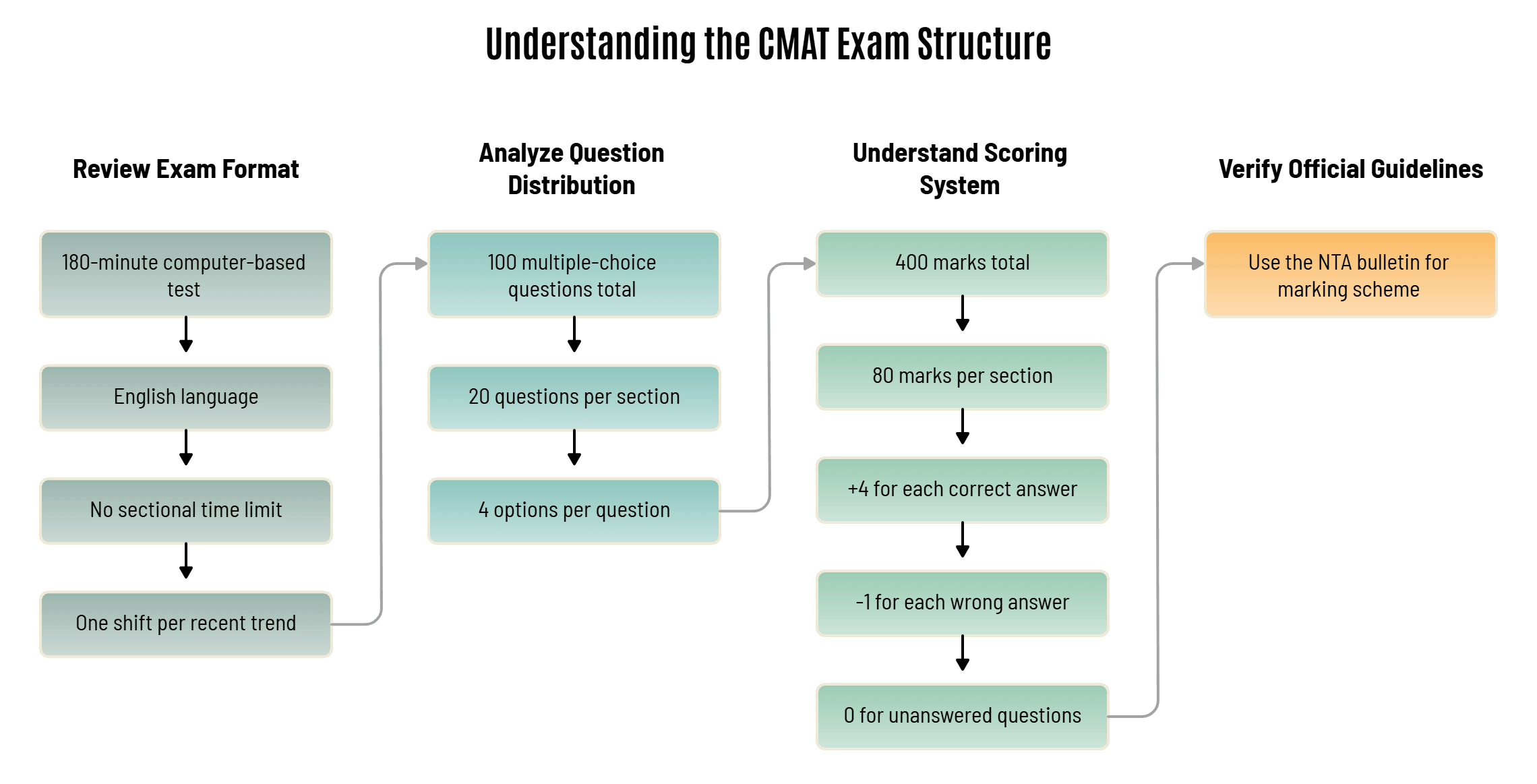
CMAT is a 180-minute computer-based test with 100 multiple-choice questions, 20 per section, for 400 marks. Each correct answer earns 4 marks and each wrong answer costs 1.
| Feature | Detail |
|---|---|
| Mode and language | Computer-based, English |
| Duration | 3 hours (180 min), no sectional time limit |
| Questions and marks | 100 questions, 400 marks |
| Options per question | 4 |
| Marking | +4 correct, −1 wrong, 0 unanswered |
| Shifts | One, per recent trend |
| Section | Questions | Marks |
|---|---|---|
| Quantitative Techniques and Data Interpretation | 20 | 80 |
| Logical Reasoning | 20 | 80 |
| Language Comprehension | 20 | 80 |
| General Awareness | 20 | 80 |
| Innovation and Entrepreneurship | 20 | 80 |
| Total | 100 | 400 |
Third-party sources disagree on negative marking: one FAQ says none, while the NTA scheme reported on registration day and most guides say −1. Use the NTA bulletin.
Eligibility
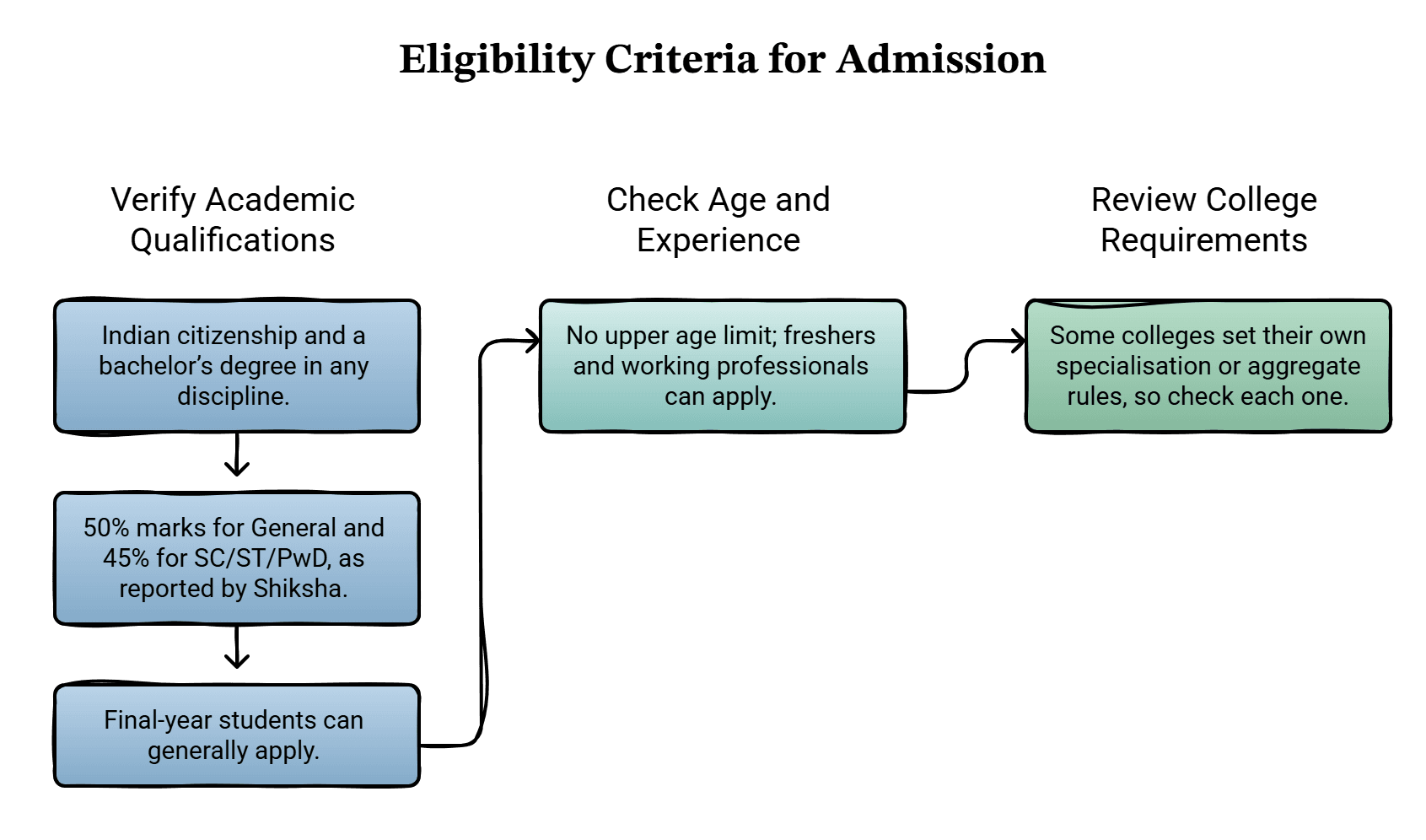
- Indian citizenship and a bachelor’s degree in any discipline.
- 50% marks for General and 45% for SC/ST/PwD, as reported. Final-year students can generally apply.
- No upper age limit; freshers and working professionals can apply.
- Some colleges set their own specialisation or aggregate rules, so check each one.
CMAT 2027 Syllabus
| Section | Topics |
|---|---|
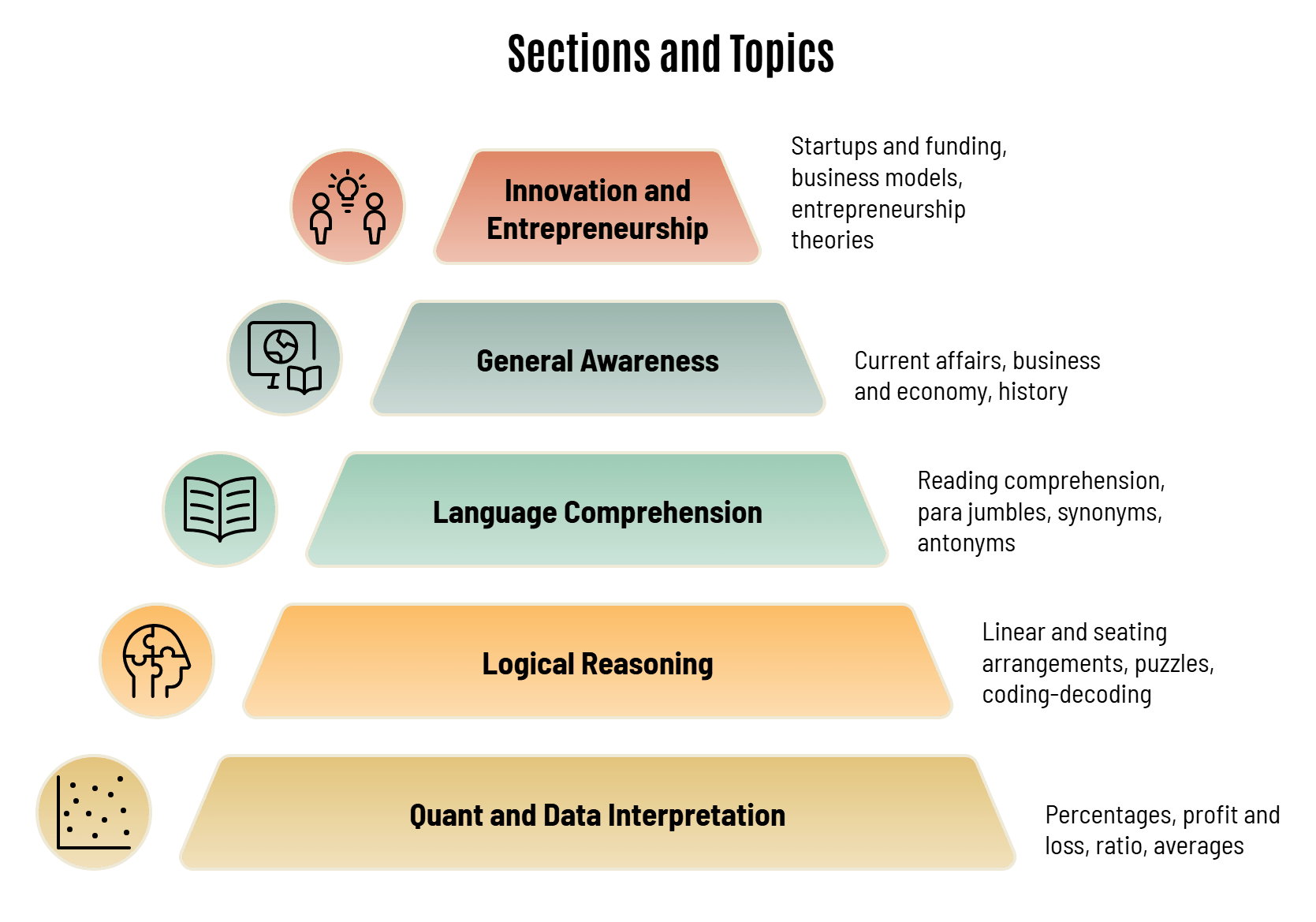
| Quant and Data Interpretation | Percentages, profit and loss, ratio, averages, mixtures, time and work, time-speed-distance, geometry, algebra, mensuration, number systems, permutations, combinations, probability, tables and graphs |
| Logical Reasoning | Linear and seating arrangements, puzzles, coding-decoding, series, syllogism, assumptions, conclusions, blood relations, direction sense |
| Language Comprehension | Reading comprehension, para jumbles, synonyms, antonyms, idioms, sentence correction, fill in the blanks, analogies |
| General Awareness | Current affairs, business and economy, history, geography, politics, sports, science, awards, books, static GK |
| Innovation and Entrepreneurship | Startups and funding, business models, entrepreneurship theories, rural, women and social entrepreneurship, government schemes, case studies, leadership and motivation |
CMAT vs CAT: What Is Different
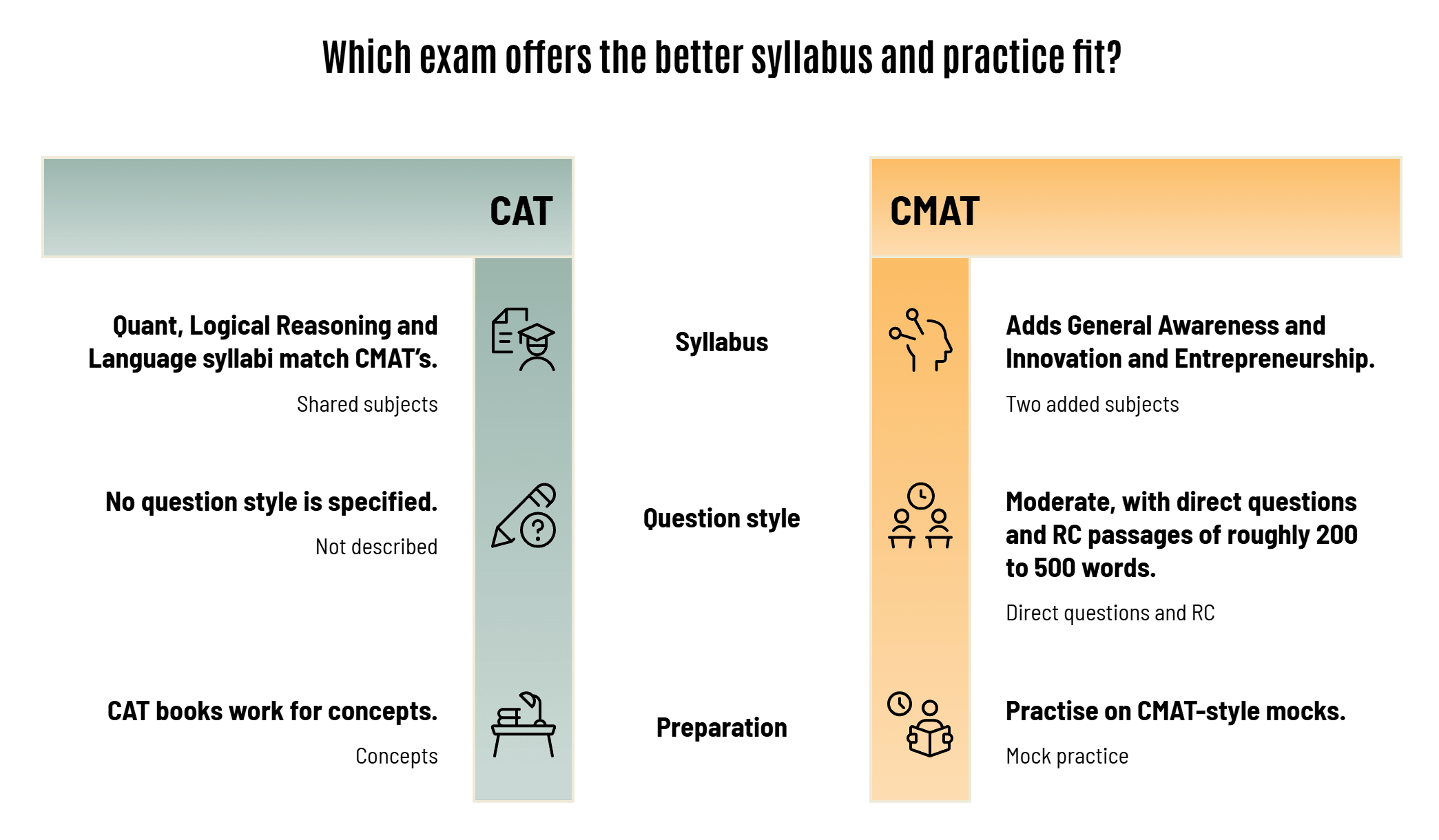
The Quant, Logical Reasoning, and Language syllabi match CAT’s, but CMAT adds General Awareness and Innovation and Entrepreneurship. Reports call CMAT moderate, with direct questions and RC passages of roughly 200 to 500 words. CAT books work for concepts, but practise on CMAT-style mocks.
Section-by-Section Preparation Tips
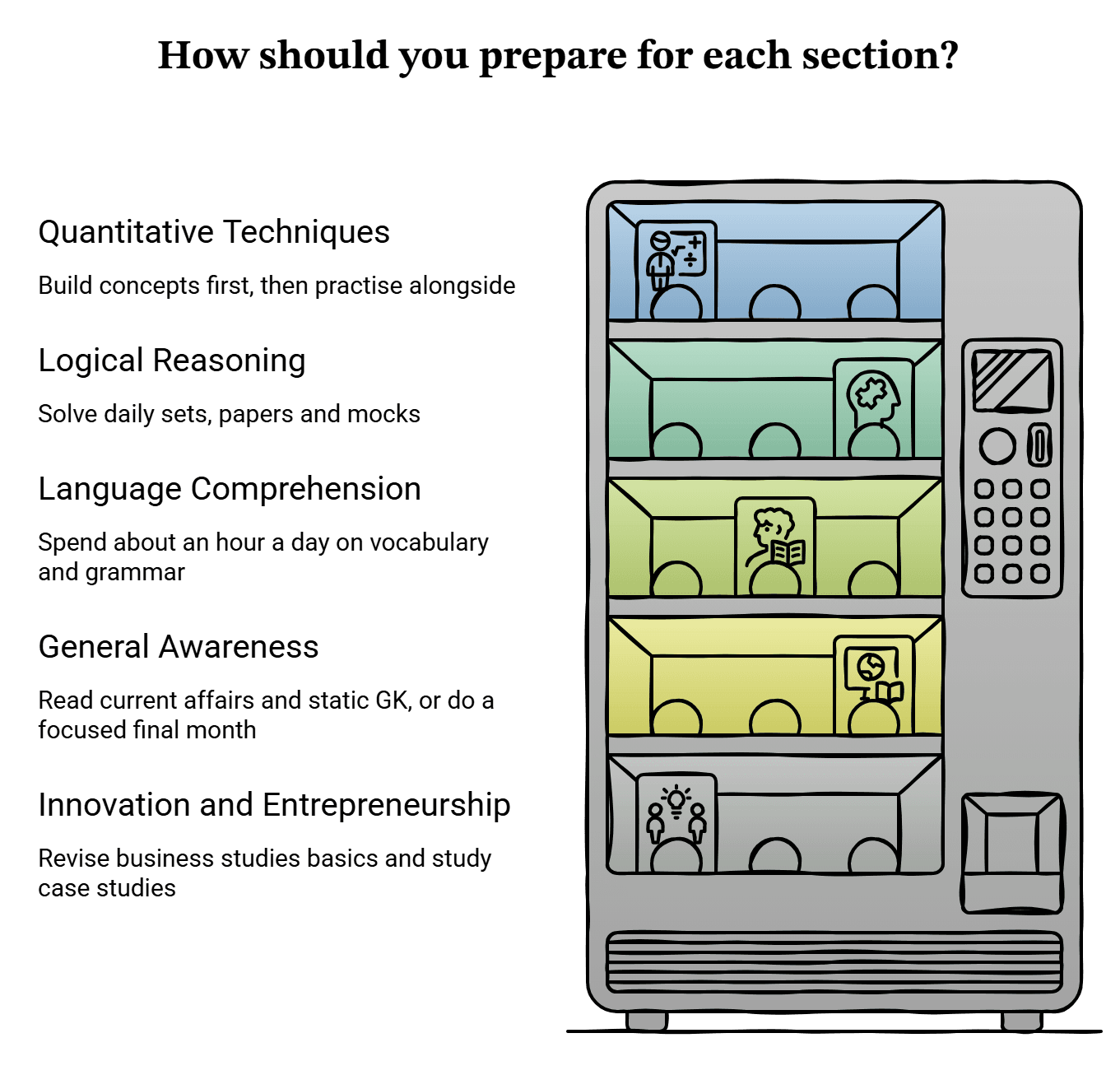
Quantitative Techniques and Data Interpretation
If maths is strong, sample questions may be enough. If not, build concepts first across arithmetic, mensuration, geometry, trigonometry and algebra, then practise alongside. We suggest aiming for nearly 1,000 practice questions before the exam.
Logical Reasoning
This is a practice section. List your strengths and weaknesses, solve daily sets, use previous-year papers and mocks, and learn shortcuts that save time.
Language Comprehension
Questions lean toward grammar and vocabulary over long RCs, so 2 to 3 passages are manageable. Spend about an hour a day on vocabulary and grammar, and use past papers for RC and para jumbles. Avoid over-attempting critical reasoning; about 15 good attempts is the suggested target.
General Awareness
It is memory-based. Either read current affairs and static GK for an hour a day, or do a focused final month with yearbooks. Don’t over-prepare; it is the most random section.
Innovation and Entrepreneurship
Revise business studies basics, read about startups and founders, study case studies and practise the last two years’ questions. One month near the end is enough for many candidates.
How Many Questions Should You Attempt?
Aim for 70 to 75 of 100 with high accuracy. That means 15 to 18 per section at about 80% accuracy and 10 to 12 correct in General Awareness. This is third-party guidance, not an official figure.
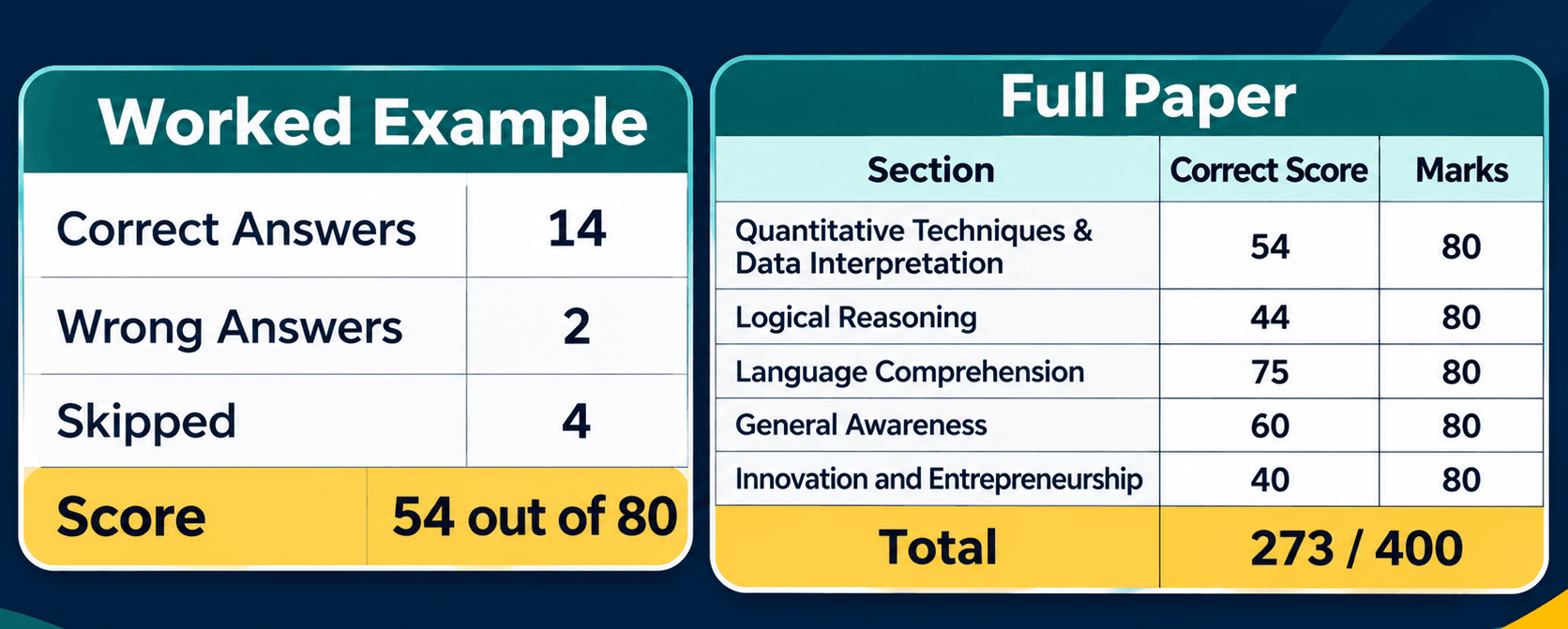
| Worked example: 14 right, 2 wrong, and 4 skipped in a section: (14 × 4) − 2 = 54 out of 80. | Full paper: section scores of 54, 44, 75, 60 and 40 add up to 273, not 203; add carefully when you self-score. |
CMAT 2027 Weekly Preparation Plan
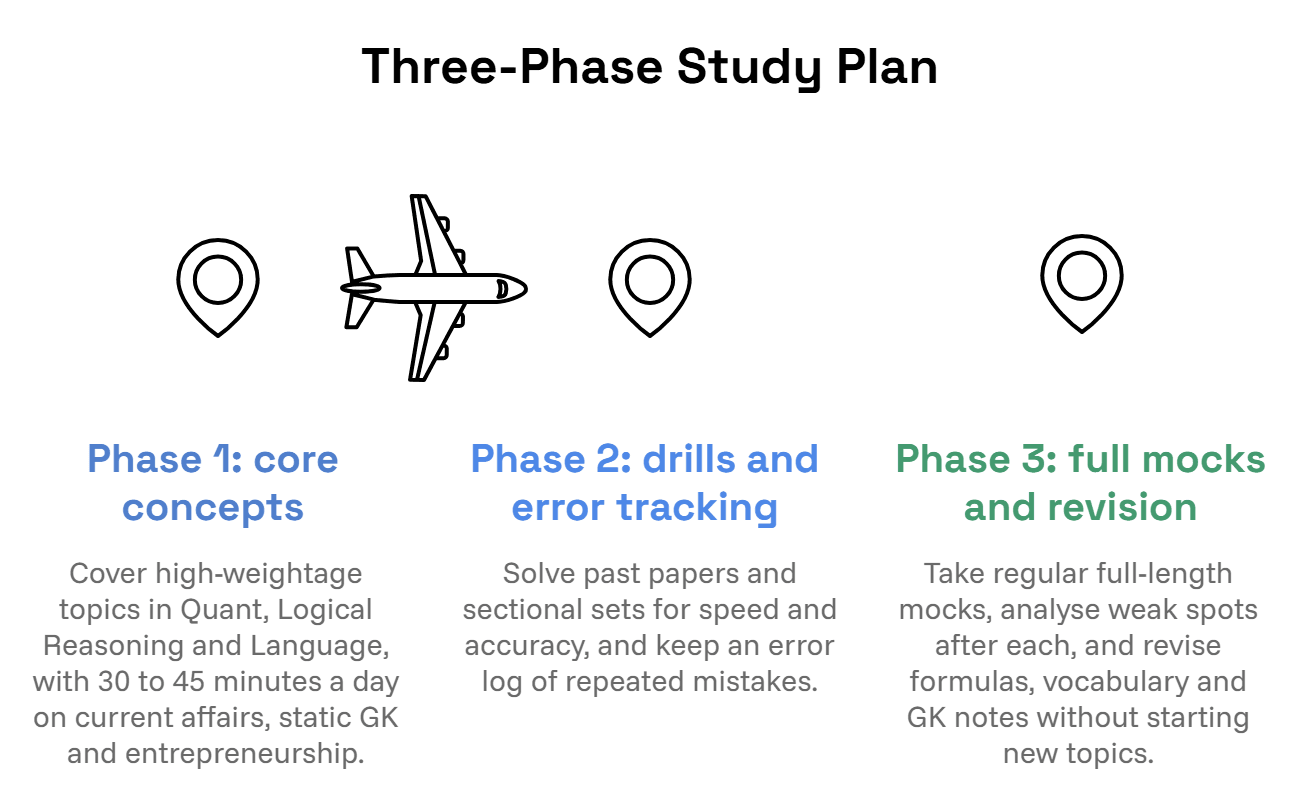
Split the weeks you have left into three phases: about a third on concepts, a third on drills, and the rest on full mocks and revision. The plan flexes with your start date. It follows the roadmap in the reports we read; it is our suggestion, not an official schedule.
- Phase 1: core concepts (first third). Cover high-weightage topics in Quant, Logical Reasoning, and Language, with 30 to 45 minutes a day on current affairs, static GK and entrepreneurship.
- Phase 2: drills and error tracking (middle third). Solve past papers and sectional sets for speed and accuracy, and keep an error log of repeated mistakes.
- Phase 3: full mocks and revision (last third). Take regular full-length mocks, analyse weak spots after each, and revise formulas, vocabulary, and GK notes without starting new topics. Experts suggest at least 10 mocks of varying difficulty.
A Typical Week
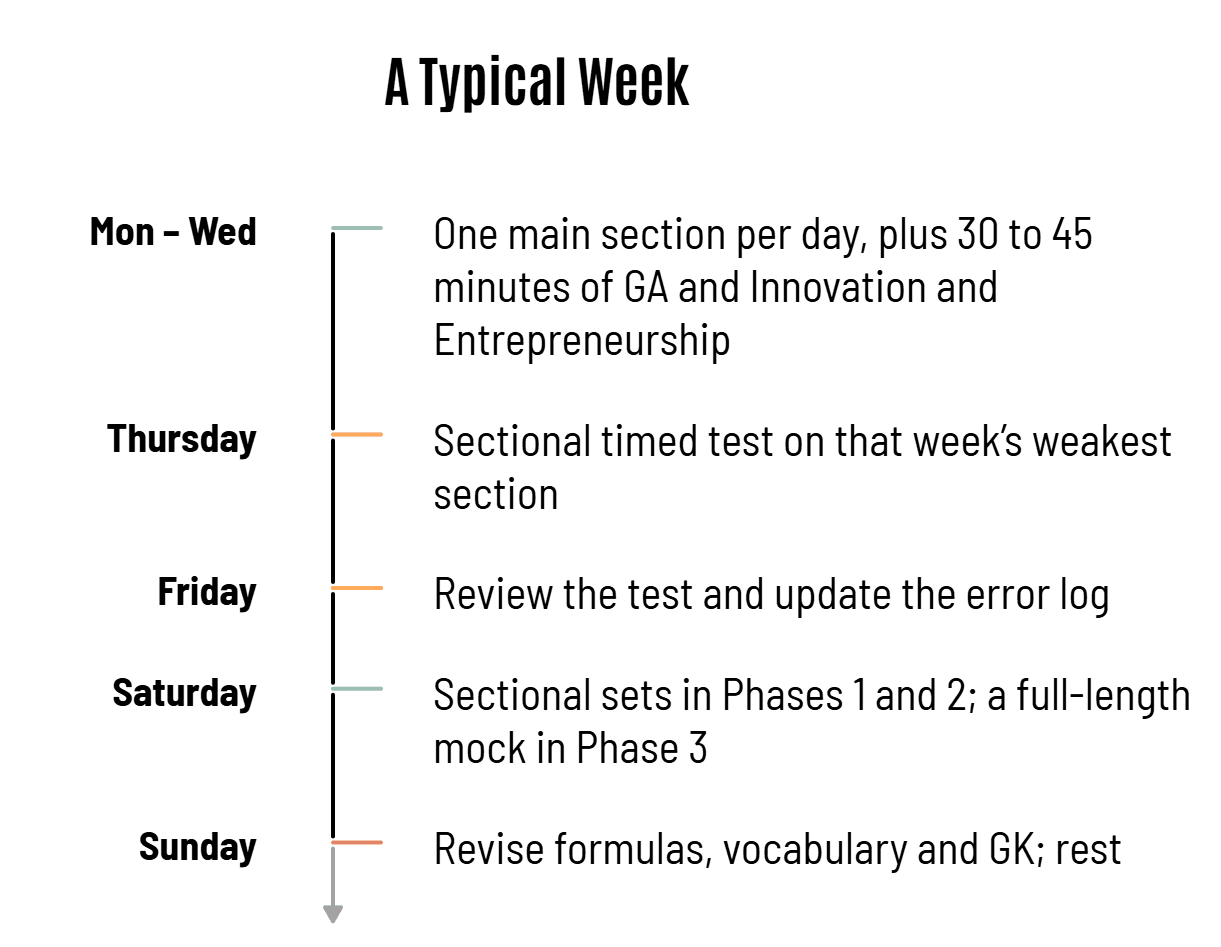
| Day | Focus |
|---|---|
| Mon – Wed | One main section per day (Quant, Logical Reasoning, Language), plus 30 to 45 minutes of GA and Innovation and Entrepreneurship |
| Thursday | Sectional timed test on that week’s weakest section |
| Friday | Review the test and update the error log |
| Saturday | Sectional sets in Phases 1 and 2; a full-length mock in Phase 3 |
| Sunday | Revise formulas, vocabulary and GK; rest |
If You Are Starting Late
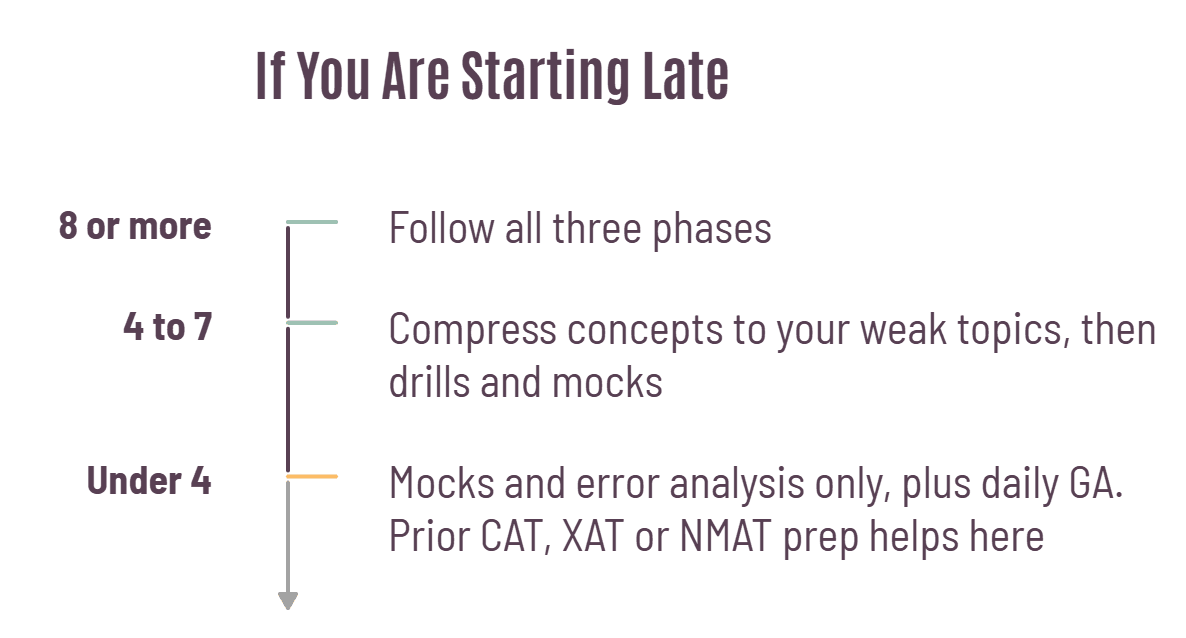
Weeks left | Priority |
8 or more | Follow all three phases. |
4 to 7 | Compress concepts to your weak topics, then drill and mock. |
Under 4 | Mocks and error analysis only, plus daily GA. Prior CAT, XAT, or NMAT prep helps here |
Also writing MAH MBA CET? Its first attempt ends on 30 January, 12 days before CMAT. Treat late January to 11 February as one revision cycle, and add GA and Innovation and Entrepreneurship early.
Recommended Books
| Section | Book | Author |
|---|---|---|
| Quant | How to Prepare for Quantitative Aptitude for CAT | Arun Sharma |
| Quant | Quantum CAT | Sarvesh K Verma |
| Quant | Quantitative Aptitude for Competitive Examinations | Abhijit Guha |
| Verbal | How to Prepare for Verbal Ability and RC for the CAT | Arun Sharma |
| Verbal and LR | Pearson Guide to Verbal Ability and Logical Reasoning | Nishit K Sinha |
| Reasoning | A Modern Approach to Verbal and Non-Verbal Reasoning | R S Aggarwal |
| LR | Concepts of LR for CAT and Other MBA Exams | Gajendra Kumar |
| All sections | Complete Reference Manual for CMAT | S K Sinha, S Satyanarayan, J S Rana |
| I&E | Innovation and Entrepreneurship | Peter F. Drucker |
| I&E | Entrepreneurship | Robert D. Hisrich |
| I&E | Entrepreneurship and Innovation Management | R Gopal |
| GA | Manorama Yearbook | Mammen Mathew |
Book lists are from Hitbullseye and other prep sites. Previous-year CMAT papers and NTA’s official mock for registered candidates matter more than extra books.
Exam-Day Tips and Guidelines
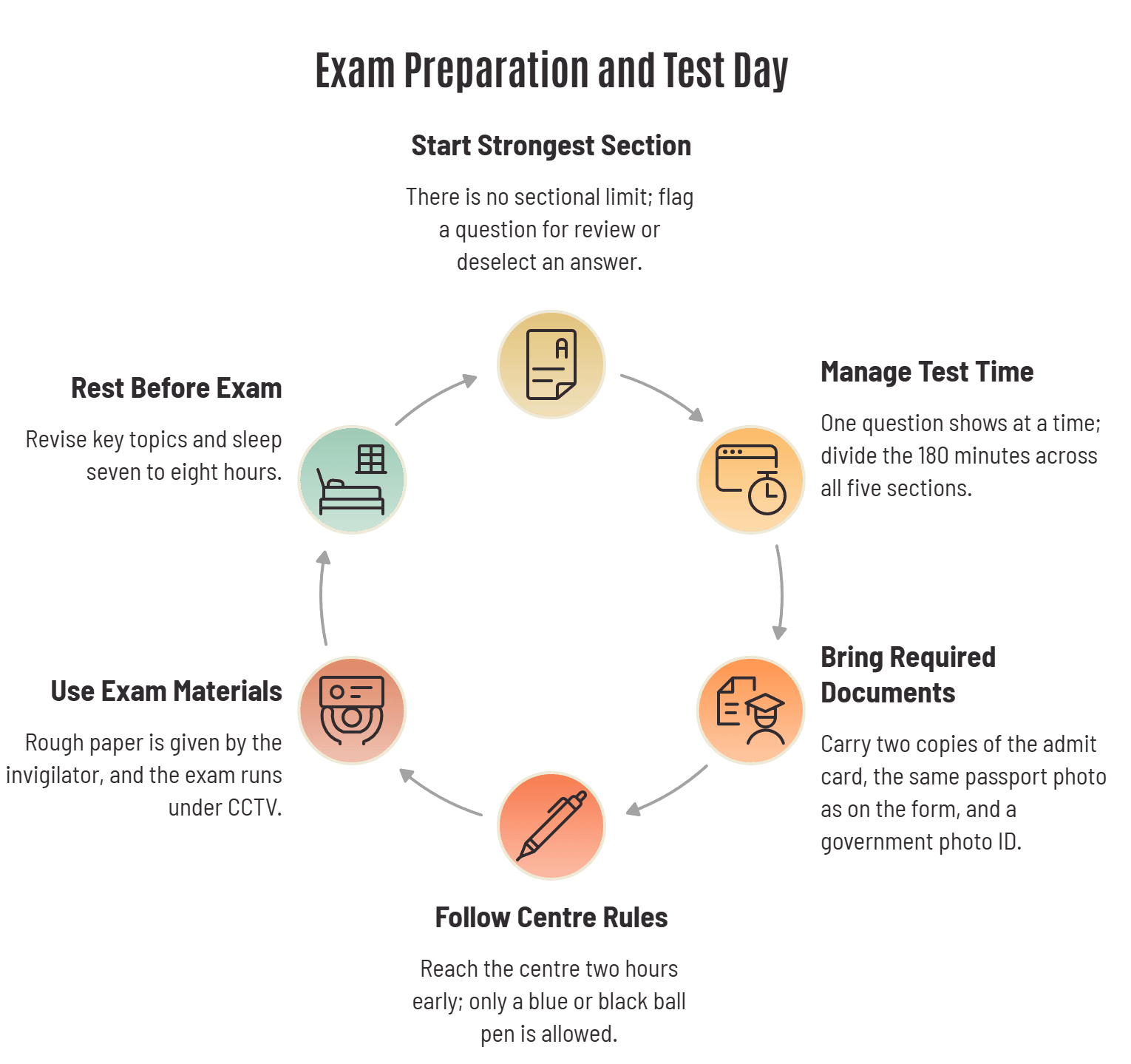
- Start with your strongest section. There is no sectional limit, and you can flag a question for review or deselect an answer.
- One question shows at a time, and the timer starts when you click Start Test. Divide the 180 minutes across all five sections.
- Carry two copies of the admit card, the same passport photo as on the form, and a government photo ID.
- Past guidance says to reach the center two hours early. Phones, calculators, bags, earphones, and metal accessories are not allowed; only a blue or black ball pen is.
- Rough paper is given by the invigilator, and the exam runs under CCTV.
- Don’t study hard the day before; revise key topics and sleep seven to eight hours.
Common CMAT Mistakes
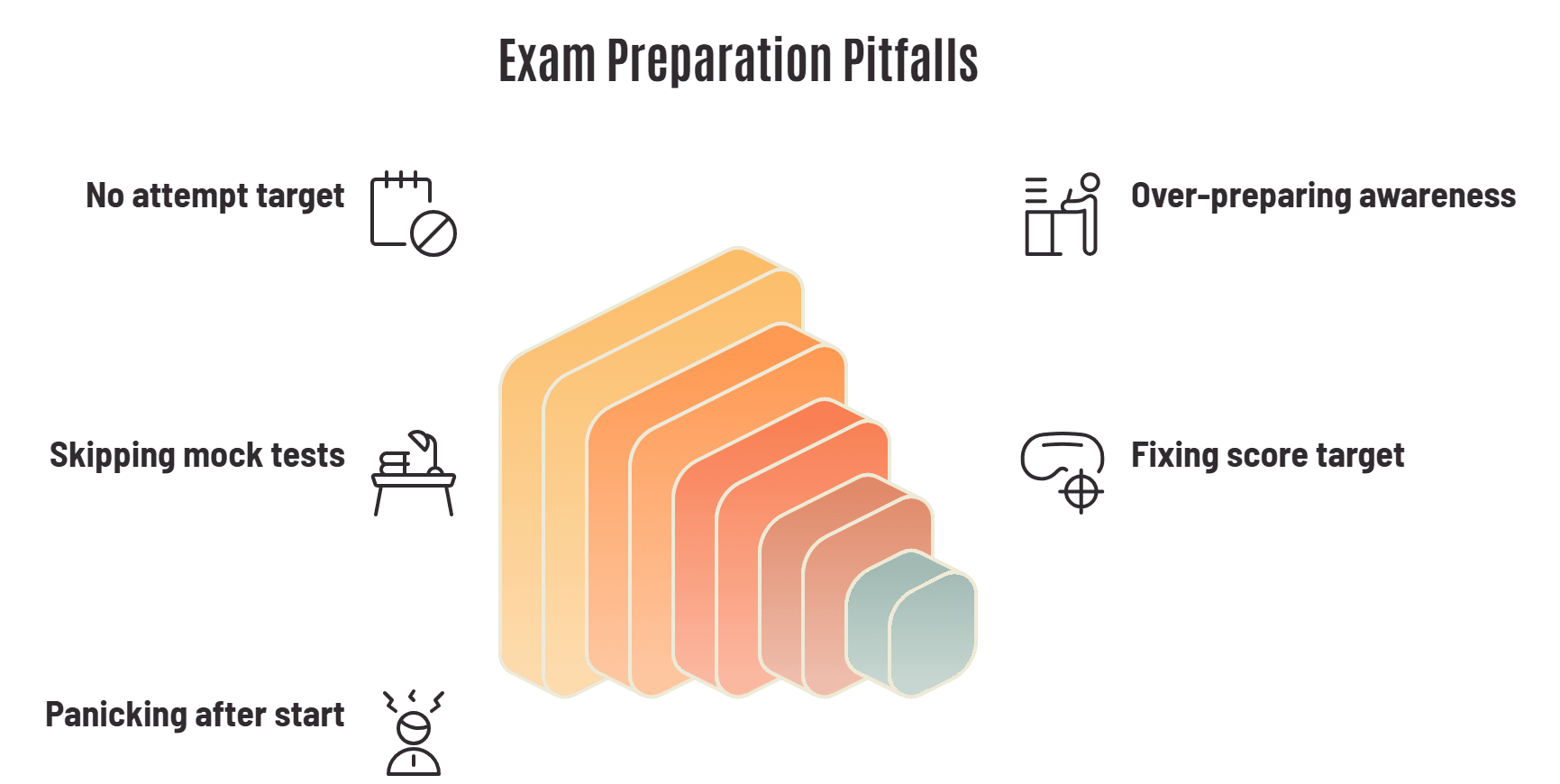
- Not deciding a target number of attempts. Over-attempting beyond 70 to 75 risks negative marks.
- Over-preparing General Awareness.
- Skipping mock tests.
- Fixing an absolute target score; ranking matters more, and difficulty changes the score needed.
- Panicking after a bad start. There is no sectional cut-off, so you can recover.
Admission Process After CMAT
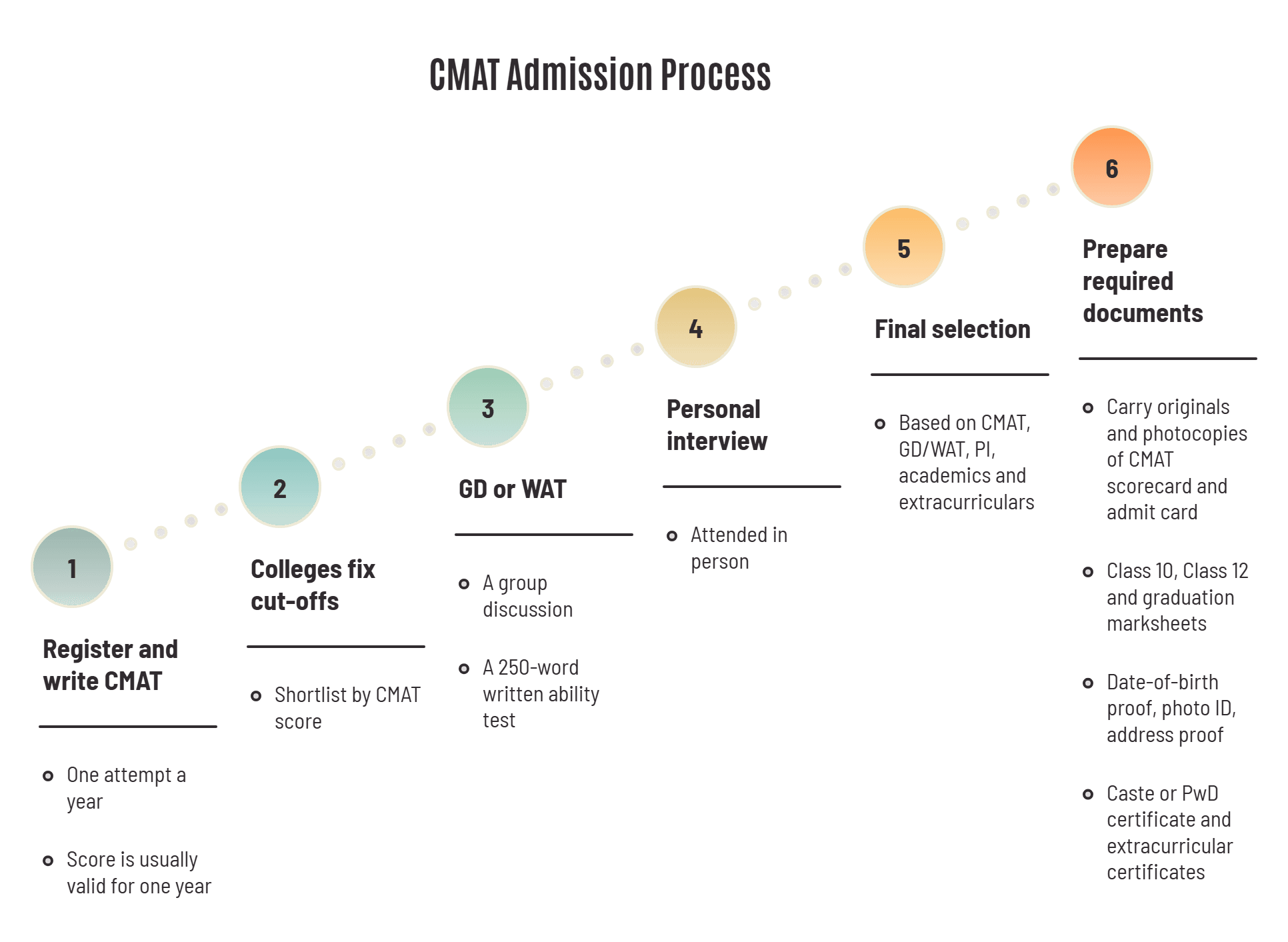
NTA only conducts the exam; there is no common counselling. You apply to each college separately, usually from February to August.
- Register and write CMAT. One attempt a year, and a score is usually valid for one year.
- Colleges fix cut-offs and shortlist by CMAT score.
- GD or WAT. A group discussion or a 250-word written ability test.
- Personal interview, attended in person.
- Final selection on CMAT, GD/WAT, PI, academics and extracurriculars.
Carry originals and photocopies of: CMAT scorecard and admit card, Class 10, Class 12 and graduation marksheets, date-of-birth proof, photo ID, address proof, caste or PwD certificate and extracurricular certificates.
Top MBA Colleges Accepting CMAT
CMAT is accepted by AICTE-approved institutes, reportedly over 1,300. The cut-offs below are estimates, not official figures.
| College & Location | Programme | Expected CMAT Cutoff | 2-Yr Tuition Fee (₹ lakh) |
|---|---|---|---|
| JBIMS, Mumbai, Maharashtra | MMS/MBA | 99.97 | ~6–8 |
| SIMSREE, Mumbai, Maharashtra | MMS | 99.97* | ~1.34–1.38 |
| Goa Institute of Management (GIM), Goa | PGDM | 99.85 | 21.45 |
| K J Somaiya Institute of Management, Mumbai, Maharashtra | MBA | 99.20 | ~23.88 |
| Great Lakes Institute of Management, Chennai, Tamil Nadu | PGDM | 99.06 | 16.03 (tuition); ~22.50 total incl. hostel |
| IFMR Graduate School of Business (Krea), Sri City, Andhra Pradesh | MBA | 97 | 16.00 |
| XISS, Ranchi, Jharkhand | PGDM | 95 | 12.00 |
| PUMBA (Dept. of Management Sciences), Pune, Maharashtra | MBA | 95–96 | ~1.64 |
| IFIM Business School, Bengaluru, Karnataka | PGDM | 85 | 15.90* |
| Asia-Pacific Institute of Management, New Delhi | PGDM | 85 | 11.50 |
| NL Dalmia Institute of Management, Mumbai, Maharashtra | PGDM | 85 | 16.50 (tuition); ~19.30 incl. accommodation |
| IMI Kolkata, Kolkata, West Bengal | PGDM | — | 15.03* |
| Jaipuria Institute of Management, Noida, Uttar Pradesh | PGDM | 82 | 1.40–14.80* (varies) |
| KIIT School of Management (KSOM), Bhubaneswar, Odisha | MBA | 80 | 13.60* |
| SRM Institute of Science and Technology, Chennai, Tamil Nadu | MBA | 80 | 4.70* |
| Amrita School of Business, Bengaluru, Karnataka | MBA | 80 | 7.50* |
| BIMTECH, Greater Noida, Uttar Pradesh | PGDM | 75 | 13–14* |
| BIT Mesra, Ranchi, Jharkhand | MBA | 75 | 5.50* |
| DY Patil School of Management, Pune, Maharashtra | MBA | 75 | 2.30* |
| XIME, Bengaluru, Karnataka | PGDM | 75 | 11.00* |
| Alliance School of Business, Bengaluru, Karnataka | MBA | 75 | 13.50* |
| SSN School of Management, Chennai, Tamil Nadu | MBA | 75 | 4.00* |
| Christ University Institute of Management, Bengaluru, Karnataka | MBA | 70 | 7.70* |
| Welingkar (WeSchool), Mumbai, Maharashtra | PGDM | 70 | ~15.00 (₹7.5L/yr) |
| IMS Ghaziabad, Ghaziabad, Uttar Pradesh | PGDM | 70 | 7.95* |
| DY Patil University School of Management, Navi Mumbai, Maharashtra | MBA | 70 | 8.40* |
| Jagannath International Management School (JIMS), New Delhi | PGDM | 70 | 8.00* |
| Universal Business School, Karjat, Maharashtra | PGDM | 70 | 8.48* |
| NSB Academy, Bengaluru, Karnataka | MBA | 70 | 6.00* |
| Indira Institute of Management (IIMP), Pune, Maharashtra | MBA | 70 | 2.20* |
| AIMS Institute, Bengaluru, Karnataka | MBA | 70 | 4.85* |
| Accurate Group of Institutions, Greater Noida, Uttar Pradesh | MBA | 70 | 5.60* |
| Rajagiri Centre for Business Studies, Kochi, Kerala | MBA | 70 | 6.00* |
| Indus Business Academy, Bengaluru, Karnataka | PGDM | 60 | 5.58* |
| ISME, Bengaluru, Karnataka | PGDM | 60 | 8.25* |
| VIT Business School, Vellore, Tamil Nadu | MBA | 60 | 7.00* |
Estimates: the cut-offs and fees are from third-party education sites, which call the cut-offs speculative and the fees from a previous session. *SIMSREE appears only in the second list at 99.97, and JBIMS appears there at 99.99. Admission also depends on GD/WAT and PI. Colleges are listed in Delhi, Mumbai, Bangalore, Pune, Hyderabad, and Bhopal.
Conclusion: How to Choose the Right MBA College
Compare fees, placements, specialisation, eligibility, location and total budget before you rely on a cut-off. Shortlist colleges early so you can arrange finance, and check each one’s selection process and dates.
Before you rely on any date or fee, check cmat.nta.nic.in and the NTA bulletin. Dates and fees are from NTA’s schedule as reported on 23 November 2026. Pattern, syllabus, strategy, books, cut-offs and admission steps are from Shiksha, Hitbullseye and similar sites, and day counts, the study plan and score example are ours. More guides on OnlyEducation.
Need help with CMAT 2027 or MBA admissions? Only Education offers free guidance on registration and form filling, college shortlisting, fee and placement comparison, counselling, and deadlines. Call 6262929248.