
MAH MBA CET 2027 Preparation Strategy: How to Score in the New 150-Question Paper


Quick answer
With 150 questions in 120 minutes, you get about 48 seconds a question and no room for long puzzles. Win by taking easy marks first, capping time on hard questions, attempting everything (no negative marking reported) and practising in the new format. Logical Reasoning is 40% of the paper, so it decides most results. For dates, registration and eligibility, see our complete Maharashtra CET 2027 guide.
What the New Paper Rewards
The 2027 paper is shorter, but not slower: you still have under a minute per question. It is reported to have 150 multiple-choice questions for 150 marks, and every section is smaller than in 2026. Our main guide has the full 2026 vs. 2027 comparison; this is the version you need for planning.
| Section | Questions | Share of paper |
|---|---|---|
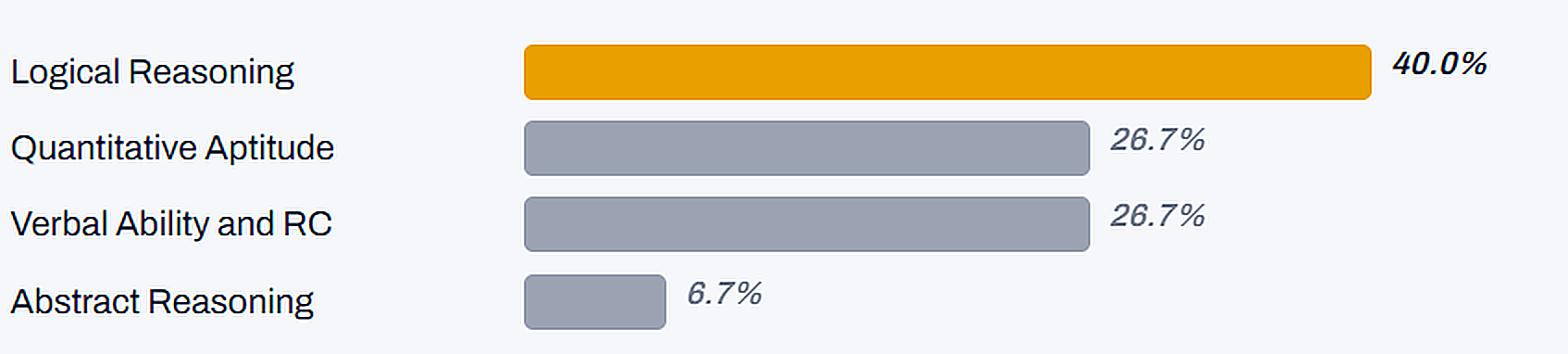
| Logical Reasoning | 60 | 40.0% |
| Quantitative Aptitude | 40 | 26.7% |
| Verbal Ability and Reading Comprehension | 40 | 26.7% |
| Abstract Reasoning | 10 | 6.7% |
| Total, 120 minutes | 150 | 100% |
Pattern as reported by education sites on the CET Cell's 16 November 2026 notice; percentages are our arithmetic. Confirm in the official brochure.
Where the Marks Are
The two reasoning sections together are 70 of 150 marks (46.7%), and Logical Reasoning alone is the biggest block in the paper. Quantitative and Verbal together carry the other 53.3%. Abstract Reasoning, which was 25 questions in 2026, is now small enough to practise lightly.
The practical rule: if you have limited hours, put the largest share into Logical Reasoning and Arithmetic, then Reading Comprehension, and only then polish Abstract Reasoning.
Build a Time Budget Before You Take a Mock
Decide in advance how many minutes each section may take, so the paper never decides for you. The split below is an illustrative starting point of ours, not an official guideline. Adjust it after your first few mocks, based on where you gain marks fastest.
| Section | Questions | Suggested time | Per question |
|---|---|---|---|
| Logical Reasoning | 60 | 45 min | 45 sec |
| Abstract Reasoning | 10 | 6 min | 36 sec |
| Quantitative Aptitude | 40 | 32 min | 48 sec |
| Verbal Ability and RC | 40 | 27 min | 41 sec |
| Review and guessing buffer | – | 10 min | – |
| Total | 150 | 120 min | 48 sec |
The buffer matters. With no negative marking reported, those last 10 minutes are worth more spent guessing every open question than squeezing a little more time out of one hard puzzle.
Section-by-Section Tactics
Logical Reasoning (60 questions)
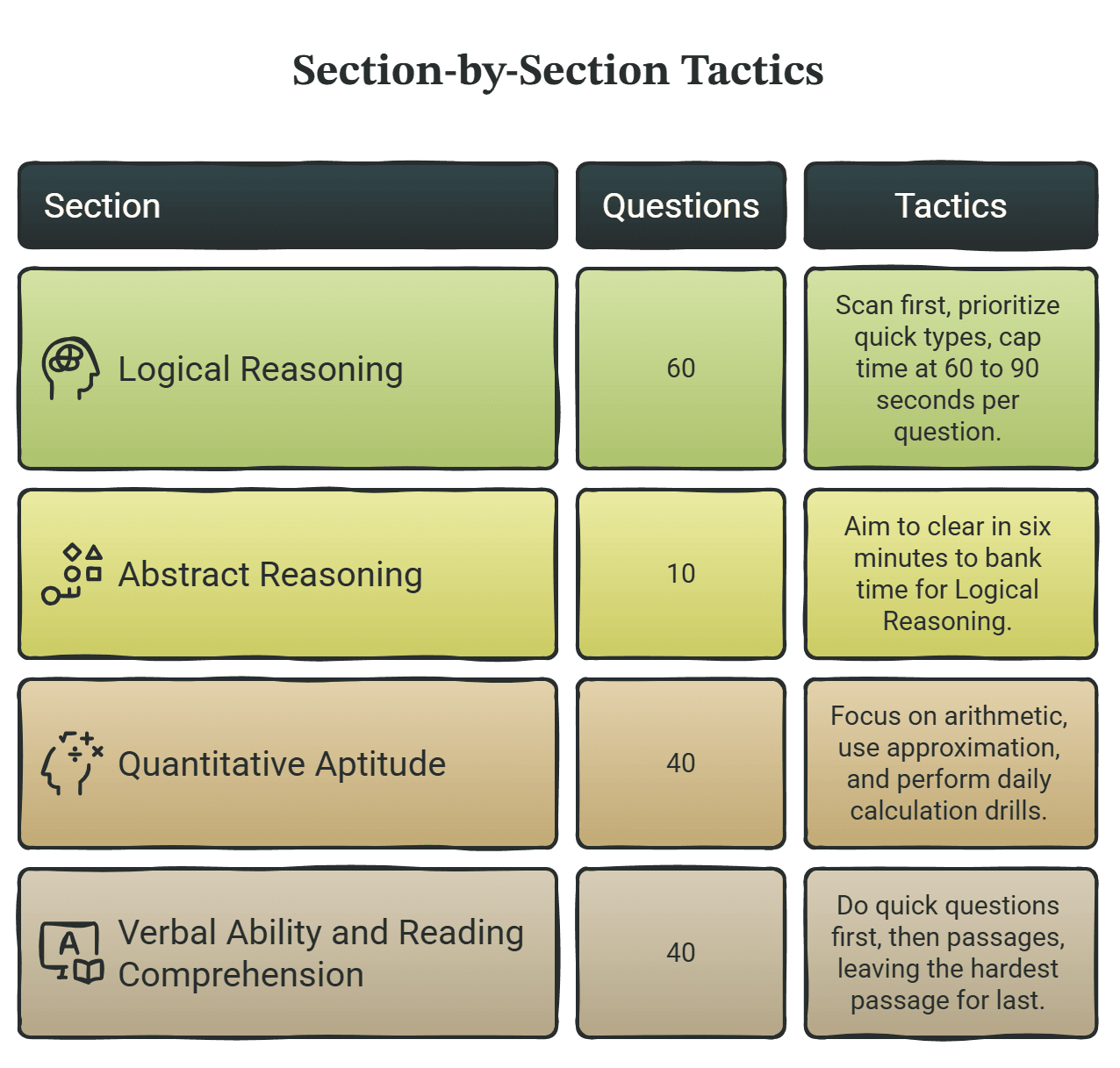
Reports on the 2026 paper describe this section as conceptually fair but time-hungry. Scan first and take the quick types, such as blood relations, coding-decoding, direction sense, syllogisms and Venn diagrams, before the big arrangement puzzles with many conditions. Give any question a hard cap of 60 to 90 seconds. Practise with a timed set of 10 to 15 questions a day and review every miss.
Abstract Reasoning (10 questions)
Keep 10 to 15 minutes a day on series, figure counting, pattern comparison, paper folding and analogies. These questions are visual, so you can usually tell quickly whether you will solve one. Aim to clear the section in about six minutes and bank the time for Logical Reasoning.
Quantitative Aptitude (40 questions)
Arithmetic carries the section: percentages, ratios, profit and loss, time-speed-distance, time and work, and the number system. Data interpretation sets are dependable marks, because one table or chart can yield several questions. Check how calculation-heavy a set is before committing, and use approximation. Daily fraction-to-percentage and squares drills make every other question faster.
Verbal Ability and Reading Comprehension (40 questions)
Reading Comprehension and vocabulary dominated the 2026 paper, though patterns shift. Do the quick questions first: grammar, error correction, sentence completion, synonyms and antonyms, paragraph ordering. Then take the passages, and leave the hardest passage for last. Read two short passages a day under a timer so that speed builds alongside comprehension.
Triage: Take Three Passes Through the Paper
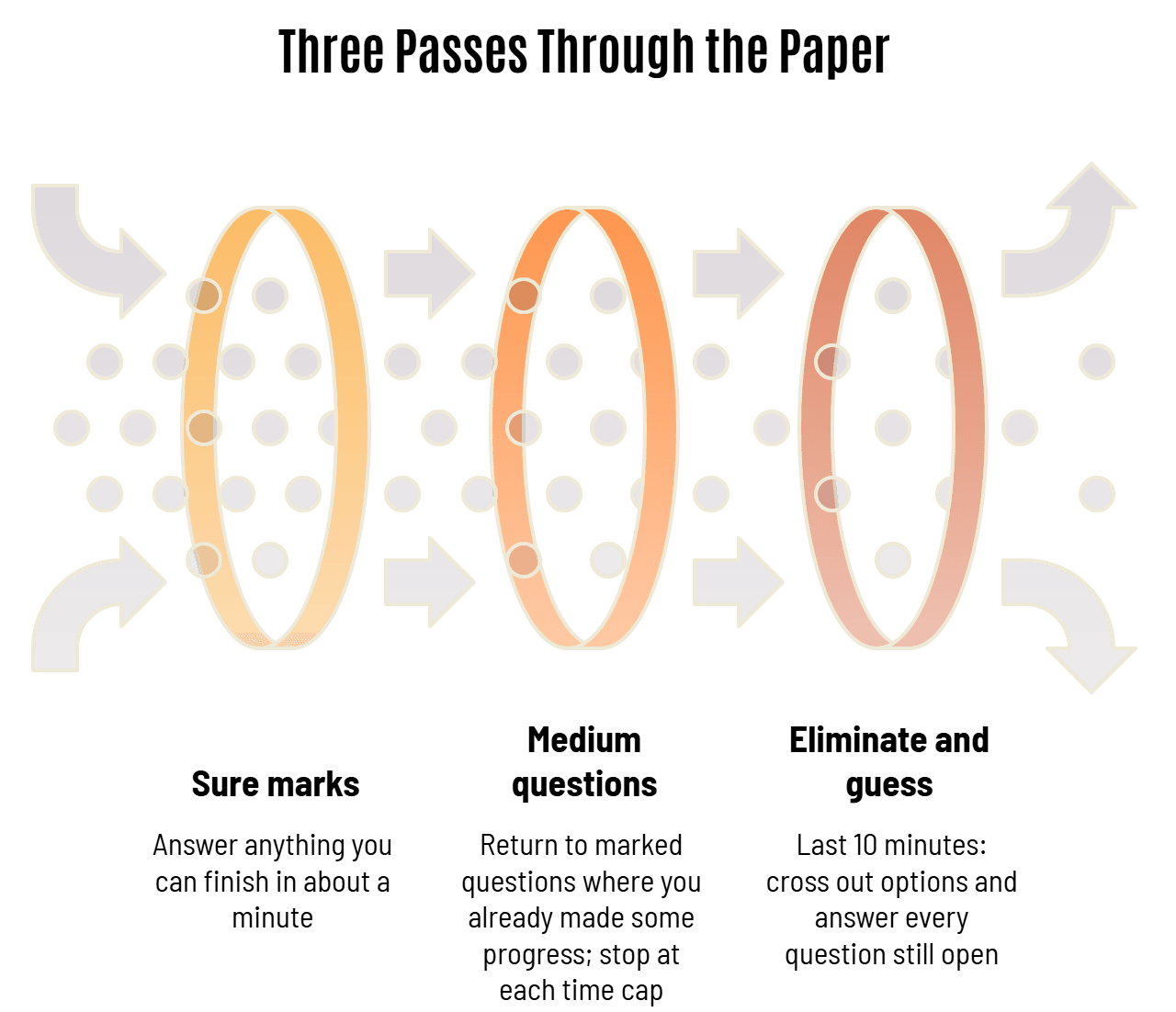
Do not solve the paper in order. Pass over it more than once, collecting the easiest marks first. This is our suggested approach.
- First pass: the sure marks. Answer anything you can finish in about a minute. Mark long arrangement puzzles, heavy data sets and the hardest passage, and move on without guilt.
- Second pass: the medium questions. Return to marked questions where you already made some progress. Stop each one once you reach its time cap.
- Last 10 minutes: eliminate and guess. Cross out options you can rule out and answer every question still open. Leave nothing blank.
Use Mock Tests as a Diagnostic, Not a Scoreboard
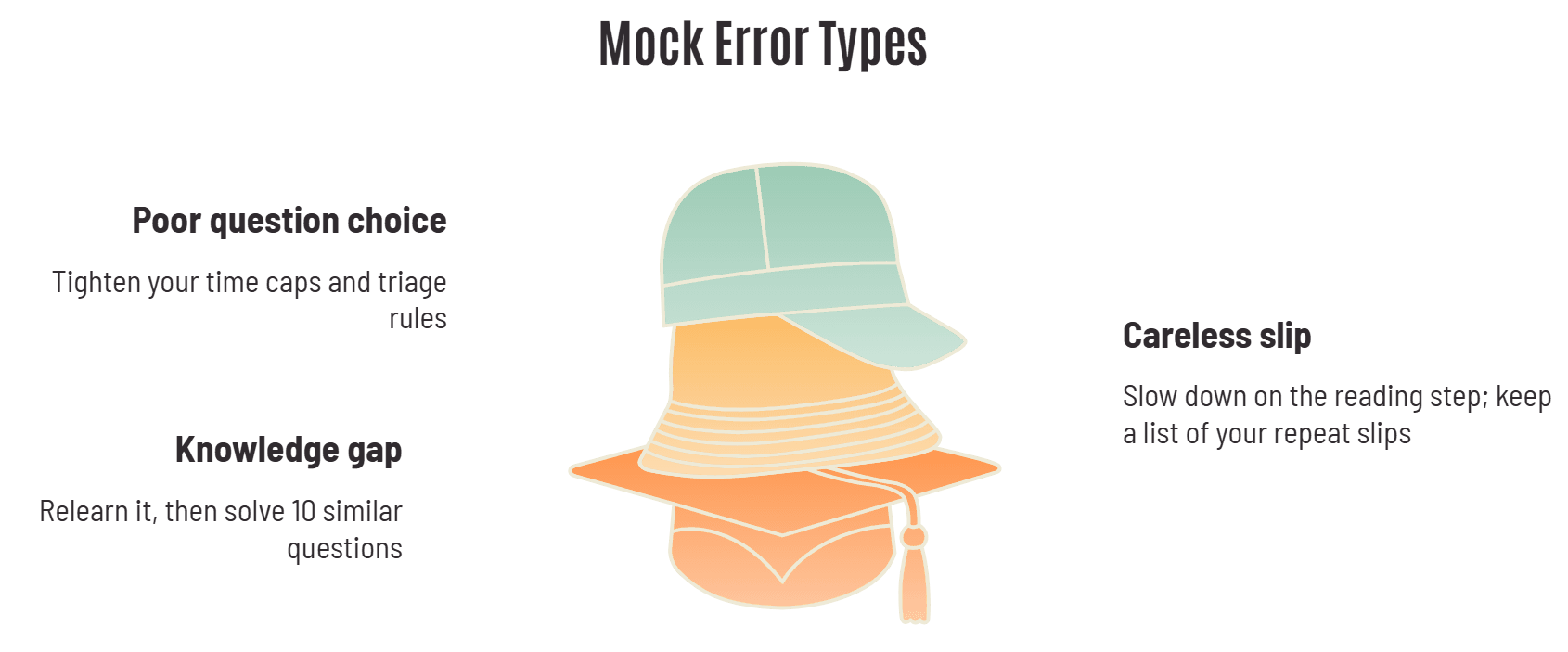
The point of a mock is the review afterwards. Practise in the new format of 150 questions and 120 minutes, because a 200-question habit will make you feel behind when you are not. Plan 6 to 8 full-length mocks in the middle phase of your preparation, then 3 to 4 a week in the last two weeks. Take them in the time slot of your exam if you can. Spend longer analysing each mock than sitting it, and sort every lost mark into one of three groups.
| Error type | What it looks like | Fix |
|---|---|---|
| Knowledge gap | You did not know the method or concept | Relearn it, then solve 10 similar questions |
| Careless slip | You knew it but misread or miscalculated | Slow down on the reading step; keep a list of your repeat slips |
| Poor question choice | You spent too long on a question you should have skipped | Tighten your time caps and triage rules |
Keep a simple log of these, plus the minutes you spent in each section. After four or five mocks, patterns show up: the section that leaks time, the topic that keeps costing marks. Fix those before taking another full test.
Treat the first attempt as the real one. The first attempt is compulsory, and reports say that taking both attempts gives you the higher percentile. April is a chance to improve, not a safety net, so do not plan to use January as practice.
If You Are Also Preparing for CAT, XAT or CMAT
The skills overlap, but the habits do not. Quantitative and verbal work carries over. Reasoning is heavier in this paper, and several national MBA exams penalise wrong answers, whereas the CET is reported to have no negative marking. That means the cautious skipping that protects your score elsewhere will cost you marks here. Run at least a few CET-format mocks in which you attempt every question, so the habit is switched on by January.
Common Mistakes
- Practising with 2026's 200-question papers and misjudging pace.
- Spending large blocks on Abstract Reasoning for 10 questions.
- Sinking three minutes into one Logical Reasoning puzzle.
- Taking mocks without reviewing them.
- Leaving questions blank when no negative marking is reported.
- Planning to "use January as practice".
- Relying on sites that still show the old pattern.
Conclusion
MAH MBA CET 2027 is a shorter paper, not an easier one. With 150 questions in 120 minutes, you still have under a minute for each question, and Logical Reasoning alone carries 40% of the marks. The candidates who do well will not necessarily be those who know the most, but those who spend their time where the marks are, stop before a hard question drains the clock, and attempt every question.
Build your preparation around three habits: a time budget for each section, a three-pass approach that takes the easy marks first, and full-length mocks in the new 150-question format that you review properly. Give Logical Reasoning and Arithmetic the largest share of your hours, keep Abstract Reasoning light, and practise guessing smartly in the last 10 minutes, since no negative marking is reported.
Before you rely on any rule, check cetcell.mahacet.org and the information brochure. The pattern is from news and education-site reports of the CET Cell's 16 November 2026 notice. Percentages, the time budget and all strategy advice are ours. For exam dates, registration, eligibility, syllabus and CAP, read our complete Maharashtra CET 2027 guide. More guides on OnlyEducation.