
Should IITs Adopt a Flexible 5-Year B.Tech Model With Multiple Exit Options?
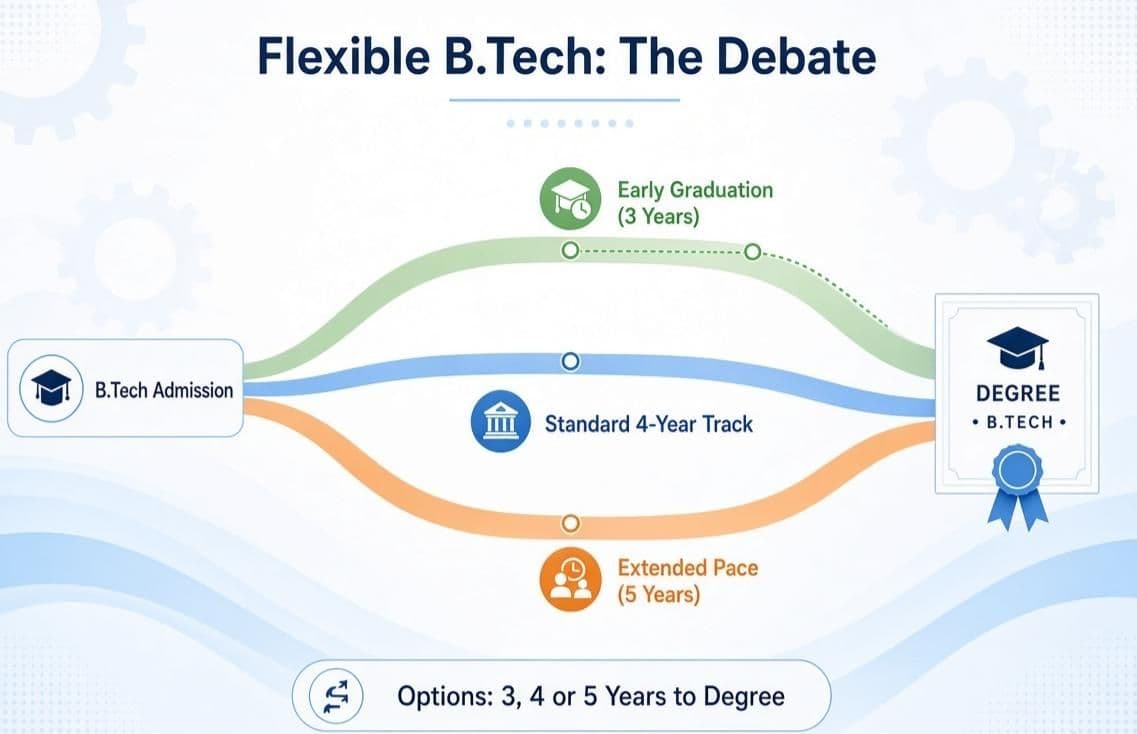
A renewed debate is underway over whether IITs should move away from the rigid four-year B.Tech structure toward a flexible model — one where students could graduate in three years, four years, or five years, depending on their pace, without academic penalty. The idea has gained fresh attention following recent developments at IIT Bombay and public advocacy from former IIT Delhi director Prof. V Ramgopal Rao. No IIT or central education body has announced a formal decision on this yet — it remains a subject of active discussion among educationists and policymakers.
What Is Being Proposed
The proposal draws on the National Education Policy (NEP) 2020's vision of flexible, multi-exit higher education. Under the idea being discussed, B.Tech students would no longer be bound to a single four-year timeline:
- Fast learners could complete their coursework and graduate in three years, entering the workforce or further study earlier.
- Average learners would continue on the standard four-year track.
- Students who need more time could take a fifth year to complete the same B.Tech degree, without it being treated as an academic failure.
Rao has argued that a uniform pace for all students — regardless of background or learning speed — is a significant source of stress, contributing to anxiety, burnout, and dropout in some cases.
IIT Bombay's Existing Exit Option: What's Already in Place
IIT Bombay already offers a related, narrower option: since 2023, students can exit after three years with a BSc (Engineering) degree instead of continuing to a full BTech, in line with NEP 2020 guidelines. Students who take this route remain eligible to participate in campus placements. This is a single, one-directional early-exit provision, distinct from the fully flexible three-to-five-year model now being discussed, which would also allow students extra time rather than only an earlier exit.
The Case for Flexible Timelines
Supporters of the flexible model argue that India's B.Tech curriculum is largely standardised regardless of a student's learning pace or background, and that this standardisation is itself a source of pressure. Allowing students to move at their own speed, the argument goes, could reduce stress-related dropouts and burnout without lowering academic standards.
Cost and Stigma Concerns
Two practical concerns dominate the debate:
- Cost: An extra year of tuition, housing, and living expenses could make the five-year option significantly more expensive, potentially putting it out of reach for students from low-income families.
- Stigma: Students who take the extended route could be perceived as "slower" than their peers, even though the model is designed to remove exactly that kind of academic penalty.
Why Pedagogy, Not Just Timelines, May Need to Change
Some educationists argue that flexible timelines alone won't solve the underlying problem. They point to a need for modular coursework, the ability for students to follow individualised learning paths, and continuous evaluation instead of rigid semester-based teaching. Without these pedagogical changes, the argument goes, simply extending or shortening the calendar won't meaningfully adapt the curriculum to how differently students actually learn.
What Happens Next
As of now, this remains a policy discussion rather than an announced change. Any move toward a flexible, multi-exit B.Tech structure at IITs would require institutional deliberation and, likely, coordination across the IIT system given how standardised current admission and academic timelines are through JoSAA counselling. [VERIFY: no official response or timeline from IIT Bombay, the IIT Council, or the Ministry of Education has been confirmed as of this writing.]
FAQ Section
Q1: What is the flexible 5-year B.Tech model being discussed for IITs?
A proposal under discussion that would let students complete their B.Tech in three, four, or five years depending on their learning pace, instead of a fixed four-year timeline.
Q2: Has this been officially adopted by any IIT?
No. As of this writing, it remains a policy debate among educationists; no formal decision has been announced. [VERIFY]
Q3: Does IIT Bombay already have a similar option?
Partially — since 2023, IIT Bombay has allowed students to exit after three years with a BSc (Engineering) degree, though this differs from the full flexible three-to-five-year model now under discussion.
Q4: Who is advocating for this change?
Former IIT Delhi director Prof. V Ramgopal Rao has publicly supported the idea, citing academic pressure from a uniform pace of teaching.
Q5: What are the main concerns with the 5-year option?
The extra year could raise costs significantly for students from low-income families, and there are concerns that students who take longer could face stigma, despite the model being designed to remove academic penalty for a slower pace.
Q6: Would flexible timelines alone solve academic pressure at IITs?
Some educationists argue no — they say changes to teaching methods, such as modular coursework and continuous evaluation, are also needed alongside flexible timelines.