
KIITEE 2027 Exam Pattern & Syllabus Released — Check Marking Scheme and Subject-Wise Topics
Published 21 Nov 20266 min read
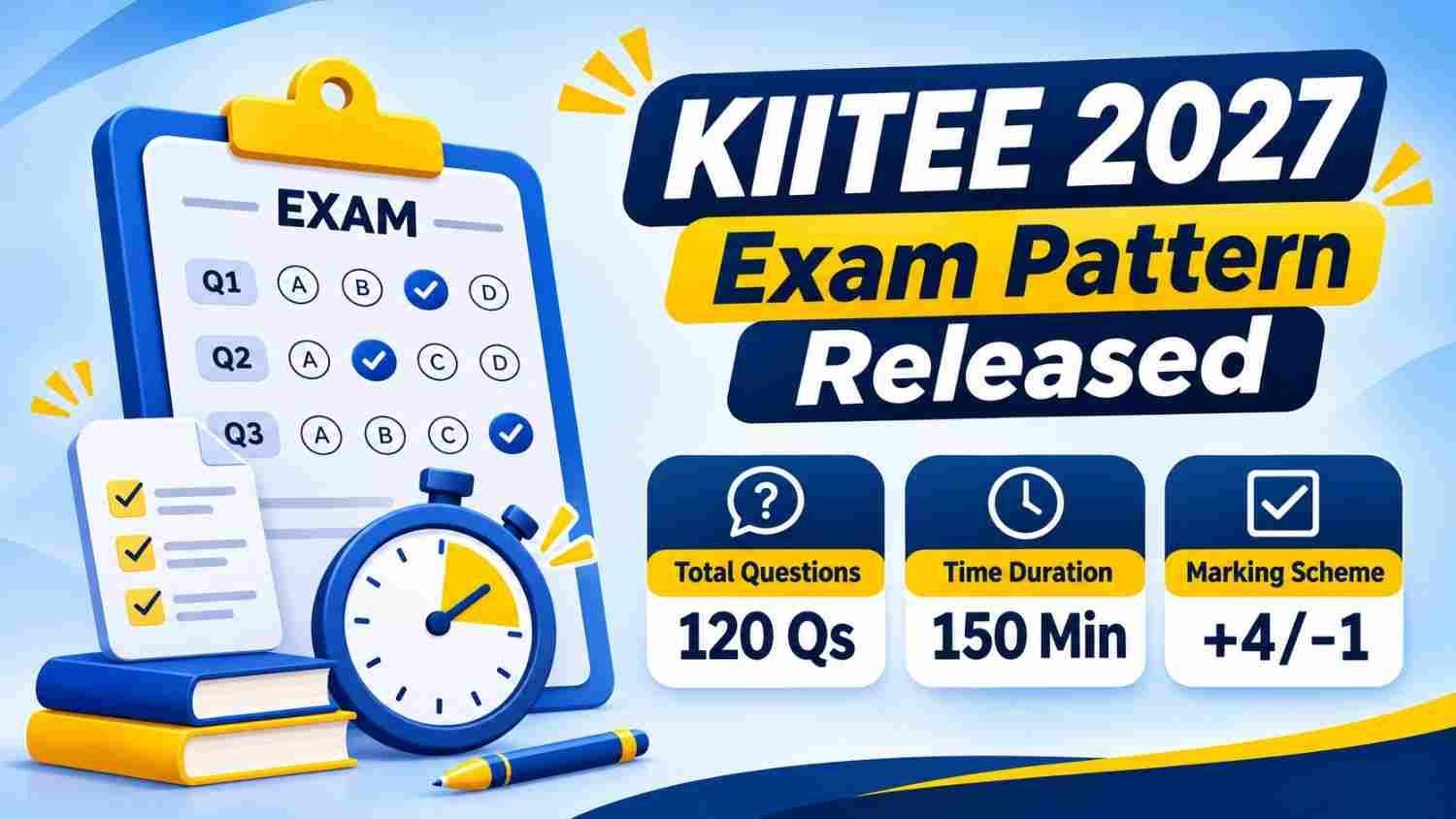
KIIT (Kalinga Institute of Industrial Technology), Bhubaneswar, has published the KIITEE 2027 exam pattern and syllabus for B.Tech aspirants. The entrance test will be conducted in Computer-Based Test (CBT) mode across three sections—Physics, Chemistry, and Mathematics—with a total of 120 questions to be answered in 150 minutes. The marking scheme carries +4 marks for each correct answer and −1 mark for each incorrect answer, for a total paper value of 480 marks .
The first phase of KIITEE 2027 is scheduled for 16–20 April 2027. The application deadline for Phase 1 is 8 April 2027, and there is no application fee .
KIITEE 2027 Exam Pattern: Key Details
| Parameter | Details |
|---|---|
| Exam Mode | Online (Computer-Based Test) |
| Number of Sections | 3 (Physics, Chemistry, Mathematics) |
| Language | English |
| Duration | 150 minutes (2.5 hours) |
| Total Questions | 120 |
| Question Type | Multiple Choice Questions (MCQs) |
| Options per Question | 4 |
| Marking Scheme | +4 for correct, −1 for incorrect |
| Total Marks | 480 |
Source: Official KIITEE 2027 pattern as published by KIIT .
Important Note on Marking Scheme and Total Marks
The official pattern released by KIIT states a +4/−1 marking scheme with a total of 480 marks . Some third-party preparation websites have published conflicting information referencing a +3/−1 scheme and 360 total marks . Candidates are advised to rely only on the official KIITEE 2027 information brochure and the portal kiitee.kiit.ac.in for accurate details. The official source is authoritative.
KIITEE 2027 Syllabus: Subject-Wise Topics
The syllabus covers Class 11 and Class 12 (10+2) standard topics across three subjects. The official unit list is summarised below.
Physics
Units include: Units and Measurement; Description of Motion in One and Two/Three Dimensions; Laws of Motion; Work, Energy and Power; Rotational Motion and Moment of Inertia; Gravitation; Solids and Fluids; Oscillations; Waves; Heat and Thermodynamics; Transfer of Heat; Electrostatics; Current Electricity; Thermal and Chemical Effects of Currents; Magnetic Effects of Currents; Magnetostatics; Electromagnetic Induction and Alternating Currents; Ray Optics; Wave Optics; Electromagnetic Waves; Electrons and Photons; Atoms, Molecules and Nuclei; Solids and Semiconductor Devices.
Chemistry
Units include: Some Basic Concepts; States of Matter; Atomic Structure; Solutions; Chemical Energetics and Thermodynamics; Chemical Equilibrium; Redox Reactions and Electrochemistry; Rates of Chemical Reactions and Chemical Kinetics; Surface Chemistry; Chemical Families and Periodic Properties; Chemical Bonding and Molecular Structure; Chemistry of Non-Metals I and II; Chemistry of Lighter Metals; Heavy Metals; Chemistry of Representative Elements; Transition Metals Including Lanthanides; Coordination Chemistry and Organo Metallics; Nuclear Chemistry; Purification and Characterization of Organic Compounds; Some Basic Principles; Hydrocarbons; Organic Compounds Containing Halogens; Organic Compounds Containing Oxygen; Organic Compounds Containing Nitrogen; Synthetic and Natural Polymers; Bio Molecules and Biological Processes; Chemistry In Action; Environmental Chemistry.
Mathematics
Units include: Sets, Relations and Functions; Complex Numbers; Matrices and Determinants; Quadratic Equations; Permutations and Combinations; Binomial Theorem and Its Applications; Sequences and Series; Differential Calculus; Integral Calculus; Differential Equations; Two-Dimensional Geometry; Three-Dimensional Geometry; Vector Algebra; Measures of Central Tendency and Dispersion; Probability; Trigonometry.
Candidates can download the official KIITEE 2027 B.Tech syllabus PDF from the KIITEE portal.
Section-Wise Question Distribution [VERIFY]
The official pattern states 120 total questions across 3 sections . It does not explicitly confirm the exact number of questions per section in the 2027 notification. Previous KIITEE brochures and preparation analyses indicate 40 questions per subject (Physics: 40, Chemistry: 40, Mathematics: 40) . Candidates should verify this against the official KIITEE 2027 information brochure before finalising their preparation plan.
KIITEE 2027 Exam Dates & Application Deadline
| Event | Date |
|---|---|
| Registration opens | 10 November 2026 |
| Phase 1 application deadline | 8 April 2027 |
| Phase 1 exam dates | 16–20 April 2027 |
| Phase 2 exam dates | 4–6 June 2027 |
Note: KIIT has described the exam dates as tentative and subject to confirmation. Candidates should monitor the official portal for updates on slot booking and admit card release .
What This Pattern Means for Preparation
Negative marking demands accuracy. With −1 for every wrong answer, random guessing is counterproductive. Candidates should attempt only questions they can solve with reasonable confidence.
Speed matters. 120 questions in 150 minutes averages 75 seconds per question. Physics numericals may take longer; Chemistry theory and Mathematics short computations can be faster.
PCM balance is essential. All three sections contribute equally to the total, so neglecting any one subject limits the maximum achievable score.
Use the official syllabus. The unit list is comprehensive and covers the full Class 11–12 PCM curriculum. Prioritise high-weightage topics based on previous year trends, but do not skip units entirely.
Official Links
KIITEE Official Portal: https://kiitee.kiit.ac.in/
KIITEE 2027 Syllabus PDF: Available via the official portal


