
JEE Main 2027 Application Form for Session 1 Expected in Last Week of October: Exam Dates, Eligibility and How to Apply
Published 28 Sept 20264 min read
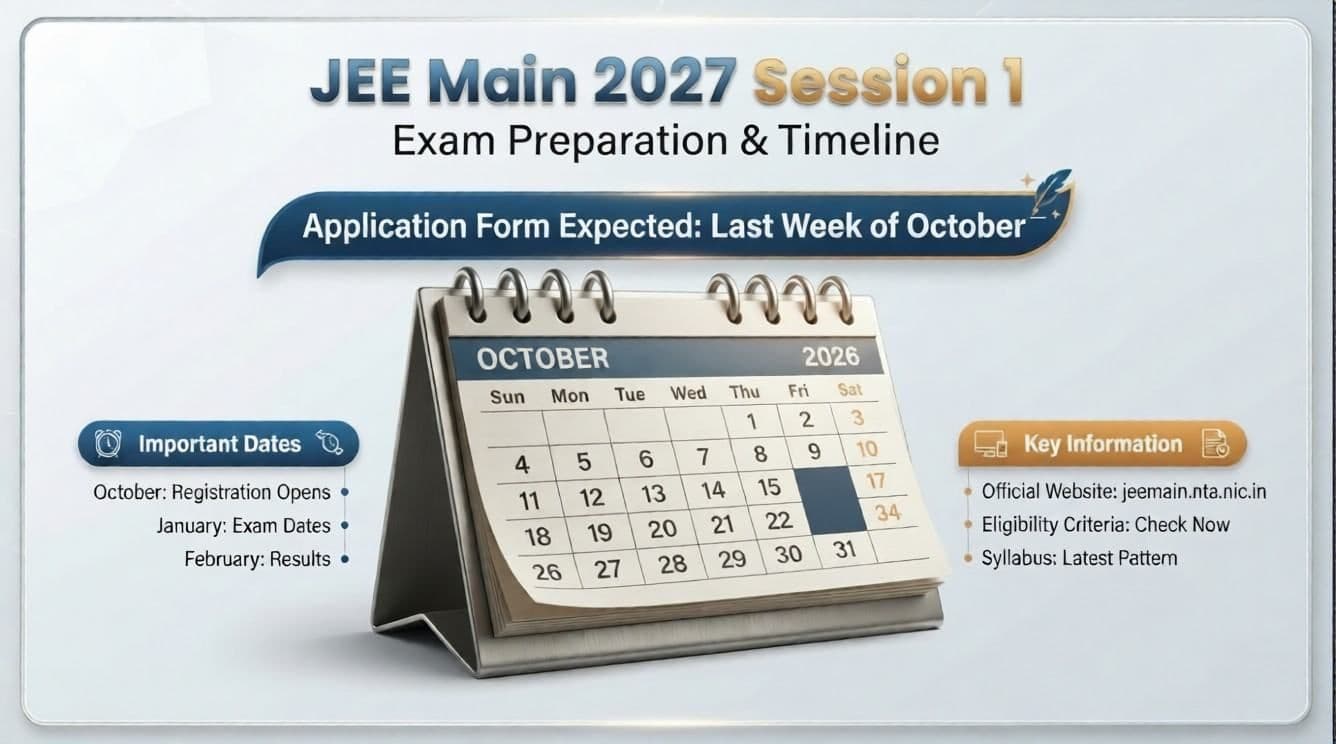
The National Testing Agency (NTA) has not yet opened registration for JEE Main 2027 Session 1. The application form is expected to be available on jeemain.nta.nic.in in the last week of October 2026, but NTA has not confirmed a date. Session 1 is scheduled for January 2027 in the NTA exam calendar.
JEE Main 2027 Session 1: Key Facts
| Detail | Status |
|---|---|
| Conducting body | National Testing Agency (NTA) |
| Official website | jeemain.nta.nic.in |
| Notification and bulletin | Not released; expected October 2026 |
| Registration start | Not announced; expected last week of October 2026 |
| Session 1 exam dates | 22, 23, 24, 28, 29 and 30 January 2027 (tentative, per calendar) |
| Buffer date | 31 January 2027 |
| Application fee | Not announced [VERIFY] |
| Mode | Online only |
When Will JEE Main 2027 Registration Start?
NTA has not announced the date. Education portals expect the form in the fourth week of October 2026. The information bulletin is usually released a few days before the link opens or on the same day. Treat all dates as estimates until NTA publishes the notification.
Expected Registration Timeline
| Event | Date | Status |
|---|---|---|
| Notification and form release | Last week of October 2026 | Expected |
| Last date to apply | Around late November 2026 | Tentative |
| Correction window | Around first week of December 2026 | Tentative [VERIFY] |
| Session 1 exam | 22 to 30 January 2027 | Per the NTA calendar, subject to change |
Based on past cycles, the form is likely to stay open for about 28 to 30 days. That points to a late November deadline.
Session 1 and Session 2
Session 1 is the January attempt. Session 2 is expected in April 2027, with registration likely in February 2027. Candidates must fill a separate form and pay the fee separately for each session.
How to Apply (Expected Process)
NTA has not published the 2027 bulletin. The steps follow the source and past cycles. [VERIFY]
- Visit jeemain.nta.nic.in and click "New Registration."
- Enter basic details and generate login credentials.
- Log in and fill in personal and academic details.
- Select exam city preferences. The source says four cities [VERIFY].
- Upload the photograph, signature, and any category certificate.
- Pay the fee online. Payment is via credit/debit card, net banking, or UPI/wallets.
- Submit and download the confirmation page.
Eligibility
Candidates who have passed Class 12 (or equivalent) or are appearing for it can apply, according to the source, which says there is no upper age limit. Attempt limits and qualifying rules come from the bulletin [VERIFY].
Application Fee
The 2027 fee is not announced. Some publishers list the previous-cycle fees below, and NTA's 2027 bulletin will confirm any change. [VERIFY]
| Category | Previous-cycle fee (reference only) |
|---|---|
| Unreserved male | Rs 1,000 |
| Gen-EWS/OBC male | Rs 900 |
| Female (Unreserved/Gen-EWS/OBC) | Rs 800 |
| SC/ST/PwD/Transgender | Rs 500 |
The source notes that fees are non-refundable [VERIFY].
Documents and Upload Specifications
The source gives these specifications, which come from past cycles. [VERIFY for 2027]
| Item | Size |
|---|---|
| Passport photo | 10–200 KB |
| Signature | 4–30 KB |
| Certificates | PDF (as per source) [VERIFY] |
Exam Pattern and Marking
- Paper 1 has 75 questions: 25 each from Physics, Chemistry, and Mathematics.
- Each subject has 20 MCQs and 5 numerical value questions, all compulsory.
- 300 marks in total, with +4 for a correct answer, −1 for an incorrect answer, and 0 for unanswered.
- Negative marking applies to numerical questions as well.
- Duration: three hours.
Paper 2A is for B.Arch and Paper 2B is for B.Planning. Confirm the 2027 pattern in the bulletin.
How Scores Are Reported
JEE Main is held over multiple days and shifts. According to the source, NTA uses a normalization process and reports results as percentile scores so that candidates in tougher shifts are not disadvantaged [VERIFY exact method in the bulletin].
JEE Main and JEE Advanced
JEE Main is the route to NITs, IIITs, and other centrally funded institutions. The source says candidates must be among the top 2,50,000 rank holders to qualify for JEE Advanced, which leads to IIT admission [VERIFY for 2027]. Qualifying cut-offs change each year and are not announced for 2027.
What Candidates Should Do Now
- Check jeemain.nta.nic.in for the notification and bulletin.
- Keep a passport photo and signature scan ready in the specified sizes.
- Match name and date of birth across school records and ID.
- Do not trust third-party sites that claim the form is live.
- Source: Times of College
Live Updates
ended- Latest#48
JEE Main 2027: 30-Day Checklist Before Registration Opens
While waiting for the JEE Main 2027 application form, candidates can use the time to:
- Complete pending chapters
- Revise important formulas and concepts
- Solve previous-year JEE Main papers
- Find weak topics through mock tests
- Analyse mistakes after every test
- Keep application documents ready
- #47
JEE Main 2027 Session 1 Dates Are Out: How to Start Preparing
With the JEE Main 2027 Session 1 exam dates announced, candidates have time to start early. They can split their preparation into syllabus completion, revision, previous-year question practice and mock tests. They should also keep checking for the official registration date instead of waiting for the application form.
- #46
JEE Main 2027: Review Your Form Before Final Submission
Candidates should review the completed application form before final submission and fee payment. The exact correction rules for JEE Main 2027 will be confirmed by NTA once its notice is released.
- #45
Normalization Process and NTA Percentile System
As the exam is held across multiple shifts, NTA uses normalization to ensure fair evaluation. Raw scores are converted into percentiles based on performance within each shift, reducing the impact of differences in paper difficulty.
- #44
JEE Main 2027: Marking scheme
Each correct answer earns +4 marks, each incorrect answer costs -1, and unanswered questions get 0. Attempt questions you are reasonably sure about and avoid blind guesses, so wrong answers don't pull your score and rank down.
- #43
JEE Main 2027: Choose Exam Centres Wisely During Registration
While filling the JEE Main 2027 application form online, candidates must select four preferred test cities. The NTA allots centres based on availability and operational capacity. To improve the chances of securing your first-choice city, apply early instead of waiting until the last date.
- #42
JEE Main 2027: PwD Candidates Can Request Scribe and Extra Time During Registration
PwD candidates registering for JEE Main 2027 can opt for scribe assistance and other accommodations. Eligible candidates are entitled to 20 extra minutes per hour and must upload valid medical certificates from competent authorities during registration.
- #41
JEE Main 2027: Maths Shortcuts and Quick Drills
Mathematics is the most calculation-heavy section, so speed matters. Practise shortcut methods in Matrices, Determinants and Vector Algebra, and add short daily mental-math drills to finish within the three-hour limit.
Focus How to practise Matrices and Determinants Learn standard properties and shortcuts, then apply them in timed sets Vector Algebra Practise direct formula-based problems against the clock Mental math Do a 30-minute daily drill on calculations and estimation Tip: Time every practice set, and note which questions take the longest.
- #40
JEE Main 2027: Chemistry Chapters to Prioritise
Chemistry is often the quickest section to score in, since many questions are direct. Analyses of the 2026 papers point to Coordination Compounds, Chemical Bonding, Mole Concept and Salt Analysis, plus Physical Chemistry numericals [VERIFY, unofficial analyses].
Branch Focus chapters Physical Mole Concept, Equilibrium, Thermodynamics, Kinetics Inorganic Chemical Bonding, Coordination Compounds, Salt Analysis Organic Name reactions, mechanisms, conversions Tip: Read NCERT Chemistry first, especially Inorganic, and learn name reactions with their reagents and products.
- #39
Best Physics Books for JEE Main 2027
A strong JEE Main Physics shelf usually has three layers: NCERT for the basics, H.C. Verma's Concepts of Physics for concepts, and D.C. Pandey's Understanding Physics series for graded practice. A commonly suggested order is H.C. Verma, then D.C. Pandey, then selective Irodov.
Book Best used for Limitation NCERT Physics, Class 11 and 12 The foundation for all advanced books; direct questions often appear in JEE Main. Not a complete source of JEE-level problem variety. Concepts of Physics (Vol. 1 and 2), H.C. Verma Explains the intuition behind formulas, not just the formulas themselves. Can feel slow for students short on time Understanding Physics series, D.C. Pandey (Arihant) Structured, difficulty-scaled problem practice for JEE Main and JEE Advanced. Published in five books (Mechanics in two volumes, Waves and Thermodynamics, and others). Can duplicate an existing comprehensive practice module. Problems in General Physics, I.E. Irodov Selected challenging problems after strong conceptual preparation. Not JEE-specific; some problems go beyond the required scope. Previous years' papers (chapter-wise) Learning the actual question style and difficulty of JEE Main Do not replace concept books Best Physics Book for JEE Main And Advanced +6 How to Use These Books
- Start with NCERT. Read each chapter fully and do the solved examples.
- Build concepts with H.C. Verma. Attempt the chapter exercises after reading the theory.
- Practise with D.C. Pandey. Begin with the basic-level problems and move up.
- Add Irodov selectively. Pick 5 to 10 problems per chapter and solve them after mastering H.C. Verma. Treat it as optional for JEE Main.
- Finish with previous years' papers and timed mock tests.
Which Path Suits You?
- Beginners: NCERT plus H.C. Verma.
- Class 12 students focused on JEE Main: One source suggests focusing on DC Pandey Level 1 problems and NCERT, with H.C. Verma used selectively for chapters needing deeper understanding.
- Students with limited time: NCERT plus one practice series is enough. Avoid collecting every book.
Tip: Commit to one main book per subject rather than switching between several.
- #38
JEE Main 2027: Expected Registration Fee
The official JEE Main 2027 fee structure has not been released. NTA will publish the category-wise fees in the information bulletin when registration opens. The figures below are based on the previous year's structure and may change [VERIFY].
Exam centre One paper Multiple papers Within India ₹500 to ₹1,000 ₹1,000 to ₹2,000 Outside India ₹2,500 to ₹5,000 Up to ₹10,000 The exact amount depends on the candidate's gender and category, and is charged per session. Candidates pay online during registration.
Tip: Check the final category-wise fee on jeemain.nta.nic.in before paying, and keep the payment receipt.
- #37
Balancing Board Exams and JEE Main 2027 Preparation
Plan your time early. NTA has not yet announced the JEE Main 2027 registration date, but Session 1 is expected in January 2027 (tentative), so students preparing for both board exams and JEE Main should start planning now [VERIFY once NTA releases the schedule].
- Start with NCERT: NCERT textbooks cover the Class 12 board syllabus and the basic concepts that JEE Main tests, so one round of study helps both exams.
- Solve past papers on a schedule: Many students choose early-morning hours for this, since it builds objective-test speed while keeping board-style descriptive answers in practice. Choose a time that suits your routine.
- Alternate the two styles: Write full answers for board subjects and attempt timed objective questions for JEE Main in the same week.
Tip: Once NTA announces the exam schedule, check it against your board exam dates and plan your revision around any clash.
- #36
JEE Main 2027: Document Specifications for Uploads
Expected upload specifications (subject to the official notice): Candidates will upload a passport-size photograph, a signature, and scanned certificates during the application. The size limits below are the ones listed in your source. They must be confirmed against the 2027 information bulletin, which NTA has not yet released [VERIFY].
Document Expected size limit Format Passport-size photograph 10 KB to 200 KB Check the bulletin [VERIFY] Signature 4 KB to 30 KB Check the bulletin [VERIFY] Scanned certificates Check the bulletin [VERIFY] PDF [VERIFY] Tip: Prepare your scanned documents in advance, and check the size and format against the official bulletin before uploading, since files that do not meet the specifications may be rejected.
- #35
Types of Questions in JEE Main 2027
JEE Main has two question types: single-choice multiple-choice questions (MCQs) and numerical value questions. This is based on the pattern of recent years, and the 2027 bulletin is not out yet [VERIFY].
Question type Format Marking Multiple-choice (MCQ) Four options, one correct answer Negative marking applies Numerical value Candidates calculate the answer and type it in Check the 2027 bulletin [VERIFY] For numerical questions, there are no options to guess from, so precise calculation matters. The answer format (integer or rounded value) should be checked in the official instructions [VERIFY].
Tip: Candidates should practise typing numerical answers in mock tests that use the CBT interface.
- #34
JEE Main 2027: Expected Difficulty Level and Preparation Trends
Expected difficulty: JEE Main 2027 is likely to follow the moderate-to-difficult pattern seen in recent years, although NTA has not released any information on the paper. This is an editorial estimate, not an official indication [VERIFY with previous-year analysis].
Subject What to expect Mathematics Calculation-heavy, so speed and accuracy matter most Physics Conceptual and application-based questions Chemistry Conceptual and application-based questions Tip: Review how difficulty shifted across previous JEE Main papers and shifts. Practise timed mock tests to build calculation speed in Mathematics.
- #33
What Is the JEE Main 2027 Exam Pattern?
JEE Main is a computer-based test (CBT) conducted by NTA. The B.E./B.Tech paper has 90 questions, of which candidates answer 75, within three hours [VERIFY on the 2027 bulletin].
Feature Details Mode Computer-based test (CBT) Paper 1 (B.E./B.Tech) Physics, Chemistry and Mathematics Question types Multiple-choice and numerical-value questions Total questions 90 Questions to attempt 75 Duration 3 hours Paper for B.Arch and B.Planning Separate paper(s) [VERIFY paper names] Tip: Read the official JEE Main 2027 information bulletin for the full marking scheme, section choices and the B.Arch and B.Planning paper pattern
- #32
JEE Main 2027: Eligibility Criteria and Attempt Limits
Expected eligibility (subject to the official notice): Candidates who passed Class 12 or an equivalent board examination in 2025 or 2026, or who are appearing in 2027, are expected to be eligible for JEE Main 2027 [VERIFY]. NTA has not yet released the 2027 information bulletin.
Criteria Details Qualifying exam Class 12 or equivalent board examination Pass-out years 2025, 2026, or appearing in 2027 [VERIFY] Upper age limit None specified by NTA for the application form [VERIFY] Attempt limit A maximum of three consecutive years from the year of passing Class 12 Tip: Candidates should check the final eligibility conditions in the official information bulletin on jeemain.nta.nic.in once it is released.
- #31
Direct Link to JEE Main 2027 Information Bulletin
The JEE Main 2027 information bulletin and application link are not available yet. NTA has not announced the registration date.
Once NTA releases the official notice, it will publish the registration link and the information bulletin (brochure) on jeemain.nta.nic.in. We will add the direct links to this page as soon as they go live.
Item Status JEE Main 2027 registration link Not active yet JEE Main 2027 information bulletin (PDF) Not released yet Official website jeemain.nta.nic.in Tip: Bookmark this page and check the official NTA website directly. Avoid unofficial links or third-party sites that claim to offer early access.
- #30
How to Apply Online for JEE Main 2027 (Expected Process)
The JEE Main 2027 registration date has not been announced yet, so the steps below describe the usual NTA process and may change once the official notice is out. The application will be released on jeemain.nta.nic.in.
- Visit jeemain.nta.nic.in and click the new registration link for JEE Main 2027.
- Register with your details to generate an application number and password.
- Log in again with those credentials and complete the application form, including your qualification details.
- Upload scanned photographs and documents as specified in the official notice.
- Pay the JEE Main 2027 application fee online.
- Download the confirmation page and keep a copy for future reference.
Tip: Keep your photograph, signature, and ID documents ready before the form opens, and use only the official NTA website.
- #29
JEE Main 2027: What you can carry into the exam hall
Allowed: printed admit card, a valid photo ID, a transparent ballpoint pen, and a clear water bottle.
Not allowed: electronic gadgets, smartwatches, calculators, paper, and notebooks.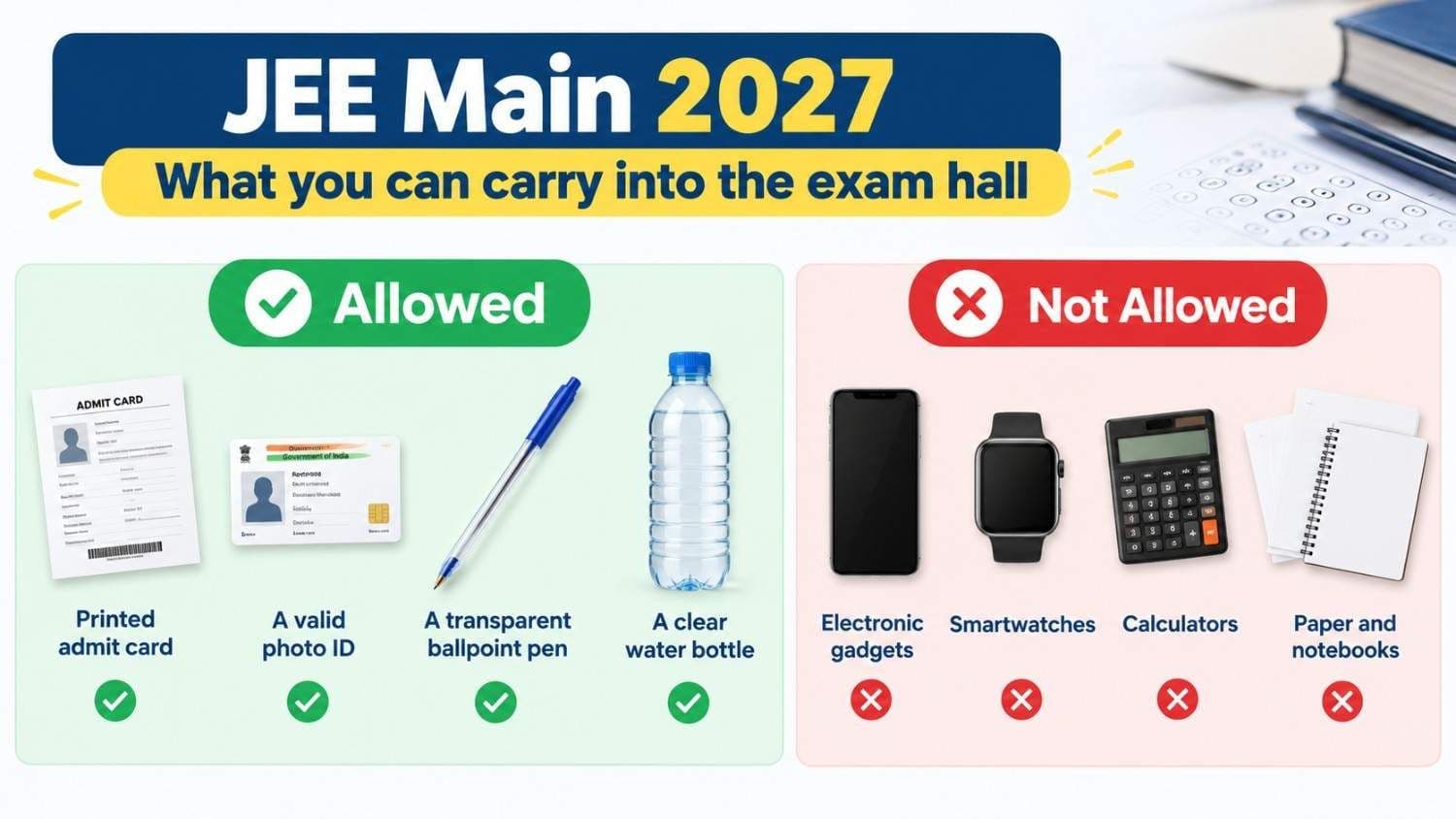
- #28
JEE Main 2027 Registration Process: Step by Step
- Visit the portal: Go to jeemain.nta.nic.in and click "New Registration".
- Verify identity: Verify through Aadhaar or DigiLocker, enter contact details, and generate the application number and password via OTP verification.
- Fill in the form: Log in and enter personal details and academic records (Class 10 and Class 12, appearing or passed). Select exam city preferences and choose the paper (B.E./B.Tech, B.Arch or B.Planning).
- Upload documents: Upload the following in JPG/PDF format:
- Recent passport-sized photograph (10 to 200 KB, white background)
- Clear signature (4 to 30 KB)
- PwD certificate, if applicable
- Pay the fee: Review all entries and pay the non-refundable registration fee online via UPI, Net Banking or Debit/Credit Card.
- Download the confirmation page: Download and print multiple copies of the final Confirmation Page, which is needed for admit card release and counselling verification.
- #27
JEE Main Registration Fee 2027
The JEE Main 2027 notification is yet to be released. The fee is expected to remain the same as last year, but this is not confirmed. The figures below are the previous year's fees.
One paper (Paper 1: B.E./B.Tech, Paper 2A: B.Arch or Paper 2B: B.Planning)
Category Gender Centres in India Centres outside India General Male INR 1,000 INR 5,000 General Female INR 800 INR 4,000 Gen-EWS/OBC (NCL) Male INR 900 INR 4,500 Gen-EWS/OBC (NCL) Female INR 800 INR 4,000 SC/ST/PwD/PwBD/Third Gender Male/Female/Third Gender INR 500 INR 2,500 Two papers (Paper 1 + Paper 2A/2B, any two papers)
Category Gender Centres in India Centres outside India General/Gen-EWS/OBC (NCL) Male INR 2,000 INR 10,000 General/Gen-EWS/OBC (NCL) Female INR 1,600 INR 8,000 SC/ST/PwD/PwBD/Third Gender Male/Female/Third Gender INR 1,000 INR 5,000 - #26
JEE Main 2027 Application Tips
- Apply on a laptop or desktop, not a mobile phone.
- Use a stable, high-speed internet connection.
- Keep all documents ready before registering.
- Read the official instructions first.
- Use an active mobile number and email address for OTP verification.
- Cross-check every field before final submission.
- Pay the application fee carefully.
- Save the confirmation page for future reference.
- #25
JEE Main 2027 Registration Link and Expected Date
- JEE Main 2027 Session 1 registration is expected in October at jeemain.nta.nic.in. NTA has not announced the date.
- #24
JEE Main 2027 Registration: What to Prepare Before the Form Opens
- Keep your ID, academic details, photo, signature and certificates ready before JEE Main 2027 registration opens.


