
Major Reforms Likely for NEET, JEE & Board Exams; Govt Considers 50% Board Weightage, Multiple Attempts
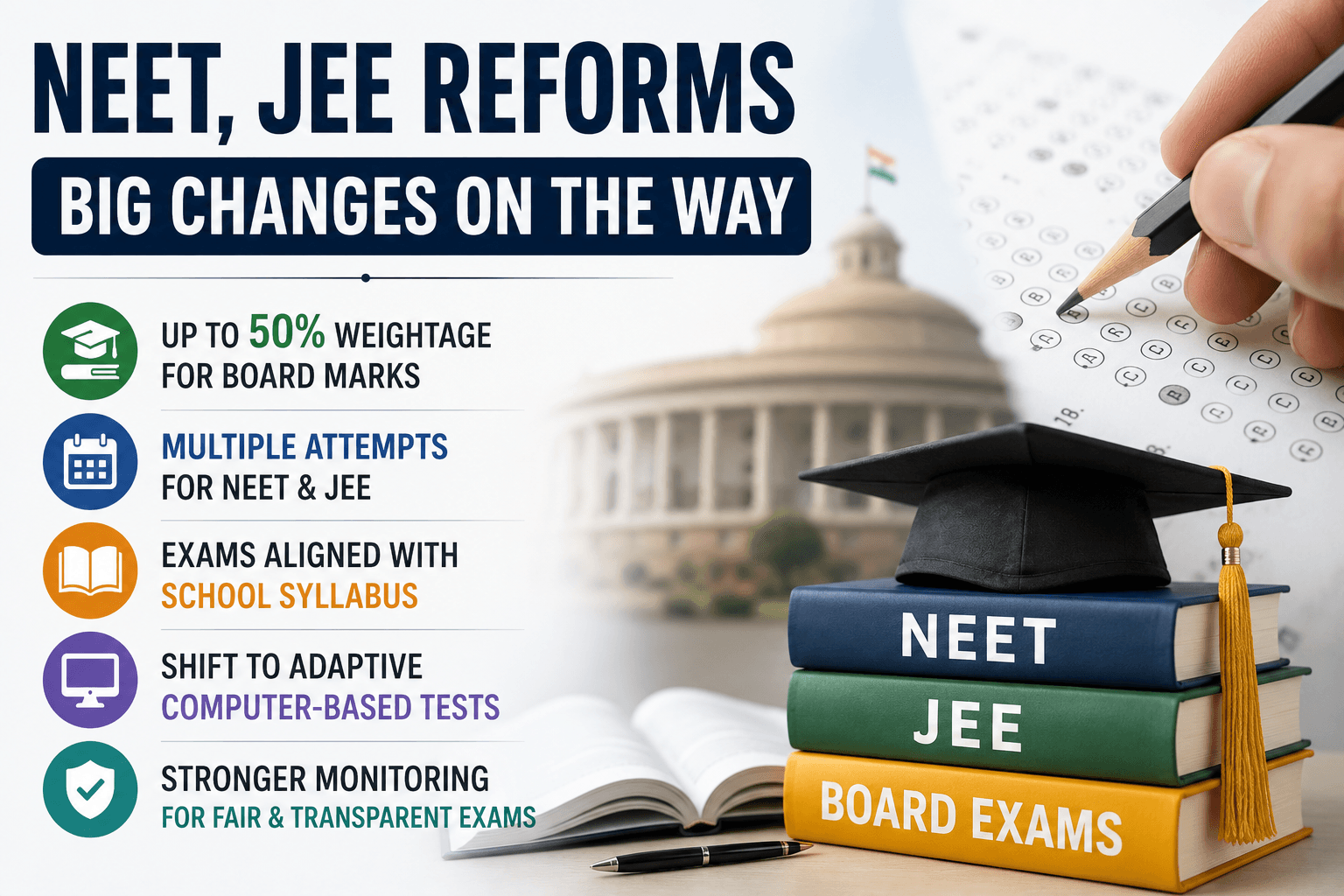
The Central Government is planning significant changes to India's examination system that could affect NEET, JEE, and Class 10 and 12 Board exams in the coming years. The proposed reforms are aimed at making exams fairer, reducing pressure on students, and giving greater importance to school education.
The move comes after several exam-related controversies, including the NEET-UG paper leak, which sparked nationwide concerns about the credibility of entrance examinations. According to government sources, the Prime Minister's Office (PMO) is closely monitoring the reform process, highlighting its importance at the highest level.
The recommendations have been made by a nine-member committee set up by the Ministry of Education in 2025. The committee studied issues such as the growing coaching culture, the rise of dummy schools, and the need to make competitive exams more transparent and student-friendly. Its final report is expected to be submitted to the government soon.
What Changes Are Being Considered?
Although the reforms are yet to receive final approval, several major proposals are on the table.
| Proposed Reform | What It Means for Students |
|---|---|
| Up to 50% weightage for Class 12 board marks | School performance may play a bigger role in admissions. |
| Multiple attempts for NEET and JEE | Students may get more than one chance to improve their scores. |
| Entrance exams based more on school syllabus | Less dependence on coaching institutes. |
| Adaptive computer-based tests | More secure and modern examination system. |
| Stronger monitoring of exams | Better protection against paper leaks and malpractice. |
If implemented, these changes could reshape how students prepare for higher education admissions.
Board Exams May Become More Important
One of the biggest proposals is to give up to 50% weightage to Class 12 board marks while preparing admission merit lists.
At present, admissions to top engineering and medical colleges depend mainly on entrance exam scores. Under the proposed system, students who perform consistently well in school may get an added advantage.
Experts believe this could encourage students to focus more on classroom learning instead of relying only on coaching centres.
Multiple Attempts Could Reduce Pressure
The government is also considering allowing students to take NEET and JEE more than once in a year.
Instead of depending on a single exam, candidates may get multiple opportunities, with their best score being considered for admission.
This system is expected to reduce exam stress and give students a fairer chance to perform at their best.
Less Focus on Coaching, More on School Learning
Another important recommendation is to align entrance exams more closely with the NCERT curriculum and school syllabus.
Today, many students spend years preparing at coaching institutes because entrance exams often go beyond what is taught in school. If the proposed changes are implemented, students may be able to prepare more effectively through regular classroom learning.
The committee also believes this could help reduce the growing trend of dummy schools, where students skip regular classes to focus only on competitive exam preparation.
Safer and Smarter Exams
The government also wants to gradually introduce adaptive computer-based tests (CBTs).
Unlike traditional exams, adaptive tests change the difficulty level of questions based on a candidate's responses. This makes the assessment more accurate while reducing the chances of paper leaks, as question papers do not need to be printed or transported.
Officials have also suggested that the coordination between multiple government agencies during the recent NEET re-examination could become the model for conducting future national-level exams.
What Should Students Do Now?
Students should remember that these reforms have not been approved yet. They are currently under consideration, and the existing admission rules for NEET, JEE, and Board exams remain unchanged.
For now, students should continue preparing according to the current syllabus and exam pattern. At the same time, they should keep an eye on official announcements from the Ministry of Education and the National Testing Agency (NTA) for any future updates.
If implemented, these reforms could create a more balanced examination system—one that values consistent academic performance, reduces dependence on coaching, and makes competitive exams more transparent and student-friendly.