
Design Education in India: Bridging the Gap Between Classroom Creativity and Real-World Design Practice

This article explores the gap between design education and industry readiness in India, tracing its history, current challenges, and future opportunities. It highlights skill mismatches, the role of technology and internships, and offers actionable steps for students, institutions, industry, and policymakers to build a stronger, industry-aligned design ecosystem.
Introduction
Design has fundamentally changed. Once seen as a niche skill related only to aesthetics and craft, it is now recognized globally as a strategic pillar for innovation, business success, and social impact. In India, with its ambitious economic goals and digital transformation, the demand for skilled, industry-ready designers—be it in UI/UX, Product, Graphic, Fashion, or Interior Design—has exploded.
Yet, a critical disconnect persists. Many talenteddesign graduates, fresh out of some of the best institutions, find themselves ill-equipped for the demandsof the professional world. The spark of creativitynurtured in the classroom often struggles to ignite in the fast-paced, problem-solving environment of a designstudio or tech company. This article dives deep into this gap, exploring the history, current challenges, and actionable steps needed to align academiclearning with real-world design practice. The goal is to provide an insightful, motivational roadmap for students, educators, and the industryto collectively build a strongerdesign future for India.
History of Design Education in India
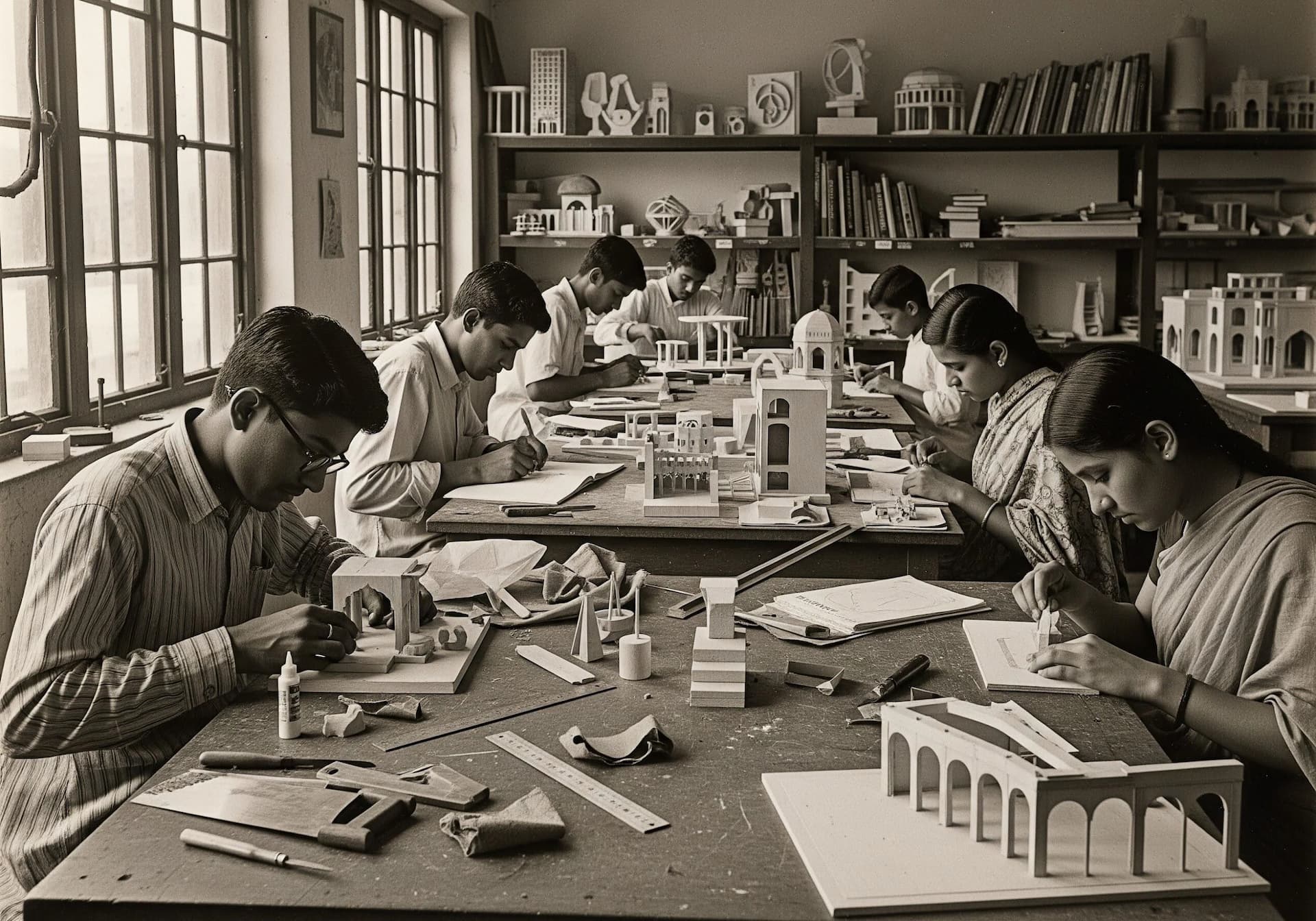
Design education in India has a relatively short but fascinating history, often mirroring the nationʼs post-independence journey. The initialfocus was largelyon preserving and modernizing traditional crafts.
The establishment of the National Instituteof Design NID in Ahmedabad in 1961, based on the vision of Charles and Ray Eames, marked the formal birth of professional design education. NIDʼs mandate was to create designers for industry, focusing on areas like product design and visual communication. This was a critical first step, prioritizing design as an agent of change and industrial growth.
For decades, this model was the gold standard, focusing on foundational principles, rigorous craft training, and critical thinking. Gradually, state-level art colleges and polytechnics began introducing design-related courses, though often focused on traditional graphic arts or commercial art rather than holistic design thinking.
The real shift began in the 1990s with economic liberalization and the subsequent IT boom. Suddenly, the need for designers moved from manufacturing to service industries, demanding skills in digital media, interface design, and branding. Institutes
like the IDC School of Design at IIT Bombay and numerous private colleges emerged to meet this new demand. While the volume of institutes grew, the core curriculum often lagged, remaining rooted in traditional methodologies, struggling to keep pace with global digital trends.
Current State of Design Colleges & Curriculum
Today, the landscape is diverse, rangingfrom highly selective national institutes to private universities and specialized boot camps. The quantity of design programs has never been higher, offeringcourses across a spectrum:
- UI/UX and Interaction Design: The most sought-after stream, driven by the massive growth of the Indian startup ecosystem and global technology companies.
- Product Design Industrial): Focused on physical goods, though increasingly integrating smart technology and sustainable practices.
- Graphic and Communication Design: The foundation, now heavily digitized, focusing on branding, motion graphics, and digital publishing.
- Fashion and Textile Design: A strong sector with institutes focusing on craft, technology, and global supply chains.
- Interior and Architecture Design: Focused on built spaces, sustainable materials, and human-centric environments.
However, a closer look revealssystemic challenges withinthe curriculum:
- Syllabus Rigidity: Many older institutions operate under rigid,university-mandated syllabi that are updated too slowly to incorporate newtechnologies or methodologies like service design, ethical AI, or circular economy principles.
- Focus on Aesthetics over Strategy: Courses often overemphasize visual polish, rendering, and portfolio aesthetics at the expenseof strategic thinking, user research, business context, and design metrics.
- Faculty Constraints: While many senior faculty are brilliant educators, they often lack recent, sustained real-world industry experience in high-growth sectors like digital product design, leading to a theoretical, rather than practical, teaching approach.
- Lack of Interdisciplinary Learning: Design is inherently multidisciplinary, yet many colleges keep streams isolated. A UI/UX designer rarely collaborates on a project with a Fashion designer, missing the opportunity to learn about systems thinking across domains.

Why Many Design Graduates Struggle
After Graduation
The transition from academia to the professional world is often jarring for Indian design graduates. The struggles stem from fundamental differences between the classroom environment and industry expectations.
Incollege, projects are typically:
- Self-contained with clear,pre-defined constraints.
- Graded primarily on creative executionand visual quality.
- Not subjected to real-world budgets,timelines, or client politics.
In a design job, projectsare:
- Ambiguous and Constantly Changing: The problem statement evolves daily based on user feedback, market changes, or new business objectives. Graduates struggle with uncertainty and rapid iteration.
- Business-Driven: Success is measured by impact on revenue, user retention, or cost efficiency, not just artistic merit.
- Collaborative and Political: Design involves negotiation with engineers, product managers, marketingteams, and executives, requiring advanced communication and influencing skills.
Many fresh graduates lack the abilityto articulate their design decisions using business logic or to handleconstructive, sometimes harsh, criticism from stakeholders. The comfortable creative bubble of college bursts upon contact with reality.
Skill Gap: Theory vs Real-World Design Practice
The most pronounced issue is the skill gap between what is taught and what is needed. This gap manifestsacross several dimensions:
- Digital Proficiency Beyondthe Basics
While students use software,their command often stops at basic feature functionality.
- Required: Mastery of current industry tools Figma, Sketch, Adobe CC, Blender), understanding of design systems (e.g., Material Design, Ant Design), and a workflow built around collaboration and version control (e.g., Git).
- Often Taught: Isolated projectsin older softwareversions, focusing on visual output rather than collaborative file management and scalable system design.
2. Research and Validation Rigor
The foundation of effective designis thorough research.
- Required: Planning and executing professional-grade user interviews, usability testing, A/B testing, synthesizing qualitative and quantitative data, and presenting research findings clearly.
- Often Taught: Limited, small-scale academic research or theoretical case studies, lacking the pressure of recruiting real users or analyzing large datasets.
3. Engineering and Technical Empathy
Especially crucial in UI/UX and Product Design.
- Required:Understanding the technical constraints and capabilities of platforms (iOS, Android, Web), communicating seamlessly with developers, writing clear design specifications, and understanding the basics of front-end code
HTML/CSS/JavaScript).
- Often Taught: Design is treatedas a silo, disconnected from the implementation phase, leadingto designs that are beautifulbut technically unfeasible or too costly to build.
This table highlights the core difference:
| Academic Focus | Real-World Practice |
| Creative Exploration | Strategic Problem Solving |
| Visual Aesthetics | User Experience & Business Metrics |
| Individual Project Work | Cross-Functional Team Collaboration |
| Fixed Project Scope | Iterative &Evolving Problem Space |
| Theoretical Tools, Psychology, Semiotics) | Practical ToolsFigma, Analytics, A/BTesting) |
 Role of Internships, Live Projects &
Hands-on DesignWork
The bridge acrossthe skill gap is builtwith hands-on experience. Internships and live projects are not optional—they are the essential finishing school for a designer.
Internships: A structured internship exposes a student to the daily rhythm, bureaucracy, and complexity of a real workplace. It teaches them how to manage feedback, adhere to deadlines, and navigate team dynamics. Crucially, it allows them to fail safely under professional guidance.
Live Projects:Colleges must move beyond hypothetical briefs.Engaging with NGOs, local businesses, or internal institutional challenges (e.g., designing a better campus navigation app) offers invaluable experience. These projectsintroduce real stakeholders, real budgets, and real consequences, forcing students to make difficult trade-offs.
The Portfolio Transformation: An industry-ready portfolio showcases not just final outputs, but the process. It must detail:
- The business problemidentified.
- The research methodology used (who they talked to, what data they analyzed).
- The iterations and failures encountered.
- The measurable impactof the final design solution.
This shift in focus from "what I made" to "how I solved a problem and why" is what recruiters look for.
 Importance of Soft Skills, Communication & Design Thinking
In the modern workplace, a designerʼs success is often 20% technical skill and 80% soft skill.Technical skills get you the interview; soft skills get you the job and the promotion.
Communication
Design is about persuasion. Designers must be able to:
- Articulate: Clearly explain complexdesign decisions to non-designers (e.g., why a certain button color increased conversion).
- Listen: Truly understand the needs and constraints of clients, users,and team members.
- Document: Write concise, actionable design specifications and user stories.
Collaboration & Teamwork
No major designproject is executedalone. Graduates must be proficient in:
- Giving and Receiving Feedback: Delivering constructive criticism and accepting feedback graciously, understanding that the design is about the product, not personal ego.
- Conflict Resolution: Mediating disagreements between technical feasibility and design vision.
Design Thinking as a Way of Life
Design Thinking is not just a methodology taught in a two-week module; it is a mindset. It is the ability to maintain empathy(understanding the user)while balancing business needs and technical possibilities. Colleges should integrate this iterative, human-centric approach across all assignments, not just theoretical ones.
 Impact of Technology UI/UX Tools, AI in Design, Automation, AR/VR
Technology is reshaping the design profession at an unprecedented pace, and education must react swiftly.
The Rise of UI/UX and Product Design
This sector is now the dominant force, requiring skills distinct from traditional graphic design. Focus areas include:
- Prototyping Tools: Deepfluency in Figma,Adobe XD, or Sketch is non-negotiable.
- Interaction Design: Understanding micro-interactions, motion design,and accessibility standards.
- Data-Informed Design: Using analytics and user data to justify design choices.
AIin Design and Automation
Artificial Intelligence is moving from being a futuristic concept to a daily tool.
- Automation: AI tools can automate repetitive tasks like image cropping, minor layout adjustments, and generating basic design variations. Students must learn to delegate these tasks to AI to focus on high-level strategic problem-solving.
- Generative Tools: Tools like Midjourney or DALLE are changing concept ideation in graphic and fashion design. The designerʼs role shifts from execution to prompt engineering, curation, and ethical application.
- Ethics: Students must be educated on the ethical implications of AI—bias in datasets, job displacement, and the moral responsibility of designing autonomous systems.
Immersive Design AR/VR
The future includes designingfor three-dimensional, immersivespaces. While niche now, foundational knowledge in spatial design,3D modeling, and the specificuser experiences of AR/VR will be essential for the next generation of product, interior, and entertainment designers.
The curriculum must treat these technologies not as optional additions, but as core elements of the modern design toolkit.
What Design Students Should Do Differently Actionable Steps
The onus of career readinessis not solely on the institution; studentsmust take proactive ownership of their learningand career trajectory.
1. Build an "Industry-Mirror" Portfolio
- Focus on Case Studies: Document 35 high-quality projects. For each, clearly state the problem,the process (research, wireframes, prototypes), the stakeholders, and the measurable outcome. Show your work, not just your finish.
- Go Beyond Visuals: Include research artifacts like affinity diagrams, user personas, and competitor analysis.
2. Embrace the T-Shaped Skillset
- Develop deep expertisein one area (the verticalpart of the T, such as UI accessibility or sustainable textile design.
- Develop broad competence (the horizontal part) in related disciplines: coding basics, marketing strategy, business modeling, and research methodologies.
3. Seek ExternalValidation and Mentorship
- Take Micro-Internships: Even short, two-weekpro-bono projects for startups or non-profits offer real-world constraints.
- Find a Mentor: Connect with industry professionals on platforms like LinkedIn. Seek structured feedback on your portfolio and career choices.
- Participate in Hackathons and Design Challenges: These high-pressure environments simulate industry deadlines and foster rapid prototyping skills.
4. Master Professional Tools
- Do not wait for the college to teach the latest tools. Commit to self-learning the current industry standard software (e.g., Figma for UI/UX, tools for 3D modeling/rendering). YouTube tutorials, online courses, and free community resources are abundant.
Role of Design Institutes, Industry,Government & Creative Ecosystem
Bridging the gap requires a synchronized effortfrom all stakeholders.
Design Institutes
- Curriculum Overhaul: Adopt a rapid, agile curriculum update cycle (yearly,not every five years)to integrate emergingtechnologies AI, AR/VR.
- Industry Integration: Mandate longer, structured internships 6 months minimum). Establish permanent industry advisory boards to vet and shape the curriculum.
- Faculty Development: Sponsor facultyfor short industrysabbatical programs to gain recent professional experience. Hire more adjunct faculty directly from the industry.
The Industry Design Studios, Tech Companies)
- Invest in Education: Viewearly-career training as a sharedresponsibility, not just an HR cost. Offer structured mentorship programs and paid internships.
- Standardize Expectations: Clearly communicate the skills they need—not just names of software, but proficiency levels in design methodologies.
- Offer Live Briefs: Partner with colleges to offer real, non-sensitive business problems as student projects, complete with budgets and real-time feedback.
Government and Policymakers
- Accreditation Reform: Encourage institutions to prioritize practical, outcome-based learning metrics over purely academic ones.
- IP Protection: Strengthen Intellectual Propertylaws to fostera culture of innovation and reward original design, encouraging professional practice.
- Funding for Research: Invest in design researchcenters focused on solving national problems (e.g., healthcare access, sustainable urban planning) that involve student participation.
Success Stories/ Case Examples
The gap is being bridged in pockets, showcasing the immense potential when academia and industry collaborate effectively.
Example 1 The UI/UX Accelerator
Aleading private design university in Bangalore partnered with a major Indian
e-commerce platform. Instead of a typical final year project, students worked on redesigning a non-critical flow within the platform (e.g., the returns process). The university provided the academic oversight; the company provided the data, engineering constraints, and weekly professional feedback from their senior design team. Two student designs were later implemented, and the students received direct job offers, proving that real constraint leads to real innovation.
Example 2 Craft Revival Through Product Design
A national institute collaborated with a state government initiative to revive a struggling regional handicraft cluster. Product Design students spent six months living with the artisans, applying design thinking not to replace the craft, but to innovate the product line and market strategy. They designed modern, marketable products while documenting the entire process for scaling. This project not only preserved heritage but taughtthe students supply chain management, material sourcing, and social impact design.
These examples underscore that the most impactful learning happens at the intersection of academic rigor and industry accountability.
Future of Design Careers in India
The outlook for design careers in India is exceptionally bright, provided the educational system evolves.
The Design Strategist
The future designer will be less of a hands-on executorand more of a strategist, leading product vision and user experience. They will need strong skillsin business acumen, data analysis, and cross-functional leadership.
Specialist Demand
While foundational knowledge remains key, the industry increasingly needs specialists: DesignOps professionals (managing design processesand tools), AI Interaction Designers (designing conversational interfaces), and Sustainability Designers (integrating circular economy principles).
Global Opportunity
Indian designers are highly valued globally. With the rise of remote work and the growth of India as a global capability center for multinational corporations, the market is international. Education must focus on global design standards, cultural nuances, and accessibility norms.
Designing for India
The greatest opportunity lies in designing for Indiaʼs unique challenges: low bandwidth, low literacy rates, multilingual user bases, and first-time internet users. A designer trained to solve these complex, high-impact problems will be an invaluable asset to the nation.
Conclusion
The journey of design educationin India is at a crucial inflection point. We stand at the crossroads of immense creativetalent and unprecedented professional demand. The gapbetween classroom creativity and real-world practiceis real, but it is entirely bridgeable.
The responsibility for this evolutionis shared. Institutes must shed outdatedsyllabi and embrace agile, industry-vetted learningmodels. Industry must invest in nurturing fresh talent through sustained, meaningful engagement. Students must abandon the mindset of passivelearning and aggressively seek out real-world exposure,
self-learning the toolsand mastering the soft skillsthat define professional success.
Indiaʼs designfuture is not just aboutmaking things look good; it is aboutdesigning solutions for the next billion users, designing sustainable systems, and designing a better quality of life. By fostering a learning environment rooted in practical
problem-solving, strategic thinking, and ethical innovation, we can ensure that every design graduate is not just ready for a job, but ready to lead the creative transformation of India. The next generation of designers has the power to shape the future, but only if we give them the right foundation today.